Spaced Repetition Explained
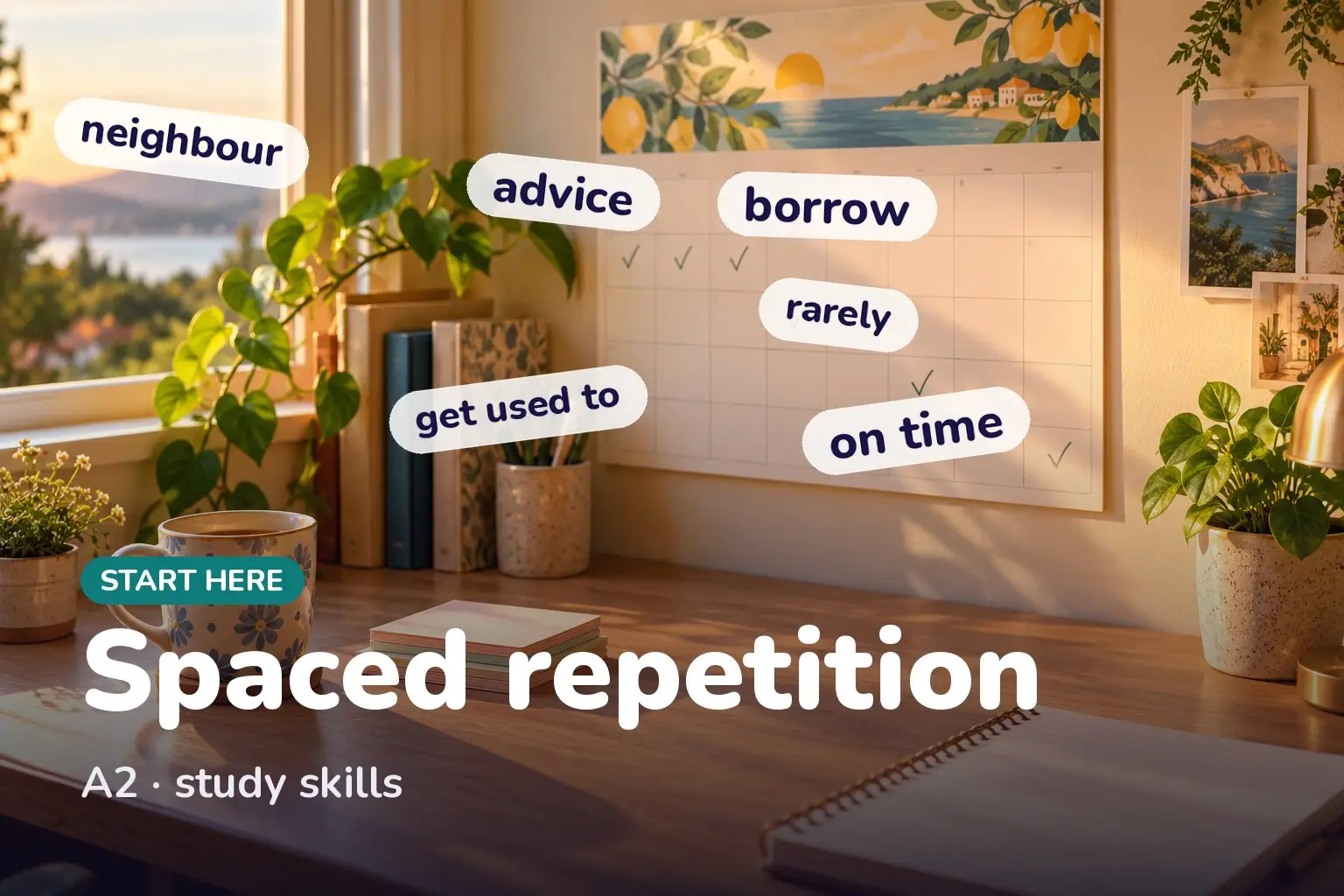
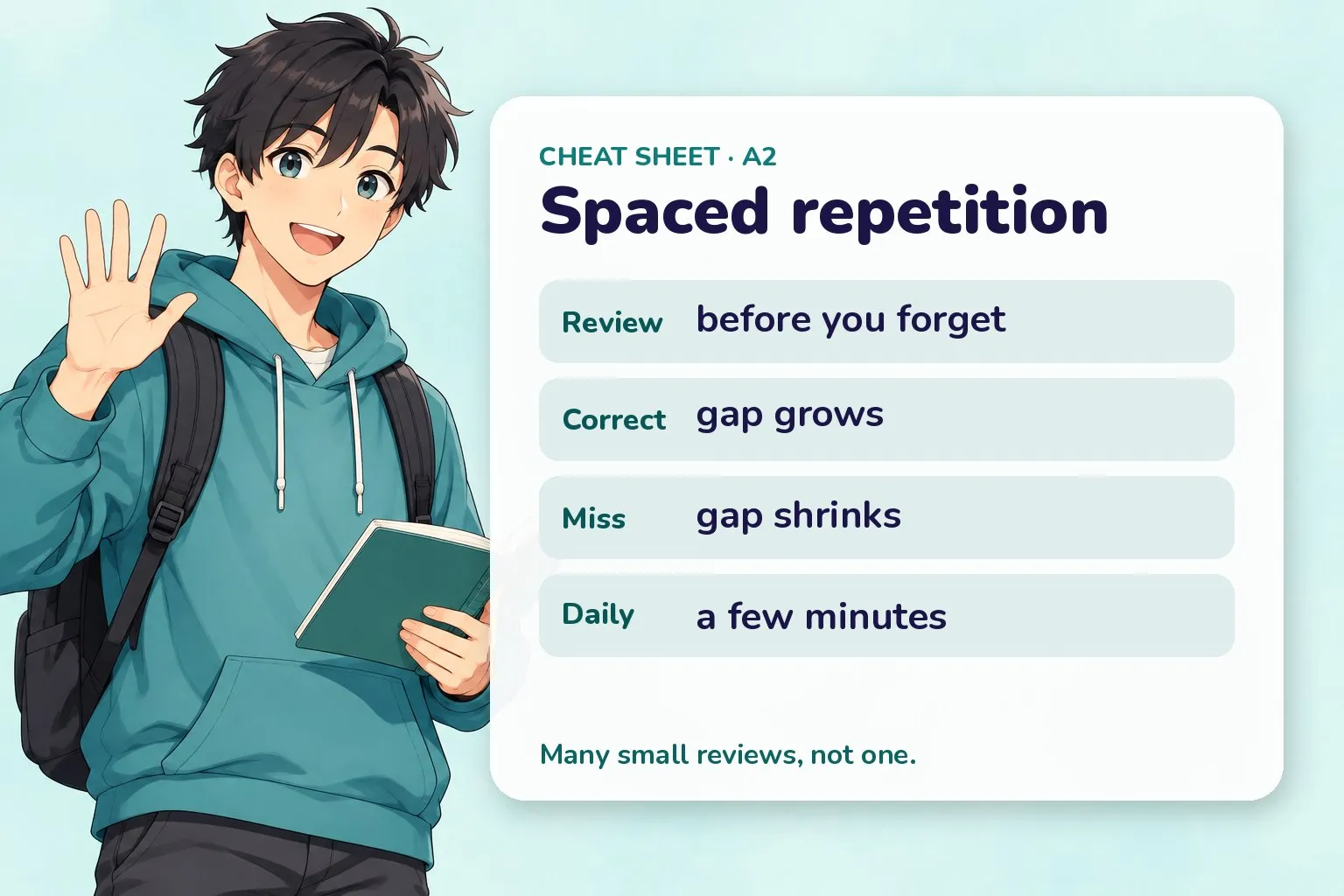
Spaced repetition means reviewing a word just before you would forget it. Each time you recall it correctly the gap grows; each time you forget, the gap shrinks. That rhythm moves words into long-term memory with far less study time than cramming.
Level: A2. Spaced repetition is the simplest way to stop forgetting the English you study. Instead of reviewing everything every day (slow) or cramming once and losing it (wasteful), you meet each word again at growing intervals — a day, then a few days, then a week, then a month.
By the end of this page you can…
…explain what spaced repetition is, say why it works, and set up a review schedule for your own English words.
What spaced repetition is
Spaced repetition means spreading your reviews out over time rather than bunching them together. You see a word, try to remember its meaning, check, and then the system decides when to show it to you next. A word you recalled easily comes back later; a word you missed comes back soon.
The word interval means the gap between two reviews of the same card. In a spaced-repetition system the interval is not fixed — it changes based on how well you remembered. That is the whole idea: your time flows to the words you find hard and away from the words you already know.
Why spacing works
When you learn a word and then do nothing, memory of it fades. If you review it just before it would slip away, you have to work to pull it back — and that effort of retrieval is what strengthens the memory. Review too early and there is no effort, so little is gained; review too late and the word is already gone, so you are learning it again from scratch.
Cramming puts all your reviews in one block. It feels productive and it works for a test tomorrow, but the words fade fast afterwards because you never practised recalling them after a gap. Spacing trades that short-term feeling for words that are still there next month.
How the gaps grow
A typical schedule starts with short gaps and widens them each time you succeed. These are common default intervals, not a fixed rule — your tool may use different numbers, and that is fine:
| Review | Typical gap after a correct answer |
|---|---|
| After you first learn it | about 1 day |
| 2nd review | about 3 days |
| 3rd review | about 1 week |
| 4th review | about 2–3 weeks |
| 5th review | about 1 month, then longer |
Each correct recall multiplies the gap; each miss drops the card back to a short gap so you see it again soon. You do not calculate any of this — you just answer honestly.
See it in action
Here is how a few English cards might move through a schedule. Press play to hear each word:
- neighbourthe person who lives next to you — new card, review tomorrow.
- borrowto take and use something you will give back — recalled, so wait 3 days.
- on timenot late — a chunk you keep missing, so it returns soon.
- advicea suggestion about what to do — easy, so the gap grows to a week.
- get used toto slowly become comfortable with something — hard, stays on a short gap.
- rarelyalmost never — recalled twice, now review in two weeks.
How to set up your reviews
- Build a small deck from common words first. Frequency-ranked lists put the most useful English words at the top, so study those before rare ones. Add just a handful of new cards a day.
- Learn words in short phrases. Put make a decision or on time on the card, not the bare word, so you learn how it is used.
- Review every day, briefly. Ten focused minutes daily beats an hour once a week, because spacing needs many small meetings with a word.
- Answer honestly. Tell the tool the truth about whether you remembered; it schedules the next date from your answer.
- Keep the deck finishable. A small deck you clear every day builds the habit; a huge backlog kills it.
Tools on this site
- Build quick self-tests with the vocabulary quiz generator.
- Print review sheets with the printable language worksheets.
- New to cards? Read How to Use Flashcards for English.
Quick recap before you practise.
Practice
Spaced repetition practice
Try each one, then press Check. No sign-up, nothing is sent anywhere — it all runs in your browser.
Hint: it grows each time you succeed
Show answer
interval — In a spaced-repetition system the interval changes based on how well you remembered.
5 Match each habit with its effect on your learning.
- review before you forget
- mark a half-known card easy
- ten minutes every day
- one long session a week
Show answer
- review before you forget → strong memory
- mark a half-known card easy → forget it later
- ten minutes every day → spacing works
- one long session a week → fast fading
Spacing rewards short, honest, daily reviews and punishes dishonest ratings and rare marathons.
Quiz
Spaced repetition quiz
8 questions · pick an answer and you'll see straight away if it's right.
-
Show answer
stop forgetting what you have studied — It schedules reviews so words move into long-term memory instead of fading.
-
Show answer
try to recall the answer before checking — The effort of retrieval just before forgetting is what makes a word stick.
-
Show answer
widens the gap before the next review — Correct recalls grow the interval so your time goes to harder cards.
-
Show answer
soon, on a short gap — A miss drops the card to a short interval so you see it again quickly.
-
Show answer
about ten focused minutes every day — Spacing needs many short meetings with a word, not one long block.
-
Show answer
your answer sets the next review date — A dishonest easy rating pushes the card too far away and you forget it.
-
Show answer
keeping words you have already met — Meet a word properly first; spacing then keeps it in memory.
-
Show answer
you learn the word inside a natural phrase — Learning chunks teaches how a word is actually used, not just its meaning.
Next
- Browse all topics in the English start-here section
- Learn to make the cards you will space: How to Use Flashcards for English
- New here? Start with Start Learning English Here
All English study topics
Vocabulary, pronunciation, phrases, practice and exam help, ordered by level. Pick a topic and go straight to it. New lessons go live every day, so topics marked Coming soon fill in over the next weeks.
Study topics
Start here 6 topics · 6 ready
- 01 Start Learning English Here
- 02 English Level Self-Test (A1-C1 Guide)
- 03 How to Use Flashcards for English
- 04 Spaced Repetition Explained You are here
- 05 Top Mistakes English Learners Make
- 06 Building a Daily English Habit
Lessons 56 topics · 56 ready
See the lessons page →- 07 English: Greetings & Introductions
- 08 English: Numbers 0 to 100
- 09 English: Introducing Yourself
- 10 English: Days, Months & Dates
- 11 English: Telling the Time
- 12 English: Giving Personal Information
- 13 English: Family Members
- 14 English: Describing People
- 15 English: Colours & Shapes
- 16 English: Food & Drink Basics
- 17 English: Ordering at a Cafe
- 18 English: Shopping & Prices
- 19 English: Clothing & Sizes
- 20 English: Asking for Directions
- 21 English: Using Public Transport
- 22 English: At the Hotel
- 23 English: Weather & Seasons
- 24 English: Hobbies & Free Time
- 25 English: Daily Routine
- 26 English: Housing & Rooms
- 27 English: Household Chores
- 28 English: At the Doctor
- 29 English: Parts of the Body
- 30 English: Emotions & Feelings
- 31 English: Making Appointments
- 32 English: Making Plans & Invitations
- 33 English: Phone & Messaging
- 34 English: Expressing Opinions
- 35 English: Talking About Past Experiences
- 36 English: Future Plans & Goals
- 37 English: School & Education
- 38 English: Jobs & Professions
- 39 English: At the Office
- 40 English: The Job Interview
- 41 English: Formal Writing & Emails
- 42 English: Money & Banking
- 43 English: Restaurant & Dining Out
- 44 English: Supermarket & Groceries
- 45 English: Travel & the Airport
- 46 English: Sightseeing & Tourism
- 47 English: Emergencies & Safety
- 48 English: Technology & the Internet
- 49 English: News & Current Affairs
- 50 English: Environment & Nature
- 51 English: Health & Lifestyle
- 52 English: Culture & Traditions
- 53 English: Describing Trends & Data
- 54 English: Debating & Argumentation
- 55 English: Idioms & Colloquialisms
- 56 English: Formal vs Informal Register
- 57 English: Storytelling & Narration
- 58 English: Complaints & Solving Problems
- 59 English: Giving a Short Presentation
- 60 English: Small Talk & Networking
- 61 English Small-Talk & Politeness Culture
- 62 Writing Business Emails in English
Vocabulary 47 topics · 47 ready
See the vocabulary page →- 63 100 Most Common English Words
- 64 English Words 101-250 (Frequency)
- 65 English Words 251-500 (Frequency)
- 66 English Words 501-1000 (Frequency)
- 67 English Words 1001-1500 (Frequency)
- 68 English Words 1501-2000 (Frequency)
- 69 English Words 2001-3000 (Frequency)
- 70 100 Essential English Verbs
- 71 Common English Adjectives
- 72 Everyday English Adverbs
- 73 English Connectors & Linking Words
- 74 English Question Words & Phrases
- 75 English Time Expressions
- 76 English Food & Cooking Vocabulary
- 77 English Animals Vocabulary
- 78 English Body & Health Vocabulary
- 79 English Clothing Vocabulary
- 80 English House & Furniture Vocabulary
- 81 English Kitchen & Tableware Vocabulary
- 82 English Transport & Travel Vocabulary
- 83 English Places in Town Vocabulary
- 84 English Nature & Geography Vocabulary
- 85 English Weather Vocabulary
- 86 English Jobs & Professions Vocabulary
- 87 English Technology & Internet Vocabulary
- 88 English Money & Shopping Vocabulary
- 89 English Emotions & Feelings Vocabulary
- 90 English Sports & Exercise Vocabulary
- 91 English Education & School Vocabulary
- 92 English Business & Work Vocabulary
- 93 English Family & Relationships Vocabulary
- 94 English Colours Vocabulary
- 95 English Verbs of Motion
- 96 English Opinion & Attitude Vocabulary
- 97 English Academic Vocabulary
- 98 English Medical & Pharmacy Vocabulary
- 99 English Admin & Paperwork Vocabulary
- 100 English Environment & Climate Vocabulary
- 101 English Arts, Music & Film Vocabulary
- 102 100 Essential English Phrasal Verbs
- 103 Commonly Confused English Words
- 104 British vs American English
- 105 English Irregular Verbs Reference
- 106 Academic Word List: Set 1
- 107 Academic Word List: Set 2
- 108 Linking Words for Essays
- 109 English Numbers, Dates & Money
Pronunciation & writing 11 topics · 11 ready
See the pronunciation & writing page →- 110 English Pronunciation Overview
- 111 The English Alphabet & Its Sounds
- 112 English Vowel Sounds (IPA)
- 113 English Consonant Sounds (IPA)
- 114 English Word Stress
- 115 Sentence Stress & Rhythm
- 116 English Intonation Patterns
- 117 English Silent Letters
- 118 English Spelling Rules & Patterns
- 119 English Contractions & Reductions
- 120 English Connected Speech (Linking)
Practice 9 topics · 9 ready
See the practice page →- 121 Shadowing to Improve English Speaking
- 122 How to Practise English Listening
- 123 English Reading Practice: Beginner
- 124 English Reading Practice: Elementary
- 125 English Reading Practice: Intermediate
- 126 English Reading Practice: Upper-Intermediate
- 127 How to Practise English Writing
- 128 Common English Collocations
- 129 English Minimal Pairs Practice
Phrases 20 topics · 20 ready
See the phrases page →- 130 50 English Survival Phrases
- 131 English Greetings & Goodbyes
- 132 English Politeness & Please/Thank-You
- 133 English Travel Phrases
- 134 English Restaurant Phrases
- 135 English Hotel Phrases
- 136 English Shopping Phrases
- 137 English Asking Directions Phrases
- 138 English Emergency Phrases
- 139 English Small Talk Phrases
- 140 English Phone & Call Phrases
- 141 English Business Meeting Phrases
- 142 English Social & Making-Friends Phrases
- 143 English Airport Phrases
- 144 English Doctor & Pharmacy Phrases
- 145 English Opinion & Discussion Phrases
- 146 English Agreeing & Disagreeing Phrases
- 147 English Texting & Chat Phrases
- 148 English Classroom Phrases
- 149 English Complaint & Problem Phrases
Exams 21 topics · 21 ready
See the exams page →- 150 English Exams: Which One & How to Prepare
- 151 IELTS Overview: Format & Scoring
- 152 IELTS Listening: Format & Strategies
- 153 IELTS Reading: Format & Strategies
- 154 IELTS Academic Writing Task 1
- 155 IELTS Writing Task 2 (Essay)
- 156 IELTS Speaking: Parts 1-3
- 157 Understanding IELTS Band Scores
- 158 TOEFL iBT Overview: Format & Scoring
- 159 TOEFL Reading Strategies
- 160 TOEFL Listening Strategies
- 161 TOEFL Speaking Tasks
- 162 TOEFL Writing (incl. Integrated)
- 163 Cambridge English Exams Explained
- 164 A2 Key (KET) Overview
- 165 B1 Preliminary (PET) Overview
- 166 B2 First (FCE) Overview
- 167 C1 Advanced (CAE) Overview
- 168 C2 Proficiency (CPE) Overview
- 169 Exam Essay & Writing Skills
- 170 Exam Speaking Strategies