English: Jobs & Professions
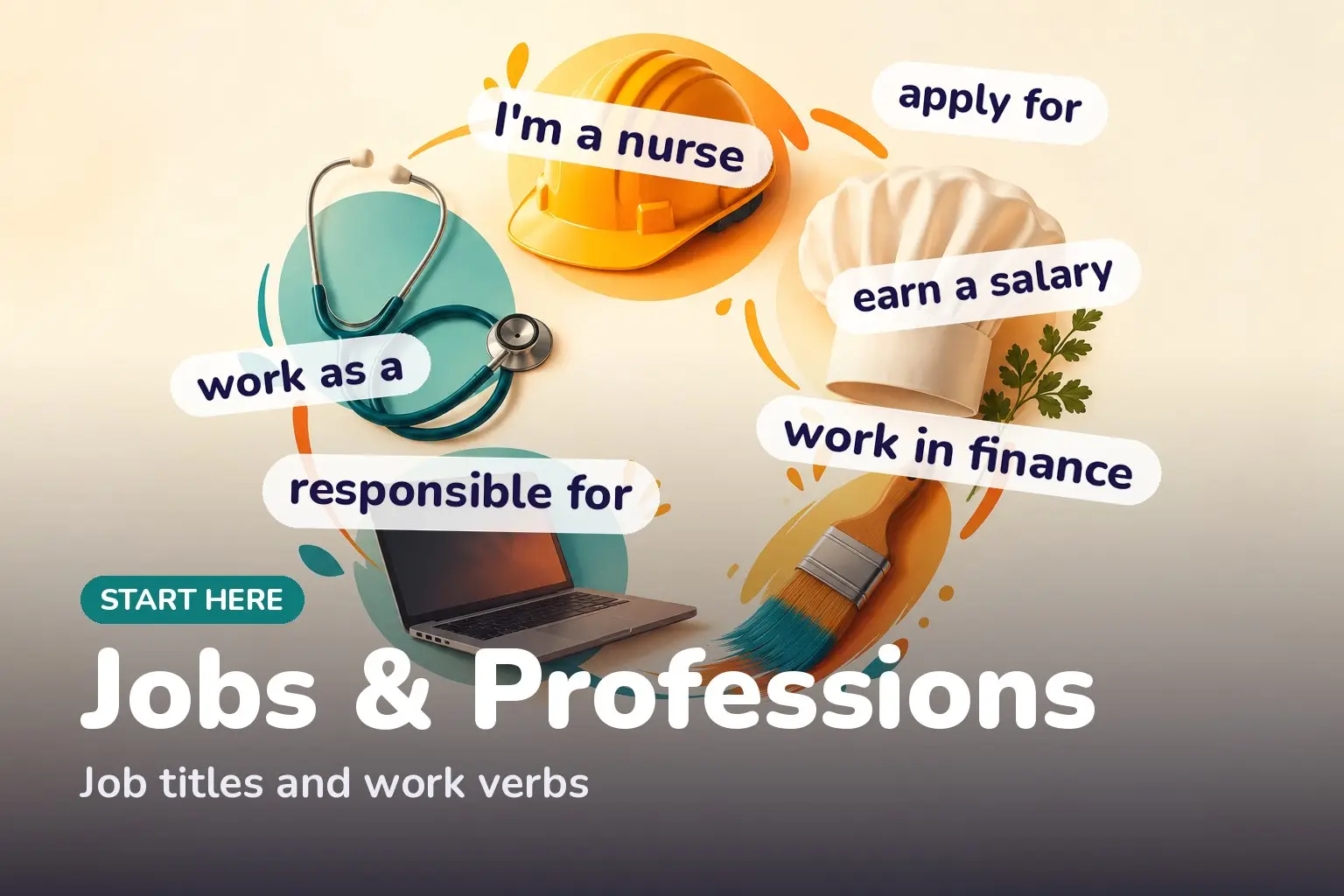
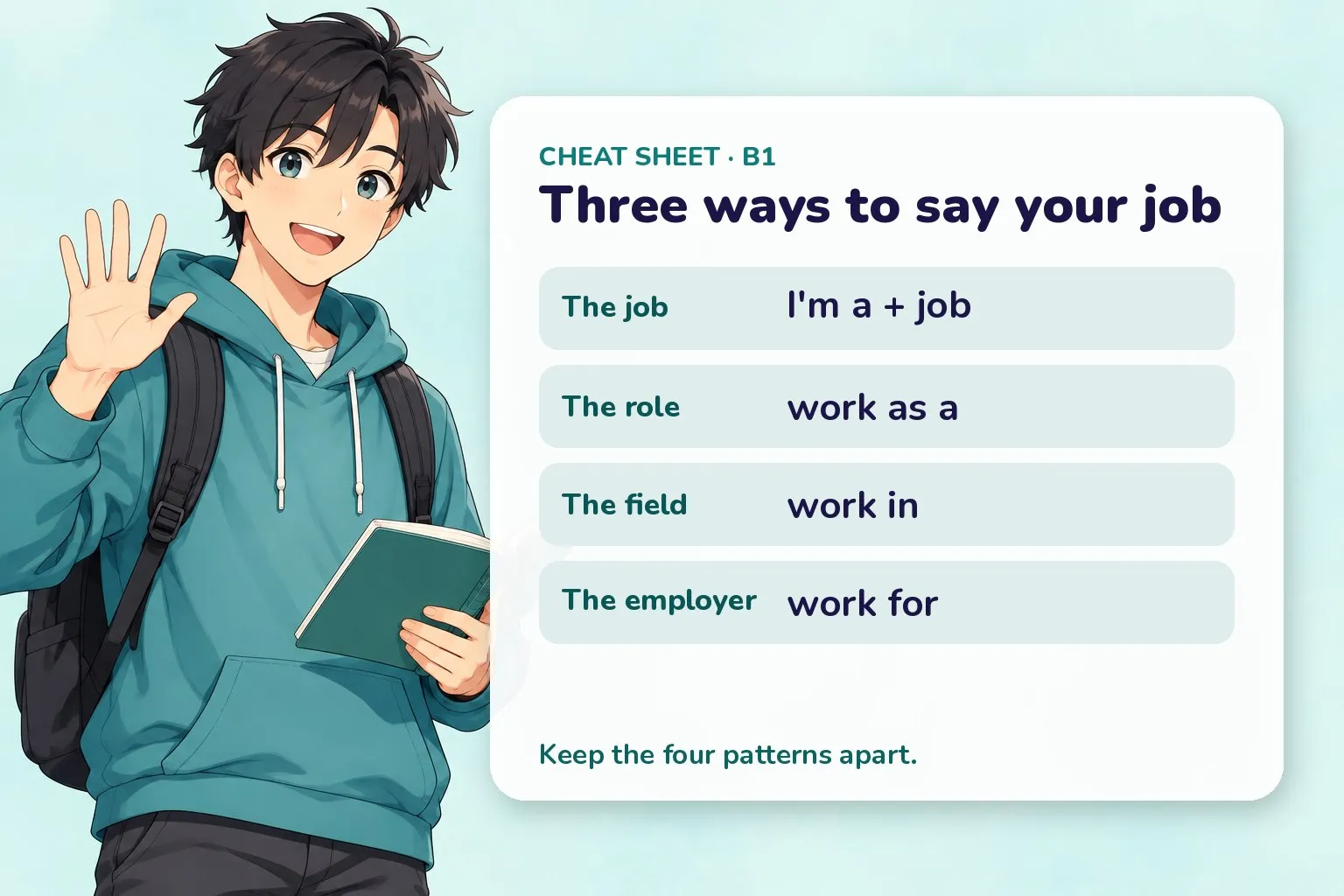
To talk about work in English, say 'I'm a' plus the job (I'm a nurse), or 'I work as a' plus the job. Use 'I work in' for the field (I work in finance) and 'I work for' for the company. Remember the article: a doctor, an engineer.
Level: B1. The question ‘What do you do?’ comes up in almost every first conversation. This lesson gives you the job titles, the three patterns for saying what you do, and the verbs to describe your daily work — so you can answer clearly and ask the same back.
By the end of this page you can…
…name common jobs with the right article, say where you work and what you do, describe your main duties, and ask someone about their job.
Saying what you do: three patterns
English has three fixed patterns, and learners mix them up more than almost anything else. Keep them apart:
- I’m a / an + job. → I’m a nurse. She’s an engineer.
- I work as a / an + job. → I work as a translator.
- I work in + field / place. → I work in marketing. He works in a hospital.
A fourth pattern names the employer: I work for + company. → I work for a small startup.
Common jobs
Modern English job titles have no gender — a woman and a man are both a doctor, a firefighter, an actor.
| Job | Where they work / what they do |
|---|---|
| nurse | cares for patients in a hospital |
| engineer | designs and builds machines or systems |
| accountant | manages money and taxes |
| lawyer | advises on and argues the law |
| chef | cooks in a restaurant kitchen |
| electrician | installs and repairs wiring |
| journalist | writes news reports |
| sales assistant | serves customers in a shop |
Note the word-building: many jobs end in -er / -or (teacher, actor), -ist (journalist, dentist), or -ian (electrician, technician).
The verbs of work
Describe your working life with this small set:
- work full-time or part-time; do shifts or overtime.
- earn a salary or a wage; get paid weekly or monthly.
- deal with customers; be responsible for a team or a task.
- apply for a job; get, start or leave a job.
- be unemployed (have no job) or be retired (have stopped working with age).
Describing your duties
To describe what you actually do, use the present simple and these frames:
- I’m responsible for + noun or -ing: I’m responsible for the schedule. / I’m responsible for training new staff.
- My job involves + -ing: My job involves meeting clients.
- I deal with + noun: I deal with complaints.
- I have to + verb: I have to travel a lot.
Example sentences
Press play and copy the rhythm. These are the exact sentences you will use to talk about work.
- What do you do?The standard way to ask about someone's job.
- I'm a software developer.I'm a + job, with the article.
- She's an architect.An before a vowel sound: an architect.
- I work as a translator.Work as a + job title.
- He works in finance.Work in + field.
- They work in a big hospital.Work in + place.
- I work for a small company.Work for + employer.
- My sister is a nurse.Job titles have no gender.
- I earn a good salary.You earn money, you don't win it.
- We get paid at the end of the month.Get paid describes how often money comes.
- I'm responsible for the whole team.Be responsible for + noun.
- My job involves travelling a lot.Involve is followed by the -ing form.
- I deal with customer complaints.Deal with + a problem or people.
- He works part-time while he studies.Part-time means fewer hours.
- She often does overtime.Do overtime means work extra hours.
- I applied for three jobs last week.Apply for a job, with for.
- I'd love to work from home.Work from home is common and useful.
- My father is retired now.Be retired: stopped working with age.
- He's been unemployed since the factory closed.Be unemployed: have no job.
- I really enjoy my job.Enjoy + noun or -ing to show you like it.
Quick recap before you practise.
A short conversation
Priya: So, what do you do, Tom? Tom: I’m an electrician. I work for a building company. What about you? Priya: I work in marketing — I’m responsible for our social media. Tom: Sounds interesting. Do you enjoy it? Priya: Most of the time. The hours are long, but I earn a decent salary.
Quick recap before the quiz.
Usage notes
- job vs work: job is countable (a good job, two jobs); work is usually uncountable (a lot of work, no work today). Do not say a work for a position.
- a / an depends on sound, not spelling: an hour (silent h) but a university (it starts with a y sound).
- what’s your job? is understood but the natural question is what do you do? — answer with the job, not with a full sentence about your day.
- boss, colleague, client: your boss or manager is in charge; a colleague (AmE often co-worker) works with you; a client or customer pays for your service.
Practice
Jobs and professions practice
Try each one, then press Check. No sign-up, nothing is sent anywhere — it all runs in your browser.
Hint: money from work, not a prize
Show answer
earn — You earn money from work; you win a prize or a game.
Hint: work ___ a place or a field
Show answer
in — Work in + a place or field: she works in a hospital.
4 Put the words in order to describe a duty.
Show answer
I'm responsible for the team — Be responsible for + noun: I'm responsible for the team.
5 Match each pattern to its ending.
- I work as
- I work in
- I work for
- My job involves
Show answer
- I work as → a translator
- I work in → finance
- I work for → a big company
- My job involves → meeting clients
Work as a job, work in a field, work for a company; involve takes -ing.
How to say it
A few job words trip up English learners. Copy the audio rather than the spelling.
- engineer stresses the last part: en-ji-NEER, with a soft g.
- nurse has the ur sound of her: nurs, one syllable.
- colleague stresses the first part: KOL-eeg, with a hard g.
- salary squeezes to three light beats: SAL-uh-ree.
Quiz
Jobs and professions quiz
10 questions · pick an answer and you'll see straight away if it's right.
-
Show answer
She's an architect. — Architect starts with a vowel sound, so use an.
-
Show answer
in — Work in + a place: I work in a bank. (Work for a bank is also possible for the employer.)
-
Show answer
earn — You earn money from work; you win a prize.
-
Show answer
I work as a teacher. — Work as a + job title, with the article.
-
Show answer
stopped working with age — To be retired is to have stopped working, usually with age.
-
Show answer
a colleague — A colleague (or co-worker) is a person you work with.
-
Show answer
involves — Present simple after my job: my job involves + -ing.
-
Show answer
a job — Job is countable (a job, two jobs); work is usually uncountable.
-
Show answer
for — You apply for a job.
-
Show answer
none of them — Modern English job titles have no gender: a woman is also a doctor, nurse or firefighter.
Recap cheat-sheet
| Idea | Pattern | Example |
|---|---|---|
| The job | I’m a / an + job | I’m an engineer. |
| As a role | work as a + job | I work as a translator. |
| The field | work in + field | I work in finance. |
| The employer | work for + company | I work for a startup. |
| Money | earn a salary / get paid | I earn a good salary. |
| Duty | be responsible for + noun | I’m responsible for the team. |
Next
- Previous lesson: English: School & Education
- Next lesson: English: At the Office
- New here? Start with Start Learning English Here
- Build the sounds: English Pronunciation Overview
All English lessons topics
Vocabulary, pronunciation, phrases, practice and exam help, ordered by level. Pick a topic and go straight to it. New lessons go live every day, so topics marked Coming soon fill in over the next weeks.
Lessons
A1 9 topics · 9 ready
A2 14 topics · 14 ready
- 10 English: Describing People
- 11 English: Ordering at a Cafe
- 12 English: Shopping & Prices
- 13 English: Clothing & Sizes
- 14 English: Asking for Directions
- 15 English: Using Public Transport
- 16 English: At the Hotel
- 17 English: Weather & Seasons
- 18 English: Hobbies & Free Time
- 19 English: Daily Routine
- 20 English: Housing & Rooms
- 21 English: Parts of the Body
- 22 English: Emotions & Feelings
- 23 English: Supermarket & Groceries
B1 19 topics · 19 ready
- 24 English: Household Chores
- 25 English: At the Doctor
- 26 English: Making Appointments
- 27 English: Making Plans & Invitations
- 28 English: Phone & Messaging
- 29 English: Expressing Opinions
- 30 English: Talking About Past Experiences
- 31 English: Future Plans & Goals
- 32 English: School & Education
- 33 English: Jobs & Professions You are here
- 34 English: Money & Banking
- 35 English: Restaurant & Dining Out
- 36 English: Travel & the Airport
- 37 English: Sightseeing & Tourism
- 38 English: Emergencies & Safety
- 39 English: Technology & the Internet
- 40 English: Complaints & Solving Problems
- 41 English: Small Talk & Networking
- 42 English Small-Talk & Politeness Culture
B2 11 topics · 11 ready
- 43 English: At the Office
- 44 English: The Job Interview
- 45 English: Formal Writing & Emails
- 46 English: News & Current Affairs
- 47 English: Environment & Nature
- 48 English: Health & Lifestyle
- 49 English: Culture & Traditions
- 50 English: Describing Trends & Data
- 51 English: Storytelling & Narration
- 52 English: Giving a Short Presentation
- 53 Writing Business Emails in English