English: Parts of the Body
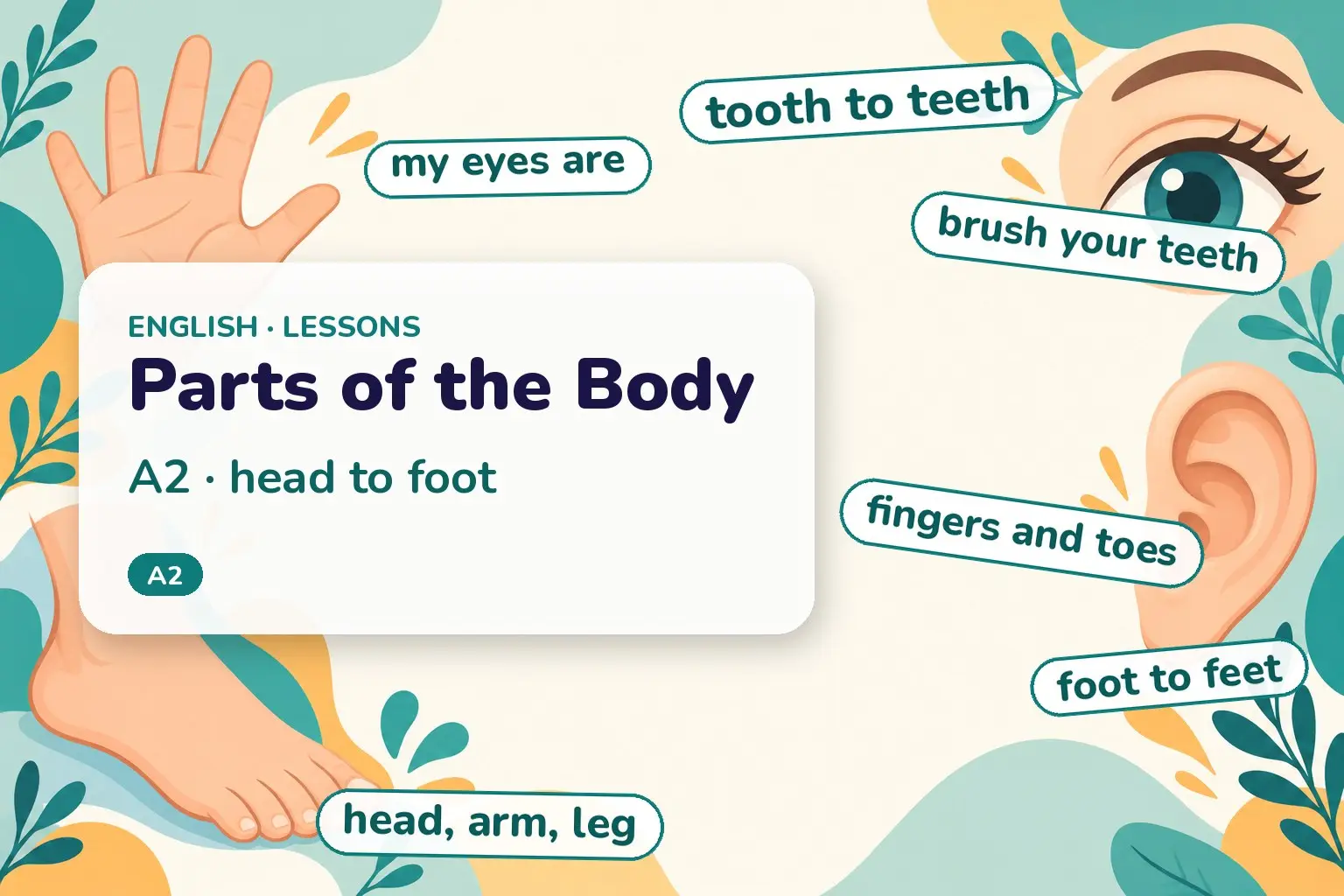
English body words split into the head and face (eye, ear, nose, mouth), the upper body (shoulder, arm, hand, finger) and the lower body (leg, knee, foot, toe). Make most plurals with -s, but learn the irregular ones: foot becomes feet, tooth becomes teeth.
On this page13 sections · tap to jump
Level: A2. The parts of the body are among the most useful words you can learn: you need them to say what hurts, to follow instructions, and to describe people. Most are short, everyday words. This lesson groups them from head to foot and points out the few irregular plurals that catch learners out.
By the end of this page you can…
…name the main parts of the body, use the right plural (feet, teeth), pair them with ‘my’ and ‘your’, and link them to simple health phrases.
From head to foot
It helps to learn the words in groups, working down the body. Start at the top with the head, which holds the face.
- Head and face: head, hair, face, eye, ear, nose, mouth, lip, tooth, tongue, cheek, chin.
- Upper body: neck, shoulder, chest, back, arm, elbow, wrist, hand, finger, thumb.
- Lower body: stomach, hip, leg, knee, ankle, foot, toe.
Notice two small parts that learners often confuse: on your hand you have four fingers and one thumb; on your foot you have five toes. Fingers are not toes.
Singular and plural
Most body words add -s to make the plural, just like other nouns: one arm, two arms; one hand, two hands. But a few are irregular and you must learn them as pairs.
| Singular | Plural | Note |
|---|---|---|
| foot | feet | irregular |
| tooth | teeth | irregular |
| eye | eyes | regular -s |
| ear | ears | regular -s |
| arm | arms | regular -s |
| leg | legs | regular -s |
| finger | fingers | regular -s |
| hand | hands | regular -s |
Body parts come in pairs or singles
Your body has one of some parts and two of others. This matters because it changes the number.
- One (singular): head, nose, mouth, neck, chest, back, stomach.
- Two (usually plural): eyes, ears, arms, hands, legs, feet, shoulders, knees.
So you say my nose is blocked (one) but my eyes are tired (two).
Using my, your, his, her with the body
In English we almost always use a possessive word — my, your, his, her, our, their — with a body part, not the. You wash your hands, you brush your teeth, she shakes her head.
Linking the body to health
You already met these in a doctor’s visit. The body words slot straight into the health phrases My … hurts and I have a sore …:
- My head hurts. / My feet hurt.
- I have a sore throat. / I have a sore back.
- My stomach aches.
A short conversation
Nurse: Where does it hurt? Patient: My right shoulder and my arm. Nurse: Can you raise your arm above your head? Patient: Not very far — it hurts when I lift it. Nurse: All right. And can you move your fingers? Patient: Yes, my fingers are fine. It’s just the shoulder.
Example sentences
Play each line and say it aloud, touching the part of your body as you name it.
- This is my head.The top of the body.
- I have two eyes and one nose.Showing singular and plural together.
- Close your eyes.A common instruction with a possessive.
- My ears are a little blocked.Ears come as a pair, so plural.
- Open your mouth, please.What a doctor or dentist says.
- Brush your teeth twice a day.Teeth is the irregular plural of tooth.
- Raise your right hand.Hand with a possessive word.
- I have five fingers on each hand.Fingers, including the thumb for many counts.
- My thumb is sore.The thumb is separate from the fingers.
- Put your hands on your shoulders.Two plural parts in one instruction.
- My back hurts after work.A single part with 'hurts'.
- She has long hair.Hair is usually uncountable: no 'hairs' here.
- My stomach aches.Stomach is the everyday word for the belly.
- Bend your knees slowly.Knees come as a pair, so plural.
- My feet are tired after the walk.Feet is the irregular plural of foot.
- I hurt my ankle playing football.A common injury word.
- Wiggle your toes.Toes are on the foot, not the hand.
- Turn your head to the left.Head is singular.
- My whole body aches today.Body is the word for everything together.
- Point to your elbow.The joint in the middle of the arm.
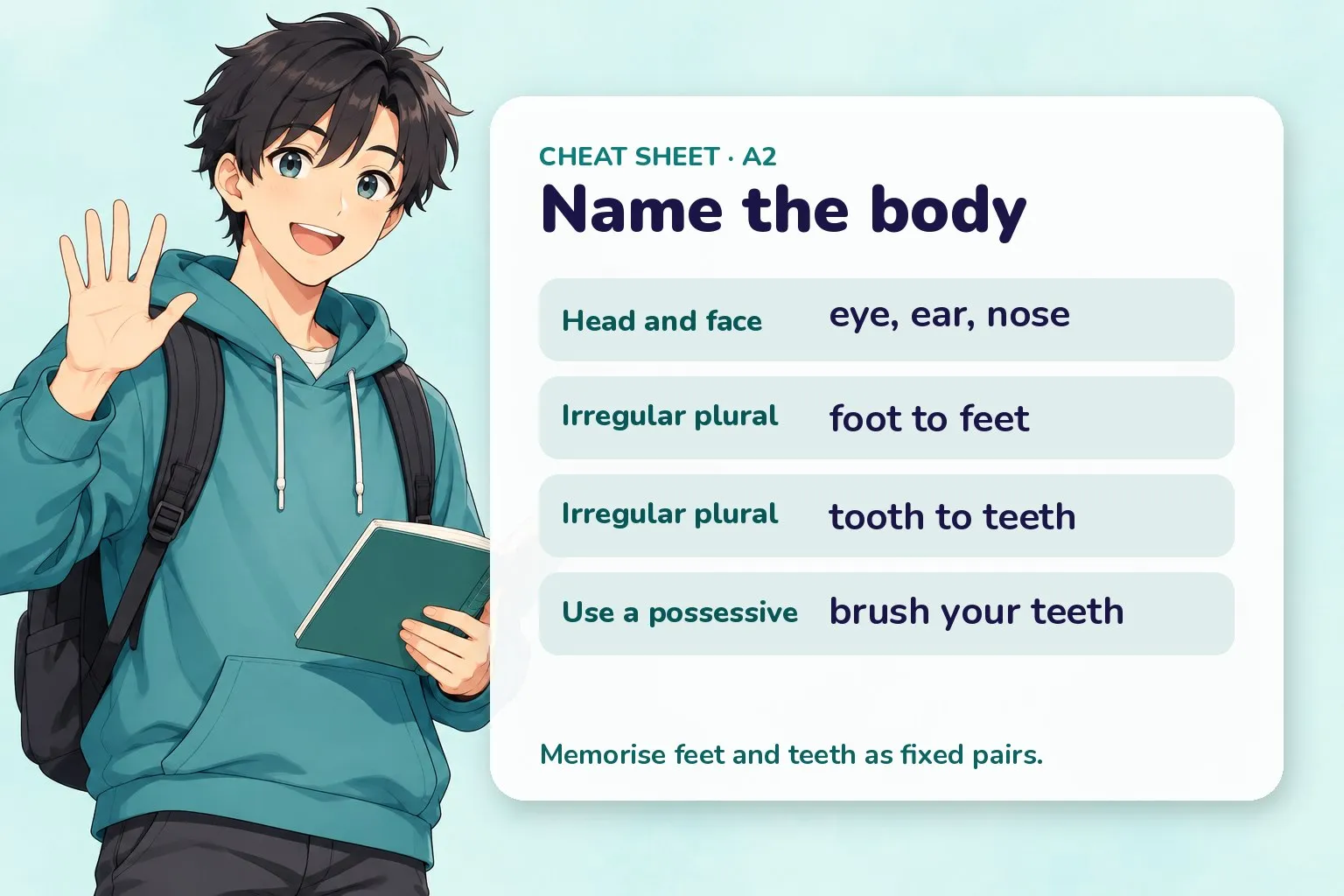
Quick recap before you practise.
Usage notes
- hair is usually uncountable: say she has short hair, not short hairs. A single strand you pull off your coat is a hair, but the hair on your head is one mass.
- stomach, belly, tummy: stomach is the standard word; tummy is gentle and childish; belly is informal.
- toe vs finger: fingers are on the hand, toes are on the foot — never swap them.
- arm includes the hand? No: the arm is the whole limb, but the hand is named separately, as are the elbow and wrist. The same split applies to leg, knee, ankle and foot.
Practice
Parts of the body practice
Try each one, then press Check. No sign-up, nothing is sent anywhere — it all runs in your browser.
Hint: irregular plural
Show answer
teeth — Tooth becomes teeth, an irregular plural.
Hint: English uses my/your, not 'the'
Show answer
your — English prefers a possessive with body parts: close your eyes.
5 Put the words in order to give an instruction.
Show answer
Raise your right hand — Instruction order: Raise your right hand.
6 Match each part to where it is.
- elbow
- knee
- toe
- thumb
Show answer
- elbow → middle of the arm
- knee → middle of the leg
- toe → on the foot
- thumb → on the hand
Joints sit in the middle of a limb; fingers and thumb on the hand, toes on the foot.
How to say it
A few body words trip up English learners — copy the audio, not the spelling.
- stomach sounds like “STUM-uk” — the ch is a k, and the first vowel is like “stum”.
- knee has a silent k: just “nee”.
- thumb has a silent b: “thum”, and starts with the soft th as in thin.
- tongue sounds like “tung” — the gue is just a hard g ending.
Quiz
Parts of the body quiz
8 questions · pick an answer and you'll see straight away if it's right.
-
Show answer
I have two feet. — Foot becomes feet, an irregular plural.
-
Show answer
mouth — You have one mouth, so it is singular: open your mouth.
-
Show answer
toe — Toes are on the foot; fingers and the thumb are on the hand.
-
Show answer
Wash your hands. — English uses a possessive with body parts: wash your hands.
-
Show answer
are — Eyes is plural, so it takes 'are': my eyes are tired.
-
Show answer
teeth — Tooth becomes teeth, an irregular plural.
-
Show answer
in the middle of the arm — The elbow is the joint in the middle of the arm; the knee is in the leg.
-
Show answer
hair — The hair on your head is uncountable: 'she has long hair', not 'long hairs'.
Recap cheat-sheet
| Idea | Rule | Example |
|---|---|---|
| Head and face | learn as a group | eye, ear, nose, mouth |
| Irregular plurals | memorise as pairs | foot–feet, tooth–teeth |
| One vs two | match the verb | my nose is / my eyes are |
| Possessive, not ‘the’ | my / your / his / her | brush your teeth |
| Hand vs foot | fingers vs toes | five fingers, five toes |
Next
- Previous lesson: English: At the Doctor
- Next lesson: English: Emotions & Feelings
- New here? Start with Start Learning English Here
All English lessons topics
Vocabulary, pronunciation, phrases, practice and exam help, ordered by level. Pick a topic and go straight to it. New lessons go live every day, so topics marked Coming soon fill in over the next weeks.
Lessons
A1 9 topics · 9 ready
A2 14 topics · 14 ready
- 10 English: Describing People
- 11 English: Ordering at a Cafe
- 12 English: Shopping & Prices
- 13 English: Clothing & Sizes
- 14 English: Asking for Directions
- 15 English: Using Public Transport
- 16 English: At the Hotel
- 17 English: Weather & Seasons
- 18 English: Hobbies & Free Time
- 19 English: Daily Routine
- 20 English: Housing & Rooms
- 21 English: Parts of the Body You are here
- 22 English: Emotions & Feelings
- 23 English: Supermarket & Groceries
B1 19 topics · 19 ready
- 24 English: Household Chores
- 25 English: At the Doctor
- 26 English: Making Appointments
- 27 English: Making Plans & Invitations
- 28 English: Phone & Messaging
- 29 English: Expressing Opinions
- 30 English: Talking About Past Experiences
- 31 English: Future Plans & Goals
- 32 English: School & Education
- 33 English: Jobs & Professions
- 34 English: Money & Banking
- 35 English: Restaurant & Dining Out
- 36 English: Travel & the Airport
- 37 English: Sightseeing & Tourism
- 38 English: Emergencies & Safety
- 39 English: Technology & the Internet
- 40 English: Complaints & Solving Problems
- 41 English: Small Talk & Networking
- 42 English Small-Talk & Politeness Culture
B2 11 topics · 11 ready
- 43 English: At the Office
- 44 English: The Job Interview
- 45 English: Formal Writing & Emails
- 46 English: News & Current Affairs
- 47 English: Environment & Nature
- 48 English: Health & Lifestyle
- 49 English: Culture & Traditions
- 50 English: Describing Trends & Data
- 51 English: Storytelling & Narration
- 52 English: Giving a Short Presentation
- 53 Writing Business Emails in English