English: Family Members
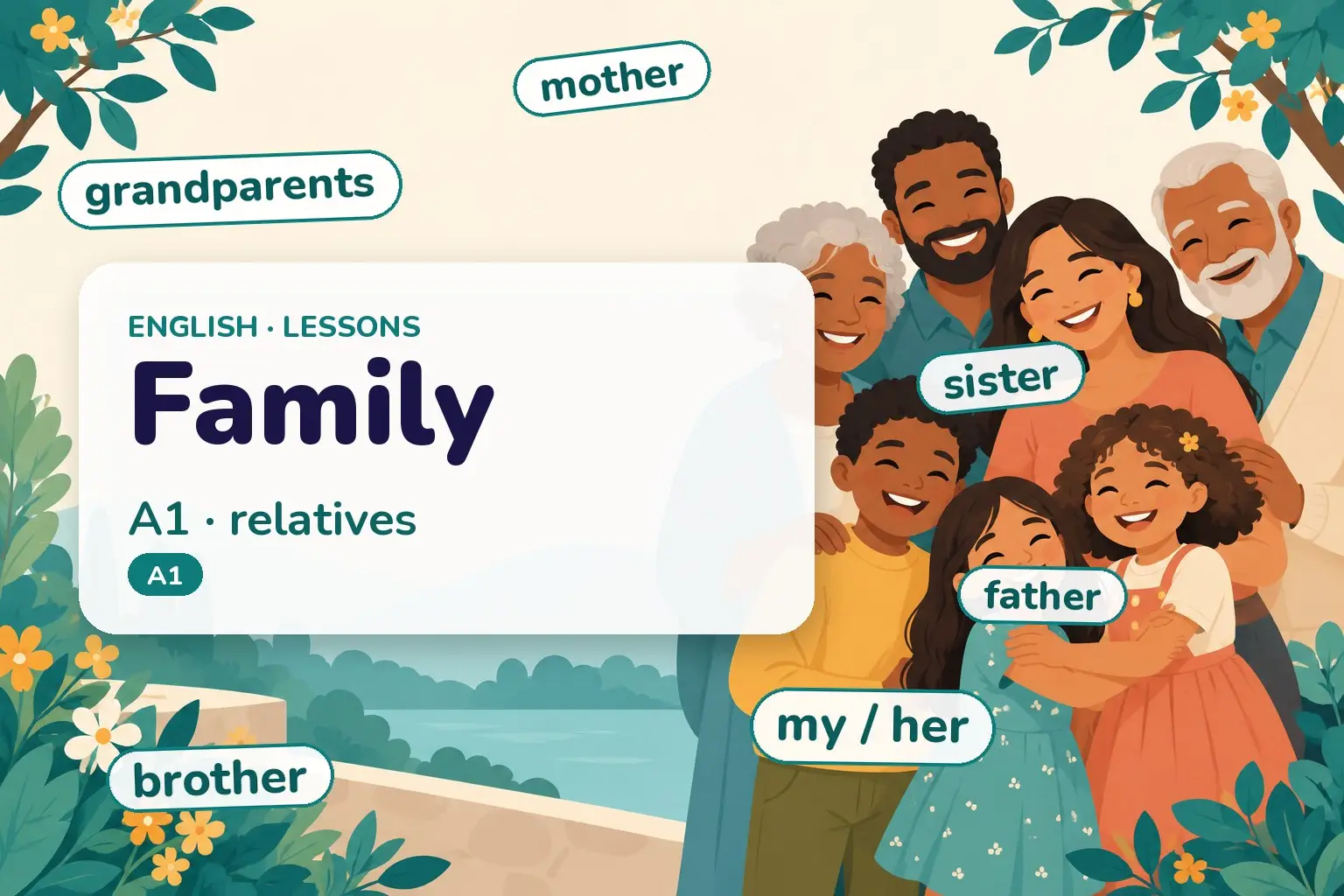
Family words name each relative: mother, father, sister, brother, grandparents, aunt, uncle and cousin. To show who someone belongs to, add apostrophe-s to a name (Tom's sister) or use my, your, his, her, our or their before the word.
Level: A1. Talking about your family is one of the first things people ask you to do. A small set of words — plus a simple way to say whose someone is — lets you describe everyone from your parents to your cousins.
By the end of this page you can…
…name the people in a family, use the casual and formal versions of each word, and say who belongs to whom with possessives like my, her and Tom’s.
The family words
English family words split into a few natural groups. Learn them in groups, not as one long list.
Parents and children are the core of most families. Your mother and father are your parents; their children are their son (a boy) and daughter (a girl). A very young child is a baby.
Brothers and sisters share the same parents. A brother is male, a sister is female, and the general word for both is sibling. English does not have a special word for “older brother” or “younger sister” — you simply add older or younger if it matters: my older sister.
Grandparents are your parents’ parents: your grandmother and grandfather, together your grandparents. Their children’s children are their grandchildren (a grandson or granddaughter).
The wider family is the people around that core. Your parent’s sister is your aunt; your parent’s brother is your uncle; their children are your cousins. If you have children, your sister’s or brother’s children are your niece (female) and nephew (male). A married couple are husband (male) and wife (female).
Everyday and formal versions
Many family words have a warm, informal version you will hear far more often at home.
| Formal word | Everyday word |
|---|---|
| mother | mum (British) / mom (American) |
| father | dad |
| grandmother | grandma / granny |
| grandfather | grandpa / grandad |
| children | kids |
Saying who belongs to whom
To link a person to their family, English uses two tools.
Apostrophe-s goes on a name or noun to mean belonging to: Tom’s sister, my brother’s wife, the baby’s mother. Read it as “the sister of Tom”.
Possessive adjectives go straight in front of the family word: my, your, his, her, our, their. You choose the word by who the owner is, not by the family member: a man says my sister; about that man you say his sister.
- my → belongs to me
- your → belongs to you
- his → belongs to him · her → belongs to her
- our → belongs to us · their → belongs to them
Example sentences
Play each line and say it along with the audio.
- This is my mother.Introducing your mum.
- My father works in a hospital.Talking about your dad's job.
- I have one brother and two sisters.Saying how many siblings you have.
- She is my older sister.Add 'older' when the age matters.
- Tom's sister is a teacher.Apostrophe-s shows the sister belongs to Tom.
- My grandparents live in the countryside.Both grandmother and grandfather together.
- Our grandmother tells wonderful stories.'Our' means she belongs to us.
- His grandfather is ninety years old.'His' follows the owner — a boy or man.
- They have two children, a son and a daughter.A boy is a son, a girl is a daughter.
- The baby is my brother's daughter.So the baby is my niece.
- My aunt and uncle live next door.A parent's sister and brother.
- We are cousins.Our parents are brothers or sisters.
- Her husband cooks every evening.A wife talks about her husband.
- My wife and I have three kids.'Kids' is the casual word for children.
- Is this your family photo?Asking about someone's family picture.
- My parents' house is near the river.Plural owners take the apostrophe after the -s.
- My little nephew loves football.A nephew is a brother's or sister's son.
- How many people are there in your family?A common question about family size.
- I look like my mum.Talking about family resemblance.
- My grandparents have six grandchildren.Their children's children.
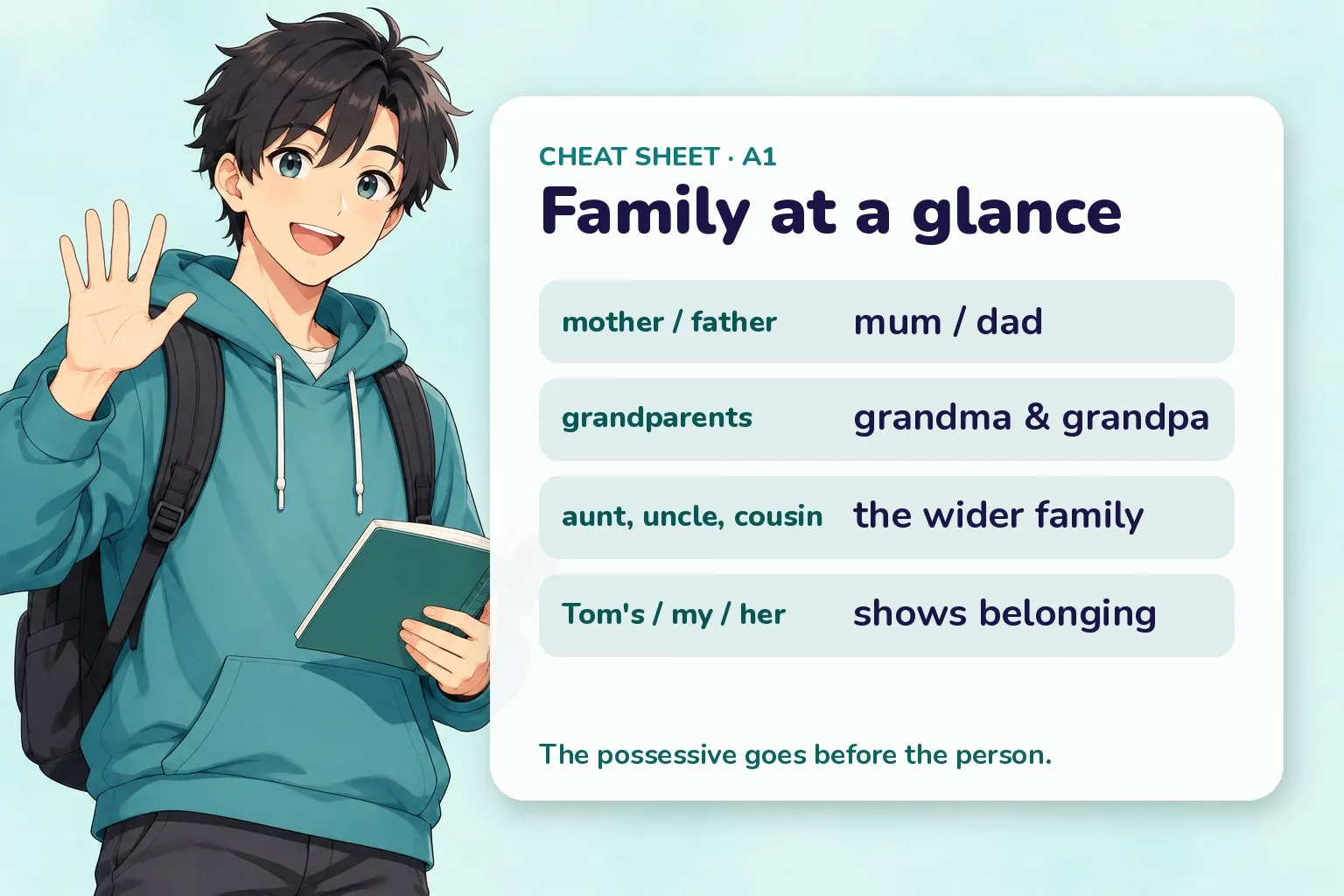
Quick recap before you practise.
How to say it
A few of these words trip up learners — copy the sounds, not the spelling.
- mother, father, brother all share the soft, voiced th (as in this): tongue lightly between the teeth, not “muvver” or “mudder”.
- daughter has a silent gh: say “DAW-ter”.
- cousin sounds like “KUH-zun” — the ou is a short u, not “koo”.
- aunt has two standard pronunciations: “ahnt” (common in Britain) and “ant” (common in America). Both are correct.
Practice
Family members practice
Try each one, then press Check. No sign-up, nothing is sent anywhere — it all runs in your browser.
1 Match each person to who they are.
- your mother's mother
- your parent's brother
- your aunt's child
- your brother's son
Show answer
- your mother's mother → grandmother
- your parent's brother → uncle
- your aunt's child → cousin
- your brother's son → nephew
Each relative is defined by their link to you through your parents or siblings.
Hint: the owner is female
Show answer
Her — The owner is a girl, so use 'her': her father.
Hint: add apostrophe-s to the name
Show answer
Tom's — Apostrophe-s on the name shows belonging: Tom's sister.
6 Put the words in order.
Show answer
This is my brother — The possessive 'my' comes before the family word: This is my brother.
Quiz
Family members quiz
8 questions · pick an answer and you'll see straight away if it's right.
-
Show answer
sibling — A sibling is a brother or sister — the word covers both.
-
Show answer
grandparents — Your grandmother and grandfather together are your grandparents.
-
Show answer
his mother — The owner is male, so use 'his': his mother.
-
Show answer
Her father is tall. — The possessive adjective 'her' comes before the family word.
-
Show answer
nephew — A brother's or sister's son is your nephew; their daughter is your niece.
-
Show answer
children — The plural of child is the irregular form children.
-
Show answer
my sister — Use the possessive 'my' before the noun: my sister.
-
Show answer
husband — A wife's partner is her husband; a husband's partner is his wife.
Next
- Previous lesson: English: Giving Personal Information
- Next lesson: English: Describing People
- New here? Start with Start Learning English Here
All English lessons topics
Vocabulary, pronunciation, phrases, practice and exam help, ordered by level. Pick a topic and go straight to it. New lessons go live every day, so topics marked Coming soon fill in over the next weeks.
Lessons
A1 9 topics · 9 ready
- 01 English: Greetings & Introductions
- 02 English: Numbers 0 to 100
- 03 English: Introducing Yourself
- 04 English: Days, Months & Dates
- 05 English: Telling the Time
- 06 English: Giving Personal Information
- 07 English: Family Members You are here
- 08 English: Colours & Shapes
- 09 English: Food & Drink Basics
A2 14 topics · 14 ready
- 10 English: Describing People
- 11 English: Ordering at a Cafe
- 12 English: Shopping & Prices
- 13 English: Clothing & Sizes
- 14 English: Asking for Directions
- 15 English: Using Public Transport
- 16 English: At the Hotel
- 17 English: Weather & Seasons
- 18 English: Hobbies & Free Time
- 19 English: Daily Routine
- 20 English: Housing & Rooms
- 21 English: Parts of the Body
- 22 English: Emotions & Feelings
- 23 English: Supermarket & Groceries
B1 19 topics · 19 ready
- 24 English: Household Chores
- 25 English: At the Doctor
- 26 English: Making Appointments
- 27 English: Making Plans & Invitations
- 28 English: Phone & Messaging
- 29 English: Expressing Opinions
- 30 English: Talking About Past Experiences
- 31 English: Future Plans & Goals
- 32 English: School & Education
- 33 English: Jobs & Professions
- 34 English: Money & Banking
- 35 English: Restaurant & Dining Out
- 36 English: Travel & the Airport
- 37 English: Sightseeing & Tourism
- 38 English: Emergencies & Safety
- 39 English: Technology & the Internet
- 40 English: Complaints & Solving Problems
- 41 English: Small Talk & Networking
- 42 English Small-Talk & Politeness Culture
B2 11 topics · 11 ready
- 43 English: At the Office
- 44 English: The Job Interview
- 45 English: Formal Writing & Emails
- 46 English: News & Current Affairs
- 47 English: Environment & Nature
- 48 English: Health & Lifestyle
- 49 English: Culture & Traditions
- 50 English: Describing Trends & Data
- 51 English: Storytelling & Narration
- 52 English: Giving a Short Presentation
- 53 Writing Business Emails in English