English: Expressing Opinions
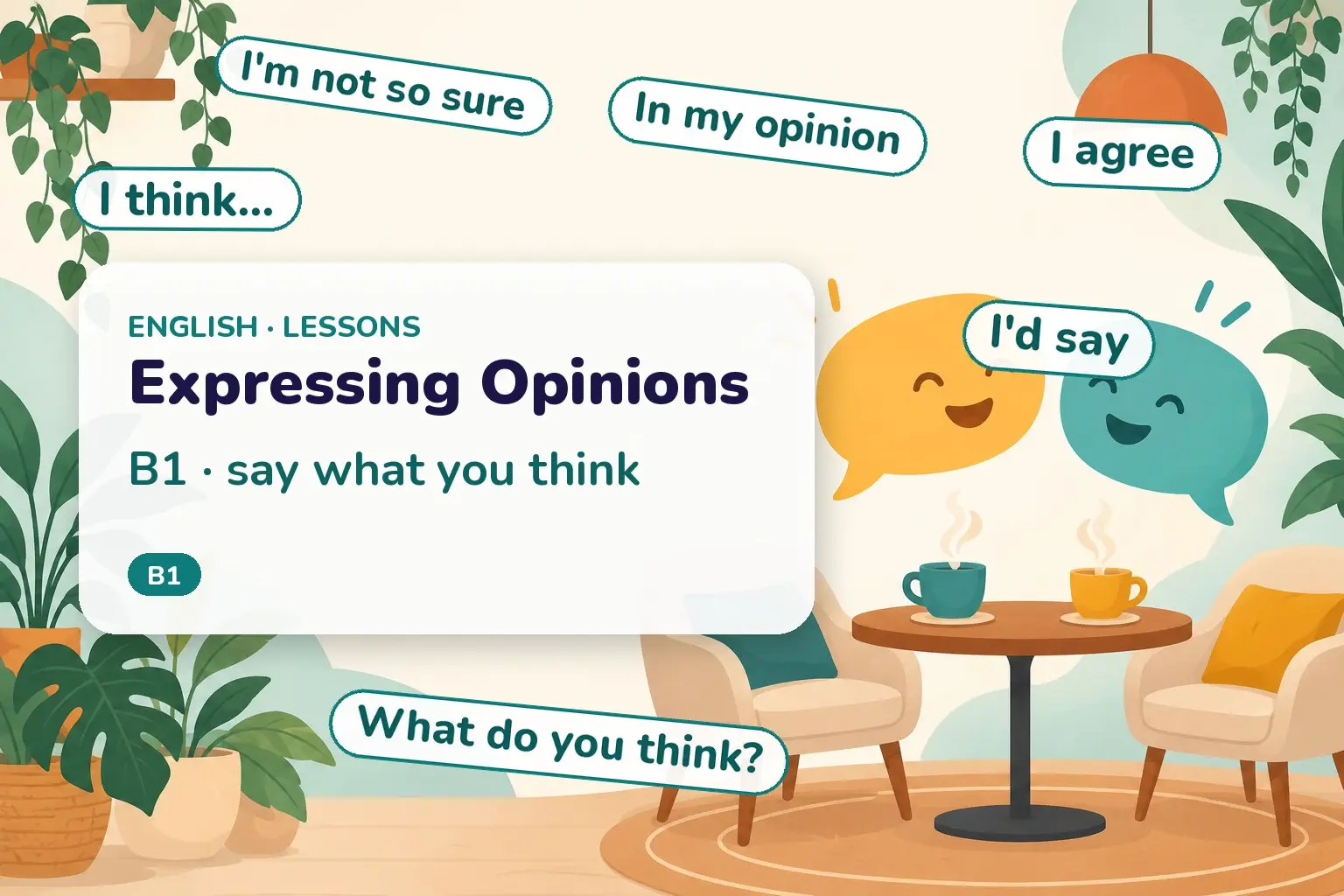
To give an opinion in English, start with a frame like 'I think', 'In my opinion' or 'It seems to me that', then say your idea. Soften strong views with 'maybe' or 'I'm not sure, but', and disagree politely with 'I see your point, but'.
On this page12 sections · tap to jump
Level: B1. Giving your opinion well is about more than the words I think. At B1 you can say what you believe, make it sound polite rather than pushy, and disagree without an argument. This lesson gives you the frames to open an opinion, the words to soften it, and the phrases to agree and disagree the way English speakers actually do.
By the end of this page you can…
…open an opinion with a natural frame, make a strong view sound polite, ask other people what they think, and agree or disagree in a friendly way during a discussion.
Frames for giving an opinion
An opinion usually starts with a short frame, then your idea. Learn a handful and vary them so you don’t repeat I think every sentence.
- Neutral and common: I think (that)…, I believe (that)…, In my opinion,…, It seems to me that…
- A little more formal: From my point of view,…, As far as I’m concerned,…, I would say that…
- Casual and spoken: If you ask me,…, Personally,…, I reckon… (informal British)
The word that after think and believe is optional: I think that it’s true and I think it’s true are both correct, and speakers usually drop it.
Making an opinion stronger or softer
The same idea can sound gentle or firm depending on one or two words. This is called hedging (softening) and emphasising (strengthening).
- Softer: I tend to think…, I suppose…, Maybe…, Perhaps…, It’s a bit expensive, I’m not sure, but…
- Stronger: I’m convinced (that)…, I really think…, There’s no doubt that…, I strongly believe…
At B1, softening is the more useful skill: it makes you sound polite and open, not weak. Adding a bit, quite or I’d say to a criticism takes the edge off it.
Asking what other people think
A good discussion goes both ways, so invite the other person’s view.
- General: What do you think? What’s your opinion? What do you reckon? (informal)
- About a topic: How do you feel about…? What’s your view on…? Do you agree?
- Checking: Don’t you think…? Wouldn’t you say…?
Agreeing and disagreeing politely
Agreeing is easy; disagreeing is where B1 learners need the right phrases so they don’t sound rude.
- Agreeing: I agree. / I think so too. / That’s a good point. / Exactly. / You’re right. / I couldn’t agree more. (very strong)
- Partly agreeing: I agree up to a point. / That’s true, but…
- Disagreeing softly: I see what you mean, but… / I’m not so sure. / I take your point, but… / Actually, I think… / I’m afraid I disagree.
Example sentences
Press play and copy the rhythm. Notice how each opinion opens with a frame.
- I think it's a great idea.The most common frame; that is dropped.
- In my opinion, the film was too long.In my opinion opens the sentence, then a comma.
- It seems to me that prices keep rising.It seems to me that + a full clause.
- Personally, I prefer tea to coffee.Personally signals your own taste.
- As far as I'm concerned, the meeting can wait.A slightly formal way to give your view.
- I'd say it's worth the money.I'd say softens a judgement.
- I tend to agree with you.Tend to makes agreement gentle.
- I'm not sure, but I think she's right.Hedging before an opinion.
- Maybe we should ask someone else.Maybe opens a soft suggestion.
- I'm convinced this is the best option.A strong, confident opinion.
- What do you think about the plan?Asking directly for an opinion.
- How do you feel about working weekends?How do you feel about + a topic.
- That's a good point.A short way to agree and value the idea.
- I couldn't agree more.Very strong agreement, not a negative.
- I agree up to a point.Partial agreement before a but.
- I see what you mean, but I disagree.The polite way to open a disagreement.
- I'm afraid I don't agree.I'm afraid softens the bad news.
- Actually, I think it's too risky.Actually marks a gentle correction.
- To be honest, I found it boring.To be honest introduces a frank view.
- I suppose you could be right.I suppose shows reluctant agreement.
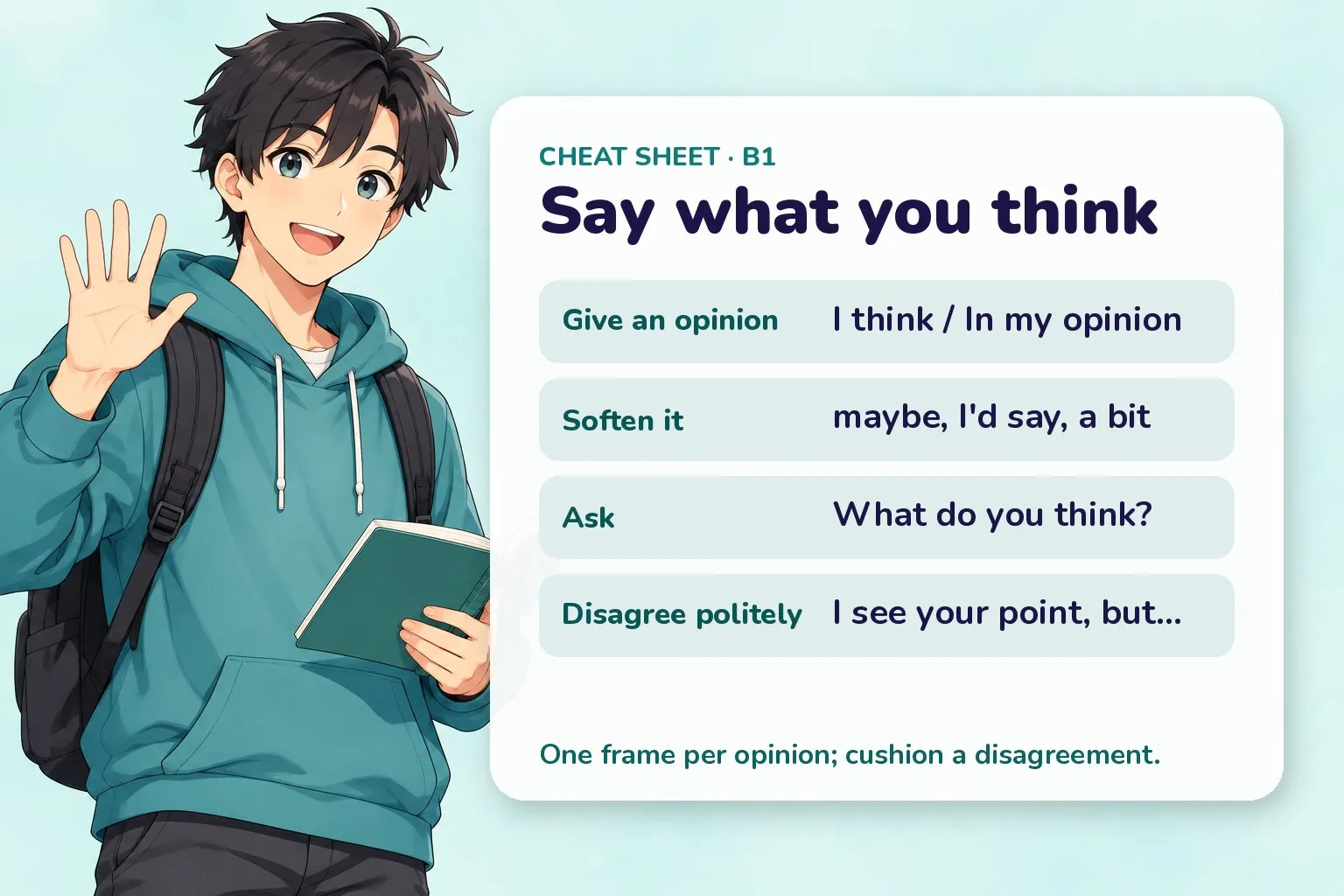
Quick recap before you practise.
A short conversation
Nadia: What do you think of the new café? Tom: Honestly, I’m not sure. I think the coffee is good, but it’s a bit expensive. Nadia: I see what you mean, but I’d say it’s worth it for the quiet. Tom: That’s a good point. Maybe I’ll give it another try. Nadia: Exactly — go on a weekday morning.
Usage notes
- that is optional: after think, believe, suppose, feel you can keep or drop that. In speech it is usually dropped.
- Actually ≠ now: English actually means ‘in fact’ and often introduces a polite correction, not a time. Actually, I disagree.
- I’m afraid = sorry to say: it has nothing to do with fear; it softens bad news or disagreement.
- reckon and I’d say are informal: fine with friends, but use I think or In my opinion in writing and formal talk.
- Don’t say ‘according to me’: English uses in my opinion or I think, never according to me for your own view. According to is for other sources: according to the report.
Practice
Expressing opinions practice
Try each one, then press Check. No sign-up, nothing is sent anywhere — it all runs in your browser.
Hint: the word that makes 'sure' negative
Show answer
not — 'I'm not sure, but…' hedges before you give a view.
Hint: 'I see what you ___' = I understand your point
Show answer
mean — 'I see what you mean, but…' opens a disagreement gently.
4 Put the words in order to ask for an opinion.
Show answer
What do you think? — The question is 'What do you think?'
5 Match each phrase to its job.
- In my opinion
- I couldn't agree more
- I'm afraid I disagree
- What's your view?
Show answer
- In my opinion → give an opinion
- I couldn't agree more → agree strongly
- I'm afraid I disagree → disagree politely
- What's your view? → ask an opinion
Frames open an opinion; agree/disagree phrases respond; a question invites the other view.
How to say it
A few opinion words are easy to mispronounce. Copy the audio rather than spelling them out.
- opinion has the stress on the middle syllable: “uh-PIN-yuhn”, three beats, not “o-PINE-ion”.
- believe stresses the second syllable and ends in a v sound: “bih-LEEV”.
- comfortable usually drops a syllable in speech: “KUMF-tuh-buhl”, not “com-for-TA-ble”.
- honestly is silent on the h: “ON-ist-lee”.
Quiz
Expressing opinions quiz
10 questions · pick an answer and you'll see straight away if it's right.
-
Show answer
In my opinion, it's cheap. — English uses 'in my opinion', never 'according to me' for your own view.
-
Show answer
I see your point, but I don't agree. — Open with a soft phrase, then your view: 'I see your point, but…'
-
Show answer
I agree completely. — It is strong agreement, not a negative.
-
Show answer
maybe — 'Maybe' hedges; the others make an opinion stronger.
-
Show answer
seems — The fixed frame is 'It seems to me that…'
-
Show answer
How do you feel about it? — 'How do you feel about…?' invites an opinion on a topic.
-
Show answer
I think that it's true. / I think it's true. — The 'that' after 'think' is optional; both versions are correct.
-
Show answer
introduces a polite correction — English 'actually' means 'in fact' and usually softens a correction.
-
Show answer
I agree up to a point. — 'Up to a point' means you agree only partly.
-
Show answer
I'm afraid… — 'I'm afraid…' softens disagreement or bad news; it is not about fear.
Recap cheat-sheet
| Idea | Pattern | Example |
|---|---|---|
| Give an opinion | I think / In my opinion / It seems to me that | In my opinion, it’s too long. |
| Soften it | maybe, I’m not sure but, I’d say, a bit | I’d say it’s a bit expensive. |
| Ask an opinion | What do you think? / How do you feel about…? | What do you think of it? |
| Agree | I agree / That’s a good point / Exactly | That’s a good point. |
| Disagree politely | I see what you mean, but… / I’m afraid I disagree | I see what you mean, but I disagree. |
Next
- Previous lesson: English: Phone & Messaging
- Next lesson: English: Talking About Past Experiences
- New here? Start with Start Learning English Here
- Build the sounds: English Pronunciation Overview
All English lessons topics
Vocabulary, pronunciation, phrases, practice and exam help, ordered by level. Pick a topic and go straight to it. New lessons go live every day, so topics marked Coming soon fill in over the next weeks.
Lessons
A1 9 topics · 9 ready
A2 14 topics · 14 ready
- 10 English: Describing People
- 11 English: Ordering at a Cafe
- 12 English: Shopping & Prices
- 13 English: Clothing & Sizes
- 14 English: Asking for Directions
- 15 English: Using Public Transport
- 16 English: At the Hotel
- 17 English: Weather & Seasons
- 18 English: Hobbies & Free Time
- 19 English: Daily Routine
- 20 English: Housing & Rooms
- 21 English: Parts of the Body
- 22 English: Emotions & Feelings
- 23 English: Supermarket & Groceries
B1 19 topics · 19 ready
- 24 English: Household Chores
- 25 English: At the Doctor
- 26 English: Making Appointments
- 27 English: Making Plans & Invitations
- 28 English: Phone & Messaging
- 29 English: Expressing Opinions You are here
- 30 English: Talking About Past Experiences
- 31 English: Future Plans & Goals
- 32 English: School & Education
- 33 English: Jobs & Professions
- 34 English: Money & Banking
- 35 English: Restaurant & Dining Out
- 36 English: Travel & the Airport
- 37 English: Sightseeing & Tourism
- 38 English: Emergencies & Safety
- 39 English: Technology & the Internet
- 40 English: Complaints & Solving Problems
- 41 English: Small Talk & Networking
- 42 English Small-Talk & Politeness Culture
B2 11 topics · 11 ready
- 43 English: At the Office
- 44 English: The Job Interview
- 45 English: Formal Writing & Emails
- 46 English: News & Current Affairs
- 47 English: Environment & Nature
- 48 English: Health & Lifestyle
- 49 English: Culture & Traditions
- 50 English: Describing Trends & Data
- 51 English: Storytelling & Narration
- 52 English: Giving a Short Presentation
- 53 Writing Business Emails in English