English: Formal Writing & Emails
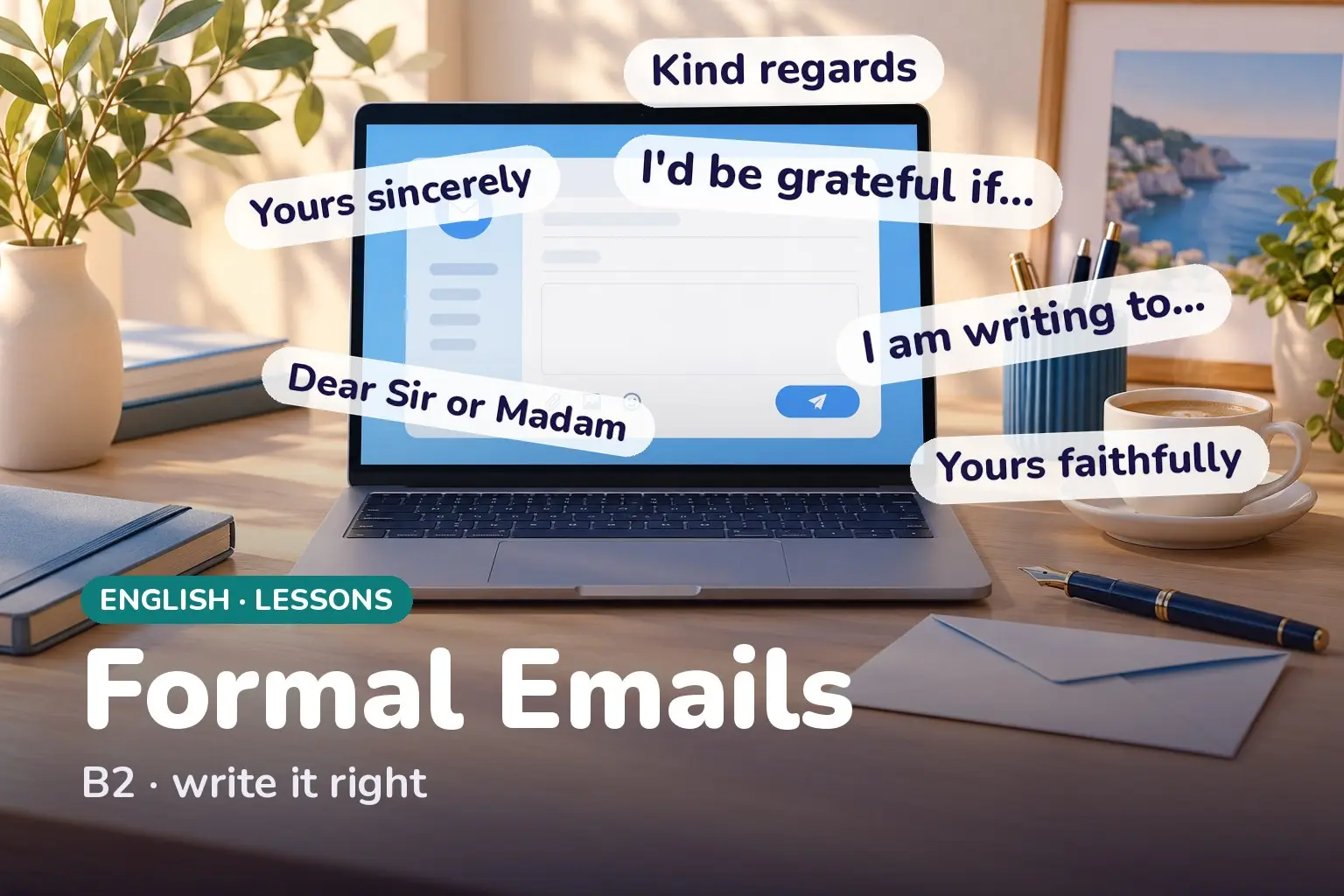
A formal English email opens with 'Dear Mr Lee' or 'Dear Sir or Madam', states its purpose in the first line, makes requests politely ('I would be grateful if you could…'), and closes with 'Yours sincerely' (named person) or 'Yours faithfully' (unnamed).
On this page13 sections · tap to jump
- 01By the end of this page you can…
- 02Register: what makes writing formal
- 03Greetings and closings that match
- 04Opening: state your purpose first
- 05Polite requests and bad news
- 06Structure: the shape of the email
- 07A short model email
- 08Example sentences
- 09Usage notes
- 10Practice
- 11How to say it
- 12Quiz
- 13Recap cheat-sheet
Level: B2. Formal English writing follows a small set of conventions: how you greet the reader, how you sign off, and the polite phrases in between. Once you know these fixed pieces, most formal emails and letters write themselves — you just slot your message into the frame.
By the end of this page you can…
…choose the right greeting and closing, open with a clear statement of purpose, make polite requests, and keep your register consistently formal.
Register: what makes writing formal
Register is how formal or casual your language is. Three habits move writing from casual to formal:
- No contractions. Write I am, do not, I will — not I’m, don’t, I’ll.
- Single verbs instead of phrasal verbs. Prefer receive over get, request over ask for, arrange over set up.
- Complete, polite sentences. Avoid slang, exclamation marks and emojis.
| Casual | Formal |
|---|---|
| Hi / Hey | Dear Mr Lee / Dear Sir or Madam |
| Thanks a lot! | Thank you for your time. |
| get back to me | reply / respond |
| sort out | resolve |
| I wanna know | I would like to know |
| Cheers | Yours sincerely |
Greetings and closings that match
The greeting and the closing are a pair. Get the match right and your email already looks professional.
- You know the name: Dear Mr Lee, / Dear Ms Tan, → close with Yours sincerely,
- You do not know the name: Dear Sir or Madam, → close with Yours faithfully,
- Slightly less formal but still professional: Dear Hiroshi, → close with Best regards, or Kind regards,
Opening: state your purpose first
A formal email should tell the reader why it exists in the first sentence. Use an I am writing to… opener, then give the detail.
- I am writing to apply for the position of…
- I am writing to enquire about…
- I am writing to confirm our meeting on…
- I am writing with regard to your email of 3 March.
If you are replying, thank them first: Thank you for your email. Then state your purpose.
Polite requests and bad news
Formal writing softens requests and bad news. Rather than a direct order, use a longer, gentler structure.
- I would be grateful if you could send me the report.
- Could you please confirm the date?
- I would appreciate it if you could reply by Friday.
For bad news or a refusal, lead in gently: I am afraid that…, Unfortunately…, or I regret to inform you that…
Structure: the shape of the email
Keep it to short paragraphs, one idea each:
- Greeting — Dear …
- Purpose — I am writing to…
- Detail — one or two short paragraphs with the facts.
- Action — what you want the reader to do, and by when.
- Closing line + sign-off — Thank you for your time. / Yours sincerely, + your name.
End with the next step so the reader is never left guessing: I look forward to your reply.
A short model email
Subject: Request for a reference
Dear Dr Alvarez,
I am writing to ask whether you would be willing to act as a reference for my application to the graduate programme at Northgate University.
I studied under you in 2024 and valued your guidance on my final project. The application is due on 15 April, and the form would take only a few minutes to complete.
I would be grateful if you could let me know by Friday whether this is possible. Thank you very much for considering my request.
Yours sincerely, Marco Rossi
Example sentences
Press play and copy the rhythm. These are the exact phrases you will reuse across many emails.
- Dear Sir or Madam,A greeting when you do not know the name.
- Dear Ms Tan,A greeting when you know the name.
- Thank you for your email.A polite opening when you are replying.
- I am writing to enquire about the course.Stating your purpose in the first line.
- I am writing with regard to your advertisement.A formal way to say 'about'.
- I would be grateful if you could send me the details.A softened, formal request.
- Could you please confirm the date?A short, polite request.
- I would appreciate it if you could reply by Friday.Asking for a reply by a deadline.
- Please find attached my CV.The fixed phrase for an attachment.
- I am afraid that I cannot attend the meeting.Softening bad news.
- Unfortunately, the item is out of stock.Leading in to a negative.
- I regret to inform you that your application was unsuccessful.A very formal way to give bad news.
- Please do not hesitate to contact me.Inviting the reader to get in touch.
- I look forward to your reply.A standard closing line.
- Thank you for your time and consideration.A polite closing before the sign-off.
- Yours sincerely,The sign-off when you named the reader.
- Yours faithfully,The sign-off for 'Dear Sir or Madam'.
- Kind regards,A safe, professional sign-off in most work emails.
- I apologise for the delay in replying.A formal apology.
- I hope this email finds you well.A gentle, optional opening courtesy.
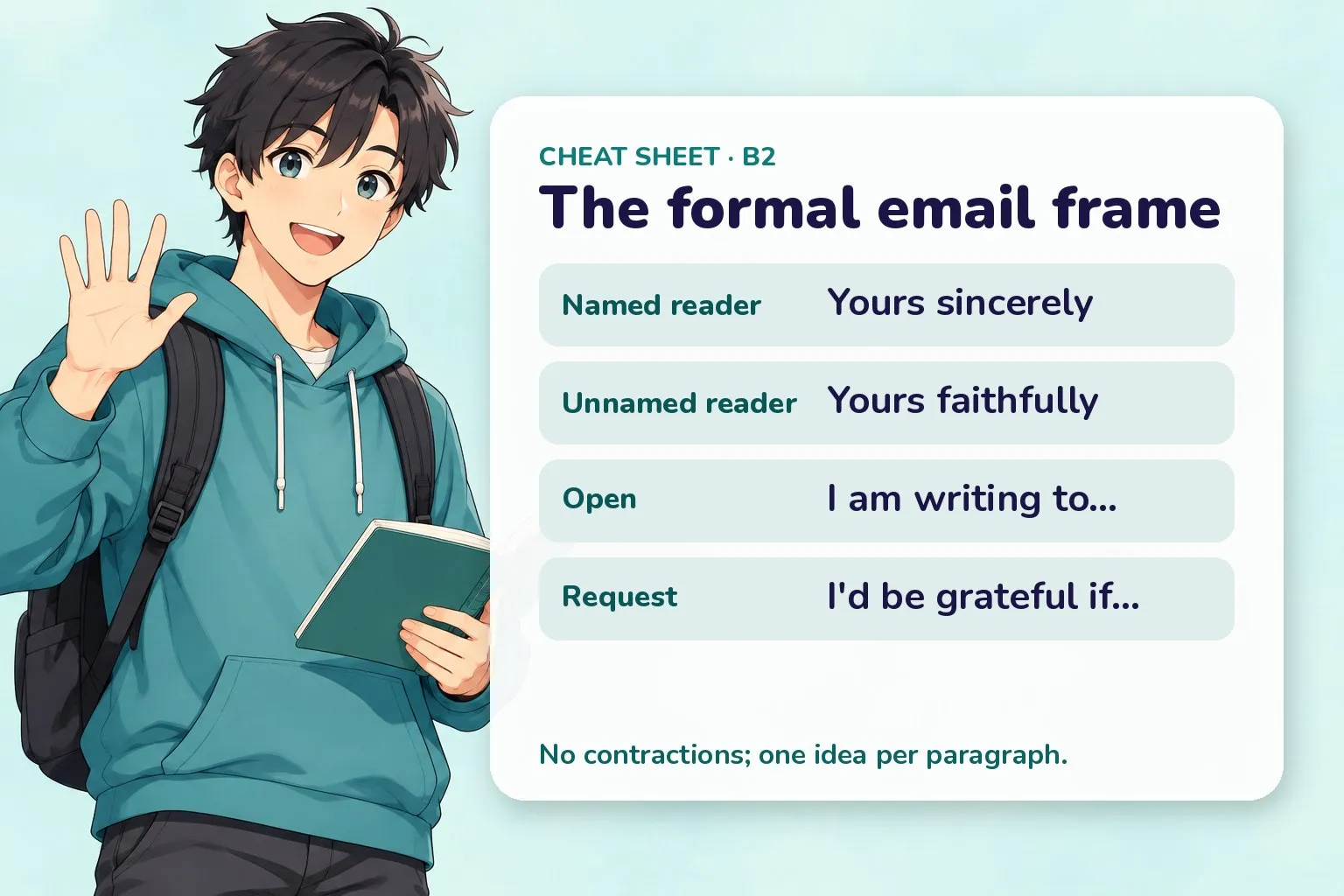
Quick recap before you practise.
Usage notes
- enquire / inquire: both are correct; British style often uses enquire for a general question and inquire for an official investigation. Either is fine in a neutral style.
- Please find attached: the standard phrase for sending a file; I have attached… is also natural and a little warmer.
- dates in formal writing: write the month in words to avoid confusion — 15 April or April 15, not 15/4, since the order differs between British and American English.
- subject line: keep it short and specific (Request for a reference), not vague (Hello). It is the first thing the reader sees.
Practice
Formal writing practice
Try each one, then press Check. No sign-up, nothing is sent anywhere — it all runs in your browser.
Hint: no contraction in formal writing
Show answer
am — Formal writing avoids contractions: write 'I am', not 'I'm'.
4 Put the words in order to state your purpose.
Show answer
I am writing to enquire about the course — Open with: I am writing to + purpose.
5 Match each casual phrase to its formal version.
- get back to me
- Thanks a lot!
- sort out
- Hi
Show answer
- get back to me → reply
- Thanks a lot! → Thank you for your time.
- sort out → resolve
- Hi → Dear Mr Lee
Formal writing swaps casual words and phrasal verbs for neutral single verbs.
Hint: a two-word lead-in: I am ___
Show answer
afraid — 'I am afraid that…' gently introduces bad news.
How to say it
A few formal-writing words are read aloud in meetings and calls — copy the sounds.
- sincerely has three beats with the stress in the middle: sin-SEER-lee.
- faithfully stresses the first part: FAYTH-fuh-lee.
- apologise has four beats, stress on the second: uh-POL-uh-jyze.
- enquire rhymes with fire: in-KWY-uhr, stress on the second part.
Quiz
Formal writing quiz
8 questions · pick an answer and you'll see straight away if it's right.
-
Show answer
Yours sincerely, — A named reader takes 'Yours sincerely'; an unnamed one takes 'Yours faithfully'.
-
Show answer
I am writing to enquire about the position. — Formal writing avoids contractions and slang and uses a clear purpose opener.
-
Show answer
Please find attached my CV. — 'Please find attached…' is the fixed formal phrase for an attachment.
-
Show answer
I am afraid that I cannot attend. — 'I am afraid that…' softens bad news in a formal register.
-
Show answer
I am writing to confirm our meeting on Monday. — Open formal emails with 'I am writing to…' plus the purpose.
-
Show answer
receive — Formal writing prefers single verbs like 'receive' over 'get' or phrasal verbs.
-
Show answer
I look forward to your reply. — 'I look forward to your reply' is a standard formal closing line.
-
Show answer
Kind regards, — 'Kind regards' is professional and works when you are unsure which pair to use.
Recap cheat-sheet
| Part | Formal choice | Example |
|---|---|---|
| Greeting (name known) | Dear Mr/Ms + surname | Dear Ms Tan, |
| Greeting (name unknown) | Dear Sir or Madam | Dear Sir or Madam, |
| Purpose | I am writing to… | I am writing to enquire about… |
| Request | I would be grateful if you could… | …send me the details. |
| Bad news | I am afraid that… / Unfortunately… | I am afraid that I cannot attend. |
| Sign-off | sincerely (named) / faithfully (unnamed) | Yours sincerely, / Yours faithfully, |
Next
- Previous lesson: English: The Job Interview
- Next lesson: English: Money & Banking
- Practise longer texts: How to Practise English Writing
All English lessons topics
Vocabulary, pronunciation, phrases, practice and exam help, ordered by level. Pick a topic and go straight to it. New lessons go live every day, so topics marked Coming soon fill in over the next weeks.
Lessons
A1 9 topics · 9 ready
A2 14 topics · 14 ready
- 10 English: Describing People
- 11 English: Ordering at a Cafe
- 12 English: Shopping & Prices
- 13 English: Clothing & Sizes
- 14 English: Asking for Directions
- 15 English: Using Public Transport
- 16 English: At the Hotel
- 17 English: Weather & Seasons
- 18 English: Hobbies & Free Time
- 19 English: Daily Routine
- 20 English: Housing & Rooms
- 21 English: Parts of the Body
- 22 English: Emotions & Feelings
- 23 English: Supermarket & Groceries
B1 19 topics · 19 ready
- 24 English: Household Chores
- 25 English: At the Doctor
- 26 English: Making Appointments
- 27 English: Making Plans & Invitations
- 28 English: Phone & Messaging
- 29 English: Expressing Opinions
- 30 English: Talking About Past Experiences
- 31 English: Future Plans & Goals
- 32 English: School & Education
- 33 English: Jobs & Professions
- 34 English: Money & Banking
- 35 English: Restaurant & Dining Out
- 36 English: Travel & the Airport
- 37 English: Sightseeing & Tourism
- 38 English: Emergencies & Safety
- 39 English: Technology & the Internet
- 40 English: Complaints & Solving Problems
- 41 English: Small Talk & Networking
- 42 English Small-Talk & Politeness Culture
B2 11 topics · 11 ready
- 43 English: At the Office
- 44 English: The Job Interview
- 45 English: Formal Writing & Emails You are here
- 46 English: News & Current Affairs
- 47 English: Environment & Nature
- 48 English: Health & Lifestyle
- 49 English: Culture & Traditions
- 50 English: Describing Trends & Data
- 51 English: Storytelling & Narration
- 52 English: Giving a Short Presentation
- 53 Writing Business Emails in English