English: Giving a Short Presentation
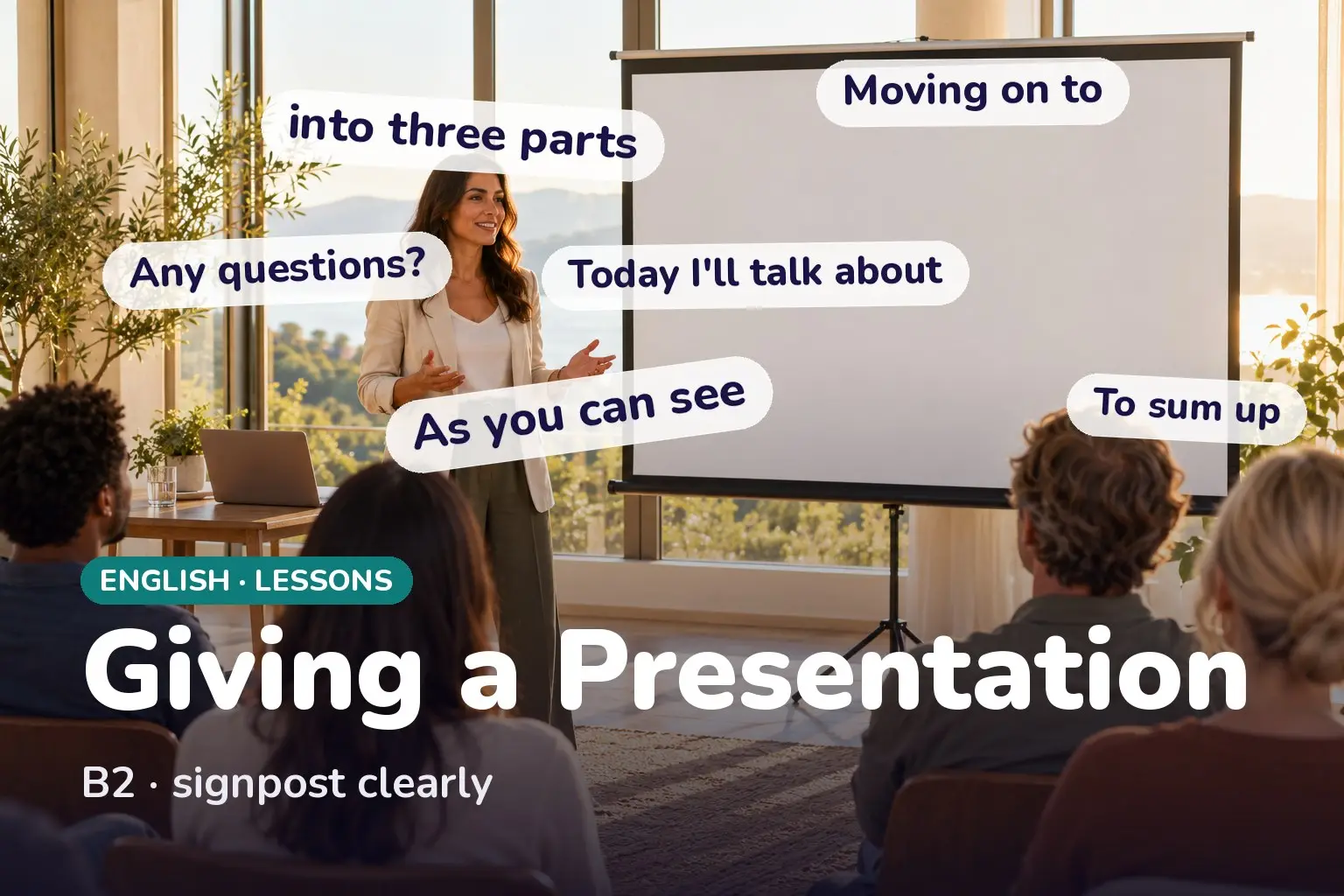
A short presentation has three parts. Open with your topic and plan, signpost each section as you go ('Let's start with…', 'Moving on to…'), then close by summarising and inviting questions ('To sum up… Any questions?').
Level: B2. A good short presentation is not about big words — it is about structure. If your listeners always know where you are (beginning, middle, or end) and where you are going next, they follow you easily. The tool that does this is signposting language: a small set of fixed phrases that mark each move. Learn them and even a five-minute talk sounds confident and clear.
By the end of this page you can…
…open a short talk, state your topic and plan, signpost each section, refer to a slide or chart, handle a close, and invite questions — all with natural, fixed phrases.
The three parts
Keep the old advice in mind: tell them what you’ll say, say it, then tell them what you said. That means three parts.
- Opening — greet, give your topic, say why it matters, outline your plan.
- Body — one point per section, each marked with a signpost.
- Close — summarise, finish, invite questions.
Opening phrases
Start with the audience, then your topic and your plan. A clear plan sentence tells people how many parts to expect.
| Purpose | Phrase |
|---|---|
| Greet / topic | Good morning. Today I’d like to talk about… |
| Why it matters | This matters because… |
| Plan | I’ve divided my talk into three parts. |
| First / last | First, I’ll…; then…; finally, I’ll… |
Signposting the body
Signposts are the phrases that say “we are moving.” Use one each time you change point, so no one gets lost. Many are built from linking words — see cause and contrast connectors and advanced discourse markers.
- Starting: Let’s start with… / First of all,…
- Moving on: Moving on to… / This brings me to my next point.
- Adding: In addition,… / What’s more,…
- Contrasting: However,… / On the other hand,…
- Giving an example: For instance,… / A good example of this is…
- Returning: As I mentioned earlier,… / Coming back to…
Referring to slides and data
When you show a slide or chart, tell people where to look and what it means. Don’t just read numbers aloud — interpret them.
- As you can see on this slide,…
- This chart shows… / The graph illustrates…
- If you look at the figures,…
- The key point here is…
When you read numbers, interpret them (they rise, fall, level off) rather than just saying the figure — tell the audience what the trend means.
Closing phrases
The close is where many talks fall apart. Mark it clearly, summarise, thank the audience, then open the floor.
- Signal the end: That brings me to the end of my talk.
- Summarise: To sum up,… / In short,…
- Thank: Thank you for listening / for your attention.
- Invite questions: I’m happy to take any questions.
Common mistakes
- ❌ Today I will talk about of my project. → ✅ Today I’ll talk about my project. (No of after talk about + object.)
- ❌ I divided my talk in three parts. → ✅ I’ve divided my talk into three parts. (into, and present perfect for the plan.)
- ❌ Let’s start with to the first point. → ✅ Let’s start with the first point. (No to after start with.)
- ❌ As you can see in this slide. → ✅ As you can see on this slide. (Use on for slides.)
- ❌ Thank you for your listening. → ✅ Thank you for listening. (No your before the -ing form here.)
- ❌ I will answer to your questions. → ✅ I’ll answer your questions. (answer takes no to.)
A short conversation
Presenter: Good morning, everyone. Today I’d like to talk about our new app. I’ve divided my talk into three parts: the problem, our solution, and the results. Presenter: Let’s start with the problem. Users told us the old sign-up was too slow. Presenter: This brings me to our solution. As you can see on this slide, we cut it from six steps to two. Presenter: Finally, the results. If you look at the figures, sign-ups rose by forty per cent. Presenter: To sum up: a simpler sign-up, happier users, more growth. Thank you for listening. I’m happy to take any questions. Colleague: Thanks — could you say more about the testing?
Usage notes
- talk about vs discuss: talk about takes a preposition (talk about X); discuss does not (discuss X, never discuss about X).
- slide / handout / deck: a slide is one screen; the whole set is a deck or a slideshow; a handout is paper you give out.
- BrE vs AmE: British per cent (two words) vs American percent; both are read the same. British maths, American math if your topic needs it.
- register: signposting phrases suit both business and academic talks. For a very informal talk you can drop some (OK, next…), but keep the opening plan and the summary.
Example sentences
Play each line and say it aloud. These are the phrases that hold a short talk together.
- Good morning, everyone. Thank you for coming.Greeting the audience.
- Today I'd like to talk about our new project.Stating the topic.
- This matters because it affects every team.Saying why the topic matters.
- I've divided my talk into three parts.Giving the plan so people know how many points.
- First, I'll explain the problem; then the solution.Outlining the order.
- Let's start with the background.Signpost to begin the first point.
- Moving on to my second point…Signpost for a change of section.
- This brings me to the results.Signpost that links sections smoothly.
- In addition, costs went down.Adding a related point.
- However, there is one risk to consider.Signalling a contrast.
- For instance, one customer saved an hour a day.Giving an example.
- As you can see on this slide, sales rose sharply.Pointing to a slide and reading the trend.
- This chart shows the growth over six months.Introducing a visual.
- If you look at the figures, the trend is clear.Directing attention to data.
- The key point here is simple.Highlighting the main idea.
- As I mentioned earlier, speed was the problem.Referring back to an earlier point.
- That brings me to the end of my talk.Signalling the close.
- To sum up, we are faster, cheaper and clearer.Summarising the main points.
- Thank you for listening.Thanking the audience.
- I'm happy to take any questions.Inviting questions.
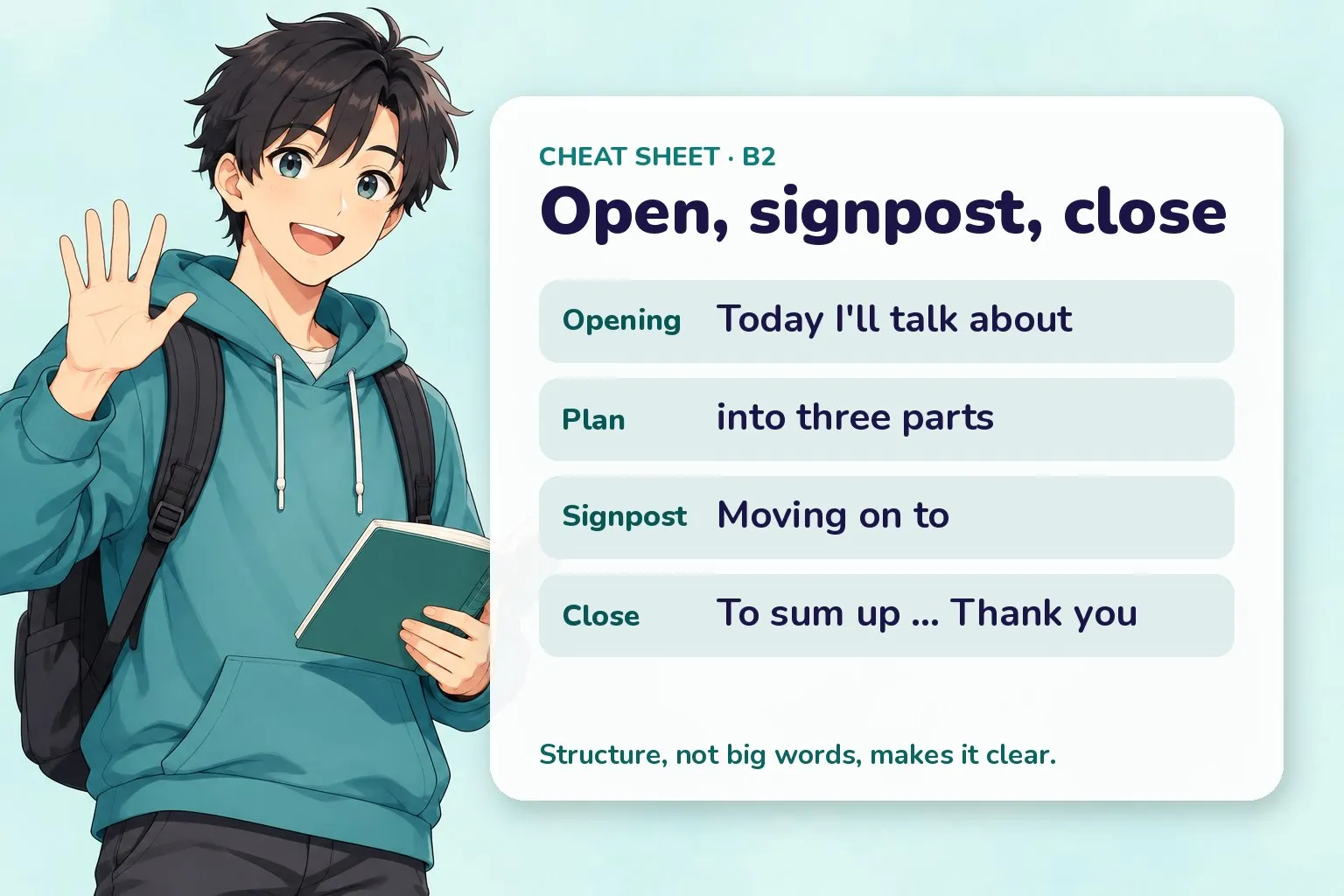
Quick recap before you practise.
How to say it
A few presentation words trip up English learners — copy the audio, not the spelling.
- presentation stresses the third part: “prez-en-TAY-shun”.
- slide rhymes with “ride” — one syllable.
- figures here means numbers: “FIG-ers” (British) or “FIG-yers” (American).
- audience is three syllables: “AW-dee-ence”.
Practice
Presentation practice
Try each one, then press Check. No sign-up, nothing is sent anywhere — it all runs in your browser.
Hint: moving ___ to
Show answer
on — The fixed signpost is 'Moving on to…' for a change of section.
Hint: use the preposition for slides
Show answer
on — Use 'on' for slides: 'As you can see on this slide…'.
5 Put the words in order to open a talk.
Show answer
Today I'd like to talk about — A standard opener: 'Today I'd like to talk about…'.
6 Match each signpost to its job.
- Let's start with…
- Moving on to…
- For instance,…
- To sum up,…
Show answer
- Let's start with… → begin the first point
- Moving on to… → change section
- For instance,… → give an example
- To sum up,… → summarise at the end
Signposts show direction, not new content.
Quiz
Giving a presentation quiz
10 questions · pick an answer and you'll see straight away if it's right.
-
Show answer
Today I'll talk about my project. — 'talk about' + object, with no 'of'; 'discuss' takes no 'about'.
-
Show answer
into — The fixed phrase is 'divided into'.
-
Show answer
Moving on to my next point, — 'Moving on to…' marks a move to the next section.
-
Show answer
As you can see on this slide, — Use 'on' with slides: 'As you can see on this slide…'.
-
Show answer
For instance, — 'For instance' and 'for example' introduce an example.
-
Show answer
To show direction and structure — Signposts show where you are and where you are going; they carry no new content.
-
Show answer
To sum up, we are faster and cheaper. — 'To sum up' signals a summary of your main points.
-
Show answer
Thank you for listening. — The fixed phrase is 'Thank you for listening' (no 'your').
-
Show answer
I'm happy to take any questions. — 'I'm happy to take any questions' politely opens the floor.
-
Show answer
I'll answer your questions. — 'answer' takes a direct object with no 'to'.
Recap cheat-sheet
| Part | Job | Phrase |
|---|---|---|
| Opening | topic + plan | Today I’d like to talk about… / into three parts |
| Body | signpost moves | Let’s start with… / Moving on to… |
| Visuals | point + interpret | As you can see on this slide… |
| Close | summarise | To sum up,… |
| Questions | open the floor | Thank you. Any questions? |
Next
- Previous lesson: English: Complaints & Solving Problems
- Next lesson: English: Small Talk & Networking
- Related grammar: cause and contrast connectors · advanced discourse markers
All English lessons topics
Vocabulary, pronunciation, phrases, practice and exam help, ordered by level. Pick a topic and go straight to it. New lessons go live every day, so topics marked Coming soon fill in over the next weeks.
Lessons
A1 9 topics · 9 ready
A2 14 topics · 14 ready
- 10 English: Describing People
- 11 English: Ordering at a Cafe
- 12 English: Shopping & Prices
- 13 English: Clothing & Sizes
- 14 English: Asking for Directions
- 15 English: Using Public Transport
- 16 English: At the Hotel
- 17 English: Weather & Seasons
- 18 English: Hobbies & Free Time
- 19 English: Daily Routine
- 20 English: Housing & Rooms
- 21 English: Parts of the Body
- 22 English: Emotions & Feelings
- 23 English: Supermarket & Groceries
B1 19 topics · 19 ready
- 24 English: Household Chores
- 25 English: At the Doctor
- 26 English: Making Appointments
- 27 English: Making Plans & Invitations
- 28 English: Phone & Messaging
- 29 English: Expressing Opinions
- 30 English: Talking About Past Experiences
- 31 English: Future Plans & Goals
- 32 English: School & Education
- 33 English: Jobs & Professions
- 34 English: Money & Banking
- 35 English: Restaurant & Dining Out
- 36 English: Travel & the Airport
- 37 English: Sightseeing & Tourism
- 38 English: Emergencies & Safety
- 39 English: Technology & the Internet
- 40 English: Complaints & Solving Problems
- 41 English: Small Talk & Networking
- 42 English Small-Talk & Politeness Culture
B2 11 topics · 11 ready
- 43 English: At the Office
- 44 English: The Job Interview
- 45 English: Formal Writing & Emails
- 46 English: News & Current Affairs
- 47 English: Environment & Nature
- 48 English: Health & Lifestyle
- 49 English: Culture & Traditions
- 50 English: Describing Trends & Data
- 51 English: Storytelling & Narration
- 52 English: Giving a Short Presentation You are here
- 53 Writing Business Emails in English