English Small-Talk & Politeness Culture
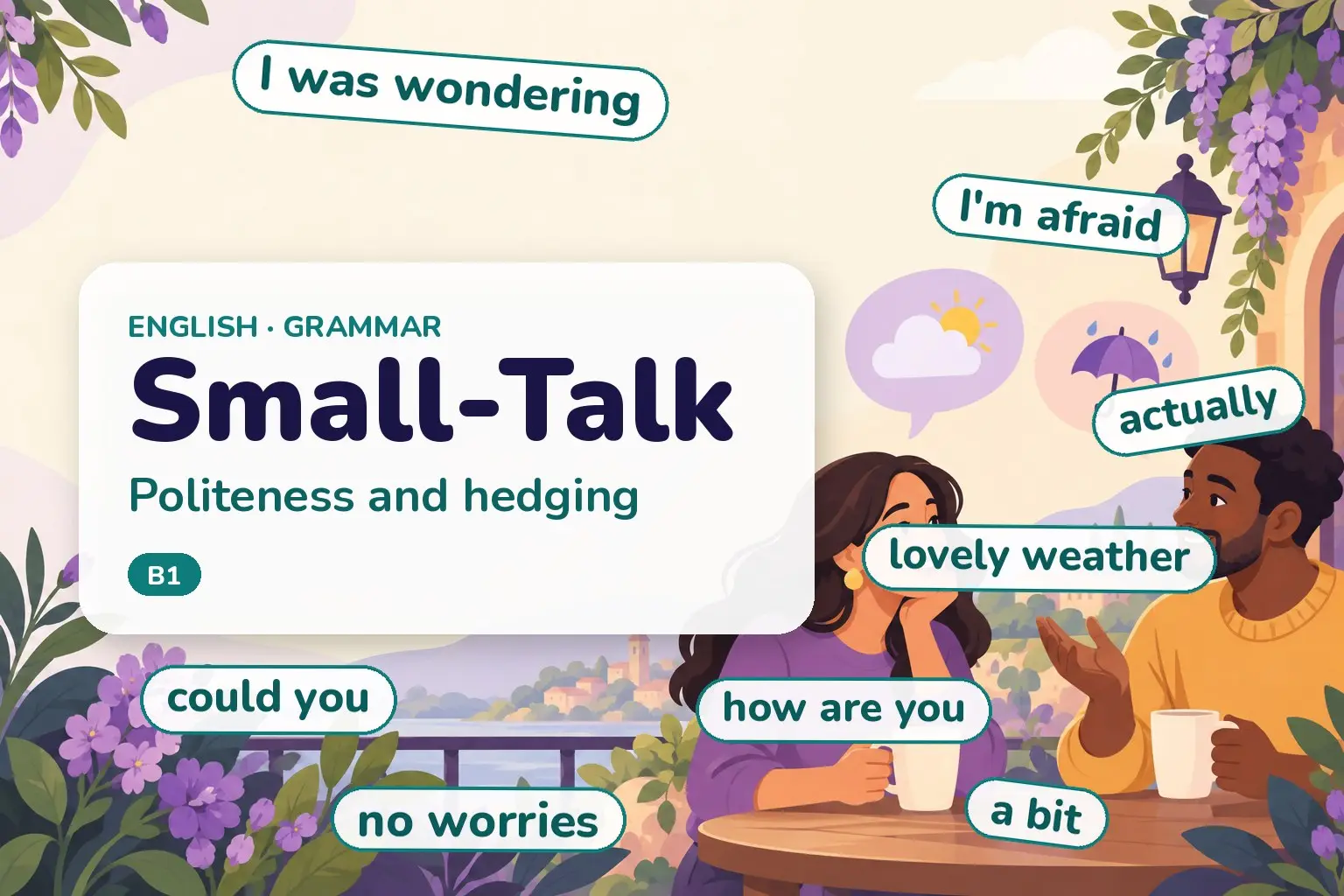
English small-talk fills short social gaps with safe, light topics like the weather, weekends or travel — not deep or personal questions. Politeness often works through indirectness and hedging: 'Could you possibly…', 'I was wondering if…', 'It might be a bit…'. Softer usually sounds more polite.
On this page11 sections · tap to jump
Level: B1. In many English-speaking settings, how you say something matters as much as what you say. Small-talk opens a conversation gently, and politeness often works by being indirect and soft rather than blunt. This lesson shows the safe topics, the hedging words, and the indirect patterns so you sound friendly and considerate, not cold or pushy.
By the end of this page you can…
…start and keep up light small-talk, choose safe topics, soften requests and opinions with hedging, and understand why indirectness often sounds more polite in English.
What small-talk is for
Small-talk is light, friendly talk that fills a short social gap — in a lift, before a meeting, at a bus stop, or when you meet someone new. Its job is social, not informational: it signals I am friendly and I notice you, rather than exchanging real facts. That is why the weather is such a common opener; everyone can join in and no one is put on the spot.
Keep topics safe and shared: the weather, the weekend, the journey, a shared event, food, sport, a TV show. With people you do not know well, it is usually wise to avoid money and salary, age, weight, religion, politics and private family matters.
Politeness through indirectness
English politeness often means saying things in a roundabout way. A direct order (Give me the salt) can sound rude even when it is grammatically perfect. The polite version turns the order into a question and adds softeners: Could you pass the salt, please?
Three patterns do most of the work:
- Requests as questions: Could you…?, Would you mind…?, Do you think you could…?
- Wrapping the request: I was wondering if you could…, Would it be possible to…?
- Softening a ‘no’ or bad news: I’m afraid…, Actually…, Unfortunately…
These patterns connect to grammar you can study on their own pages: polite requests with can and could, indirect questions, and cautious, hedging language.
Hedging: taking off the hard edge
Hedging means adding small words that soften a statement so it does not sound too strong or too certain. Hedging does not make you sound weak — it makes you sound considerate and open to disagreement.
| Instead of (blunt) | Hedged (softer) |
|---|---|
| You are wrong. | I’m not sure that’s quite right. |
| That’s a bad idea. | I’m not sure that would work, to be honest. |
| I want a coffee. | I’d quite like a coffee, actually. |
| This is expensive. | It’s a bit pricey, isn’t it? |
| No. | I’m afraid I can’t, sorry. |
| Help me. | Could you give me a hand, if you have a minute? |
Common hedging words: maybe, perhaps, probably, a bit, kind of, sort of, quite, actually, I think, I’m afraid, it seems, I was wondering.
Understatement and ‘reading between the lines’
English speakers often understate. It’s a bit cold can mean it is freezing; not bad can mean very good; I might be a little late can mean quite late. Replies can also be indirect: That’s an interesting idea or I’ll think about it is sometimes a gentle way of saying no. Listen to tone and context, not just the words.
A short conversation
A: Morning! Bit chilly today, isn’t it? B: It is, yeah. Did you have a good weekend? A: Not bad, thanks. Quiet, mostly. You? B: Lovely, actually — we went walking. Oh, I was wondering, could you possibly send me those notes when you get a minute? A: Of course, no problem. I’ll do it this afternoon. B: Brilliant, thanks so much.
Notice how B wraps the request (I was wondering, could you possibly…) and A keeps the replies short and warm.
Example sentences
Play each line and say it aloud. These are the openers, softeners and replies you will use most.
- Lovely weather today, isn't it?A classic safe small-talk opener.
- Bit cold this morning, isn't it?Understatement plus a question tag invites a reply.
- How are you? — Fine, thanks, and you?The expected short exchange, not a real health update.
- Did you have a good weekend?A safe, friendly topic for colleagues.
- How was your journey over?Small-talk when someone arrives.
- I was wondering if you could help me with something.Wrapping a request to make it polite.
- Could you possibly send me the file?'Possibly' softens the request further.
- Would you mind opening the window?'Would you mind' is a very polite request form.
- Sorry to bother you, but do you have a minute?An apology softens the interruption.
- I'm afraid I can't make it on Friday.'I'm afraid' softens bad news or a refusal.
- Actually, I'm not sure that would work.'Actually' gently signals disagreement.
- It's a bit pricey, to be honest.'A bit' and 'to be honest' hedge a strong opinion.
- That's an interesting idea; I'll think about it.Sometimes a polite, indirect way of saying no.
- It might be a little late by then, maybe.Understatement: 'a little late' can mean quite late.
- No worries, these things happen.A light, reassuring reply to an apology.
- Anyway, I'd better let you get on.A natural way to close a small-talk chat.
- It was really nice chatting to you.A warm way to end a conversation.
- Thanks so much, I really appreciate it.A friendly close after someone helps you.
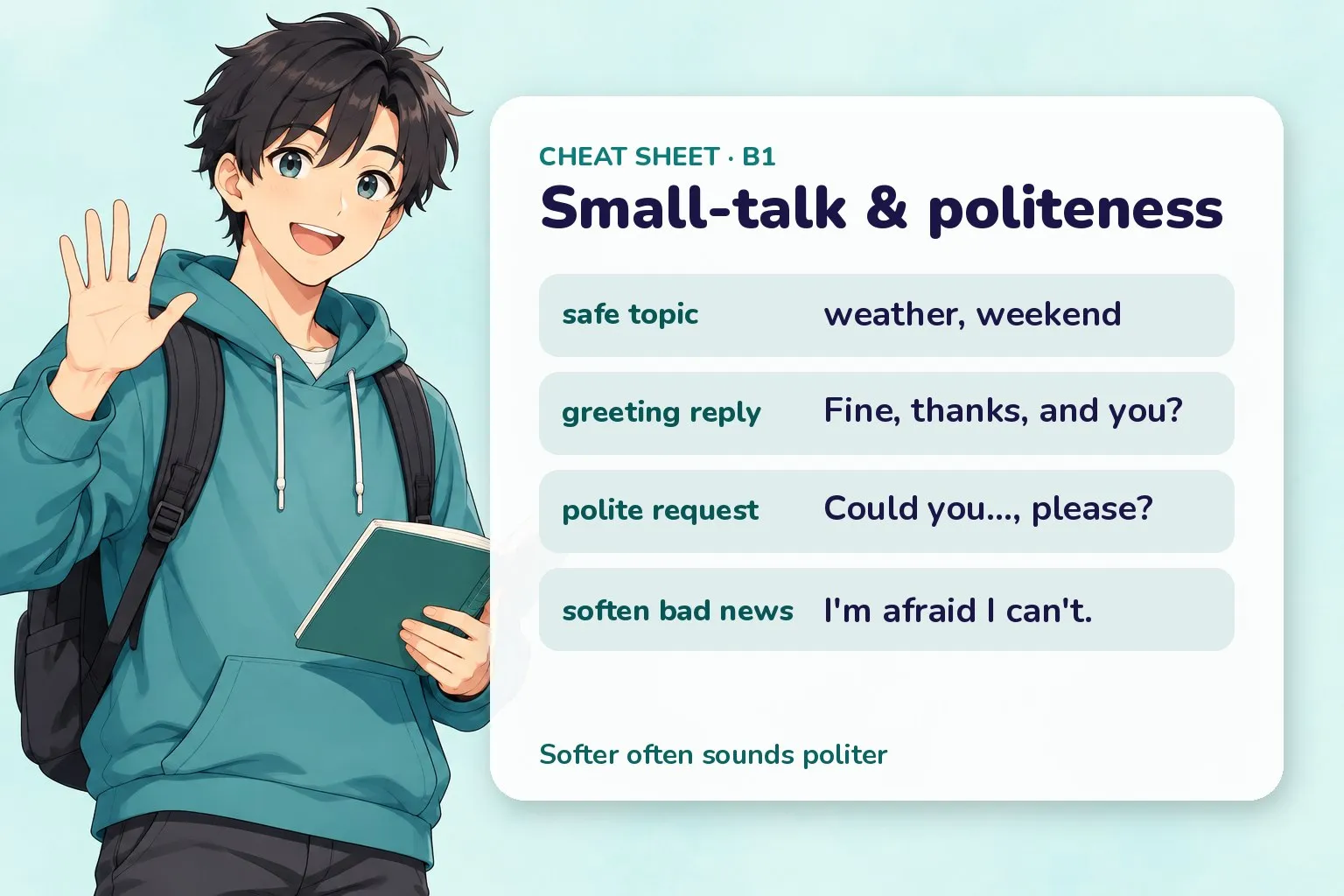
Quick recap before you practise.
Usage notes
- please and thanks do a lot of work: adding please to a request and thanks to a reply covers most everyday politeness.
- question tags invite small-talk: …isn’t it?, …aren’t they? at the end of a comment gently ask the other person to join in.
- sorry is multipurpose: it apologises (Sorry I’m late), interrupts (Sorry, could I ask…), and asks for repetition (Sorry?). Tone tells you which.
- register shifts: with close friends, direct and blunt talk is normal and friendly; the indirect patterns matter most with strangers, customers, and people senior to you. See formal and informal register.
- regional variation exists: politeness norms differ across English-speaking cultures and situations; this lesson gives widely useful patterns, not fixed rules for every place.
Practice
Small-talk and politeness practice
Try each one, then press Check. No sign-up, nothing is sent anywhere — it all runs in your browser.
3 Match the hedging phrase to its job.
- I'm afraid…
- I was wondering…
- a bit
- isn't it?
Show answer
- I'm afraid… → softening bad news
- I was wondering… → wrapping a request
- a bit → softening an opinion
- isn't it? → inviting small-talk
Each softener has a slightly different social job.
Hint: a polite phrase before bad news
Show answer
I'm afraid — 'I'm afraid' (or 'Unfortunately') softens a refusal so it does not sound cold.
6 Put this polite request in order.
Show answer
Could you open the window please — A polite request turns the order into a question and adds 'please'.
Quiz
Small-talk and politeness quiz
12 questions · pick an answer and you'll see straight away if it's right.
-
Show answer
to be social and friendly — Small-talk is social glue; it signals friendliness rather than sharing real information.
-
Show answer
a short, light reply like 'Fine, thanks' — In passing, 'How are you?' is a greeting expecting a brief, light answer.
-
Show answer
Could you pass the salt, please? — A question form plus 'please' softens an order into a polite request.
-
Show answer
softens a statement so it is not too strong — Hedging softens the edge of a statement and sounds considerate, not weak.
-
Show answer
I'm afraid… — 'I'm afraid' gently prepares the listener for a refusal or bad news.
-
Show answer
it is very cold — English speakers often understate; 'a bit cold' can mean quite cold.
-
Show answer
their salary — Money and salary are private; weather, weekends and journeys are safe.
-
Show answer
being too direct can feel blunt without softeners — Politeness in English often needs indirectness and softeners, not just correct grammar.
-
Show answer
a gentle, indirect 'no' — Indirect replies can soften a refusal; listen to tone and context.
-
Show answer
Anyway, I'd better let you get on. — 'I'd better let you get on' is a warm, natural way to end the conversation.
-
Show answer
invites the other person to join in — Tags like 'isn't it?' gently invite a reply and keep small-talk going.
-
Show answer
Could you repeat that? — A short 'Sorry?' with a rising tone asks the speaker to repeat.
Recap cheat-sheet
| Idea | What to do | Example |
|---|---|---|
| safe topics | keep it light and shared | weather, weekend, journey |
| greeting reply | keep it short | Fine, thanks, and you? |
| polite request | question + please | Could you…, please? |
| wrap a big ask | add a soft frame | I was wondering if you could… |
| hedge an opinion | soften strong words | It’s a bit pricey, actually. |
| soften bad news | warn gently | I’m afraid I can’t. |
Next
- Use it to meet people: Small Talk & Networking
- Ready-made polite phrases: English Politeness Phrases
- More openers: English Small-Talk Phrases
- When to be direct or indirect: Formal & Informal Register
- Previous set: English Minimal Pairs Practice
- New here? Start with Start Learning English Here
All English lessons topics
Vocabulary, pronunciation, phrases, practice and exam help, ordered by level. Pick a topic and go straight to it. New lessons go live every day, so topics marked Coming soon fill in over the next weeks.
Lessons
A1 9 topics · 9 ready
A2 14 topics · 14 ready
- 10 English: Describing People
- 11 English: Ordering at a Cafe
- 12 English: Shopping & Prices
- 13 English: Clothing & Sizes
- 14 English: Asking for Directions
- 15 English: Using Public Transport
- 16 English: At the Hotel
- 17 English: Weather & Seasons
- 18 English: Hobbies & Free Time
- 19 English: Daily Routine
- 20 English: Housing & Rooms
- 21 English: Parts of the Body
- 22 English: Emotions & Feelings
- 23 English: Supermarket & Groceries
B1 19 topics · 19 ready
- 24 English: Household Chores
- 25 English: At the Doctor
- 26 English: Making Appointments
- 27 English: Making Plans & Invitations
- 28 English: Phone & Messaging
- 29 English: Expressing Opinions
- 30 English: Talking About Past Experiences
- 31 English: Future Plans & Goals
- 32 English: School & Education
- 33 English: Jobs & Professions
- 34 English: Money & Banking
- 35 English: Restaurant & Dining Out
- 36 English: Travel & the Airport
- 37 English: Sightseeing & Tourism
- 38 English: Emergencies & Safety
- 39 English: Technology & the Internet
- 40 English: Complaints & Solving Problems
- 41 English: Small Talk & Networking
- 42 English Small-Talk & Politeness Culture You are here
B2 11 topics · 11 ready
- 43 English: At the Office
- 44 English: The Job Interview
- 45 English: Formal Writing & Emails
- 46 English: News & Current Affairs
- 47 English: Environment & Nature
- 48 English: Health & Lifestyle
- 49 English: Culture & Traditions
- 50 English: Describing Trends & Data
- 51 English: Storytelling & Narration
- 52 English: Giving a Short Presentation
- 53 Writing Business Emails in English