English: Storytelling & Narration
To narrate well in English you mix tenses on purpose: the past simple carries the main events, the past continuous paints the background, and the past perfect reaches back to what happened earlier. Add sequencing words like 'then', 'suddenly' and 'eventually', and your story flows and keeps the listener hooked.
On this page12 sections · tap to jump
Level: B2. Telling a good story — about your weekend, a trip, a problem at work — is one of the most useful B2 skills, and it comes down to two things: the right mix of past tenses, and clear sequencing. This lesson shows you how the tenses share the work and gives you the connectors that keep a listener following along.
By the end of this page you can…
…set the scene for a story, tell a sequence of past events with the right tenses, link them with narrative connectors, and finish with a clear ending.
The three narrative tenses
Most stories happen in the past, and three tenses divide the job. For the full grammar, see narrative tenses, past continuous vs past simple and the past perfect.
- Past simple — the main events, in order. I woke up, got dressed and left. This is the backbone of every story.
- Past continuous — the background: a longer action already in progress, or the scene around an event. The sun was shining and birds were singing when I set off.
- Past perfect — a step further back: something that had already happened before the main event. When I arrived, the train had already left.
Think of it as layers: the past continuous sets the scene, the past simple moves the plot forward, and the past perfect fills in what came before.
How the tenses share one moment
| Tense | Job in the story | Example |
|---|---|---|
| Past simple | the main event / the next thing | A loud noise woke me. |
| Past continuous | what was going on around it | I was sleeping when the noise woke me. |
| Past perfect | an earlier, already-finished action | I realised I had locked myself out. |
| used to / would | a repeated past habit (scene-setting) | Every summer we would visit my aunt. |
Setting the scene
Don’t start with the first event — start with the situation. A strong opening answers when, where, who and what was happening:
It was a cold Friday evening in late autumn. I was waiting for the last bus, and the street was completely empty. I had had a long week and just wanted to get home.
Notice the tense mix: was waiting and was for the scene, had had for the earlier background. Only after the scene is set does the first past-simple event arrive.
Sequencing: the connectors that carry a story
These linking words tell the listener where they are in the story. Vary them — don’t say and then every time.
- Starting: At first…, To begin with…, It all started when…
- Continuing: Then…, After that…, Next…, A moment later…, Soon…
- Background at the same time: Meanwhile…, As this was happening…, While…
- A sudden turn: Suddenly…, All of a sudden…, Out of nowhere…, Just then…
- Ending: Eventually…, In the end…, Finally…, After all that…
A short narration
It was late and the office was empty. I was finishing a report when the lights suddenly went out. At first I thought it was a power cut, but then I remembered I had seen a notice about maintenance. I grabbed my phone for its torch and felt my way to the door. Eventually, I found the stairs and made it outside. In the end, it turned out the whole building had lost power.
Example sentences
Play each line and listen for which tense does which job.
- It all started on a quiet Sunday morning.An opening line that sets the scene.
- The sun was shining and the market was busy.Past continuous for the background scene.
- I was walking home when I heard a strange noise.Past continuous interrupted by a past-simple event.
- Suddenly, a cat jumped out in front of me.'Suddenly' plus past simple for a sharp turn.
- I had never seen anything like it before.Past perfect for experience up to that point.
- When we arrived, the party had already finished.Past perfect: the earlier action was finished first.
- At first, I didn't know what to do.'At first' introduces the starting reaction.
- Then I remembered what my friend had told me.Past simple event plus past perfect for earlier speech.
- Meanwhile, my brother was looking for the keys.'Meanwhile' for an action happening at the same time.
- After that, things started to go wrong.'After that' moves the sequence forward.
- We used to spend every summer by the sea.'Used to' for a repeated past habit.
- As I was leaving, the phone rang.Background 'was leaving' plus the event 'rang'.
- A moment later, everyone was laughing.A time phrase plus the continuous for a new scene.
- I realised I had left my wallet at home.Past perfect for the earlier, regretted action.
- Out of nowhere, it began to rain.A dramatic phrase for an unexpected event.
- Eventually, we found the right road.'Eventually' signals the story is resolving.
- In the end, everything worked out fine.'In the end' for the final outcome.
- I will never forget that day.A closing line that looks back on the story.
- It was the best trip I had ever taken.Past simple plus past perfect in a final comparison.
- And that is how I met my best friend.A neat, memorable ending line.
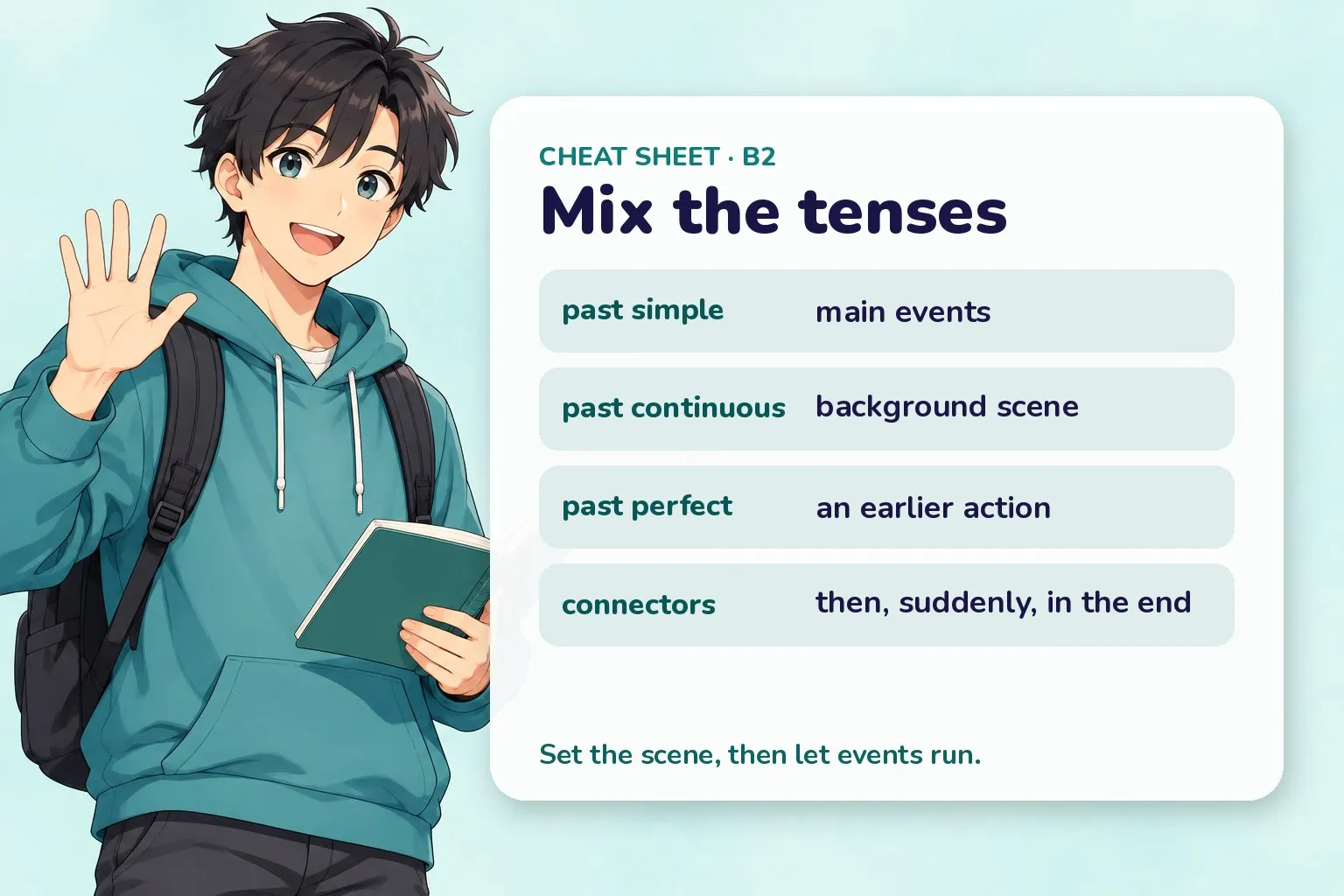
Quick recap before you practise.
Usage notes
- Past perfect only when order matters: if events are already in order, plain past simple is enough. Use the past perfect to show one thing happened before another: The train had left when I arrived.
- used to vs would: both describe past habits, but would is best for repeated actions (we would walk for hours), while used to also covers past states (I used to live there; not I would live there).
- Keep the scene short: one or two background sentences, then start the action. Too much scene-setting loses the listener.
- Direct speech adds life: dropping in a line someone said (He looked at me and said, “You’re late.”) makes a spoken story vivid.
Practice
Storytelling practice
Try each one, then press Check. No sign-up, nothing is sent anywhere — it all runs in your browser.
Hint: forms the past perfect with 'left'
Show answer
had — Past perfect 'had left' shows the train left before I arrived.
Hint: in the ___ = finally
Show answer
end — 'In the end' means finally, after everything.
5 Order the words into a scene-setting sentence.
Show answer
it was raining heavily — Past continuous ('it was raining') paints the background scene.
6 Match each tense to its job in a story.
- past simple
- past continuous
- past perfect
- used to
Show answer
- past simple → main events
- past continuous → background scene
- past perfect → an earlier action
- used to → a past habit
Each narrative tense has a distinct role in telling the story.
How to say it
Narration flows when you reduce the small grammar words — copy the audio.
- had as a helper weakens to “d” in speech: I’d seen it, the train’d gone; say it lightly, not as a stressed word.
- was and were are usually unstressed: I was walking sounds like “I wz walking”.
- used to is said “yoost-to”, with an s sound, not a z.
- Pause slightly before suddenly and in the end — a short pause makes the turn and the ending land.
Quiz
Storytelling quiz
10 questions · pick an answer and you'll see straight away if it's right.
-
Show answer
past simple — The past simple is the backbone: the chain of events in order.
-
Show answer
the background action in progress — Past continuous sets the ongoing scene; 'rang' (past simple) is the event.
-
Show answer
had started — Past perfect 'had started' shows it began before we arrived.
-
Show answer
Eventually — 'Eventually' (like 'in the end' / 'finally') signals the resolution.
-
Show answer
too many events in the past continuous — The continuous is only for background; events should be in the past simple.
-
Show answer
It was a dark, stormy night. — A scene-setter describes the situation, often in the past continuous or 'was'.
-
Show answer
finally, after everything — 'In the end' = finally; 'at the end' points to the end of a thing.
-
Show answer
We used to live by the sea. — 'Used to' + base verb describes a past state or habit: used to live.
-
Show answer
Meanwhile — 'Meanwhile' links an action happening at the same time as another.
-
Show answer
And that is how I met my best friend. — A reflective, specific closing line gives the story a satisfying finish.
Recap cheat-sheet
| Tool | Job | Example |
|---|---|---|
| Past simple | main events in order | I opened the door. |
| Past continuous | background scene | The rain was falling. |
| Past perfect | an earlier action | The bus had gone. |
| Sequencing words | guide the listener | then, suddenly, in the end |
| Strong opening/ending | hook and resolve | It all started… / In the end… |
Next
- Previous lesson: English: Formal vs Informal Register
- New here? Start with Start Learning English Here
All English lessons topics
Vocabulary, pronunciation, phrases, practice and exam help, ordered by level. Pick a topic and go straight to it. New lessons go live every day, so topics marked Coming soon fill in over the next weeks.
Lessons
A1 9 topics · 9 ready
A2 14 topics · 14 ready
- 10 English: Describing People
- 11 English: Ordering at a Cafe
- 12 English: Shopping & Prices
- 13 English: Clothing & Sizes
- 14 English: Asking for Directions
- 15 English: Using Public Transport
- 16 English: At the Hotel
- 17 English: Weather & Seasons
- 18 English: Hobbies & Free Time
- 19 English: Daily Routine
- 20 English: Housing & Rooms
- 21 English: Parts of the Body
- 22 English: Emotions & Feelings
- 23 English: Supermarket & Groceries
B1 19 topics · 19 ready
- 24 English: Household Chores
- 25 English: At the Doctor
- 26 English: Making Appointments
- 27 English: Making Plans & Invitations
- 28 English: Phone & Messaging
- 29 English: Expressing Opinions
- 30 English: Talking About Past Experiences
- 31 English: Future Plans & Goals
- 32 English: School & Education
- 33 English: Jobs & Professions
- 34 English: Money & Banking
- 35 English: Restaurant & Dining Out
- 36 English: Travel & the Airport
- 37 English: Sightseeing & Tourism
- 38 English: Emergencies & Safety
- 39 English: Technology & the Internet
- 40 English: Complaints & Solving Problems
- 41 English: Small Talk & Networking
- 42 English Small-Talk & Politeness Culture
B2 11 topics · 11 ready
- 43 English: At the Office
- 44 English: The Job Interview
- 45 English: Formal Writing & Emails
- 46 English: News & Current Affairs
- 47 English: Environment & Nature
- 48 English: Health & Lifestyle
- 49 English: Culture & Traditions
- 50 English: Describing Trends & Data
- 51 English: Storytelling & Narration You are here
- 52 English: Giving a Short Presentation
- 53 Writing Business Emails in English