Writing Business Emails in English
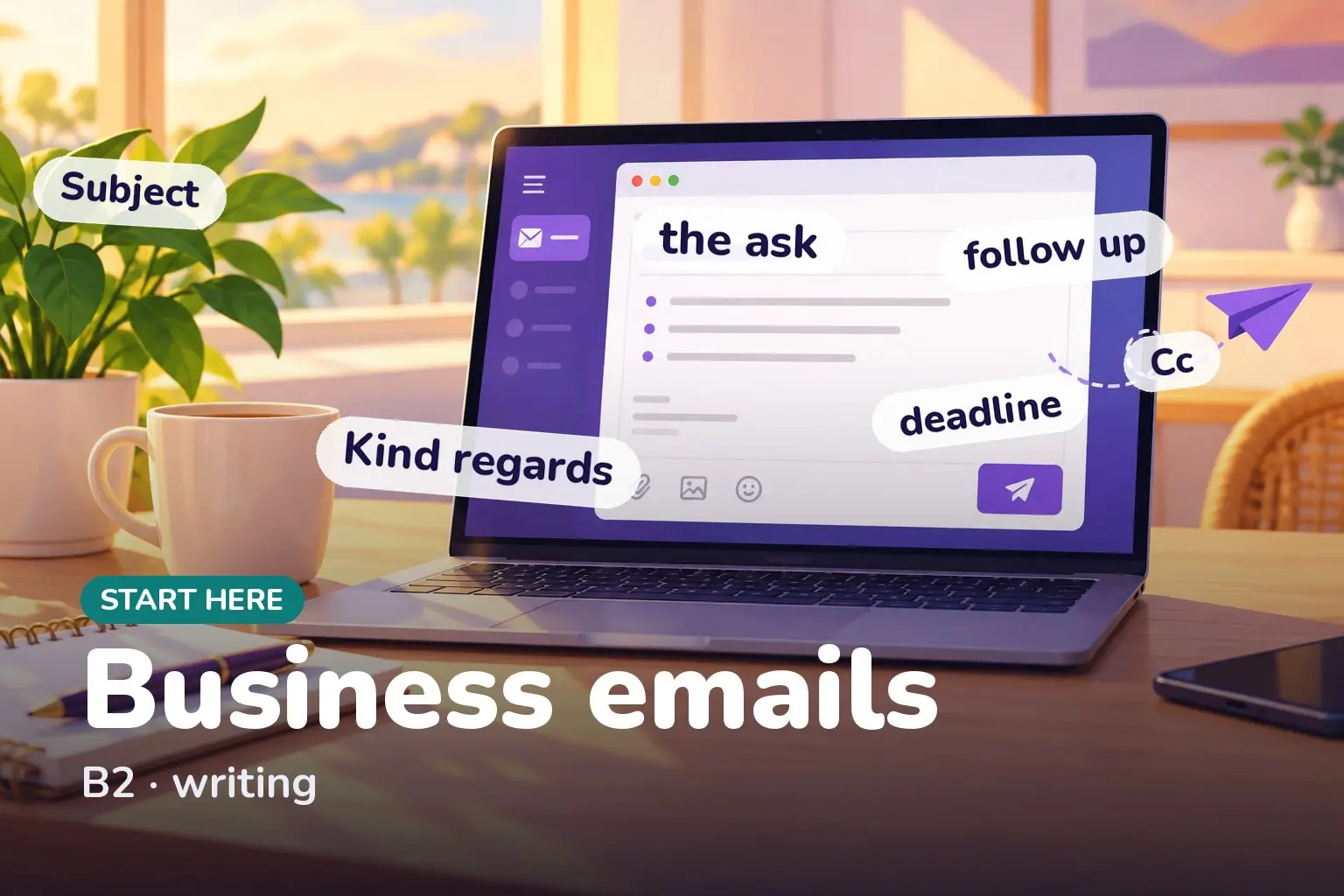
A good business email has a specific subject line, states its purpose in the first sentence, keeps one idea per short paragraph, and ends with a clear action and deadline. Reserve reply-all for the whole group, and always say what you want the reader to do next.
On this page14 sections · tap to jump
- 01By the end of this page you can…
- 02Start with the subject line
- 03The shape of a business email
- 04Useful phrases by job
- 05Following up without nagging
- 06Saying no and giving bad news
- 07CC, BCC and reply-all
- 08Two model emails
- 09Example sentences
- 10Usage notes
- 11Practice
- 12How to say it
- 13Quiz
- 14Recap cheat-sheet
Level: B2. At work, your email is often the only version of you a colleague or client sees. A good business email is not about long, elegant sentences — it is about getting your reader to understand and act quickly. This page gives you the structure, the phrases and the models to do that.
By the end of this page you can…
…write a specific subject line, open with your purpose, make and refuse requests politely, chase a reply, and close with a clear next step — in the right register for the reader.
Start with the subject line
The subject line decides whether your email is opened now, later, or never. Make it specific and action-ready:
- ❌ Hello / Quick question / Important → too vague.
- ✅ Invoice 3382 — payment due 15 May
- ✅ Action needed: approve budget by Thursday
- ✅ Meeting moved to 3pm — Room B
A reader should know the topic and whether they must do something, before they open it.
The shape of a business email
Keep it short and scannable. One idea per paragraph; the key ask near the top.
- Greeting — Hi Sara, / Dear Mr Okafor, (match the relationship).
- Purpose line — why you are writing, in one sentence.
- The ask + deadline — what you need and by when, early and clear.
- Detail — the facts, in bullets if there is more than one.
- Close — a next step, then a sign-off.
Useful phrases by job
| Job | Phrase |
|---|---|
| Open (new) | I am writing to… / I am getting in touch regarding… |
| Open (reply) | Thank you for your email. / Thanks for getting back to me. |
| Reference | With reference to… / Further to our call… |
| Request | Could you please… / Would you be able to… / I would appreciate it if you could… |
| Attach | Please find attached… / I have attached… |
| Follow up | Just following up on… / I wanted to check in on… |
| Chase gently | I appreciate you are busy, but… / A gentle reminder that… |
| Give bad news | Unfortunately, … / I am afraid that… / Regrettably, … |
| Apologise | Apologies for the delay. / I am sorry for any inconvenience. |
| Close | I look forward to hearing from you. / Let me know if you have any questions. |
Following up without nagging
Chasing a silent reader is normal at work. Keep it short, friendly and specific, and reference the original message:
Hi Dan,
Just following up on my email from Monday about the Q3 figures. Do you think you will be able to send them by end of day tomorrow? Happy to help if anything is unclear.
Thanks, Priya
Saying no and giving bad news
Refuse the request, not the person. Lead in gently, give a brief reason, and offer an alternative where you can:
- Unfortunately, we are unable to meet that deadline, but we could deliver by Friday.
- I am afraid the budget does not allow for it this quarter.
- Thank you for thinking of me; I won’t be able to join, but Mia can cover it.
CC, BCC and reply-all
- To: the people who must act.
- Cc: people who should be kept informed but need not reply.
- Bcc: hidden recipients — use it to protect a large list of addresses, not to copy someone secretly into a dispute.
- Reply-all: only when the whole group needs your reply. A “Thanks!” to fifty people is the classic office mistake.
Two model emails
A request to a client (formal):
Subject: Proposal for the Meridian project — review by 12 June
Dear Ms Adeyemi,
Thank you for your time on Tuesday. I am writing to send the proposal we discussed; please find it attached.
Could you let me know your feedback by 12 June, so we can confirm the timeline? I am happy to arrange a short call if that is easier.
Kind regards, Tomás Herrera
A quick note to a colleague (neutral):
Subject: Can you approve the leave request today?
Hi Nadia,
Quick one — could you approve my leave request in the system today? It needs sign-off before the payroll cut-off at 5pm.
Thanks a lot, Lukas
Example sentences
Press play and copy the rhythm — these are the lines you will reuse across many emails.
- I am writing to confirm the details of our order.A clear purpose opener for a new email.
- Thank you for getting back to me so quickly.A warm opening when replying.
- With reference to your email of 3 May, …Pointing back to an earlier message.
- Could you please send me the updated figures?A short, polite request.
- Would you be able to join a call on Thursday?A softened request with a time.
- Please find attached the signed contract.The fixed phrase for an attachment.
- Just following up on my email from Monday.A neutral, friendly chase.
- I appreciate you are busy, but the deadline is tomorrow.A gentle reminder with a reason.
- Unfortunately, we are unable to meet that date.Giving bad news gently.
- I am afraid the budget does not allow for it this quarter.Refusing with a brief reason.
- Apologies for the delay in replying.A short, professional apology.
- Please let me know if you have any questions.An open, helpful close.
- I look forward to hearing from you.A standard closing line.
- Let's touch base early next week.Suggesting a follow-up, informal register.
- Could you keep Sam in the loop on this?Asking to cc or inform a colleague.
- As discussed, I will send the draft by Friday.Confirming an action you will take.
- Could you please confirm receipt of this email?Asking the reader to acknowledge it.
- Thanks in advance for your help with this.A polite pre-thanks, common at work.
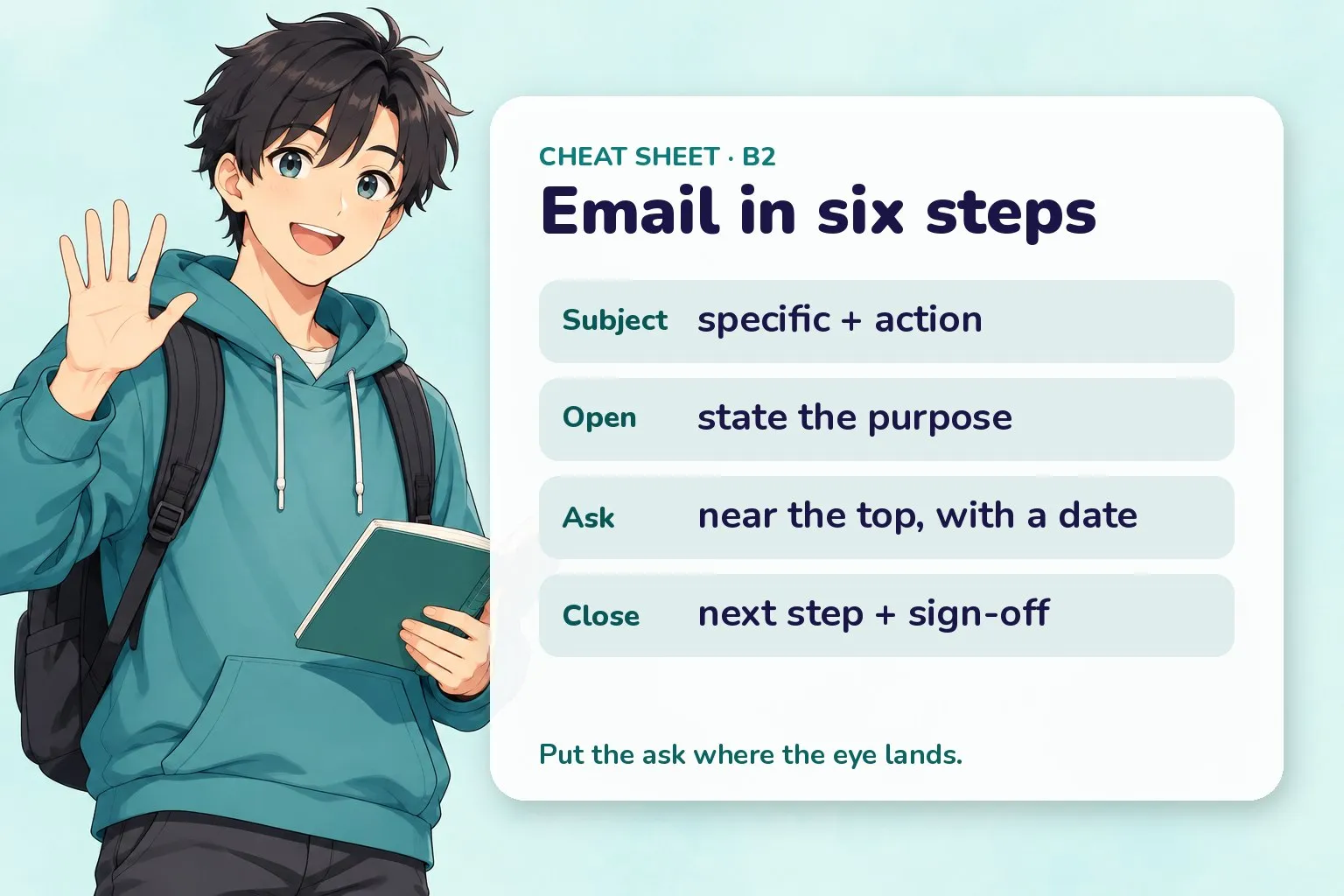
Quick recap before you practise.
Usage notes
- Hi vs Dear: Hi [name] is now standard in most internal and many external business emails; keep Dear Mr/Ms [surname] for first contact, clients and formal matters.
- Contractions: fine in a neutral, friendly email (I’ll send it); avoid them in formal letters and complaints.
- “touch base” / “circle back” / “in the loop”: common office idioms — natural with colleagues, but plain verbs (meet, reply, inform) are clearer for international readers.
- urgency: mark it in the subject line (Action needed by…), not by typing in capitals or adding five exclamation marks.
- one topic per email: if you have three unrelated asks, three short emails often get three faster replies than one long one.
Practice
Business email practice
Try each one, then press Check. No sign-up, nothing is sent anywhere — it all runs in your browser.
Hint: a neutral two-word phrase: just ___ up
Show answer
following — 'Just following up on…' is a neutral, non-blaming reminder.
4 Put the words in order to make a polite request.
Show answer
could you please send me the figures? — A standard polite request: Could you please + verb.
5 Match each email field to its correct use.
- To
- Cc
- Bcc
- Reply-all
Show answer
- To → people who must act
- Cc → people kept informed
- Bcc → hidden / protected addresses
- Reply-all → the whole group needs it
Choosing the right field keeps inboxes tidy and avoids the reply-all mistake.
Hint: a one-word lead-in to bad news
Show answer
unfortunately — 'Unfortunately,' softens the refusal before the fact.
How to say it
A few of these words are read aloud in meetings and calls — copy the sounds.
- colleague is said KOL-eeg, with a hard g and no extra syllable at the end.
- schedule is SHED-yool (British) or SKED-jool (American) — both are correct.
- apologies has four beats, stress on the second: uh-POL-uh-jeez.
- receipt is said ri-SEET — the p is silent.
Quiz
Business email quiz
11 questions · pick an answer and you'll see straight away if it's right.
-
Show answer
It is specific and shows if action is needed — A specific, action-ready subject line gets opened and acted on.
-
Show answer
I am writing to confirm the details of our order. — 'I am writing to…' tells the reader why the email exists.
-
Show answer
Just following up on my email from Monday. — A neutral, specific follow-up gets a faster, warmer reply than blame.
-
Show answer
Could you please send me the report by Friday? — 'Could you please… by [deadline]' is polite and specific.
-
Show answer
Cc — Cc keeps people in the loop without expecting a reply.
-
Show answer
Refuse the request, not the person, and offer an alternative — Lead in gently, give a brief reason, and suggest an alternative where possible.
-
Show answer
Unfortunately, we are unable to meet that date. — 'Unfortunately, …' softens the message before the fact.
-
Show answer
Near the top, after the purpose — Readers skim the top; put the ask and its deadline early.
-
Show answer
For a known colleague or many routine external emails — 'Hi [name]' is now standard for most internal and many external emails; save 'Dear Mr/Ms' for formal first contact.
-
Show answer
Say it in the subject line, e.g. 'Action needed by Thursday' — A clear subject line signals urgency without shouting.
-
Show answer
A clear next step and a sign-off — Close with the action you want and a suitable sign-off.
Recap cheat-sheet
| Part | Do this | Example |
|---|---|---|
| Subject | specific + action | Approve budget by Thursday |
| Open | state the purpose | I am writing to… |
| Ask | near the top, with a deadline | Could you reply by Friday? |
| Follow up | neutral, reference the email | Just following up on… |
| Bad news | soften, give a reason | Unfortunately, we are unable to… |
| Fields | To act / Cc inform / reply-all sparingly | — |
| Close | next step + sign-off | I look forward to hearing from you. |
Next
- Previous in this set: English Numbers, Dates & Money
- The register rules behind it: English: Formal Writing & Emails
- Polite request grammar: Requests with can / could
- For a neutral, professional tone: Hedging & cautious language
- Next in this set: English Exams: Which One & How to Prepare
- New here? Start with Start Learning English Here
All English lessons topics
Vocabulary, pronunciation, phrases, practice and exam help, ordered by level. Pick a topic and go straight to it. New lessons go live every day, so topics marked Coming soon fill in over the next weeks.
Lessons
A1 9 topics · 9 ready
A2 14 topics · 14 ready
- 10 English: Describing People
- 11 English: Ordering at a Cafe
- 12 English: Shopping & Prices
- 13 English: Clothing & Sizes
- 14 English: Asking for Directions
- 15 English: Using Public Transport
- 16 English: At the Hotel
- 17 English: Weather & Seasons
- 18 English: Hobbies & Free Time
- 19 English: Daily Routine
- 20 English: Housing & Rooms
- 21 English: Parts of the Body
- 22 English: Emotions & Feelings
- 23 English: Supermarket & Groceries
B1 19 topics · 19 ready
- 24 English: Household Chores
- 25 English: At the Doctor
- 26 English: Making Appointments
- 27 English: Making Plans & Invitations
- 28 English: Phone & Messaging
- 29 English: Expressing Opinions
- 30 English: Talking About Past Experiences
- 31 English: Future Plans & Goals
- 32 English: School & Education
- 33 English: Jobs & Professions
- 34 English: Money & Banking
- 35 English: Restaurant & Dining Out
- 36 English: Travel & the Airport
- 37 English: Sightseeing & Tourism
- 38 English: Emergencies & Safety
- 39 English: Technology & the Internet
- 40 English: Complaints & Solving Problems
- 41 English: Small Talk & Networking
- 42 English Small-Talk & Politeness Culture
B2 11 topics · 11 ready
- 43 English: At the Office
- 44 English: The Job Interview
- 45 English: Formal Writing & Emails
- 46 English: News & Current Affairs
- 47 English: Environment & Nature
- 48 English: Health & Lifestyle
- 49 English: Culture & Traditions
- 50 English: Describing Trends & Data
- 51 English: Storytelling & Narration
- 52 English: Giving a Short Presentation
- 53 Writing Business Emails in English You are here