English: Money & Banking
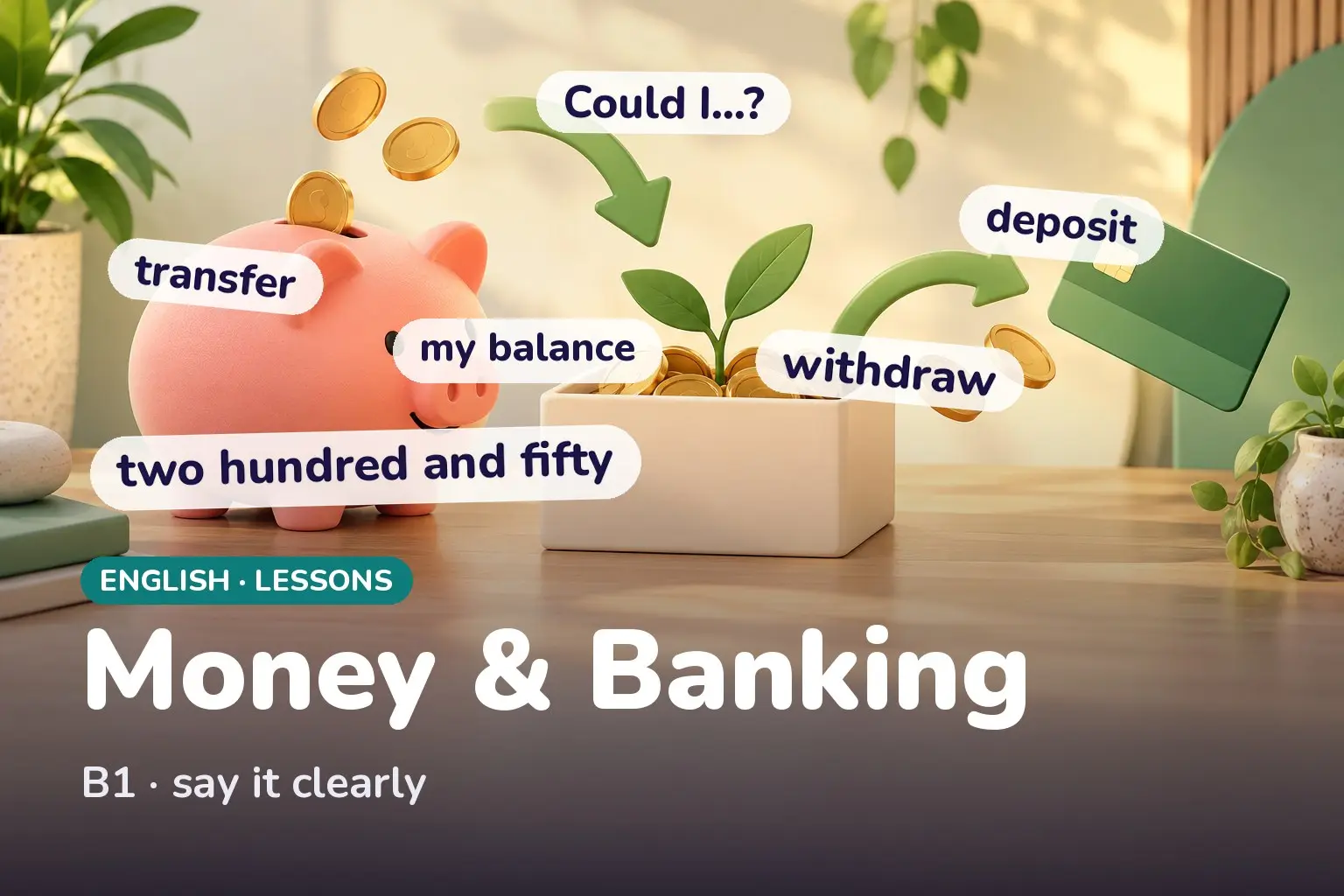
To handle money in English, learn the core words (account, deposit, withdraw, transfer, balance), ask politely with 'I'd like to…' or 'Could I…?', and practise reading numbers aloud, since prices and amounts are the part learners mishear most.
Level: B1. Money talk in English rests on a small set of verbs and nouns plus one real skill: reading numbers aloud. This lesson teaches the banking words you need, the polite phrases for a counter or a call, and how to say big amounts clearly. It is about the language — not about which account or product to choose.
By the end of this page you can…
…use the core banking words, ask for a service politely at a bank, understand a short bank dialogue, and read prices and large numbers aloud with confidence.
The core verbs: in, out, across
Most banking language turns on three verbs that describe where money goes:
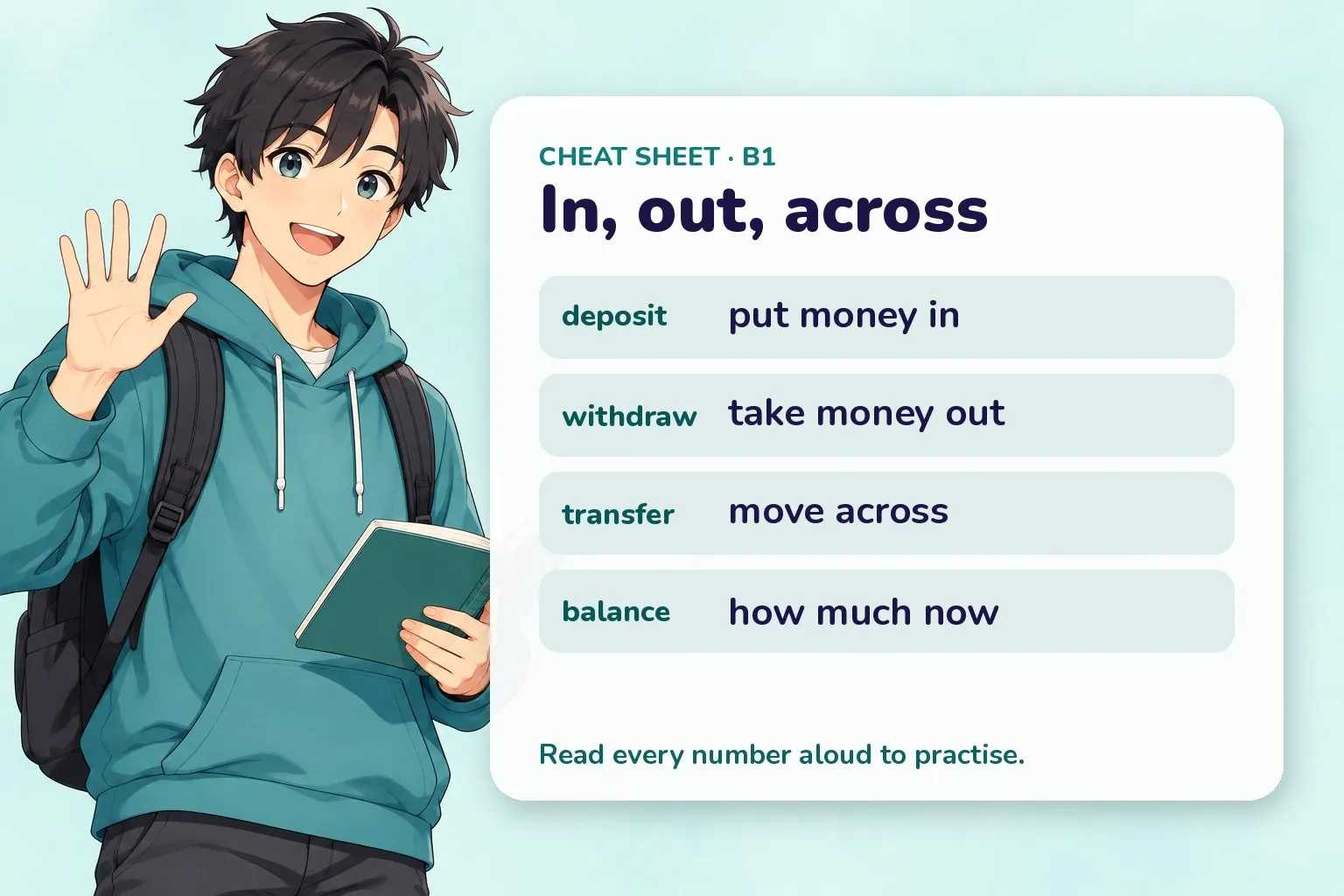
- deposit — to put money into an account. (I’d like to deposit some cash.)
- withdraw — to take money out. (I need to withdraw fifty pounds.)
- transfer — to move money between accounts. (Could I transfer money to my savings?)
Two everyday extras complete the set: pay in (an informal version of deposit) and take out (informal for withdraw).
The core nouns
| English | What it means |
|---|---|
| account | where your money is kept at a bank |
| balance | how much is in the account right now |
| statement | the list of money in and out over a period |
| deposit | money you put in (also the verb) |
| withdrawal | money you take out |
| transfer | money moved between accounts |
| fee / charge | money the bank takes for a service |
| interest | extra money an account earns or a loan costs |
Polite phrases at the bank
A bank counter works like any service situation: open with a soft request, not a command.
- I’d like to open an account.
- Could I withdraw some cash, please?
- I’d like to transfer money to another account.
- Could you check my balance, please?
- Is there a fee for this?
If you do not understand an amount or an instruction, ask the clerk to repeat it: Sorry, could you say that again? or Could you write that down for me?
Reading numbers aloud
This is the part learners find hardest, because prices and amounts come fast. Three rules cover most cases.
- Group large numbers: read them in thousands and hundreds. 1,250 is one thousand, two hundred and fifty.
- Hundred and thousand stay singular after a number: two hundred, not two hundreds; three thousand, not three thousands.
- Say the currency naturally: £20 is twenty pounds; $5.50 is five dollars fifty or five fifty; €99 is ninety-nine euros.
A short conversation
Clerk: Good morning. How can I help you? Customer: Hi, I’d like to withdraw some cash, please. Clerk: Of course. How much would you like to take out? Customer: A hundred and fifty, please. And could you check my balance too? Clerk: Certainly. Your balance is just over two thousand. Anything else? Customer: No, that’s all. Thank you very much.
Example sentences
Press play and copy the rhythm. Read every number out loud — that is the real practice here.
- I'd like to open an account, please.A polite request to start a new account.
- Could I deposit some cash?Deposit means put money in.
- I need to withdraw fifty pounds.Withdraw means take money out.
- Could I transfer money to my savings account?Transfer moves money between accounts.
- Could you check my balance, please?The balance is how much you have now.
- I'd like a statement for last month.A statement lists money in and out.
- Is there a fee for this service?A fee is what the bank charges.
- How much would you like to withdraw?A question the clerk may ask you.
- The balance is just over two thousand.Reading a rounded large number.
- That comes to twelve pounds fifty.Saying a price with pence.
- It costs ninety-nine ninety-nine.A common way to read a .99 price.
- Could I pay by card?Asking about the payment method.
- Do you take contactless?Asking about tap-to-pay.
- I'd like to pay in cash.Choosing to pay with notes and coins.
- My card has been declined.When a payment does not go through.
- Could you say that again, please?Asking the clerk to repeat an amount.
- Here's two hundred and fifty.Hundred stays singular after a number.
- The total is one thousand, three hundred.Grouping a number in thousands and hundreds.
- Can I set up a transfer online?Asking about doing it yourself online.
- Thank you, that's everything.A polite way to end at the counter.
Quick recap before you practise.
Usage notes
- cash vs card: cash means physical notes and coins; by card means paying with a bank card. Contactless is tapping the card or phone.
- cheque / check: the paper payment is spelled cheque in British English and check in American English — same word, same meaning.
- ATM / cashpoint: the machine that gives out cash is an ATM (international) or a cashpoint (British); both are understood.
- pence and cents: small coins are pence in the UK (fifty pence, often fifty p) and cents in the US; prices are usually read without the word, as in twelve fifty.
Practice
Money and banking practice
Try each one, then press Check. No sign-up, nothing is sent anywhere — it all runs in your browser.
Hint: it stays singular after a number
Show answer
hundred — Say 'two hundred', not 'two hundreds' — it is singular after a number.
4 Put the words in order to make a polite request.
Show answer
I'd like to withdraw some cash please — Open with 'I'd like to…' plus the action and 'please'.
5 Match each banking word to its meaning.
- deposit
- withdraw
- transfer
- fee
Show answer
- deposit → put money in
- withdraw → take money out
- transfer → move between accounts
- fee → a charge for a service
These are the core money verbs and one key noun.
Hint: the verb for looking something up
Show answer
check — 'Could you check my balance?' is the polite way to ask at the counter.
How to say it
A few money words trip up English learners — copy the sounds, not the spelling.
- withdraw has the stress on the second part: with-DRAW, and the th is the soft one as in this.
- balance stresses the first part: BAL-uhns, two beats.
- receipt has a silent p: say ri-SEET.
- euro is two beats: YOO-roh, not eh-oo-roh.
Quiz
Money and banking quiz
8 questions · pick an answer and you'll see straight away if it's right.
-
Show answer
take money out — Withdraw means take money out; deposit means put it in.
-
Show answer
one thousand, two hundred and fifty — Group it in thousands and hundreds: one thousand, two hundred and fifty.
-
Show answer
statement — A statement is the list; a balance is a single current number.
-
Show answer
Could I withdraw some cash, please? — Open with 'Could I…?' plus 'please', as in any service situation.
-
Show answer
Here's two hundred and fifty. — 'Hundred' stays singular after a number: two hundred and fifty.
-
Show answer
the payment did not go through — Declined means the payment was refused and did not go through.
-
Show answer
money the bank charges for a service — A fee (or charge) is what the bank takes for a service.
-
Show answer
transfer — Transfer moves money from one account to another.
Recap cheat-sheet
| Idea | Word / pattern | Example |
|---|---|---|
| Put money in | deposit / pay in | I’d like to deposit some cash. |
| Take money out | withdraw / take out | I need to withdraw fifty pounds. |
| Move it across | transfer | Could I transfer money to my savings? |
| Current amount | balance | Could you check my balance? |
| List over time | statement | I’d like a statement for last month. |
| Big numbers | group + singular hundred/thousand | one thousand, two hundred and fifty |
Next
- Previous lesson: English: Formal Writing & Emails
- Next lesson: English: Restaurant & Dining Out
- Brush up first: English: Numbers 0 to 100
All English lessons topics
Vocabulary, pronunciation, phrases, practice and exam help, ordered by level. Pick a topic and go straight to it. New lessons go live every day, so topics marked Coming soon fill in over the next weeks.
Lessons
A1 9 topics · 9 ready
A2 14 topics · 14 ready
- 10 English: Describing People
- 11 English: Ordering at a Cafe
- 12 English: Shopping & Prices
- 13 English: Clothing & Sizes
- 14 English: Asking for Directions
- 15 English: Using Public Transport
- 16 English: At the Hotel
- 17 English: Weather & Seasons
- 18 English: Hobbies & Free Time
- 19 English: Daily Routine
- 20 English: Housing & Rooms
- 21 English: Parts of the Body
- 22 English: Emotions & Feelings
- 23 English: Supermarket & Groceries
B1 19 topics · 19 ready
- 24 English: Household Chores
- 25 English: At the Doctor
- 26 English: Making Appointments
- 27 English: Making Plans & Invitations
- 28 English: Phone & Messaging
- 29 English: Expressing Opinions
- 30 English: Talking About Past Experiences
- 31 English: Future Plans & Goals
- 32 English: School & Education
- 33 English: Jobs & Professions
- 34 English: Money & Banking You are here
- 35 English: Restaurant & Dining Out
- 36 English: Travel & the Airport
- 37 English: Sightseeing & Tourism
- 38 English: Emergencies & Safety
- 39 English: Technology & the Internet
- 40 English: Complaints & Solving Problems
- 41 English: Small Talk & Networking
- 42 English Small-Talk & Politeness Culture
B2 11 topics · 11 ready
- 43 English: At the Office
- 44 English: The Job Interview
- 45 English: Formal Writing & Emails
- 46 English: News & Current Affairs
- 47 English: Environment & Nature
- 48 English: Health & Lifestyle
- 49 English: Culture & Traditions
- 50 English: Describing Trends & Data
- 51 English: Storytelling & Narration
- 52 English: Giving a Short Presentation
- 53 Writing Business Emails in English