English: At the Office
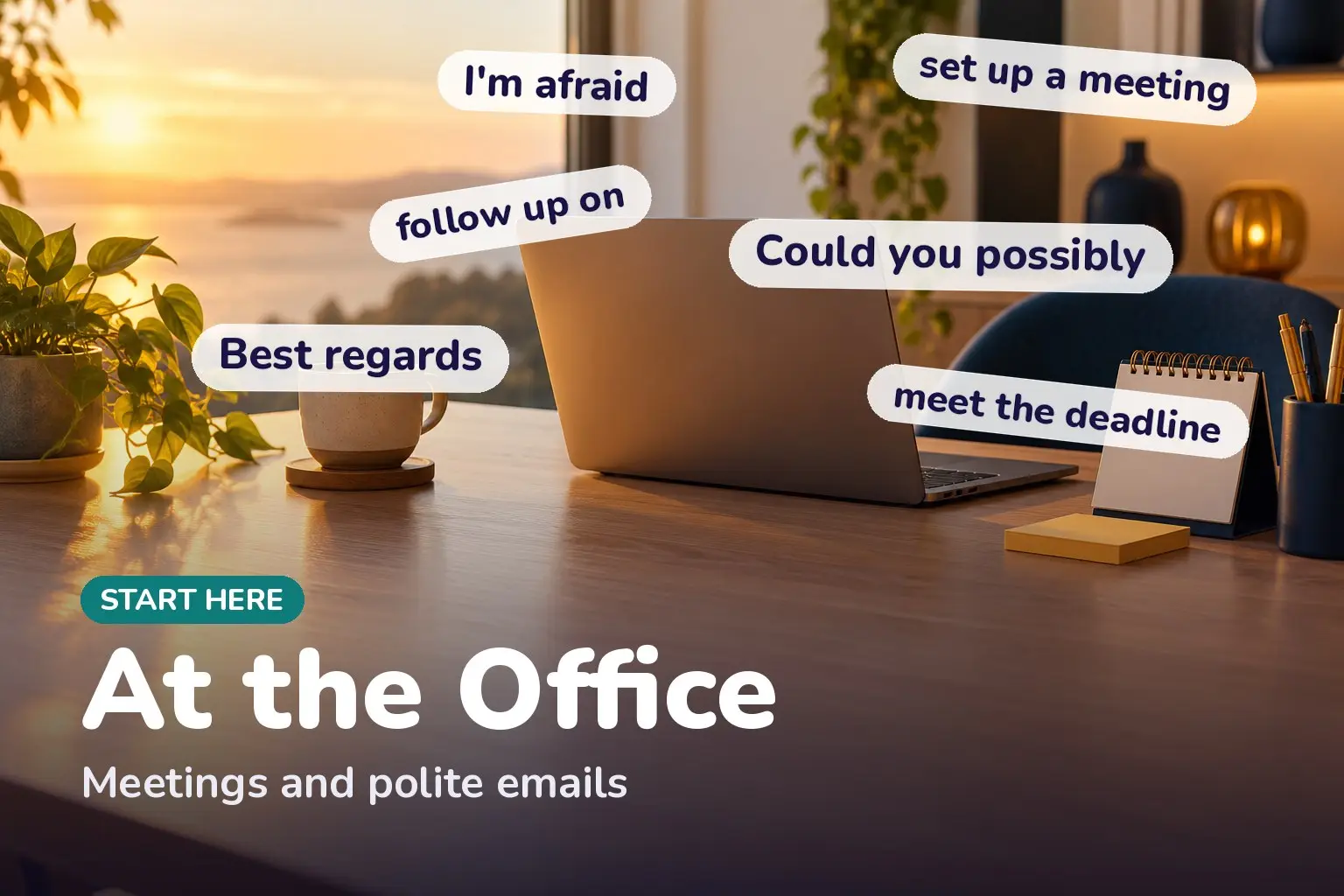
Office English runs on indirect, polite phrasing. Soften requests with 'Could you possibly …?', chase work with 'Just following up on …', and frame emails with 'I hope this email finds you well' and 'Best regards'. Learn the meeting and project words too.
Level: B2. At work, what you say matters less than how you say it. This lesson gives you the vocabulary of meetings, projects and deadlines, and — more importantly — the indirect, polite phrasing that makes office English sound professional rather than blunt.
By the end of this page you can…
…talk about meetings, deadlines and projects; write a clear, polite email with the right opening and sign-off; make and respond to requests indirectly; and judge how formal to be in a given situation.
Why office English is indirect
In professional English, a direct order sounds rude even when you have every right to ask. Compare:
- ❌ Send me the report. (an order — fine only between close colleagues)
- ✅ Could you send me the report when you get a chance?
- ✅ Would you mind sending me the report?
The trick is to wrap the request in a question and add a softener: possibly, when you get a chance, if that’s okay. This is not weakness — it is the normal register of the workplace, and skipping it marks you as abrupt.
Meetings and projects
| Word / phrase | What it means |
|---|---|
| set up / arrange a meeting | organise a time to meet |
| agenda | the list of points to discuss |
| chair / run a meeting | lead it |
| minutes | the written record of a meeting |
| deadline | the date something is due |
| deliverable | a finished item you must produce |
| get in touch / follow up | contact someone again |
| touch base | check in briefly (informal) |
Projects have their own verbs: you kick off (start) a project, keep on track (keep to schedule), fall behind (be late), and meet or miss a deadline. You report to your manager and cc (copy) people into an email.
Email openings and sign-offs
Emails run on fixed frames. Learn each as a whole chunk:
- Openings: I hope this email finds you well. / I hope you had a good weekend. / Thank you for your email.
- Reason: I’m writing to ask about … / I wanted to follow up on … / Just a quick note to …
- Requests: Could you possibly …? / Would it be possible to …? / I’d be grateful if you could …
- Sign-offs: Best regards, / Kind regards, / Many thanks, (formal) · Cheers, / Best, (informal).
Chasing and softening
Two situations come up constantly: chasing late work and giving bad news. Both need softening.
- Chasing: Just following up on my last email … / I was wondering if you’d had a chance to look at … / Sorry to chase, but …
- Declining / bad news: I’m afraid we won’t be able to … / Unfortunately, there’s been a delay. / I’m not sure that will be possible, but let me check.
Example sentences
Press play and copy the rhythm. These are the exact phrases you will use at work.
- Could you possibly send me the figures by Friday?A softened request with possibly.
- Would it be possible to move the meeting to three o'clock?A very polite way to propose a change.
- I'm writing to follow up on our last conversation.A standard email reason.
- I hope this email finds you well.A safe, formal opening line.
- Thanks for getting back to me so quickly.Acknowledging a fast reply.
- Let's set up a meeting for next week.Set up a meeting means arrange it.
- Can you send round the agenda beforehand?The agenda lists what to discuss.
- I'll take the minutes if you like.Take the minutes means record the meeting.
- We need to meet the deadline on this one.Meet a deadline, not win it.
- I'm afraid we've fallen a little behind.Fall behind means be late on schedule.
- Could we touch base on Monday?Touch base is informal for a quick check-in.
- I've cc'd Sarah in on this email.Cc means copy someone into an email.
- Just a quick note to confirm the time.A short, friendly email opener.
- I'd be grateful if you could review the draft.A formal, polite request.
- Sorry to chase, but do you have an update?A polite way to ask about late work.
- Unfortunately, there's been a slight delay.Softening bad news with unfortunately.
- I'll get back to you by the end of the day.Get back to you means reply later.
- Let me know if that works for you.Checking a suggestion is acceptable.
- I'm afraid I can't make the two o'clock call.A polite way to decline a meeting.
- Thanks in advance for your help.A common, friendly email closer.
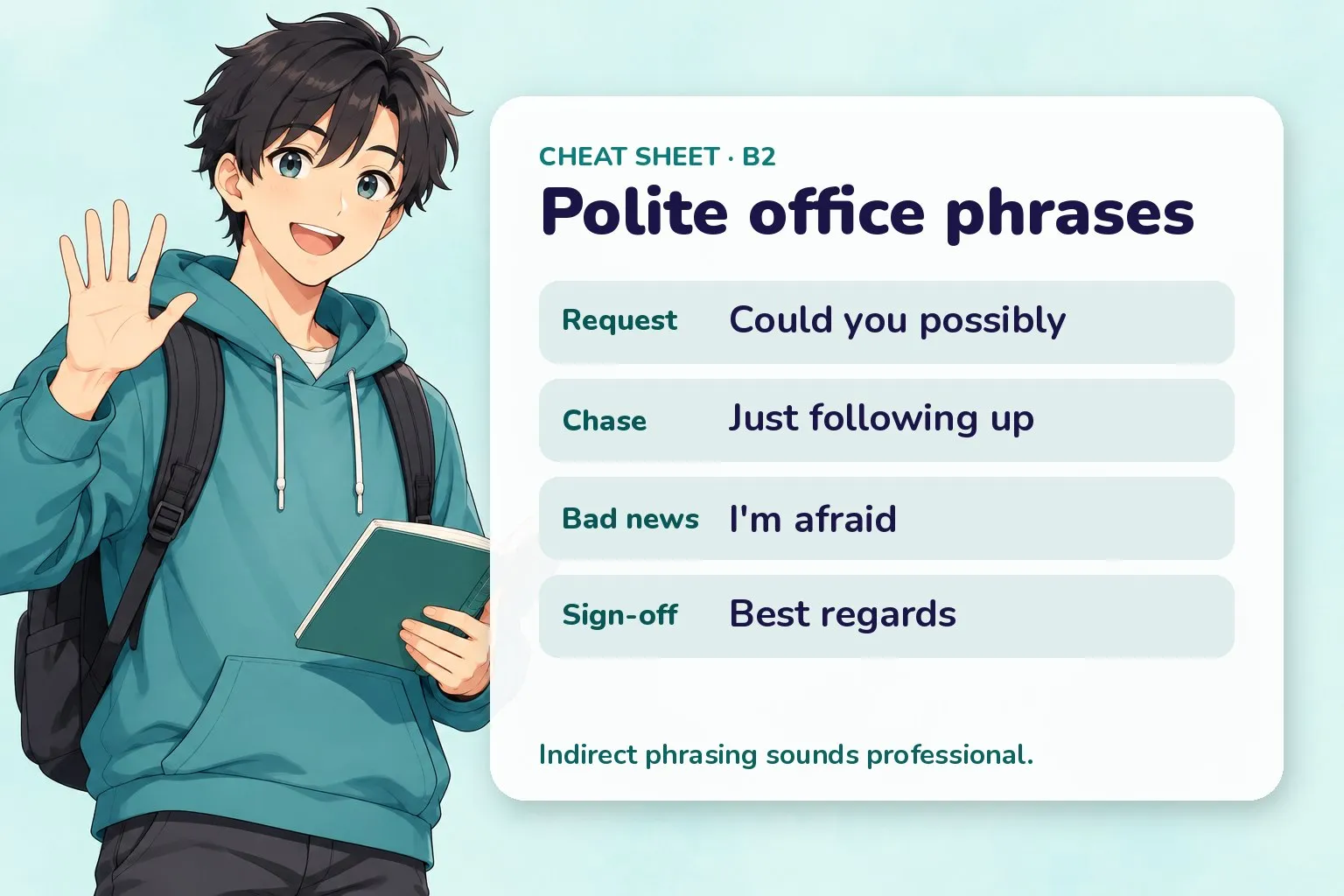
Quick recap before you practise.
A short conversation
Manager: Morning, Dan. Have you had a chance to look at the client report? Dan: Not yet, I’m afraid — I’ve been tied up with the budget. Could I get it to you by this afternoon? Manager: That works. Would you mind cc’ing me when you send it to them? Dan: Of course. I’ll follow up with the client as well, just to confirm the deadline. Manager: Perfect. Thanks, Dan.
Quick recap before the quiz.
Usage notes
- I’m afraid softens, it doesn’t mean fear: I’m afraid I can’t simply flags bad news politely.
- would you mind + -ing: the answer is back-to-front — Would you mind sending it? → Not at all (meaning yes, I’ll do it).
- ASAP sounds pushy: prefer when you get a chance or by end of day unless something is genuinely urgent.
- cc / bcc: cc copies someone visibly; bcc copies them without the others seeing. Both are used as verbs: I’ll cc you.
- touch base, circle back, reach out are common office idioms but stay informal — keep them out of formal client emails.
Practice
At the office practice
Try each one, then press Check. No sign-up, nothing is sent anywhere — it all runs in your browser.
Hint: a standard formal greeting
Show answer
well — I hope this email finds you well is a fixed, safe opening.
Hint: follow ___ means contact again
Show answer
up — Follow up means to contact someone again about something.
4 Put the words in order to make a polite request.
Show answer
Would it be possible to move the meeting? — Would it be possible to …? is a very polite request frame.
5 Match each office word to its meaning.
- agenda
- minutes
- deadline
- cc
Show answer
- agenda → list of points to discuss
- minutes → written record of a meeting
- deadline → the date work is due
- cc → copy someone into an email
These are the core meeting and email terms.
How to say it
A few office words trip up English learners. Copy the audio rather than the spelling.
- colleague stresses the first part: KOL-eeg, with a hard g.
- agenda stresses the middle: uh-JEN-duh, with a soft g.
- schedule is SHED-yool (British) or SKED-jool (American) — both are standard.
- deadline is a compound with the stress on the first part: DED-line.
Quiz
At the office quiz
10 questions · pick an answer and you'll see straight away if it's right.
-
Show answer
Could you possibly give me a hand with this? — Could you possibly …? wraps the request in a polite question.
-
Show answer
the list of points to discuss — The agenda lists what will be discussed; the minutes record what was said.
-
Show answer
meet — You meet a deadline; the opposite is miss a deadline.
-
Show answer
I hope this email finds you well. — I hope this email finds you well is a standard formal opener.
-
Show answer
copy someone into the email — To cc someone is to copy them into an email so they can see it.
-
Show answer
I'm afraid there's been a delay. — I'm afraid softens bad news politely.
-
Show answer
Cheers, — Cheers is friendly and informal; keep it for people you know.
-
Show answer
Not at all. — Would you mind …? is answered back-to-front: Not at all means I'll do it gladly.
-
Show answer
kick off — You kick off (start) a project.
-
Show answer
Let's circle back on this. — Circle back is office slang; keep it out of formal client emails.
Recap cheat-sheet
| Idea | Pattern | Example |
|---|---|---|
| Soften a request | Could you possibly …? | Could you possibly send it over? |
| Very polite ask | Would it be possible to …? | Would it be possible to meet? |
| Email opening | I hope this email finds you well | — |
| Chase late work | Just following up on … | Just following up on my email. |
| Give bad news | I’m afraid … / Unfortunately … | I’m afraid there’s a delay. |
| Safe sign-off | Best regards, | — |
Next
- Previous lesson: English: Jobs & Professions
- Next lesson: English: The Job Interview
- New here? Start with Start Learning English Here
- Build the sounds: English Pronunciation Overview
All English lessons topics
Vocabulary, pronunciation, phrases, practice and exam help, ordered by level. Pick a topic and go straight to it. New lessons go live every day, so topics marked Coming soon fill in over the next weeks.
Lessons
A1 9 topics · 9 ready
A2 14 topics · 14 ready
- 10 English: Describing People
- 11 English: Ordering at a Cafe
- 12 English: Shopping & Prices
- 13 English: Clothing & Sizes
- 14 English: Asking for Directions
- 15 English: Using Public Transport
- 16 English: At the Hotel
- 17 English: Weather & Seasons
- 18 English: Hobbies & Free Time
- 19 English: Daily Routine
- 20 English: Housing & Rooms
- 21 English: Parts of the Body
- 22 English: Emotions & Feelings
- 23 English: Supermarket & Groceries
B1 19 topics · 19 ready
- 24 English: Household Chores
- 25 English: At the Doctor
- 26 English: Making Appointments
- 27 English: Making Plans & Invitations
- 28 English: Phone & Messaging
- 29 English: Expressing Opinions
- 30 English: Talking About Past Experiences
- 31 English: Future Plans & Goals
- 32 English: School & Education
- 33 English: Jobs & Professions
- 34 English: Money & Banking
- 35 English: Restaurant & Dining Out
- 36 English: Travel & the Airport
- 37 English: Sightseeing & Tourism
- 38 English: Emergencies & Safety
- 39 English: Technology & the Internet
- 40 English: Complaints & Solving Problems
- 41 English: Small Talk & Networking
- 42 English Small-Talk & Politeness Culture
B2 11 topics · 11 ready
- 43 English: At the Office You are here
- 44 English: The Job Interview
- 45 English: Formal Writing & Emails
- 46 English: News & Current Affairs
- 47 English: Environment & Nature
- 48 English: Health & Lifestyle
- 49 English: Culture & Traditions
- 50 English: Describing Trends & Data
- 51 English: Storytelling & Narration
- 52 English: Giving a Short Presentation
- 53 Writing Business Emails in English