English: Making Plans & Invitations
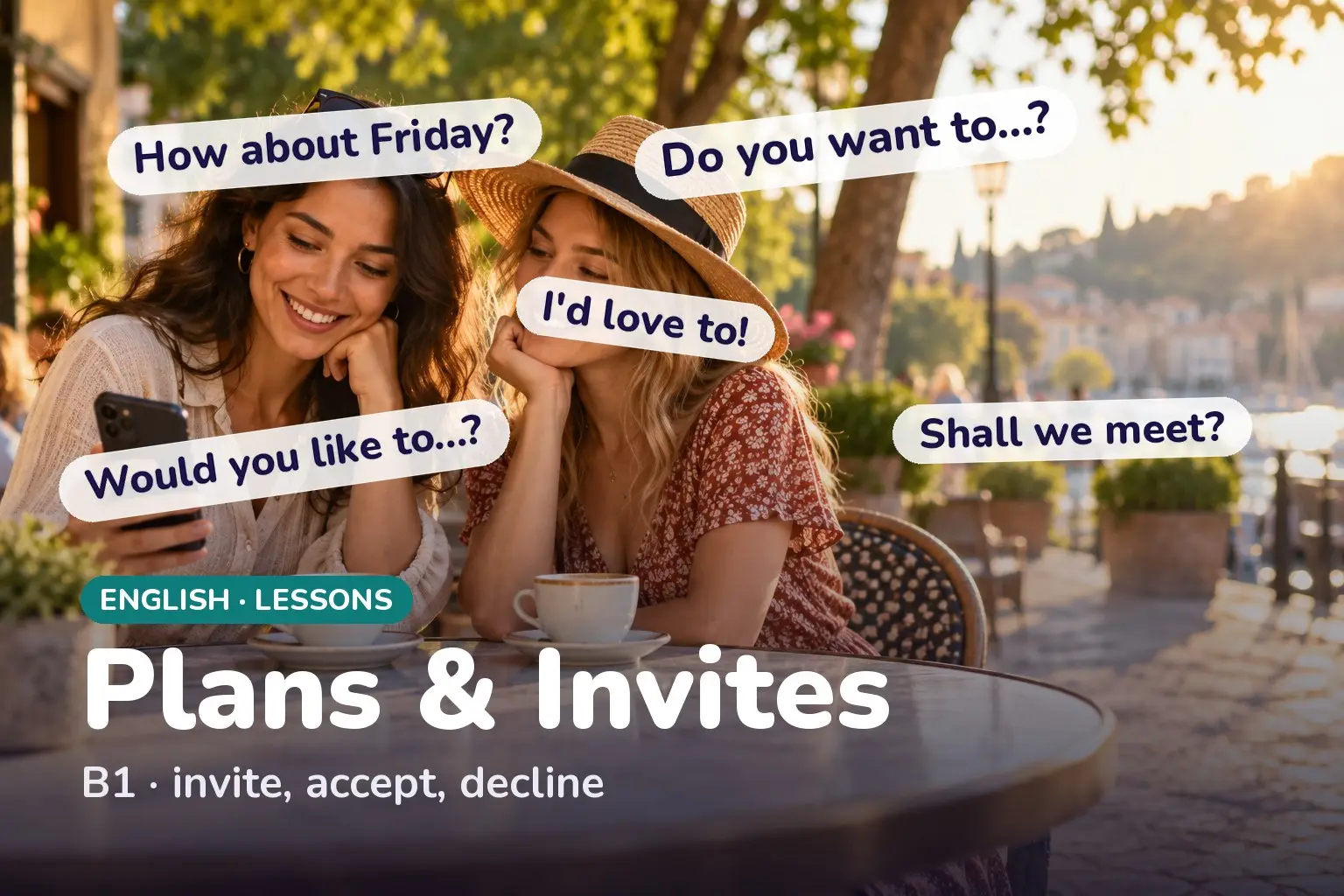
To invite someone, use 'Do you want to …?', 'Would you like to …?' or 'How about …?'. Accept warmly ('I'd love to!'), or decline softly with a reason ('I'd love to, but I'm busy — maybe another time?'). Then agree a time and place.
Level: B1. Inviting a friend for coffee, suggesting a film, saying yes with warmth or saying no without hurting anyone — this is social English you use every week. This lesson gives you the phrases to invite, accept, decline, and settle the where and when.
By the end of this page you can…
…invite someone to do something, accept an invitation warmly, decline it politely with a reason, suggest your own ideas, and agree a time and place.
Inviting: three easy openers
Most invitations in English start with one of three patterns. Learn each as a chunk and you can invite anyone to anything.
- Do you want to …? — relaxed, for friends: Do you want to grab a coffee?
- Would you like to …? — a little more formal and polite: Would you like to join us for dinner?
- How about …? / What about …? — to suggest an activity or time: How about Friday evening?
After the opener comes the base verb: Do you want to see a film?, Would you like to come over? You can also invite with Let’s … when the plan is already shared: Let’s get lunch.
Accepting and declining
| Function | Phrase | Tone |
|---|---|---|
| Accept warmly | I’d love to! / Sounds great! / That sounds good. | happy, keen |
| Accept, checking | Sure, what time? / Yeah, why not? | relaxed |
| Decline softly | I’d love to, but … / I’m afraid I can’t … | polite, kind |
| Give a reason | … I’m busy / … I’ve got other plans | honest, short |
| Keep the door open | Maybe another time? / Can we do next week? | friendly |
The golden rule for declining: thank, soften, give a short reason, and offer another time. A bare No sounds cold; I’d love to, but I’m working on Friday — maybe next week? keeps the friendship warm.
Suggesting and agreeing the details
Once someone says yes, fix the plan: what, where and when. Use shall and let’s to make suggestions.
- Shall we meet at seven? (British, a soft suggestion as a question)
- Let’s meet outside the cinema.
- Where shall we meet? · What time works for you?
- See you there! — a natural way to close.
A short conversation
Aria: Do you want to see the new film on Saturday? Noah: I’d love to, but I’m visiting my parents on Saturday. How about Sunday? Aria: Sunday works! Shall we meet at six? Noah: Sounds great. Where shall we meet? Aria: Let’s meet outside the cinema. See you there!
Usage notes
- want to vs would like to: Do you want to …? is relaxed and common with friends; Would you like to …? is softer and safer with people you know less well.
- free: Are you free on Friday? is the most common way to check availability before inviting.
- grab / get: grab a coffee, get lunch, grab a bite are everyday, friendly invitations.
- I’d love to always needs to even when the verb is dropped: Do you want to come? — I’d love to. (not I’d love).
- tentative plans: I might …, We were thinking of … and Maybe we could … leave room before the plan is fixed.
Example sentences
Press play and say each line out loud — these are the phrases you will actually use with friends.
- Do you want to grab a coffee?A relaxed invitation to a friend.
- Would you like to join us for dinner?A softer, more polite invitation.
- How about Friday evening?Suggesting a time with How about.
- Are you free this weekend?Checking availability before inviting.
- Let's get lunch on Saturday.A suggestion when the plan is shared.
- Do you fancy a walk later?Fancy means feel like; common in British English.
- I'd love to!Accepting warmly; note the 'to' stays.
- Sounds great — count me in.An enthusiastic yes.
- Sure, what time?Accepting and asking for the time.
- I'd love to, but I'm busy that night.Declining softly with a reason.
- I'm afraid I can't make it on Friday.A polite way to say no to a date.
- Maybe another time?Keeping the door open after declining.
- Can we do next week instead?Offering a new time.
- Shall we meet at seven?A soft suggestion as a question.
- Where shall we meet?Asking for the place.
- What time works for you?Letting the other person choose a time.
- Let's meet outside the station.Fixing the meeting place.
- I might be a little late.A tentative warning with might.
- We were thinking of going on Sunday.Suggesting a plan that isn't fixed yet.
- Great — see you there!A natural way to close the plan.
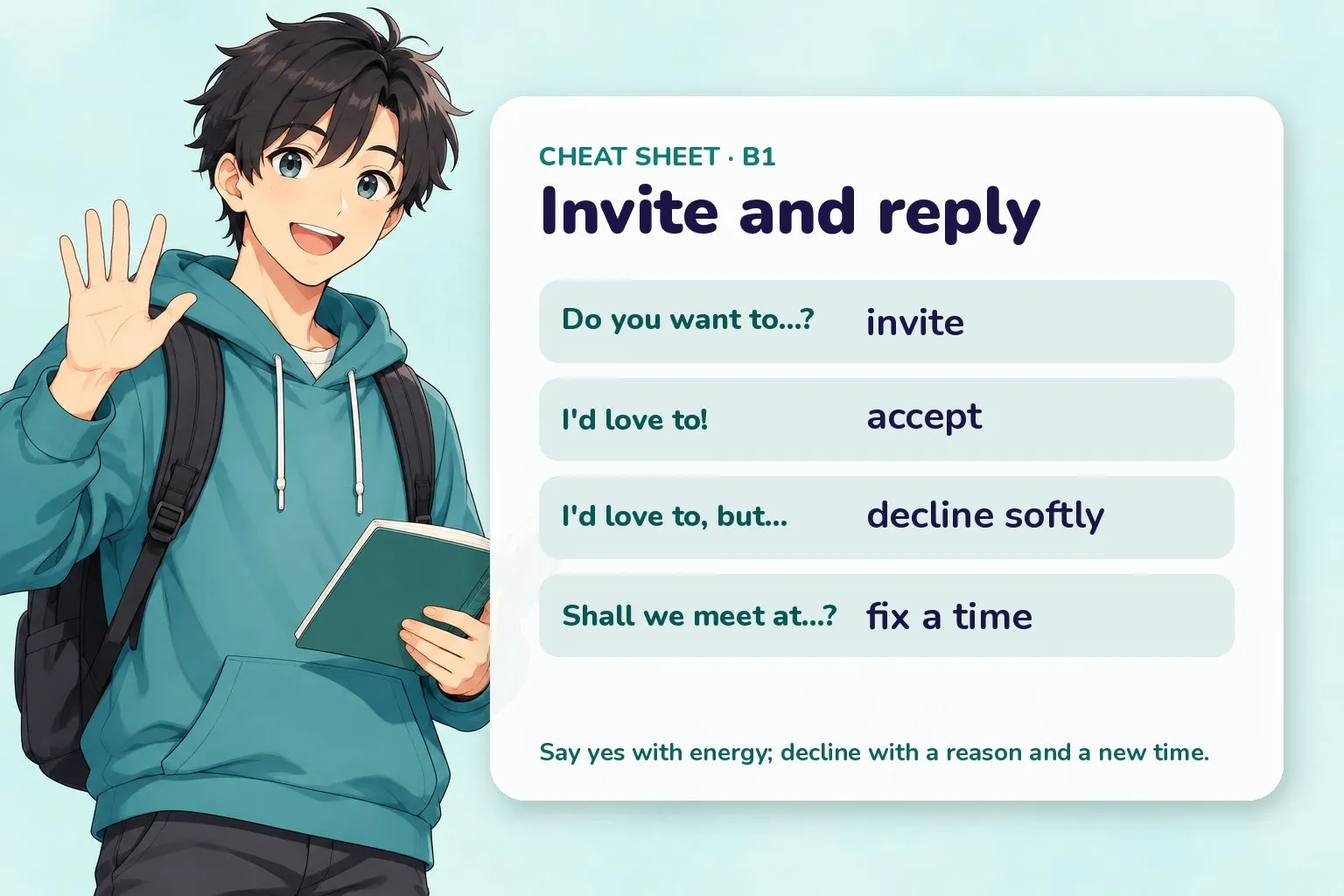
Quick recap before you practise.
Practice
Plans and invitations practice
Try each one, then press Check. No sign-up, nothing is sent anywhere — it all runs in your browser.
Hint: a soft modal for formal-ish invitations
Show answer
Would — 'Would you like to …?' is a softer, more polite way to invite.
Hint: British English for suggestions
Show answer
Shall — 'Shall we meet at seven?' is a natural, soft suggestion.
4 Put the words in order to decline politely.
Show answer
I'd love to, but I'm busy that night — Soften, then give a short reason: 'I'd love to, but I'm busy that night.'
5 Match each phrase to its job.
- Do you want to …?
- I'd love to!
- Maybe another time?
- Where shall we meet?
Show answer
- Do you want to …? → invite
- I'd love to! → accept
- Maybe another time? → decline softly
- Where shall we meet? → fix the place
Invite, accept, decline and arrange — the four moves of making plans.
How to say it
A few of these words catch English learners out — copy the audio, not the spelling.
- would has a silent l: it sounds like wood.
- shall is short and relaxed in speech, almost shl before we: shall we runs together as shaw-wee.
- fancy is FAN-see, stress on the first part.
- I’d love to links smoothly: ide-LUV-too, with love stressed.
Quiz
Plans and invitations quiz
8 questions · pick an answer and you'll see straight away if it's right.
-
Show answer
Do you want to grab a coffee? — 'Do you want to …?' is the relaxed, everyday invitation with friends.
-
Show answer
I'd love to — sounds great! — 'I'd love to — sounds great!' clearly shows you want to go.
-
Show answer
I'd love to, but I'm busy that night — maybe another time? — Soften, give a short reason, and keep the door open for another time.
-
Show answer
a little more polite and formal — 'Would you like to …?' is a softer, slightly more formal invitation.
-
Show answer
Shall we meet at seven? — 'Shall we …?' turns a suggestion into a polite question.
-
Show answer
I'd love to. — Keep the 'to': 'I'd love to.'
-
Show answer
Let's meet outside the cinema. — 'Let's meet outside the cinema' settles where you will meet.
-
Show answer
Would you like to go for a walk? — 'Do you fancy …?' (British English) means 'would you like to …?'.
Recap cheat-sheet
| Function | Phrase |
|---|---|
| Invite (relaxed) | Do you want to …? |
| Invite (polite) | Would you like to …? |
| Suggest | How about Friday? / Shall we …? |
| Accept | I’d love to! / Sounds great! |
| Decline softly | I’d love to, but … maybe another time? |
| Fix details | Where shall we meet? / What time works? |
Next
- Previous lesson: English: Making Appointments
- Next lesson: English: Phone & Messaging
- New here? Start with Start Learning English Here
All English lessons topics
Vocabulary, pronunciation, phrases, practice and exam help, ordered by level. Pick a topic and go straight to it. New lessons go live every day, so topics marked Coming soon fill in over the next weeks.
Lessons
A1 9 topics · 9 ready
A2 14 topics · 14 ready
- 10 English: Describing People
- 11 English: Ordering at a Cafe
- 12 English: Shopping & Prices
- 13 English: Clothing & Sizes
- 14 English: Asking for Directions
- 15 English: Using Public Transport
- 16 English: At the Hotel
- 17 English: Weather & Seasons
- 18 English: Hobbies & Free Time
- 19 English: Daily Routine
- 20 English: Housing & Rooms
- 21 English: Parts of the Body
- 22 English: Emotions & Feelings
- 23 English: Supermarket & Groceries
B1 19 topics · 19 ready
- 24 English: Household Chores
- 25 English: At the Doctor
- 26 English: Making Appointments
- 27 English: Making Plans & Invitations You are here
- 28 English: Phone & Messaging
- 29 English: Expressing Opinions
- 30 English: Talking About Past Experiences
- 31 English: Future Plans & Goals
- 32 English: School & Education
- 33 English: Jobs & Professions
- 34 English: Money & Banking
- 35 English: Restaurant & Dining Out
- 36 English: Travel & the Airport
- 37 English: Sightseeing & Tourism
- 38 English: Emergencies & Safety
- 39 English: Technology & the Internet
- 40 English: Complaints & Solving Problems
- 41 English: Small Talk & Networking
- 42 English Small-Talk & Politeness Culture
B2 11 topics · 11 ready
- 43 English: At the Office
- 44 English: The Job Interview
- 45 English: Formal Writing & Emails
- 46 English: News & Current Affairs
- 47 English: Environment & Nature
- 48 English: Health & Lifestyle
- 49 English: Culture & Traditions
- 50 English: Describing Trends & Data
- 51 English: Storytelling & Narration
- 52 English: Giving a Short Presentation
- 53 Writing Business Emails in English