English: Greetings & Introductions
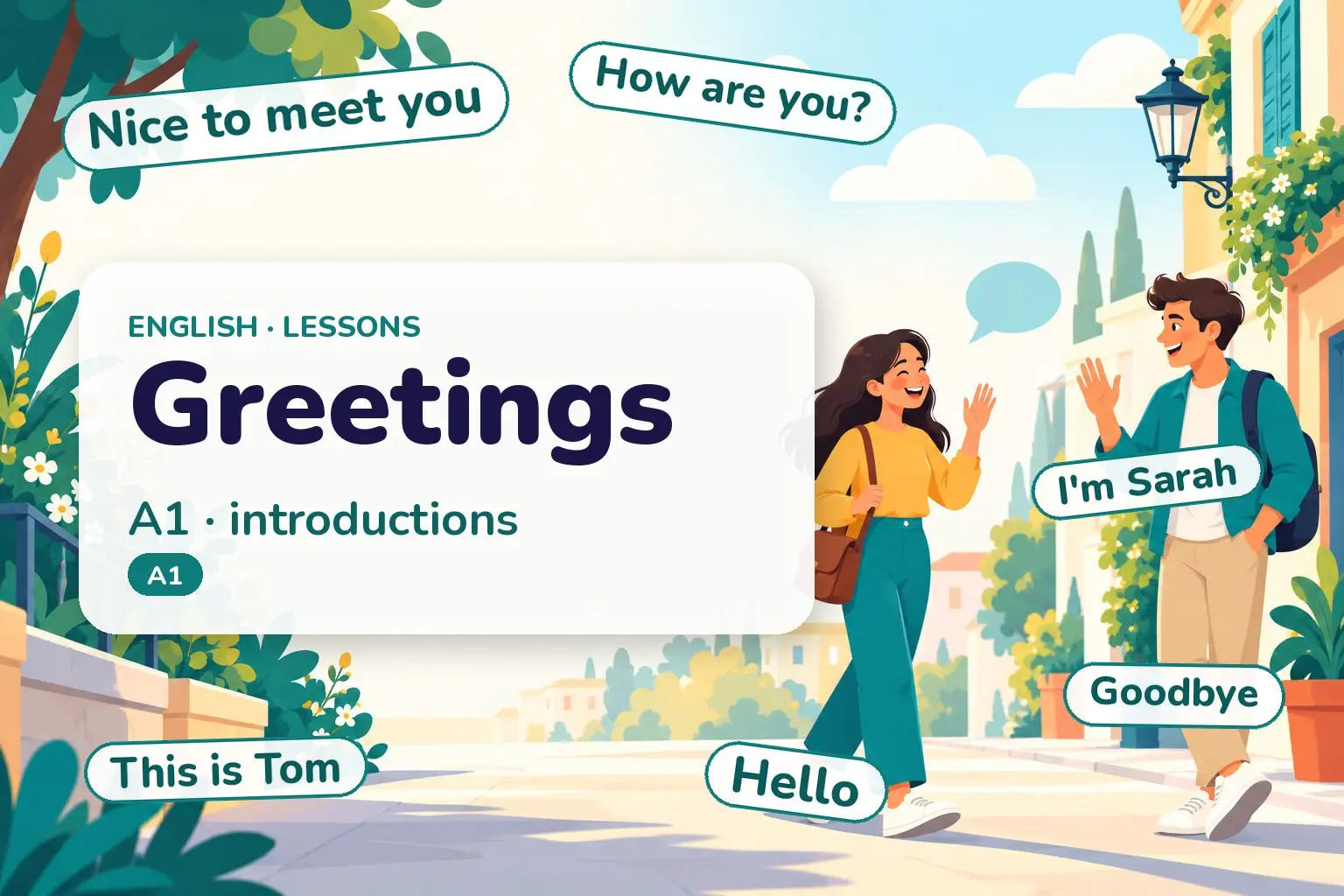
Greet someone with 'Hello' or 'Hi', ask 'How are you?', and reply 'Fine, thanks.' To introduce yourself, say 'I'm …' or 'My name is …'; to introduce someone else, say 'This is …'. Add 'Nice to meet you' the first time.
Level: A1. Greetings and introductions are the first words you use in almost every conversation. A handful of fixed phrases will carry you through meeting people, saying hello and goodbye, and asking how someone is.
By the end of this page you can…
…greet people at any time of day, introduce yourself and a friend, ask and answer ‘How are you?’, and say goodbye politely.
Saying hello
English has one all-purpose greeting and a few that depend on the time of day. Hello works everywhere and with everyone. Hi is a little more relaxed, and Hey is the most casual — good with friends, less so with a new boss.
When you want to sound warm or polite, add the time of day: Good morning until about noon, Good afternoon until the evening, and Good evening after dark. Notice that Good night is not a greeting at all — it is only for leaving or going to sleep.
Asking how someone is
After ‘Hello’, people usually ask how you are. The common questions are How are you? and, more casually, How’s it going? or How are you doing?
Here is the key point for learners: this is mostly a friendly ritual, not a real request for news. A short, positive reply is expected, followed by the same question back:
- Fine, thanks. And you?
- I’m good, thank you. How about you?
- Not bad, thanks.
Introducing yourself and others
To say who you are, use I’m … or My name is …:
- Hi, I’m Sarah.
- My name is David.
To introduce a third person, use This is …. You do not say he is or she is when you present someone — This is is the fixed phrase:
- This is my friend, Tom.
- Anna, this is my colleague, Mr Lee.
When you meet someone for the first time, the polite exchange is Nice to meet you and the reply Nice to meet you too. Use it only at that first meeting.
Saying goodbye
Goodbye is the full, slightly formal word; Bye is the everyday version. You will also hear See you later, See you tomorrow, Take care, and, in the evening, Good night. A friendly Have a good day! is common when you part.
Example sentences
Play each line, then say it along with the audio. These are the exact phrases you will use every day.
- Hello!The all-purpose greeting for anyone.Safe in every situation.
- Hi, how are you?A friendly everyday opener.Let the words run together.
- Good morning!A polite greeting before noon.
- Good afternoon, everyone.A greeting for the middle of the day.
- Good evening.A greeting after dark.
- How are you?The common 'how are you' question.
- Fine, thanks. And you?A short, expected reply plus the question back.
- I'm good, thank you.Another natural answer.
- Not bad, thanks.A relaxed, honest reply.
- Hi, I'm Sarah.Introducing yourself with 'I'm'.
- My name is David.A slightly more formal self-introduction.
- This is my friend, Tom.Introducing a third person with 'This is'.
- Anna, this is my colleague, Mr Lee.Introducing two people to each other.
- Nice to meet you.Said at a first meeting.
- Nice to meet you too.The reply to 'Nice to meet you'.
- Where are you from?A common first-conversation question.
- Goodbye, see you tomorrow!A warm way to leave.
- Bye! Take care.A friendly, casual goodbye.
- Have a good day!A kind phrase when you part.
- Good night, sleep well.Only for leaving at night or going to bed.
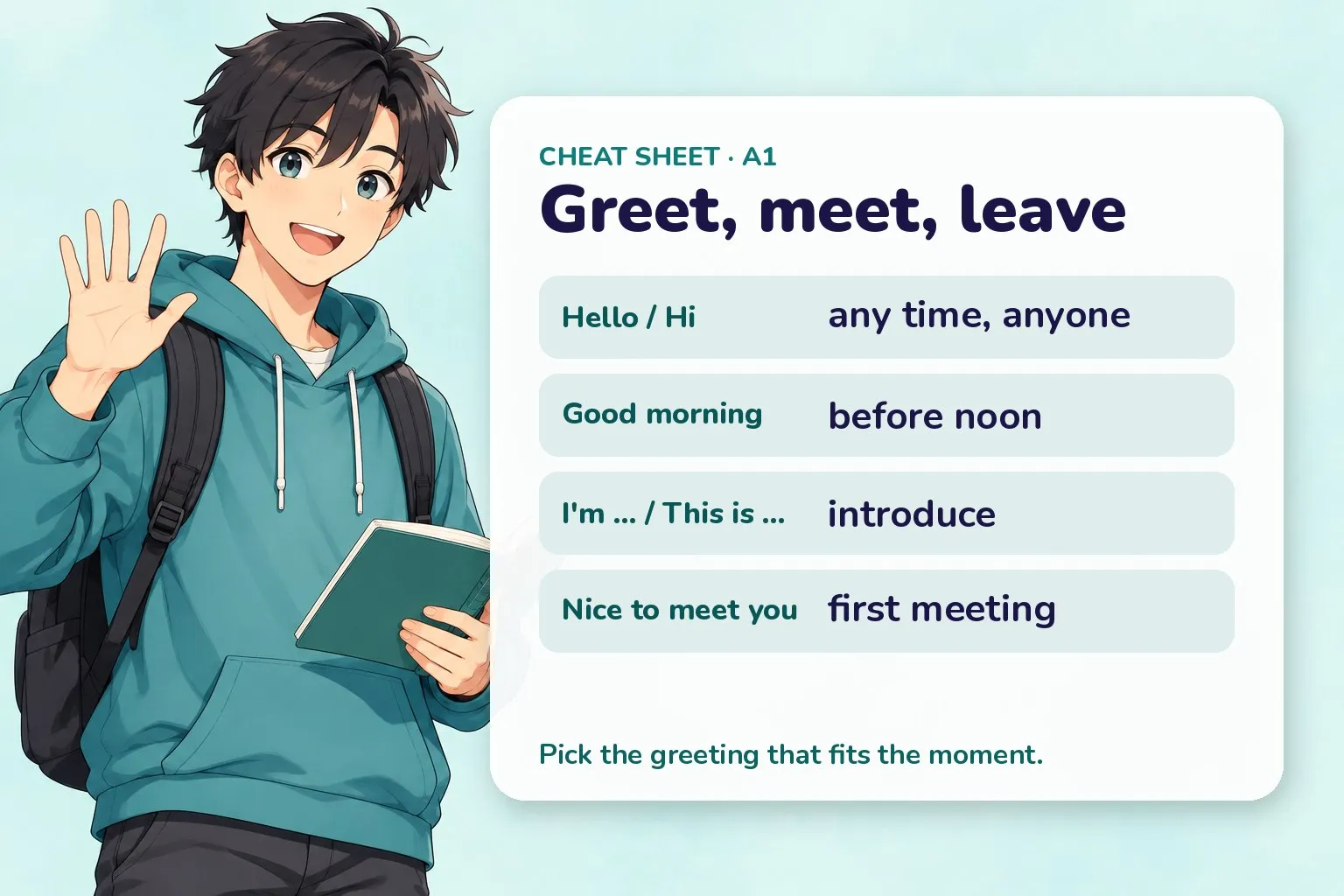
Quick recap before you practise.
Practice
Greetings and introductions practice
Try each one, then press Check. No sign-up, nothing is sent anywhere — it all runs in your browser.
Hint: a two-word fixed phrase starts with this
Show answer
This — Use the fixed phrase 'This is …' to present someone.
4 Put the words in order to introduce yourself.
Show answer
Hi, I'm Sarah — A natural self-introduction: Hi, I'm Sarah.
5 Match each phrase to when you use it.
- Good morning
- Good night
- Nice to meet you
- See you tomorrow
Show answer
- Good morning → before noon
- Good night → leaving at night
- Nice to meet you → a first meeting
- See you tomorrow → saying goodbye
Each greeting fits a specific moment in the day or conversation.
How to say it
A few of these everyday phrases get blurred in natural speech — copy the links, don’t separate every word.
- How are you? sounds like one smooth word, roughly “howaryou”. The are almost disappears.
- Nice to meet you links into “nice-to-meechoo” — the t and y join into a ch sound.
- Good morning drops the d: say “goo-morning”, not two sharp words.
- Thanks has a soft th and a short a, ending in -nks — not “tanks”.
Quiz
Greetings and introductions quiz
8 questions · pick an answer and you'll see straight away if it's right.
-
Show answer
Hello — 'Hello' is neutral — right for friends and strangers alike.
-
Show answer
when you leave at night or go to bed — 'Good night' is a parting phrase, never a greeting.
-
Show answer
This is my friend Tom — 'This is …' is the fixed phrase for presenting someone.
-
Show answer
Nice to meet you too — You answer a first introduction with 'Nice to meet you too'.
-
Show answer
Hey — 'Hey' is the most informal — fine with friends, not with a new boss.
-
Show answer
a friendly ritual expecting a short reply — It is a polite ritual; a brief positive answer is expected.
-
Show answer
I'm David / My name is David — Use 'I'm …' or 'My name is …' to say who you are.
-
Show answer
Only at the first meeting — It belongs to a first introduction only.
Next
- Next lesson: English: Numbers 0 to 100
- New here? Start with Start Learning English Here
- Build the sounds: English Pronunciation Overview
All English lessons topics
Vocabulary, pronunciation, phrases, practice and exam help, ordered by level. Pick a topic and go straight to it. New lessons go live every day, so topics marked Coming soon fill in over the next weeks.
Lessons
A1 9 topics · 9 ready
- 01 English: Greetings & Introductions You are here
- 02 English: Numbers 0 to 100
- 03 English: Introducing Yourself
- 04 English: Days, Months & Dates
- 05 English: Telling the Time
- 06 English: Giving Personal Information
- 07 English: Family Members
- 08 English: Colours & Shapes
- 09 English: Food & Drink Basics
A2 14 topics · 14 ready
- 10 English: Describing People
- 11 English: Ordering at a Cafe
- 12 English: Shopping & Prices
- 13 English: Clothing & Sizes
- 14 English: Asking for Directions
- 15 English: Using Public Transport
- 16 English: At the Hotel
- 17 English: Weather & Seasons
- 18 English: Hobbies & Free Time
- 19 English: Daily Routine
- 20 English: Housing & Rooms
- 21 English: Parts of the Body
- 22 English: Emotions & Feelings
- 23 English: Supermarket & Groceries
B1 19 topics · 19 ready
- 24 English: Household Chores
- 25 English: At the Doctor
- 26 English: Making Appointments
- 27 English: Making Plans & Invitations
- 28 English: Phone & Messaging
- 29 English: Expressing Opinions
- 30 English: Talking About Past Experiences
- 31 English: Future Plans & Goals
- 32 English: School & Education
- 33 English: Jobs & Professions
- 34 English: Money & Banking
- 35 English: Restaurant & Dining Out
- 36 English: Travel & the Airport
- 37 English: Sightseeing & Tourism
- 38 English: Emergencies & Safety
- 39 English: Technology & the Internet
- 40 English: Complaints & Solving Problems
- 41 English: Small Talk & Networking
- 42 English Small-Talk & Politeness Culture
B2 11 topics · 11 ready
- 43 English: At the Office
- 44 English: The Job Interview
- 45 English: Formal Writing & Emails
- 46 English: News & Current Affairs
- 47 English: Environment & Nature
- 48 English: Health & Lifestyle
- 49 English: Culture & Traditions
- 50 English: Describing Trends & Data
- 51 English: Storytelling & Narration
- 52 English: Giving a Short Presentation
- 53 Writing Business Emails in English