English: Emergencies & Safety
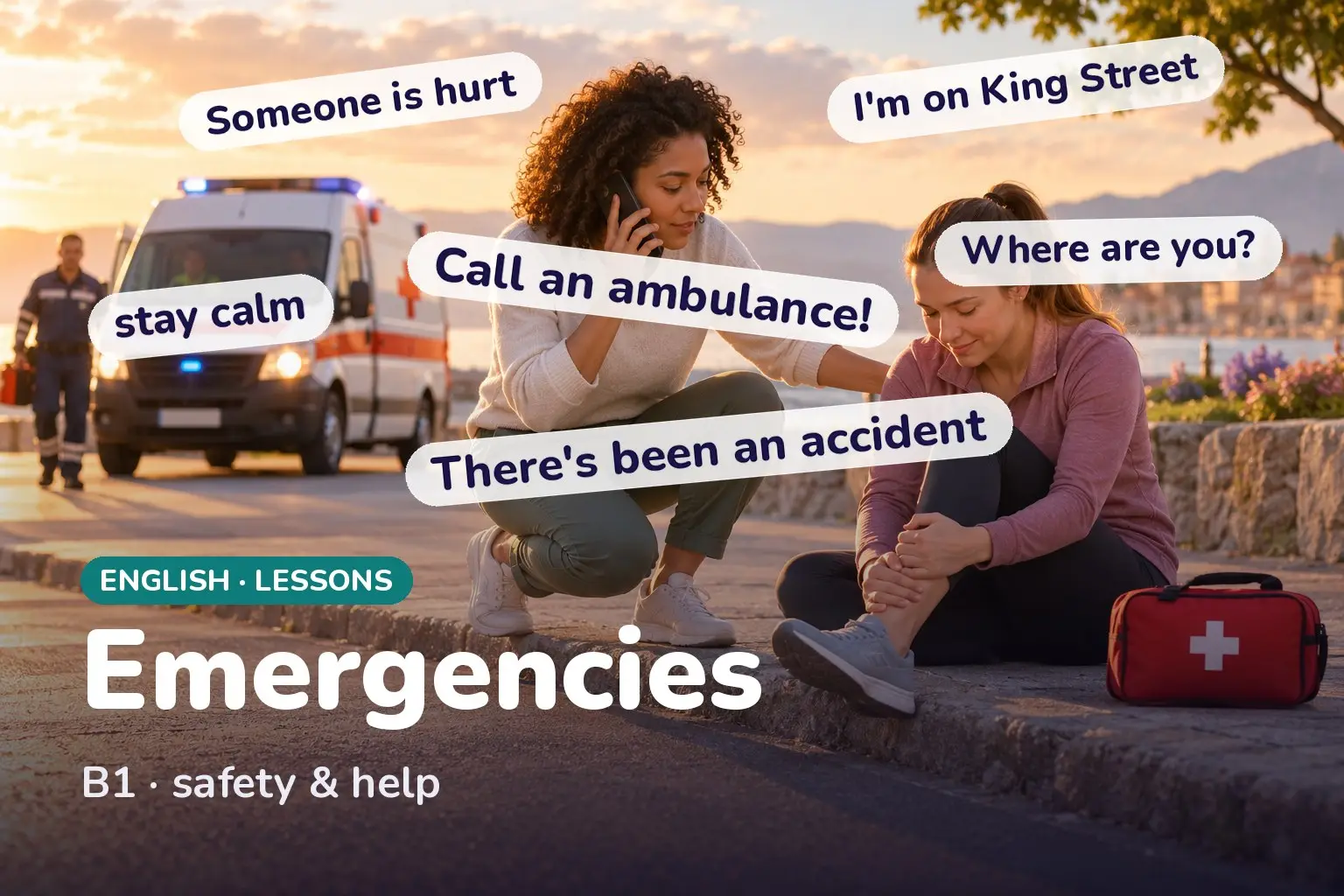
In an emergency, stay calm and say what happened plainly: 'There's been an accident' or 'Someone is hurt.' Ask for the service you need — 'Call an ambulance!' — then give your location clearly. The emergency number differs by country, so learn the local one before you travel.
Level: B1. In an emergency you have no time to search for words, so the phrases must already be in your head. This lesson gives you the core emergency vocabulary, the short sentences for calling for help, and the one skill that matters most: saying clearly where you are. Learn these before you need them.
By the end of this page you can…
…name the emergency services, call for help in a few clear words, describe what has happened, and give your location so help can reach you.
Emergency vocabulary
An emergency is a sudden, serious situation that needs help now. The three main services are the ambulance (medical), the fire brigade (BrE) or fire department (AmE), and the police. The people who come are the emergency services or first responders.
For people, use hurt or injured; someone badly hurt is seriously injured. Common situations are an accident, a fire, a robbery or theft, and getting lost. Useful places are the hospital, the pharmacy (BrE chemist), and a first-aid kit for small injuries.
| English | What it means |
|---|---|
| ambulance | the vehicle and team for medical help |
| fire brigade / fire department | the service that puts out fires |
| injured / hurt | harmed in the body (for people) |
| accident | an unplanned event that causes harm |
| first aid | simple help given before the ambulance arrives |
| casualty | a person who is hurt in an accident |
Calling for help
Keep it short. Say the service you need, then the problem, then where you are:
- Call an ambulance!
- There’s been an accident.
- Someone is hurt — we need help at the station.
When the operator answers, they will ask calm questions: What’s your emergency? Where are you? Is anyone hurt? Answer one at a time. Do not hang up until they tell you to.
Describing what happened
The operator needs to know how serious it is. Use the present perfect for a just-finished event and the present for a state that continues:
- There’s been a crash. (it just happened)
- He’s bleeding. / She’s not breathing. (state now)
- The building is on fire.
Giving your location
This is the part that saves time. Give the clearest address you can: a street name, a building or house number, a floor, and any landmark nearby.
- I’m on King Street, outside the bank.
- We’re on the second floor of the shopping centre.
- It’s near the train station, next to the pharmacy.
A short conversation
Operator: Emergency, which service do you need? Caller: Ambulance, please. There’s been an accident. Operator: Is anyone hurt? Caller: Yes, a man has fallen off his bike. He’s conscious but his leg is bleeding. Operator: Where are you exactly? Caller: On Mill Road, outside the supermarket, near the bus stop. Operator: Stay with him and keep the line open. Help is on the way.
Usage notes
- brigade vs department: fire brigade is British, fire department American; both are understood everywhere.
- hurt is both the adjective and the verb: I’m hurt / It hurts / I hurt my hand.
- Call vs phone vs ring: call an ambulance, phone the police, ring 999 (BrE) all work; call is the safest neutral choice.
- Stay calm, speak slowly: short sentences are clearer than long ones. The operator would rather hear three clear facts than a long story.
Example sentences
Press play and say each line out loud so the words are ready when you need them.
- Help! There's been an accident.Problem first, in two or three words.
- Call an ambulance, quickly!Asking for the medical service.
- Someone is hurt.Use hurt or injured for people.
- A man has fallen and he's bleeding.What happened, then the state now.
- She's not breathing.A short, urgent description of a state.
- The building is on fire.On fire = burning.
- We need the police.Asking for a different service.
- There's been a car crash.Present perfect for a just-finished event.
- My friend has broken his arm.Broken for bones and things.
- I'm on King Street, outside the bank.A clear street location.
- We're on the second floor.Giving the floor inside a building.
- It's near the station, next to the pharmacy.Using a landmark to help.
- Please send help as fast as you can.A clear request for speed.
- I don't know the exact address.Being honest so the operator can help.
- There's a sign that says Mill Road.Reading a sign aloud to find your location.
- Is there a first-aid kit nearby?Asking for simple medical help.
- Where is the nearest hospital?Asking for the hospital.
- Stay calm and wait with me.Reassuring someone who is hurt.
- I'll stay on the line.Telling the operator you won't hang up.
- He's conscious and talking.A useful detail about the casualty.
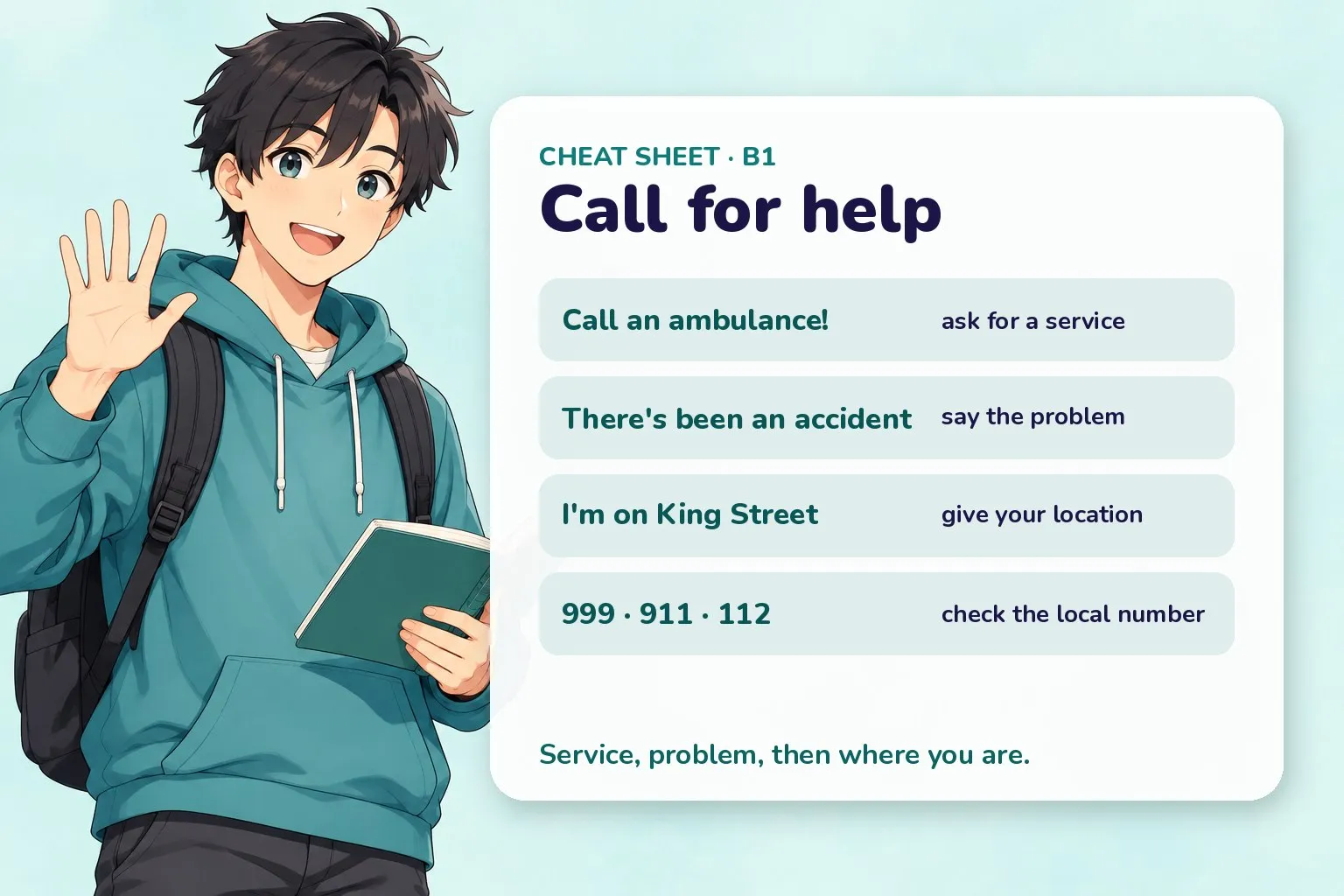
Quick recap before you practise.
Practice
Emergencies and safety practice
Try each one, then press Check. No sign-up, nothing is sent anywhere — it all runs in your browser.
Hint: a crash or fall is one
Show answer
accident — There's been an accident uses the present perfect for a just-finished event.
4 Put the words in order to give your location.
Show answer
I'm on King Street, outside the bank — Give the street then a nearby landmark: I'm on King Street, outside the bank.
Hint: used across the European Union
Show answer
112 — 112 works across the EU; 999 is the UK, 911 the US and Canada.
6 Match each service or word to its meaning.
- ambulance
- fire brigade
- first aid
- casualty
Show answer
- ambulance → medical help
- fire brigade → puts out fires
- first aid → simple help before the ambulance
- casualty → a person who is hurt
These are the core emergency words an operator will use.
How to say it
A few emergency words trip up English learners — copy the sounds, not the spelling.
- ambulance stresses the first syllable: AM-byuh-luhns, three beats.
- injured is two beats with a soft j: IN-jerd, not in-joo-red.
- emergency stresses the second syllable: ih-MUR-juhn-see.
- pharmacy starts with an f sound: FAR-muh-see; the ph is never a p.
Quiz
Emergencies and safety quiz
8 questions · pick an answer and you'll see straight away if it's right.
-
Show answer
Call an ambulance, someone is hurt. — Name the service and the problem in a few clear words.
-
Show answer
injured — Use injured or hurt for people; broken and damaged are for things.
-
Show answer
On Mill Road, outside the supermarket. — A street name plus a landmark lets help find you fast.
-
Show answer
911 — It is 911 in the US and Canada; 999 in the UK; 112 across the EU.
-
Show answer
There's been an accident. — Use the present perfect for a recent event: There's been an accident.
-
Show answer
burning — On fire means it is burning.
-
Show answer
read out a nearby sign or shop name — Read any sign or landmark aloud so the operator can locate you.
-
Show answer
stay on the line until the operator says to stop — Keep the line open until the operator tells you it's fine to hang up.
Recap cheat-sheet
| Idea | Pattern | Example |
|---|---|---|
| Ask for a service | Call a/an + service | Call an ambulance! |
| Say the problem | There’s been + event | There’s been an accident. |
| People vs things | injured/hurt vs broken/damaged | He’s hurt; his arm is broken. |
| Give location | I’m on + street, + landmark | I’m on King Street, outside the bank. |
| Numbers vary | check the local number | 999 UK · 911 US/Canada · 112 EU · 999/995 Singapore |
| On the call | stay calm, stay on the line | I’ll stay on the line. |
Next
- Previous lesson: English: Sightseeing & Tourism
- Next lesson: English: Technology & the Internet
- New here? Start with Start Learning English Here
All English lessons topics
Vocabulary, pronunciation, phrases, practice and exam help, ordered by level. Pick a topic and go straight to it. New lessons go live every day, so topics marked Coming soon fill in over the next weeks.
Lessons
A1 9 topics · 9 ready
A2 14 topics · 14 ready
- 10 English: Describing People
- 11 English: Ordering at a Cafe
- 12 English: Shopping & Prices
- 13 English: Clothing & Sizes
- 14 English: Asking for Directions
- 15 English: Using Public Transport
- 16 English: At the Hotel
- 17 English: Weather & Seasons
- 18 English: Hobbies & Free Time
- 19 English: Daily Routine
- 20 English: Housing & Rooms
- 21 English: Parts of the Body
- 22 English: Emotions & Feelings
- 23 English: Supermarket & Groceries
B1 19 topics · 19 ready
- 24 English: Household Chores
- 25 English: At the Doctor
- 26 English: Making Appointments
- 27 English: Making Plans & Invitations
- 28 English: Phone & Messaging
- 29 English: Expressing Opinions
- 30 English: Talking About Past Experiences
- 31 English: Future Plans & Goals
- 32 English: School & Education
- 33 English: Jobs & Professions
- 34 English: Money & Banking
- 35 English: Restaurant & Dining Out
- 36 English: Travel & the Airport
- 37 English: Sightseeing & Tourism
- 38 English: Emergencies & Safety You are here
- 39 English: Technology & the Internet
- 40 English: Complaints & Solving Problems
- 41 English: Small Talk & Networking
- 42 English Small-Talk & Politeness Culture
B2 11 topics · 11 ready
- 43 English: At the Office
- 44 English: The Job Interview
- 45 English: Formal Writing & Emails
- 46 English: News & Current Affairs
- 47 English: Environment & Nature
- 48 English: Health & Lifestyle
- 49 English: Culture & Traditions
- 50 English: Describing Trends & Data
- 51 English: Storytelling & Narration
- 52 English: Giving a Short Presentation
- 53 Writing Business Emails in English