English: News & Current Affairs
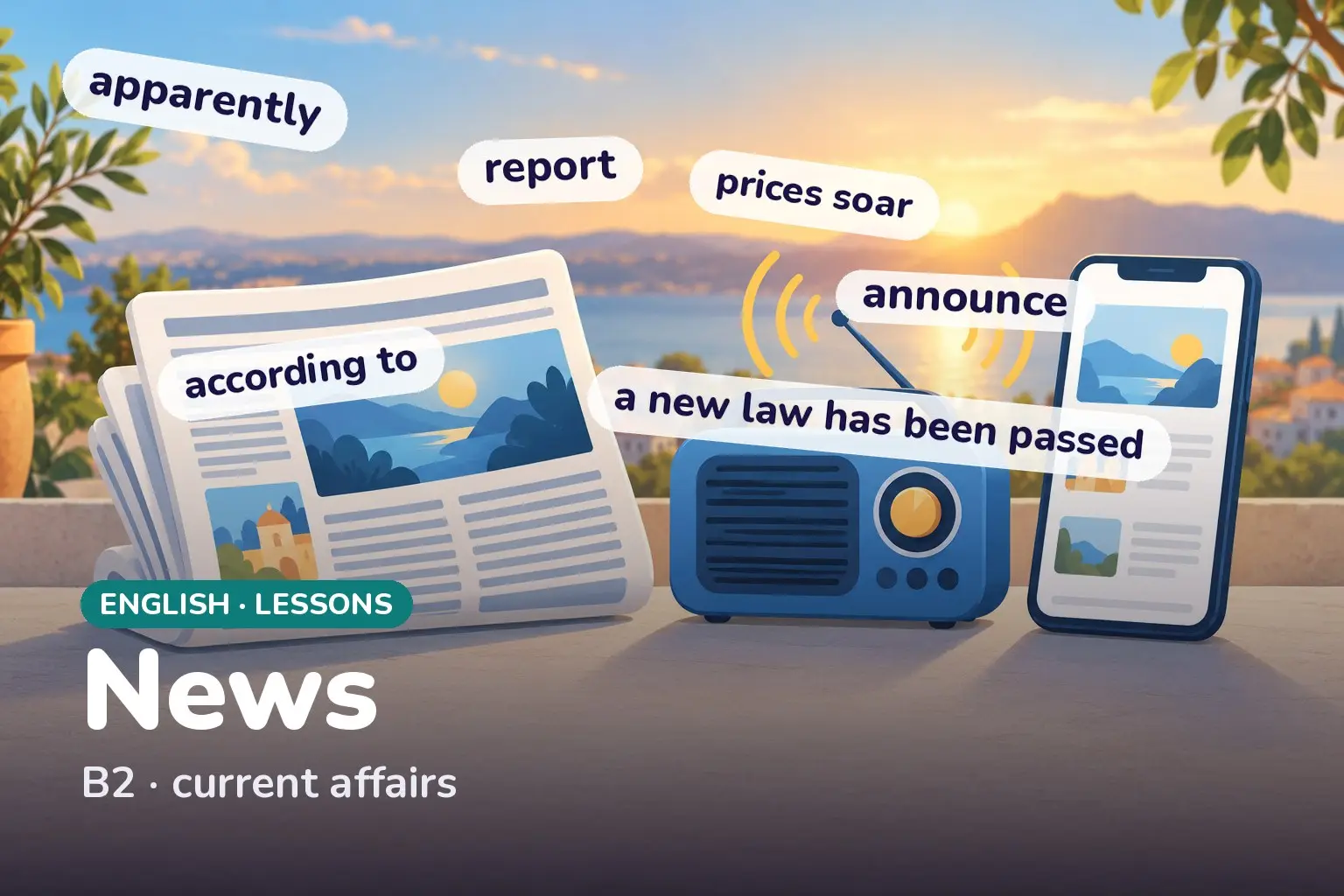
To talk about the news in English, learn the headline verbs (announce, claim, ban, cut, soar) and a few patterns for summarising: 'According to the BBC…', 'It says that…', and 'Apparently…'. Reporting verbs and the passive do most of the work: 'A new law has been announced'.
Level: B2. News English has its own compact style: short, strong verbs, lots of the passive, and headlines that break the normal rules of grammar. This lesson gives you the headline vocabulary, the patterns for summarising a story accurately, and the phrases for reacting to what you read or hear.
By the end of this page you can…
…read a news headline and work out what really happened, summarise a story while making clear whose claim it is, and react to the news with natural opinion phrases.
Headline vocabulary — short, strong verbs
Headlines use the shortest word that fits, so a small set of punchy verbs appears again and again. Learn them as news words:
| English | What it means in the news |
|---|---|
| announce | officially tell the public something |
| report | say that something happened (often repeating a source) |
| claim | say something is true without proof |
| deny | say something is not true |
| ban | officially stop something |
| cut | reduce (jobs, spending, prices) |
| rise / soar | go up / go up sharply |
| fall / plunge | go down / go down sharply |
A headline is the title of a story; the first paragraph is the lead. The person or organisation the information comes from is the source. A story that is happening now is a developing story; a short urgent one is breaking news.
Summarising a story — say whose claim it is
The skill B2 examiners look for is reporting a story without pretending every claim is a fact. Use a reporting frame and the right reported speech:
- According to the BBC, the talks have failed.
- The article says (that) prices will rise again.
- It reports that the minister has resigned.
- The government claims (that) the plan will create jobs. (claims = says, but not proven)
The passive is everywhere in the news because the action matters more than the doer. Review the passive and its reporting forms:
- Three people were injured in the accident.
- A new law has been announced.
- The minister is said to have resigned. (we are reporting what people say)
Reacting to the news
Move beyond good and bad. These frames sound natural and let you give a measured opinion:
- It’s worrying / encouraging that… + clause: It’s worrying that prices keep rising.
- I was surprised / shocked to hear (that)…: I was surprised to hear the result.
- I’m not sure I believe…: I’m not sure I believe the claim.
- It makes you wonder…: It makes you wonder what will happen next.
A short conversation
A: Did you see the news? Apparently, they’re banning cars from the city centre. B: Really? According to who? A: The local paper. It says the ban starts next year. B: It’s encouraging, but I’m not sure I believe it will actually happen. A: We’ll see. It’s still a developing story.
Usage notes
- say vs tell: tell needs a person (tell me, tell the public); say does not (say that…). The news says; a spokesperson tells reporters.
- claim vs say: claim signals the statement is unproven or disputed. Use it carefully — it quietly casts doubt.
- rise (verb) vs raise (verb): prices rise by themselves (no object); a government raises taxes (needs an object). The noun a rise means an increase.
- affect vs effect: affect is usually the verb (the law affects drivers); effect is usually the noun (the effect of the law).
Example sentences
Press play and read each line as a news presenter would — clear and even.
- The government has announced a new tax.Announce = tell the public officially.
- According to the report, prices will rise.According to = naming your source.
- Three people were injured in the crash.Passive: the doer is unknown or unimportant.
- The minister denied the claims.Deny = say it is not true.
- Apparently, the factory is closing.Apparently = I heard this but can't confirm it.
- Unemployment has fallen for the third month.Fall = go down.
- Fuel prices have soared this year.Soar = rise sharply.
- The company plans to cut 200 jobs.Cut = reduce.
- It reports that the talks have failed.Reporting frame for a news story.
- The president is said to be unwell.Is said to = people say, unconfirmed.
- A new law banning smoking has been passed.Ban = officially stop.
- I was shocked to hear the result.Reacting to news with a feeling.
- It's worrying that so many shops are closing.It's worrying that + clause.
- The strike is still a developing story.Developing story = still happening.
- Officials claim the plan will create jobs.Claim = say, but not proven.
- The BBC says the decision is final.Say does not take a person after it.
- She told reporters she would resign.Tell needs a person: told reporters.
- It makes you wonder what will happen next.A thoughtful reaction frame.
- Breaking news: the airport has reopened.Breaking news = urgent and new.
- The effect of the new rule is not yet clear.Effect = the noun; affect = the verb.
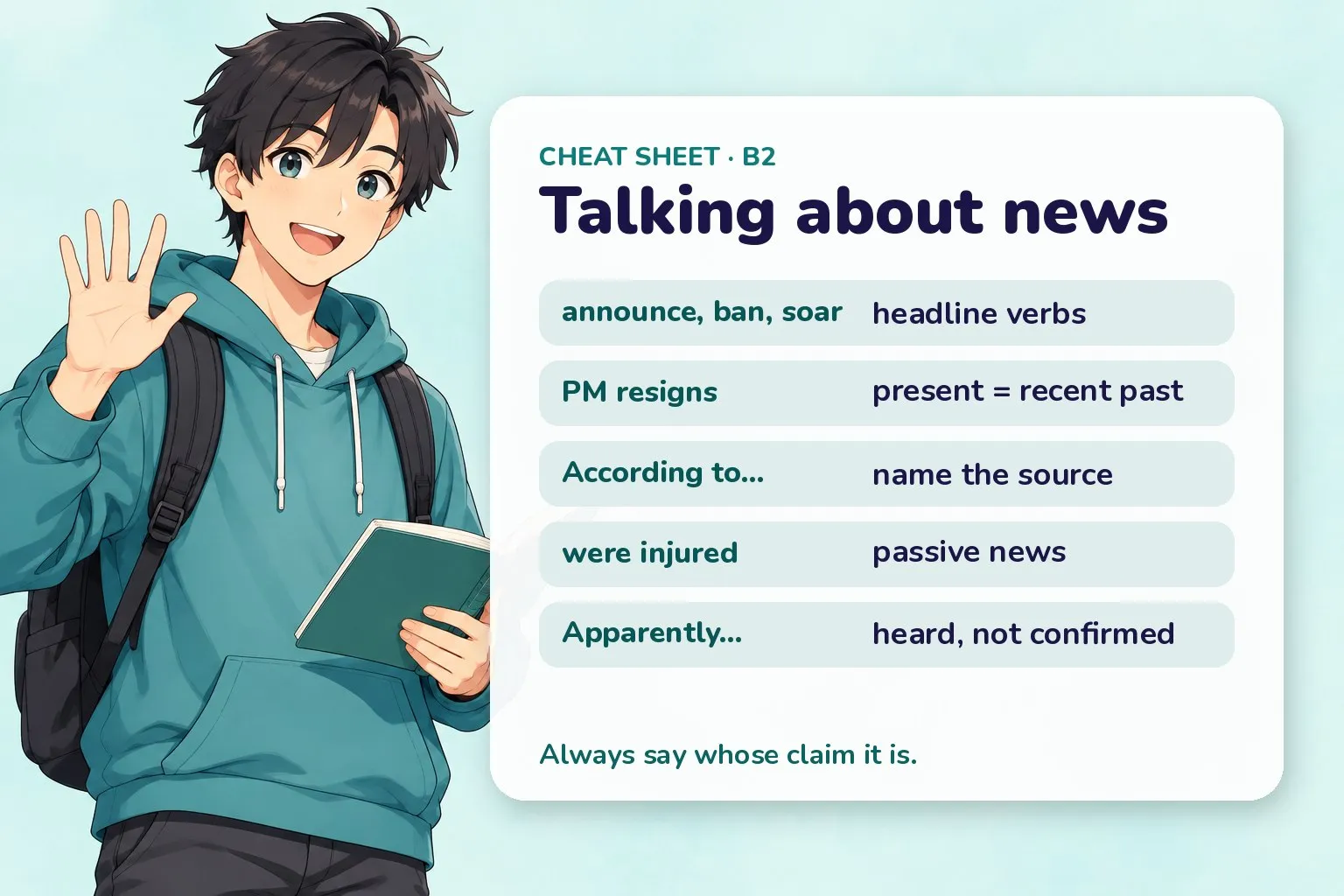
Quick recap before you practise.
Practice
News and current affairs practice
Try each one, then press Check. No sign-up, nothing is sent anywhere — it all runs in your browser.
Hint: two words that introduce a source
Show answer
According to — 'According to + source' tells the listener where the information comes from.
Hint: no person comes after this verb
Show answer
says — 'Say' takes no person directly after it: the news says that…; you tell someone.
5 Put the words in order to make a passive news sentence.
Show answer
Three people were injured — The passive puts the affected people first: Three people were injured.
6 Match each news verb to its meaning.
- ban
- soar
- cut
- deny
Show answer
- ban → officially stop
- soar → rise sharply
- cut → reduce
- deny → say it's not true
These short, strong verbs appear constantly in headlines.
Quiz
News and current affairs quiz
11 questions · pick an answer and you'll see straight away if it's right.
-
Show answer
rise sharply — Soar = go up sharply; its opposite is plunge.
-
Show answer
She told reporters the news. — Tell needs a person: told reporters. Use 'say' when there's no person.
-
Show answer
Apparently, — 'Apparently' signals you heard it but can't confirm it.
-
Show answer
people say she resigned, but it's unconfirmed — 'Is said to' reports what people say without confirming it.
-
Show answer
raise / rise — A government raises taxes (object); prices rise on their own (no object).
-
Show answer
announce — Announce = make something public officially.
-
Show answer
a, the, and forms of be — To save space, headlines drop articles and forms of 'be'.
-
Show answer
give a measured negative reaction — 'It's worrying/encouraging that + clause' gives a measured opinion.
-
Show answer
the effect of the law — Effect is normally the noun; affect is normally the verb.
-
Show answer
developing story — A developing story is one that is still unfolding.
-
Show answer
According to the report,… — 'According to + source' attributes the claim rather than stating it as fact.
Recap cheat-sheet
| Idea | Pattern | Example |
|---|---|---|
| Headline verbs | announce, ban, cut, soar, plunge | Fuel prices soar. |
| Headline grammar | present simple for past; drop a/the/be | PM resigns. |
| Attribute it | According to…, It says that… | According to the BBC,… |
| Passive news | were + past participle | Three people were injured. |
| Unconfirmed | Apparently / is said to | Apparently, it’s closing. |
| React | It’s worrying/encouraging that… | It’s worrying that prices rise. |
Next
- Previous lesson: English: Technology & the Internet
- Next lesson: English: Environment & Nature
- New here? Start with Start Learning English Here
All English lessons topics
Vocabulary, pronunciation, phrases, practice and exam help, ordered by level. Pick a topic and go straight to it. New lessons go live every day, so topics marked Coming soon fill in over the next weeks.
Lessons
A1 9 topics · 9 ready
A2 14 topics · 14 ready
- 10 English: Describing People
- 11 English: Ordering at a Cafe
- 12 English: Shopping & Prices
- 13 English: Clothing & Sizes
- 14 English: Asking for Directions
- 15 English: Using Public Transport
- 16 English: At the Hotel
- 17 English: Weather & Seasons
- 18 English: Hobbies & Free Time
- 19 English: Daily Routine
- 20 English: Housing & Rooms
- 21 English: Parts of the Body
- 22 English: Emotions & Feelings
- 23 English: Supermarket & Groceries
B1 19 topics · 19 ready
- 24 English: Household Chores
- 25 English: At the Doctor
- 26 English: Making Appointments
- 27 English: Making Plans & Invitations
- 28 English: Phone & Messaging
- 29 English: Expressing Opinions
- 30 English: Talking About Past Experiences
- 31 English: Future Plans & Goals
- 32 English: School & Education
- 33 English: Jobs & Professions
- 34 English: Money & Banking
- 35 English: Restaurant & Dining Out
- 36 English: Travel & the Airport
- 37 English: Sightseeing & Tourism
- 38 English: Emergencies & Safety
- 39 English: Technology & the Internet
- 40 English: Complaints & Solving Problems
- 41 English: Small Talk & Networking
- 42 English Small-Talk & Politeness Culture
B2 11 topics · 11 ready
- 43 English: At the Office
- 44 English: The Job Interview
- 45 English: Formal Writing & Emails
- 46 English: News & Current Affairs You are here
- 47 English: Environment & Nature
- 48 English: Health & Lifestyle
- 49 English: Culture & Traditions
- 50 English: Describing Trends & Data
- 51 English: Storytelling & Narration
- 52 English: Giving a Short Presentation
- 53 Writing Business Emails in English