Reporting Passive (It is said that / is said to)
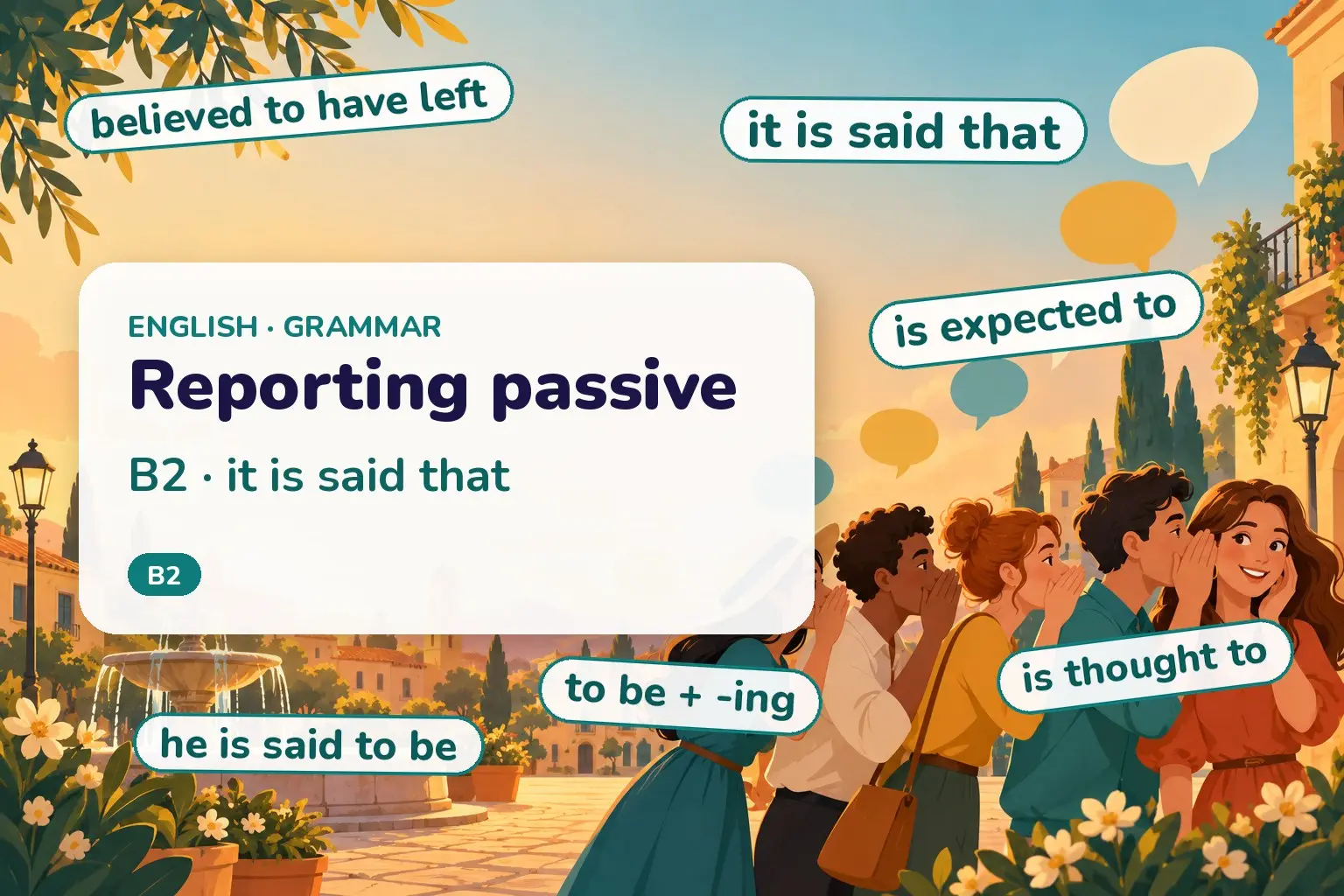
To report what people say or believe in a formal, impersonal way, use two patterns: 'It is said that he is rich' (it + reporting verb + that-clause) or 'He is said to be rich' (subject + reporting verb + to-infinitive). Use 'to have done' for an earlier event.
Level: B2. When you want to report a belief, rumour, or widely held opinion without naming who said it, English uses the reporting passive. It sounds formal and neutral — the voice of news reports, reviews, and academic writing.
The rule
A reporting verb is a verb like say, believe, think, know, report, expect, claim, consider. In the reporting passive you make that verb passive so you do not have to name the people doing the saying or believing. There are two patterns, and they mean the same thing.
The impersonal pattern starts with an empty it: It + be + reporting verb + that-clause. For example: It is said that he is very rich. Here it is just a placeholder; the real information is in the that-clause.
The personal pattern makes the person the subject and follows with a to-infinitive: Subject + be + reporting verb + to-infinitive. The same idea becomes He is said to be very rich. You lift the subject of the that-clause to the front and turn its verb into to be.
Timing matters. If the reported action happens at the same time as the reporting, use a simple infinitive: He is said to be rich. If it happened earlier, use the perfect infinitive (to have + past participle): He is said to have been rich / The suspect is believed to have left the country. For an action in progress now, use to be + -ing: He is said to be living abroad.
Reporting-passive forms
| Structure | Timing | Example |
|---|---|---|
| It + be + reporting verb + that-clause | any (shown in the clause) | It is said that he is rich. |
| Subject + be + reporting verb + to-infinitive | same time as reporting | He is said to be rich. |
| Subject + be + reporting verb + to have + participle | earlier than reporting | He is said to have left. |
| Subject + be + reporting verb + to be + -ing | in progress now | He is said to be living abroad. |
| Past reporting verb | — | It was believed that the earth was flat. |
| There + be + reporting verb + to be | existence | There are said to be ghosts here. |
Common reporting verbs in this pattern: say, believe, think, know, report, consider, expect, claim, allege, understand, rumour, suppose.
Example sentences
- It is said that he is very rich.Impersonal pattern with a that-clause.
- He is said to be very rich.Personal pattern: same meaning, subject at the front.
- It is believed that the suspect left the country.Impersonal, earlier action shown by the past tense.
- The suspect is believed to have left the country.Personal: perfect infinitive for the earlier action.
- The painting is thought to be a fake.Present belief about a present fact.
- It was once believed that the sun went around the earth.Past reporting verb: was believed.
- The company is said to be losing money.To be + -ing for something in progress now.
- She is believed to have stolen the documents.Perfect infinitive: the theft came before the belief.
- The minister is expected to resign tomorrow.A reported expectation about the future.
- It is claimed that the medicine cures headaches.Claim marks the idea as unproven.
- The ruins are thought to date from Roman times.A reported opinion about history.
- He is understood to be living abroad now.Understand as a formal reporting verb.
- Tigers are said to be excellent swimmers.A general belief about a group.
- The actor is rumoured to have married in secret.Rumour + perfect infinitive for an earlier event.
- It is expected that prices will rise next year.Impersonal with a future clause.
- The bridge is known to be unsafe.Know reports an accepted fact.
- Two men are alleged to have robbed the bank.Allege is common in legal and news language.
- The treasure is believed to be hidden on the island.A reported belief about a location.
- He is said to have been a brilliant teacher.Perfect infinitive: both the saying and the teaching are past.
- It is reported that talks have broken down.News-style impersonal reporting.
- She is said to speak five languages.Simple infinitive for a present ability.
- There are said to be wolves in these mountains.There + reporting verb + to be for existence.
- The disease is thought to be spread by insects.A reported passive inside the infinitive.
- It is generally agreed that exercise improves health.Agree reports a shared opinion.
- The company is expected to announce results on Friday.A reported future plan.
Common mistakes
- ❌ He is said that he is rich. → ✅ He is said to be rich. (or It is said that he is rich.) Do not mix the two patterns; choose subject + to-infinitive or it + that-clause.
- ❌ The suspect is believed to left the country. → ✅ The suspect is believed to have left the country. An earlier action needs the perfect infinitive to have + past participle.
- ❌ It is said he to be rich. → ✅ It is said that he is rich. The impersonal pattern takes a full that-clause, not a to-infinitive.
- ❌ He is said to being rich. → ✅ He is said to be rich. After to, use the base form be, never being.
- ❌ They are said have arrived. → ✅ They are said to have arrived. Keep the to: to have arrived.
- ❌ It says that he is rich. → ✅ It is said that he is rich. The reporting verb must be passive (is said), not active.
A short conversation
A: Is it true the company is in trouble? B: Well, it is said that they are losing money. A: Really? The CEO is thought to have sold his shares last month. B: Yes, and he is expected to resign soon.
Usage notes
- Register. The reporting passive is formal and impersonal. It is everywhere in journalism (The talks are reported to have failed), reviews, and academic writing, because it reports a claim without taking responsibility for it or naming a source.
- Present or past reporting. The reporting verb can shift in time: It is said… (people say now) versus It was believed… (people believed then). This is separate from the timing of the infinitive.
- There is/are said to be. To report the existence of something, use there: There is said to be a secret tunnel / There are said to be wolves here.
- Claim and allege signal doubt. Is claimed to and is alleged to tell the reader the statement is not proven — useful when you must report an accusation neutrally.
Compared with…
- The ordinary passive in all tenses changes only the form of be + participle (is done, has been done, will be done). The reporting passive is a specific structure for beliefs and rumours, built on reporting verbs plus a clause or infinitive. See Passive Voice: All Tenses and Modals.
- Reported speech backshifts the tense to report one person’s exact words: She said that she was tired. The reporting passive instead reports a general or anonymous belief: She is said to be tired. See Reported Speech: Statements (Backshift).
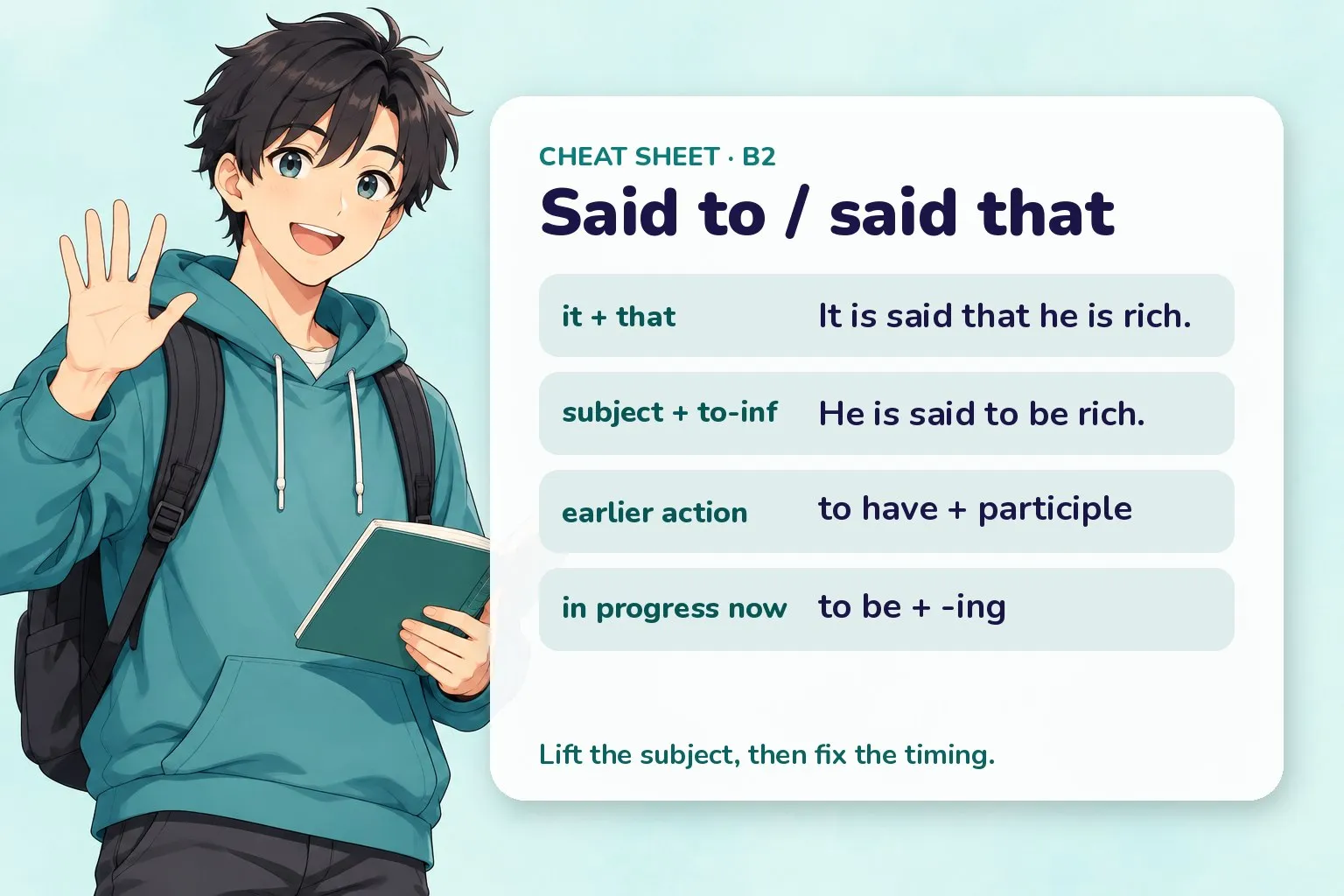
Quick recap before you practise.
Practice
Reporting passive practice
Try each one, then press Check. No sign-up, nothing is sent anywhere — it all runs in your browser.
Hint: to have + past participle
Show answer
to have left — An action before the reporting uses the perfect infinitive: to have left.
Hint: passive reporting verb
Show answer
is thought — The reporting verb is passive: it is thought that…
4 Put the words in order (personal pattern).
Show answer
The minister is expected to resign . — Subject + be + reporting verb + to-infinitive: The minister is expected to resign.
5 Match each personal sentence to its timing.
- He is said to be rich.
- He is said to have been rich.
- He is said to be living abroad.
- He is expected to resign.
Show answer
- He is said to be rich. → same time as the saying
- He is said to have been rich. → earlier than the saying
- He is said to be living abroad. → in progress now
- He is expected to resign. → future / expected
Simple infinitive = same time; perfect infinitive = earlier; to be + -ing = in progress.
Quiz
Reporting passive quiz
12 questions · pick an answer and you'll see straight away if it's right.
-
Show answer
He is said to be rich. — Subject + be + reporting verb + to-infinitive: is said to be rich.
-
Show answer
was believed — Past passive reporting verb: it was believed that…
-
Show answer
The suspect is believed to have left the country. — An earlier action needs the perfect infinitive: to have left.
-
Show answer
The painting is thought to be a fake. — Personal pattern with a simple infinitive: is thought to be.
-
Show answer
He is said that he is rich. — You cannot mix 'he is said' with a that-clause; use a to-infinitive instead.
-
Show answer
to be losing — For something in progress now, use to be + -ing: to be losing.
-
Show answer
The minister is expected to resign tomorrow. — Simple infinitive for a reported future: is expected to resign.
-
Show answer
There are — Plural existence: There are said to be wolves…
-
Show answer
is alleged to — 'Is alleged to' marks the statement as a claim, not a proven fact.
-
Show answer
is said to speak — Simple infinitive for a present ability: is said to speak.
-
Show answer
to have been — Both saying and teaching are past, so use the perfect infinitive: to have been.
-
Show answer
It is reported that talks have failed. — The reporting verb must be passive: it is reported that…
Recap cheat-sheet
| Pattern | Use | Example |
|---|---|---|
| It + be + said/believed + that… | impersonal, keeps the clause | It is said that he is rich. |
| Subject + be + said + to-infinitive | personal, same time | He is said to be rich. |
| … + to have + participle | earlier than the reporting | She is believed to have left. |
| … + to be + -ing | in progress now | He is said to be living abroad. |
Next
- Next grammar topic: Causative: Have/Get Something Done
- Back to the English grammar section
- New here? Start with Start Learning English Here
All English grammar topics
Every grammar point in order, from your first sentence to advanced structures. Pick one and go straight to it. New lessons go live every day, so topics marked Coming soon fill in over the next weeks.
Grammar path
A1 30 topics · 30 ready
- 01 Verb 'To Be' in the Present (am, is, are)
- 02 Subject Pronouns: I, You, He, She, It, We, They
- 03 Present Simple: Affirmative and the -s Ending
- 04 Present Simple: Negatives and Questions (do/does)
- 05 Articles: a / an and When to Use Each
- 06 The Definite Article 'The': When to Use It
- 07 Zero Article: When to Use No Article
- 08 Plural Nouns: Regular and Irregular Forms
- 09 This, That, These, Those (Demonstratives)
- 10 Possessive Adjectives: my, your, his, her
- 11 Possessive 's and s' (Showing Belonging)
- 12 There Is / There Are (Saying What Exists)
- 13 Have Got: Talking About Possession
- 14 Can and Can't for Ability
- 15 Present Continuous (am/is/are + -ing)
- 16 Imperatives: Giving Orders and Instructions
- 17 Adjectives: Position and Basic Use
- 18 Prepositions of Place: in, on, at
- 19 Prepositions of Time: in, on, at
- 20 Question Words: What, Where, When, Who, Why, How
- 21 How Much vs How Many
- 22 Countable and Uncountable Nouns
- 23 Some and Any: Which One to Use
- 24 Object Pronouns: me, you, him, her, us, them
- 25 Adverbs of Frequency and Their Position
- 26 Like, Love, Hate + -ing (Expressing Preferences)
- 27 Would Like: Polite Wants and Offers
- 28 Making Requests: Can, Could, May I
- 29 Past Simple of 'To Be' (was / were)
- 30 Let's and Shall We: Making Suggestions
A2 25 topics · 25 ready
- 31 Past Simple: Regular Verbs and -ed Spelling
- 32 Past Simple: Irregular Verbs (go, see, have)
- 33 Past Simple: Negatives and Questions (did)
- 34 Comparative Adjectives (bigger, more expensive)
- 35 Superlative Adjectives (the biggest, the most)
- 36 Going To: Plans and Predictions
- 37 Will: Predictions, Decisions and Offers
- 38 Present Continuous for Future Arrangements
- 39 Present Perfect for Experience (ever / never)
- 40 Present Perfect with just, already, yet
- 41 Present Perfect vs Past Simple
- 42 Have To and Don't Have To (Obligation)
- 43 Should and Shouldn't for Advice
- 44 Could: Past Ability and Polite Use
- 45 Much, Many, A Lot Of
- 46 A Few, A Little, Few, Little
- 47 Adverbs of Manner (quickly, well, hard)
- 48 Verb + -ing or Verb + to (Introduction)
- 49 Zero Conditional (Facts and Rules)
- 50 First Conditional (Real Future Possibility)
- 51 Prepositions of Movement (to, into, through)
- 52 Possessive Pronouns: mine, yours, hers
- 53 Past Continuous (was/were + -ing)
- 54 Too and Enough (Degree)
- 55 Order of Adjectives Before a Noun
B1 27 topics · 27 ready
- 56 Past Continuous vs Past Simple
- 57 Used To and Would for Past Habits
- 58 Present Perfect Continuous (have been -ing)
- 59 Present Perfect: Simple vs Continuous
- 60 Past Perfect (had + past participle)
- 61 Second Conditional (Unreal Present/Future)
- 62 Third Conditional (Unreal Past)
- 63 Reported Speech: Statements (Backshift)
- 64 Reported Questions
- 65 Reported Commands and Requests
- 66 Passive Voice: Present and Past Simple
- 67 Must and Mustn't (Strong Obligation)
- 68 May, Might, Could for Possibility
- 69 Defining Relative Clauses (who, which, that)
- 70 Non-Defining Relative Clauses (with commas)
- 71 Gerunds and Infinitives: Full Verb Patterns
- 72 Verbs Where -ing vs to Changes Meaning
- 73 Future Continuous (will be -ing)
- 74 So and Such (Emphasis)
- 75 As...As Comparisons (equality)
- 76 Question Tags (isn't it? do you?)
- 77 Phrasal Verbs: Separable and Inseparable
- 78 Linking Words: because, so, although, but
- 79 Infinitive of Purpose (to / in order to)
- 80 Indirect Questions (Can you tell me...)
- 81 Make, Let, Allow, Help (Causatives Intro)
- 82 Be Used To and Get Used To (+ -ing)
B2 25 topics · 25 ready
- 83 Narrative Tenses for Storytelling
- 84 Past Perfect Continuous (had been -ing)
- 85 Mixed Conditionals
- 86 Wish and If Only (Regrets and Wishes)
- 87 Wish/If Only + would (Complaints)
- 88 Passive Voice: All Tenses and Modals
- 89 Reporting Passive (It is said that / is said to) You are here
- 90 Causative: Have/Get Something Done
- 91 Reduced Relative Clauses (Participles)
- 92 Modals of Deduction: Present and Past
- 93 Needn't Have vs Didn't Need To
- 94 Future Perfect (will have done)
- 95 Participle Clauses (-ing / -ed / having done)
- 96 Advanced Comparatives (far/much + er, the more)
- 97 Conditional Alternatives: unless, as long as, provided
- 98 Advanced Determiners: each, every, either, neither
- 99 Intensifiers and Adverbs of Degree
- 100 Advanced Contrast: despite, in spite of, however
- 101 Advanced Linkers: therefore, moreover, consequently
- 102 Advanced Article Use (generalisations, names)
- 103 Verb + Preposition and Adjective + Preposition
- 104 Relative Clauses: whose, where, when, quantifier + whom
- 105 Subject-Verb Agreement: Tricky Cases
- 106 Emphatic Do (I do like it)
- 107 Would for Past Habits (Formal Narrative)
C1 18 topics · 18 ready
- 108 Inversion with Negative Adverbials
- 109 Inversion in Conditionals (Had I known)
- 110 Cleft Sentences (It was... / What I need is...)
- 111 Fronting and Emphasis (Word Order)
- 112 Subjunctive and Mandative (I suggest he be)
- 113 Ellipsis and Substitution (so, do, one)
- 114 Hedging and Cautious Language
- 115 Nominalisation (Academic Noun Style)
- 116 Advanced Discourse Markers (Spoken & Written)
- 117 Advanced Passive (passive + infinitive, get-passive)
- 118 Advanced Comparative Structures (no sooner...than)
- 119 Future in the Past (was going to / would)
- 120 Advanced Modals (may well, might as well, would rather)
- 121 Advanced Reported Speech (Reporting Verbs + Patterns)
- 122 Advanced and Idiomatic Phrasal Verbs
- 123 Collocation and Colligation (Natural Combinations)
- 124 Advanced Concession (much as, whatever, however + adj)
- 125 Absolute and Non-Finite Clauses (Formal)