Prepositions of Place: in, on, at
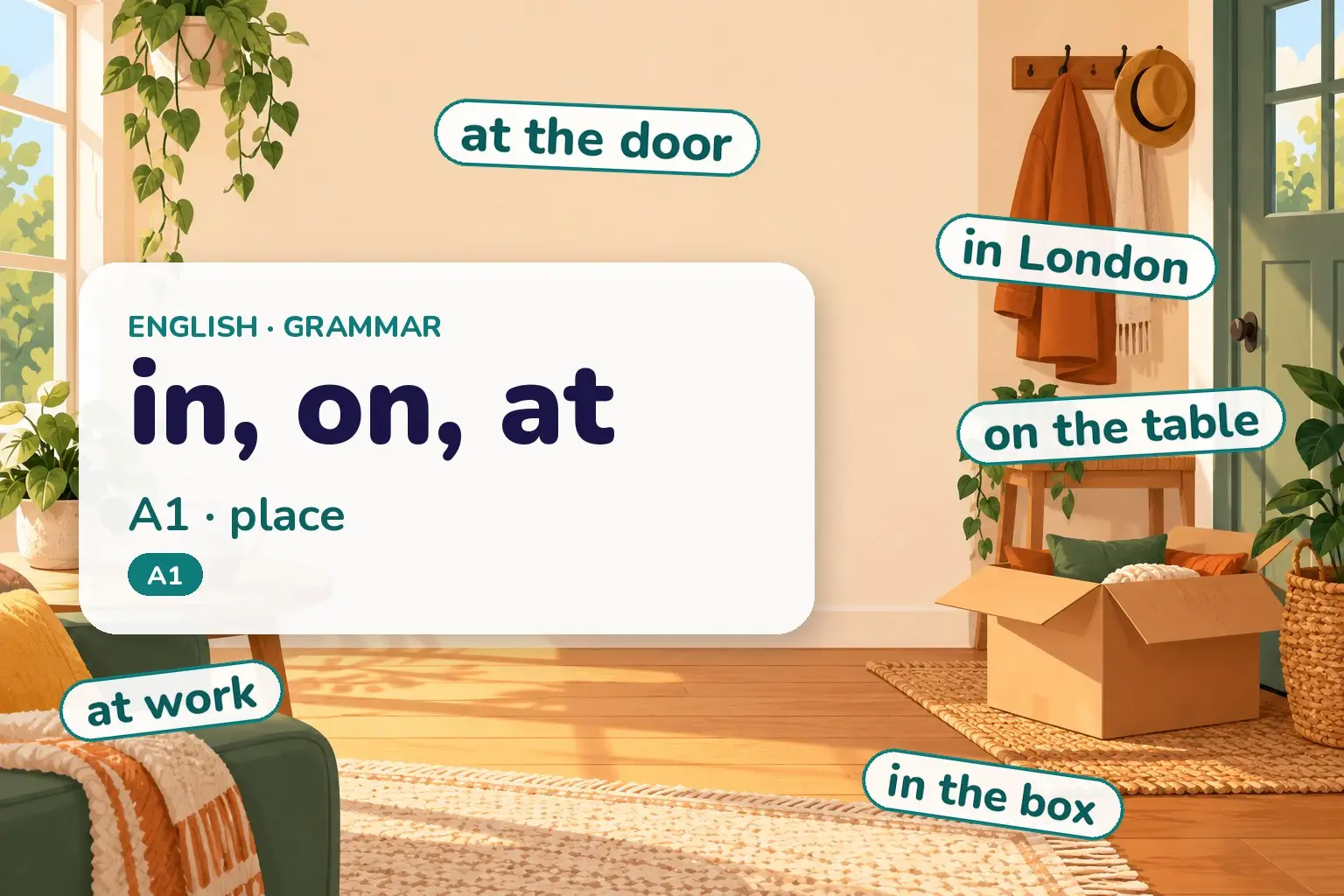
Use in for enclosed spaces (in the box, in London), on for surfaces and lines (on the table, on the wall), and at for points or specific places (at the door, at the bus stop). These three cover most everyday locations.
Level: A1. A preposition of place tells you where something is. The three you use most are in, on and at. Each has a core idea — a space, a surface, a point — and once you picture that idea, most choices become clear.
The rule
A preposition is a small word that shows a relationship between things; a preposition of place shows where something is located. The three core ones work like this.
in — inside an enclosed space. Think of something with edges or limits around it: in the box, in the kitchen, in the car, in London, in Japan. Towns, cities and countries count as spaces you are inside.
on — touching a surface or a line. Think of contact with a flat surface or something that runs in a line: on the table, on the wall, on the floor, on the second floor, on the bus.
at — a point or a specific place. Think of a single point, or a place you treat as one spot rather than a space: at the door, at the corner, at the bus stop, at school, at work, at the station.
The difference is a matter of how you picture the place, not the place itself. The same building can be in (inside it), on (on a floor of it) or at (as a point you go to): I’m in the office / on the third floor / at the office right now.
in, on, at at a glance
| Preposition | Core idea | Typical uses | Examples |
|---|---|---|---|
| in | enclosed space | rooms, vehicles you enter, towns, countries | in the box, in the car, in Paris |
| on | surface or line | flat surfaces, floors, public transport, walls | on the desk, on the bus, on the wall |
| at | point or specific place | addresses, events, named spots | at the door, at the party, at work |
A few very common phrases are fixed and worth memorising whole, even when the logic feels loose: at home, at school, at work, in bed, in hospital, on the left, on the right, on the corner / at the corner (both are used).
Example sentences
- The keys are in the drawer.'in' — inside an enclosed space.
- She lives in Madrid.'in' with a city.
- They are in the car.'in' — you get inside a car.
- The book is on the table.'on' — touching a flat surface.
- There is a picture on the wall.'on' — against a vertical surface.
- We sat on the floor.'on' — a surface underneath you.
- My office is on the third floor.'on' is used with floors.
- I read on the train.'on' for public transport you walk around in.
- Someone is at the door.'at' — a single point.
- Turn right at the corner.'at' — a point in the street.
- Wait for me at the bus stop.'at' — a specific spot.
- The children are at school.Fixed phrase: at school.
- My father is at work.Fixed phrase: at work.
- Let's meet at the station.'at' — a place seen as a point.
- The cat is in the garden.'in' — an enclosed outdoor space.
- Your coffee is on the counter.'on' — a surface.
- She is still in bed.Fixed phrase: in bed.
- We were at a party last night.'at' with an event.
- The shop is on the left.Fixed phrase: on the left.
- He is waiting at the airport.'at' — a place treated as a point.
Common mistakes
- ❌ I am in the bus stop. → ✅ I am at the bus stop. A bus stop is a point you wait at, not a space you are inside.
- ❌ She lives at London. → ✅ She lives in London. Use in for towns, cities and countries.
- ❌ The picture is in the wall. → ✅ The picture is on the wall. A wall is a surface, so use on.
- ❌ We arrived to the station. → ✅ We arrived at the station. The verb arrive takes at (a point) or in (a town), never to.
- ❌ He is in work today. → ✅ He is at work today. The fixed phrase is at work.
- ❌ The milk is at the fridge. → ✅ The milk is in the fridge. A fridge is an enclosed space: use in.
A short conversation
A: Where are you? I’m at the café. B: Still in the car, almost there. Are you inside? A: Yes, at a table on the left, near the window. B: Great, see you in a minute.
Usage notes
- in vs on for vehicles. You get in a car or taxi (a small, enclosed space) but on a bus, train or plane (you walk around inside a larger one): in the car, on the train.
- at for addresses, in for the city. Use at for a street number and in for the town: She lives at 10 King Street in Oxford.
- Floors use on. Levels of a building take on: on the ground floor, on the top floor.
- Think shape, then check the phrase. Start from space / surface / point, but trust the fixed phrases (at home, in bed, on time) when they override the logic.
Compared with…
- Prepositions of time. The same three words also mark time, with different rules: in for months and years (in May), on for days and dates (on Monday), at for clock times (at six o’clock). See Prepositions of Time: in, on, at.
- Prepositions of movement. Place prepositions say where something is; movement prepositions (to, into, onto) say where something goes: She is at school (place) versus She goes to school (movement). See Prepositions of Movement.
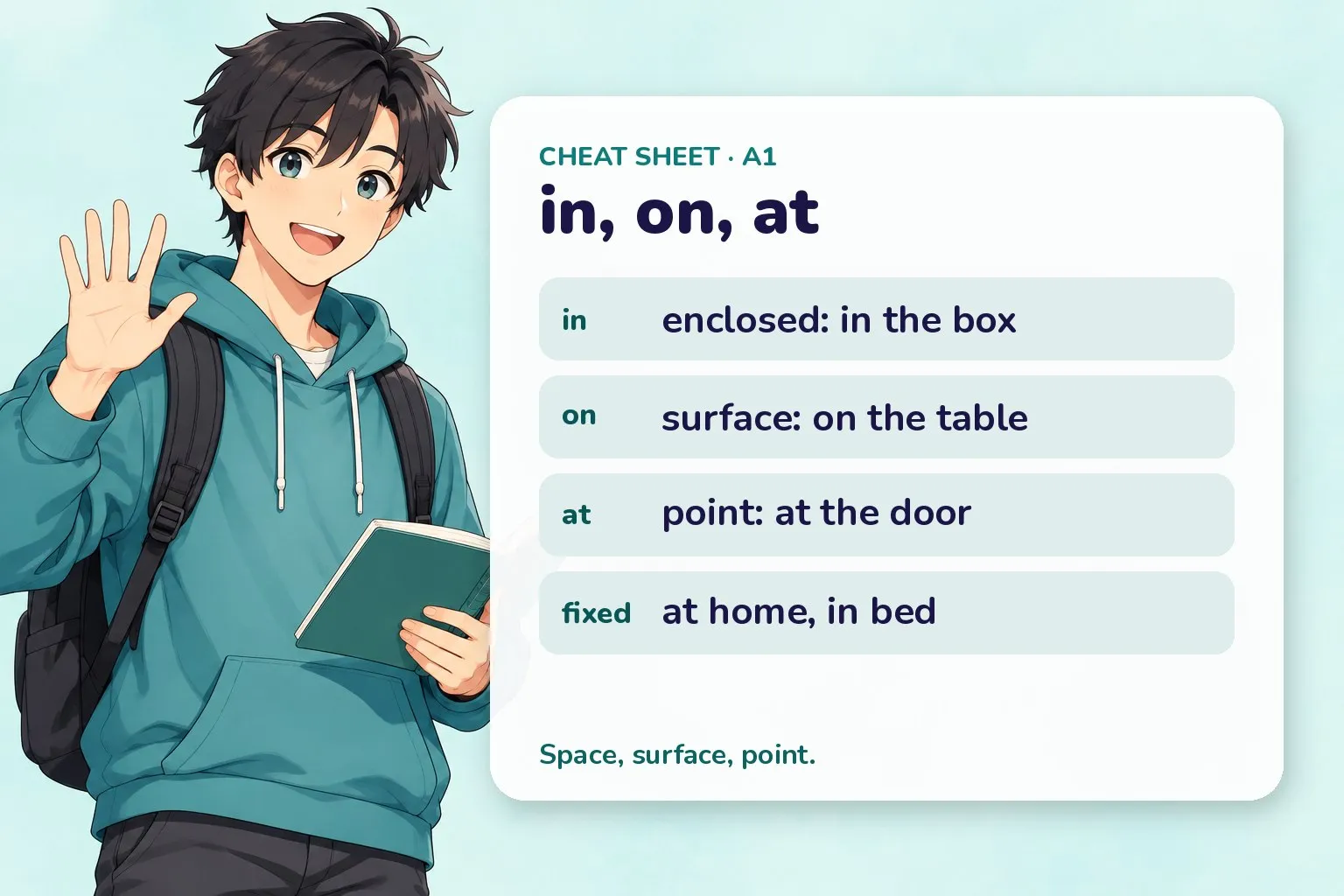
Quick recap before you practise.
Practice
Prepositions of place practice
Try each one, then press Check. No sign-up, nothing is sent anywhere — it all runs in your browser.
Hint: a point, not a space
Show answer
at — A bus stop is a point you wait at: at the bus stop.
3 Put the words in order.
Show answer
The book is on the table — A table is a surface, so the book is 'on the table'.
4 Match the place to its preposition.
- the car
- the wall
- the door
- London
Show answer
- the car → in
- the wall → on
- the door → at
- London → in
Enclosed = in; surface = on; point = at; cities = in.
Quiz
Prepositions of place quiz
12 questions · pick an answer and you'll see straight away if it's right.
-
Show answer
in — 'in' is for enclosed spaces: in the box, in the car.
-
Show answer
on — A wall is a surface, so use 'on'.
-
Show answer
at — A door is a point, so use 'at'.
-
Show answer
in — Countries take 'in': in Japan.
-
Show answer
on the bus — You walk around inside a bus, so 'on the bus'.
-
Show answer
in the car — A car is a small enclosed space, so 'in the car'.
-
Show answer
on — Floors take 'on': on the third floor.
-
Show answer
I am in the bus stop. — A bus stop is a point: 'at the bus stop', not 'in'.
-
Show answer
at — Fixed phrase: at school.
-
Show answer
in — A fridge is an enclosed space: in the fridge.
-
Show answer
at — A station is treated as a point and 'arrive' takes 'at': at the station.
-
Show answer
on — Fixed phrase for direction: on the left.
Recap cheat-sheet
| Word | Idea | Example |
|---|---|---|
| in | enclosed space | in the box |
| on | surface / line | on the table |
| at | point / spot | at the door |
| fixed | learn whole | at home, in bed |
Next
- Next topic: Prepositions of Time: in, on, at
- Back to the English grammar section
- New here? Start with Start Learning English Here
All English grammar topics
Every grammar point in order, from your first sentence to advanced structures. Pick one and go straight to it. New lessons go live every day, so topics marked Coming soon fill in over the next weeks.
Grammar path
A1 30 topics · 30 ready
- 01 Verb 'To Be' in the Present (am, is, are)
- 02 Subject Pronouns: I, You, He, She, It, We, They
- 03 Present Simple: Affirmative and the -s Ending
- 04 Present Simple: Negatives and Questions (do/does)
- 05 Articles: a / an and When to Use Each
- 06 The Definite Article 'The': When to Use It
- 07 Zero Article: When to Use No Article
- 08 Plural Nouns: Regular and Irregular Forms
- 09 This, That, These, Those (Demonstratives)
- 10 Possessive Adjectives: my, your, his, her
- 11 Possessive 's and s' (Showing Belonging)
- 12 There Is / There Are (Saying What Exists)
- 13 Have Got: Talking About Possession
- 14 Can and Can't for Ability
- 15 Present Continuous (am/is/are + -ing)
- 16 Imperatives: Giving Orders and Instructions
- 17 Adjectives: Position and Basic Use
- 18 Prepositions of Place: in, on, at You are here
- 19 Prepositions of Time: in, on, at
- 20 Question Words: What, Where, When, Who, Why, How
- 21 How Much vs How Many
- 22 Countable and Uncountable Nouns
- 23 Some and Any: Which One to Use
- 24 Object Pronouns: me, you, him, her, us, them
- 25 Adverbs of Frequency and Their Position
- 26 Like, Love, Hate + -ing (Expressing Preferences)
- 27 Would Like: Polite Wants and Offers
- 28 Making Requests: Can, Could, May I
- 29 Past Simple of 'To Be' (was / were)
- 30 Let's and Shall We: Making Suggestions
A2 25 topics · 25 ready
- 31 Past Simple: Regular Verbs and -ed Spelling
- 32 Past Simple: Irregular Verbs (go, see, have)
- 33 Past Simple: Negatives and Questions (did)
- 34 Comparative Adjectives (bigger, more expensive)
- 35 Superlative Adjectives (the biggest, the most)
- 36 Going To: Plans and Predictions
- 37 Will: Predictions, Decisions and Offers
- 38 Present Continuous for Future Arrangements
- 39 Present Perfect for Experience (ever / never)
- 40 Present Perfect with just, already, yet
- 41 Present Perfect vs Past Simple
- 42 Have To and Don't Have To (Obligation)
- 43 Should and Shouldn't for Advice
- 44 Could: Past Ability and Polite Use
- 45 Much, Many, A Lot Of
- 46 A Few, A Little, Few, Little
- 47 Adverbs of Manner (quickly, well, hard)
- 48 Verb + -ing or Verb + to (Introduction)
- 49 Zero Conditional (Facts and Rules)
- 50 First Conditional (Real Future Possibility)
- 51 Prepositions of Movement (to, into, through)
- 52 Possessive Pronouns: mine, yours, hers
- 53 Past Continuous (was/were + -ing)
- 54 Too and Enough (Degree)
- 55 Order of Adjectives Before a Noun
B1 27 topics · 27 ready
- 56 Past Continuous vs Past Simple
- 57 Used To and Would for Past Habits
- 58 Present Perfect Continuous (have been -ing)
- 59 Present Perfect: Simple vs Continuous
- 60 Past Perfect (had + past participle)
- 61 Second Conditional (Unreal Present/Future)
- 62 Third Conditional (Unreal Past)
- 63 Reported Speech: Statements (Backshift)
- 64 Reported Questions
- 65 Reported Commands and Requests
- 66 Passive Voice: Present and Past Simple
- 67 Must and Mustn't (Strong Obligation)
- 68 May, Might, Could for Possibility
- 69 Defining Relative Clauses (who, which, that)
- 70 Non-Defining Relative Clauses (with commas)
- 71 Gerunds and Infinitives: Full Verb Patterns
- 72 Verbs Where -ing vs to Changes Meaning
- 73 Future Continuous (will be -ing)
- 74 So and Such (Emphasis)
- 75 As...As Comparisons (equality)
- 76 Question Tags (isn't it? do you?)
- 77 Phrasal Verbs: Separable and Inseparable
- 78 Linking Words: because, so, although, but
- 79 Infinitive of Purpose (to / in order to)
- 80 Indirect Questions (Can you tell me...)
- 81 Make, Let, Allow, Help (Causatives Intro)
- 82 Be Used To and Get Used To (+ -ing)
B2 25 topics · 25 ready
- 83 Narrative Tenses for Storytelling
- 84 Past Perfect Continuous (had been -ing)
- 85 Mixed Conditionals
- 86 Wish and If Only (Regrets and Wishes)
- 87 Wish/If Only + would (Complaints)
- 88 Passive Voice: All Tenses and Modals
- 89 Reporting Passive (It is said that / is said to)
- 90 Causative: Have/Get Something Done
- 91 Reduced Relative Clauses (Participles)
- 92 Modals of Deduction: Present and Past
- 93 Needn't Have vs Didn't Need To
- 94 Future Perfect (will have done)
- 95 Participle Clauses (-ing / -ed / having done)
- 96 Advanced Comparatives (far/much + er, the more)
- 97 Conditional Alternatives: unless, as long as, provided
- 98 Advanced Determiners: each, every, either, neither
- 99 Intensifiers and Adverbs of Degree
- 100 Advanced Contrast: despite, in spite of, however
- 101 Advanced Linkers: therefore, moreover, consequently
- 102 Advanced Article Use (generalisations, names)
- 103 Verb + Preposition and Adjective + Preposition
- 104 Relative Clauses: whose, where, when, quantifier + whom
- 105 Subject-Verb Agreement: Tricky Cases
- 106 Emphatic Do (I do like it)
- 107 Would for Past Habits (Formal Narrative)
C1 18 topics · 18 ready
- 108 Inversion with Negative Adverbials
- 109 Inversion in Conditionals (Had I known)
- 110 Cleft Sentences (It was... / What I need is...)
- 111 Fronting and Emphasis (Word Order)
- 112 Subjunctive and Mandative (I suggest he be)
- 113 Ellipsis and Substitution (so, do, one)
- 114 Hedging and Cautious Language
- 115 Nominalisation (Academic Noun Style)
- 116 Advanced Discourse Markers (Spoken & Written)
- 117 Advanced Passive (passive + infinitive, get-passive)
- 118 Advanced Comparative Structures (no sooner...than)
- 119 Future in the Past (was going to / would)
- 120 Advanced Modals (may well, might as well, would rather)
- 121 Advanced Reported Speech (Reporting Verbs + Patterns)
- 122 Advanced and Idiomatic Phrasal Verbs
- 123 Collocation and Colligation (Natural Combinations)
- 124 Advanced Concession (much as, whatever, however + adj)
- 125 Absolute and Non-Finite Clauses (Formal)