Mixed Conditionals (Different Times)
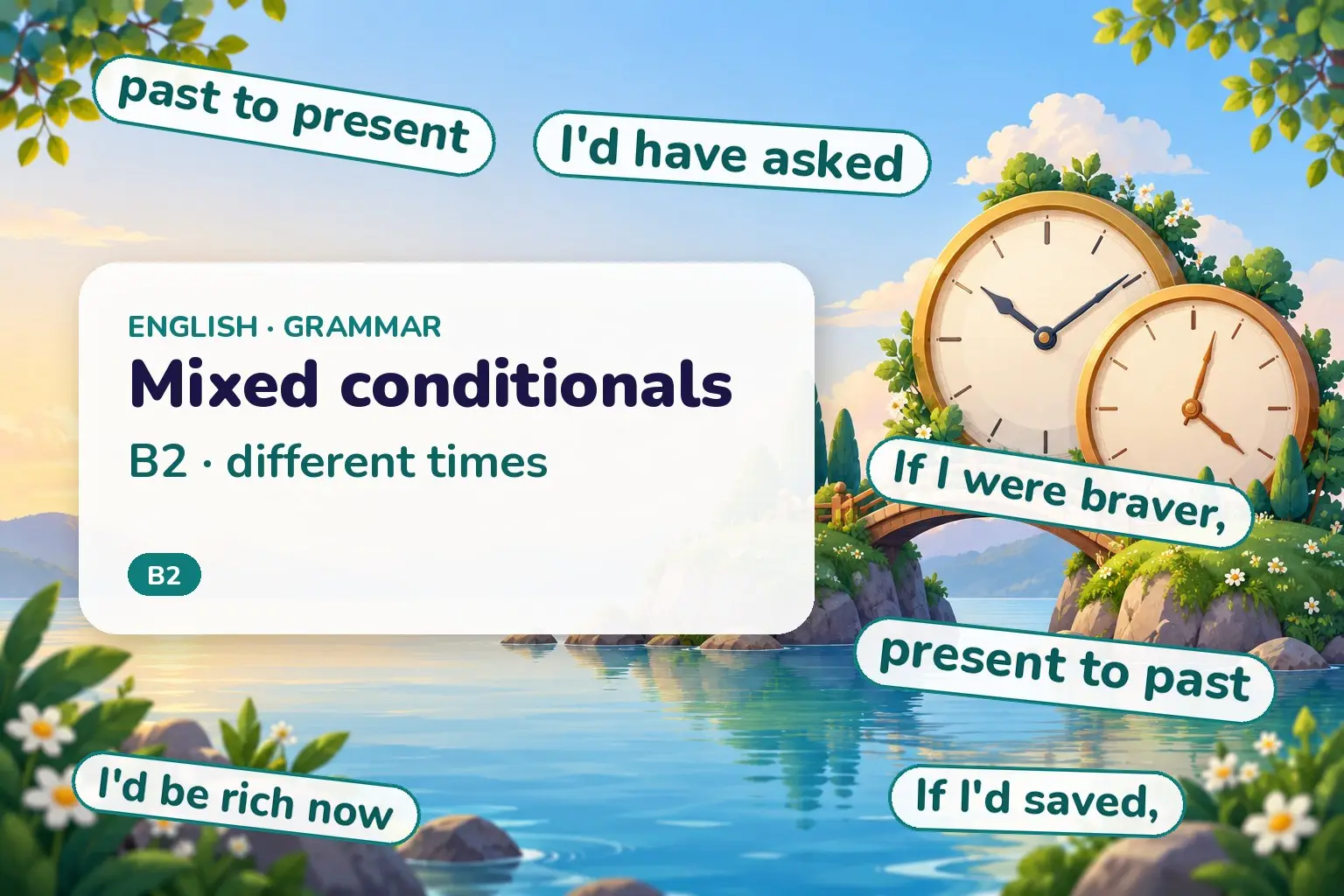
Use a mixed conditional when the condition and result happen at different times. For a past cause with a present result, use if + past perfect, would + base verb. For a present cause with a past result, use if + past simple, would have + past participle.
Level: B2. A mixed conditional joins two different times in one sentence: a condition in one time and a result in another. You build it by taking one half from the second conditional and one half from the third. It is the grammar of “that past choice still shapes my life now” and “the way I am explains what I did.”
The rule
A conditional sentence has an if-clause (the condition) and a main clause (the result). The second and third conditionals keep both halves in the same time: the second is unreal now (if + past simple, would + base verb), the third is unreal past (if + past perfect, would have + past participle). A mixed conditional breaks that match on purpose, because the condition and the result happen at different times.
There are two common patterns. Pattern 1 — past condition, present result. An unreal past that still affects now: “If I had studied medicine, I would be a doctor today.” The if-clause is past perfect (the third-conditional half) and the result is would + base verb (the second-conditional half). The truth is the opposite: I did not study medicine, so I am not a doctor now.
Pattern 2 — present condition, past result. A permanent or present fact that explains a past action or event: “If I weren’t so shy, I would have asked for her number.” The if-clause is past simple / were (the second-conditional half) and the result is would have + past participle (the third-conditional half). The truth is the opposite: I am shy, so I did not ask.
The key test is time, not feeling: ask when is the condition true? and when is the result? If they land in different times, mix the clauses so each half carries the tense of its own time. You can swap would for could or might, add a comma when the if-clause comes first, and use the contraction ’d (would in the result, had in a past-perfect if-clause).
Forms
| Pattern | if-clause | main clause | Example |
|---|---|---|---|
| 1: past → present | if + past perfect | would + base verb | If I had saved, I would be rich now. |
| 1: negative | if + hadn’t + past participle | wouldn’t + base verb | If I hadn’t quit, I wouldn’t be here. |
| 2: present → past | if + past simple / were | would have + past participle | If I were taller, I would have made the team. |
| 2: negative | if + didn’t + base verb | wouldn’t have + past participle | If I didn’t work nights, I wouldn’t have missed it. |
| possibility | (either if-clause) | could/might (+ have) | I could be fluent now / I might have come. |
In pattern 1 the ’d in “If I’d known” is had; in the result “I’d be happy” the ’d is would. With be in a pattern-2 if-clause, careful English uses were for every subject: “If he were more careful, he wouldn’t have broken it.”
Example sentences
- If I had studied medicine, I would be a doctor now.Past cause, present result: I didn't study it, so I'm not a doctor.
- If I had saved more money, I would be able to travel this year.An unreal past still shaping the present.
- If she hadn't missed the flight, she would be in Tokyo right now.She missed it, so she is not there now.
- If we had bought the house in 2015, we wouldn't be renting today.Past decision, present situation.
- If I hadn't eaten so much, I wouldn't feel sick now.Past action, present feeling.
- If he had taken the job, he would live in Berlin.He didn't take it, so he doesn't live there.
- If they had trained harder, they would be champions now.A missed past effort, a present result.
- If I had learned to drive, I wouldn't need you to pick me up.Past gap explaining a present need.
- If I were more organised, I would have finished the report yesterday.Present trait, past result: I'm not organised, so I didn't finish it.
- If he weren't afraid of flying, he would have come with us last week.A permanent fear explaining a past absence.
- If I spoke French, I would have understood the announcement.A present ability I lack explaining a past failure.
- If she didn't have such a busy job, she would have called you back.Present situation, past result.
- If I were taller, I would have made the basketball team.A permanent fact, an unreal past outcome.
- If we lived closer, we would have visited you at the weekend.Present distance explaining a past non-visit.
- If I didn't get car-sick, I would have joined the road trip.A present condition, a past decision.
- If I had charged my phone last night, I wouldn't be lost now.Past omission, present trouble.
- If he had listened to the doctor, he would feel much better today.Past advice ignored, present result.
- If I weren't so tired, I would have noticed the mistake.Present state, past result.
- If you had set an alarm, you wouldn't be late every morning.A past habit's gap and a repeated present result.
- If I could swim, I would have jumped in to help.A present ability, an unreal past action.
- If they had planned better, they would be ahead of schedule now.Past planning, present position.
- I would be fluent by now if I had practised every day.Main clause first: present result, past cause.
Common mistakes
- ❌ If I would have studied medicine, I would be a doctor now. → ✅ If I had studied medicine, I would be a doctor now. Keep would out of the if-clause; the past condition uses the past perfect.
- ❌ If I had studied medicine, I would have been a doctor now. → ✅ …I would be a doctor now. A present result uses would + base verb, not would have + past participle (that would mean a past result).
- ❌ If I were more organised, I would finish the report yesterday. → ✅ …I would have finished the report yesterday. A past result needs would have + past participle, not plain would.
- ❌ If I was you, I would have said no. → ✅ If I were you, I would have said no. Use were for all subjects with be in the present-condition if-clause in careful English.
- ❌ If I hadn’t eaten so much, I won’t feel sick now. → ✅ …I wouldn’t feel sick now. The present result of an unreal past uses would(n’t), not will(n’t).
- ❌ If I would be richer, I would have bought it. → ✅ If I were richer, I would have bought it. The present condition is past simple / were, never would be.
A short conversation
A: You look exhausted. B: I am. If I’d gone to bed earlier, I wouldn’t be this tired now. A: And if you weren’t so tired, you would have caught that typo in the email. B: True. If I were more careful in general, I wouldn’t have sent it at all.
Usage notes
- Two ’d’s, two meanings. In “If I’d known, I’d be ready”, the first ’d is had (past perfect) and the second is would. Expand them when unsure: had known, would be.
- could / might. Use could for ability or possibility (“I could be fluent now”, “I could have helped”) and might for a smaller chance (“I might be there now”, “I might have come”). Would states the result most firmly.
- were, not was. With be in a present-condition if-clause, careful and written English prefers were for every subject, as in the second conditional: “If he were here, he would have known.”
- It is still unreal. Like the second and third conditionals, a mixed conditional describes what is not true. The result is imagined, and the if-clause states the opposite of reality.
How to say it
The pronunciation that trips learners up in mixed conditionals is the reduced, run-together sound of the auxiliaries in fast speech.
- would have → “would’ve” /ˈwʊdəv/. In the past-result half, would have is squashed to would’ve, which sounds like “wood-uv”. This is why people mis-write would of — but the word is always have. Say it, don’t spell it that way.
- ’d /d/. Both had and would shrink to a single /d/ on the pronoun: I’d (/aɪd/), she’d (/ʃiːd/). Context tells you which: before a past participle it’s had; before a base verb it’s would.
- were /wɜː(r)/. In “if I were”, say it like “wur” — one syllable, with the vowel of her, not like we’re.
Compared with…
- Second conditional keeps both halves in the unreal present/future: if + past simple, would + base verb — “If I knew, I would tell you” (condition now, result now). See Second Conditional (Unreal Present/Future).
- Third conditional keeps both halves in the unreal past: if + past perfect, would have + past participle — “If I had known, I would have told you” (condition past, result past). A mixed conditional takes one half from each. See Third Conditional (Unreal Past).
- Alternatives to if (unless, provided that, as long as, suppose) and inverted conditionals (“Had I known…”) can introduce mixed sentences too; the time-mixing rule is the same. See Conditional Alternatives (unless, provided, as long as).
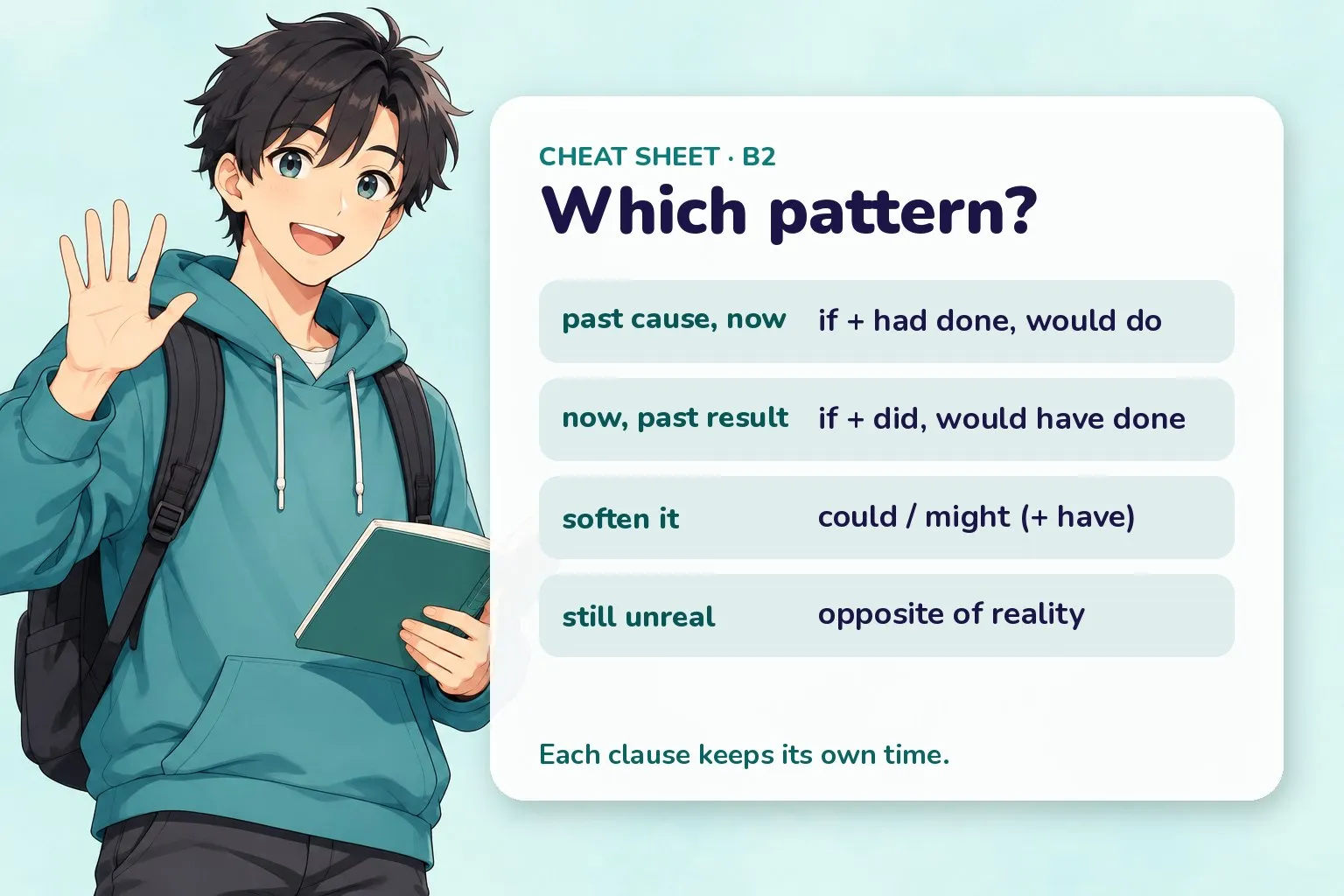
Quick recap before you practise.
Practice
Mixed conditionals practice
Try each one, then press Check. No sign-up, nothing is sent anywhere — it all runs in your browser.
Hint: would + base verb
Show answer
would be — A present result of an unreal past uses would + base verb: would be.
Hint: would have + past participle
Show answer
would have finished — A past result of a present condition uses would have + past participle: would have finished.
4 Put the words in order (present condition, past result).
Show answer
If I were taller I would have made the team — if + were (present condition), would have + past participle (past result).
5 Match each if-clause to the result in the right time.
- If I had gone to bed earlier,
- If I weren't so shy,
- If we had bought in 2015,
- If I spoke French,
Show answer
- If I had gone to bed earlier, → I wouldn't be tired now.
- If I weren't so shy, → I would have said hello.
- If we had bought in 2015, → we wouldn't be renting now.
- If I spoke French, → I would have understood it.
Past perfect pairs with a present result; past simple/were pairs with a past result.
Quiz
Mixed conditionals quiz
12 questions · pick an answer and you'll see straight away if it's right.
-
Show answer
had worked — Past condition uses the past perfect: had worked (result is present, 'would have').
-
Show answer
would be — A present result of an unreal past uses would + base verb: would be.
-
Show answer
weren't — A present/permanent condition uses past simple or 'were': weren't.
-
Show answer
If I would have slept well, I wouldn't be grumpy now. — 'If I would have slept' is wrong; the past condition takes the past perfect 'had slept'.
-
Show answer
I didn't learn to drive, so I need a lift now. — The mixed conditional is unreal: the opposite is true in both halves.
-
Show answer
If they had planned better, they would be ahead now. — Past perfect condition + present result (would be).
-
Show answer
spoke — A present ability I lack is a present condition: past simple 'spoke'; the past result uses 'would have understood'.
-
Show answer
wouldn't be — The present result of an unreal past uses wouldn't + base verb: wouldn't be.
-
Show answer
might be — 'might be' shows a smaller possibility than 'would be'.
-
Show answer
I'd — The present result uses 'would', so the contraction is I'd = I would.
-
Show answer
I would be richer now if I had invested earlier. — Present result (would be) + past condition (had invested); no 'would' in the if-clause.
-
Show answer
If I were more patient, I would have waited. — Use 'were' for the present condition; the past result 'would have waited' is already correct.
Recap cheat-sheet
| Pattern | if-clause | result | Meaning |
|---|---|---|---|
| past → present | if + past perfect | would + base verb | unreal past shapes now |
| present → past | if + past simple / were | would have + past participle | present fact explains the past |
| possibility | (either) | could / might (+ have) | ability or smaller chance |
| still unreal | opposite of reality | imagined outcome | not what happened |
Next
- Next grammar topic: Wish and If Only (Regrets and Wishes)
- Back to the English grammar section
- New here? Start with Start Learning English Here
All English grammar topics
Every grammar point in order, from your first sentence to advanced structures. Pick one and go straight to it. New lessons go live every day, so topics marked Coming soon fill in over the next weeks.
Grammar path
A1 30 topics · 30 ready
- 01 Verb 'To Be' in the Present (am, is, are)
- 02 Subject Pronouns: I, You, He, She, It, We, They
- 03 Present Simple: Affirmative and the -s Ending
- 04 Present Simple: Negatives and Questions (do/does)
- 05 Articles: a / an and When to Use Each
- 06 The Definite Article 'The': When to Use It
- 07 Zero Article: When to Use No Article
- 08 Plural Nouns: Regular and Irregular Forms
- 09 This, That, These, Those (Demonstratives)
- 10 Possessive Adjectives: my, your, his, her
- 11 Possessive 's and s' (Showing Belonging)
- 12 There Is / There Are (Saying What Exists)
- 13 Have Got: Talking About Possession
- 14 Can and Can't for Ability
- 15 Present Continuous (am/is/are + -ing)
- 16 Imperatives: Giving Orders and Instructions
- 17 Adjectives: Position and Basic Use
- 18 Prepositions of Place: in, on, at
- 19 Prepositions of Time: in, on, at
- 20 Question Words: What, Where, When, Who, Why, How
- 21 How Much vs How Many
- 22 Countable and Uncountable Nouns
- 23 Some and Any: Which One to Use
- 24 Object Pronouns: me, you, him, her, us, them
- 25 Adverbs of Frequency and Their Position
- 26 Like, Love, Hate + -ing (Expressing Preferences)
- 27 Would Like: Polite Wants and Offers
- 28 Making Requests: Can, Could, May I
- 29 Past Simple of 'To Be' (was / were)
- 30 Let's and Shall We: Making Suggestions
A2 25 topics · 25 ready
- 31 Past Simple: Regular Verbs and -ed Spelling
- 32 Past Simple: Irregular Verbs (go, see, have)
- 33 Past Simple: Negatives and Questions (did)
- 34 Comparative Adjectives (bigger, more expensive)
- 35 Superlative Adjectives (the biggest, the most)
- 36 Going To: Plans and Predictions
- 37 Will: Predictions, Decisions and Offers
- 38 Present Continuous for Future Arrangements
- 39 Present Perfect for Experience (ever / never)
- 40 Present Perfect with just, already, yet
- 41 Present Perfect vs Past Simple
- 42 Have To and Don't Have To (Obligation)
- 43 Should and Shouldn't for Advice
- 44 Could: Past Ability and Polite Use
- 45 Much, Many, A Lot Of
- 46 A Few, A Little, Few, Little
- 47 Adverbs of Manner (quickly, well, hard)
- 48 Verb + -ing or Verb + to (Introduction)
- 49 Zero Conditional (Facts and Rules)
- 50 First Conditional (Real Future Possibility)
- 51 Prepositions of Movement (to, into, through)
- 52 Possessive Pronouns: mine, yours, hers
- 53 Past Continuous (was/were + -ing)
- 54 Too and Enough (Degree)
- 55 Order of Adjectives Before a Noun
B1 27 topics · 27 ready
- 56 Past Continuous vs Past Simple
- 57 Used To and Would for Past Habits
- 58 Present Perfect Continuous (have been -ing)
- 59 Present Perfect: Simple vs Continuous
- 60 Past Perfect (had + past participle)
- 61 Second Conditional (Unreal Present/Future)
- 62 Third Conditional (Unreal Past)
- 63 Reported Speech: Statements (Backshift)
- 64 Reported Questions
- 65 Reported Commands and Requests
- 66 Passive Voice: Present and Past Simple
- 67 Must and Mustn't (Strong Obligation)
- 68 May, Might, Could for Possibility
- 69 Defining Relative Clauses (who, which, that)
- 70 Non-Defining Relative Clauses (with commas)
- 71 Gerunds and Infinitives: Full Verb Patterns
- 72 Verbs Where -ing vs to Changes Meaning
- 73 Future Continuous (will be -ing)
- 74 So and Such (Emphasis)
- 75 As...As Comparisons (equality)
- 76 Question Tags (isn't it? do you?)
- 77 Phrasal Verbs: Separable and Inseparable
- 78 Linking Words: because, so, although, but
- 79 Infinitive of Purpose (to / in order to)
- 80 Indirect Questions (Can you tell me...)
- 81 Make, Let, Allow, Help (Causatives Intro)
- 82 Be Used To and Get Used To (+ -ing)
B2 25 topics · 25 ready
- 83 Narrative Tenses for Storytelling
- 84 Past Perfect Continuous (had been -ing)
- 85 Mixed Conditionals You are here
- 86 Wish and If Only (Regrets and Wishes)
- 87 Wish/If Only + would (Complaints)
- 88 Passive Voice: All Tenses and Modals
- 89 Reporting Passive (It is said that / is said to)
- 90 Causative: Have/Get Something Done
- 91 Reduced Relative Clauses (Participles)
- 92 Modals of Deduction: Present and Past
- 93 Needn't Have vs Didn't Need To
- 94 Future Perfect (will have done)
- 95 Participle Clauses (-ing / -ed / having done)
- 96 Advanced Comparatives (far/much + er, the more)
- 97 Conditional Alternatives: unless, as long as, provided
- 98 Advanced Determiners: each, every, either, neither
- 99 Intensifiers and Adverbs of Degree
- 100 Advanced Contrast: despite, in spite of, however
- 101 Advanced Linkers: therefore, moreover, consequently
- 102 Advanced Article Use (generalisations, names)
- 103 Verb + Preposition and Adjective + Preposition
- 104 Relative Clauses: whose, where, when, quantifier + whom
- 105 Subject-Verb Agreement: Tricky Cases
- 106 Emphatic Do (I do like it)
- 107 Would for Past Habits (Formal Narrative)
C1 18 topics · 18 ready
- 108 Inversion with Negative Adverbials
- 109 Inversion in Conditionals (Had I known)
- 110 Cleft Sentences (It was... / What I need is...)
- 111 Fronting and Emphasis (Word Order)
- 112 Subjunctive and Mandative (I suggest he be)
- 113 Ellipsis and Substitution (so, do, one)
- 114 Hedging and Cautious Language
- 115 Nominalisation (Academic Noun Style)
- 116 Advanced Discourse Markers (Spoken & Written)
- 117 Advanced Passive (passive + infinitive, get-passive)
- 118 Advanced Comparative Structures (no sooner...than)
- 119 Future in the Past (was going to / would)
- 120 Advanced Modals (may well, might as well, would rather)
- 121 Advanced Reported Speech (Reporting Verbs + Patterns)
- 122 Advanced and Idiomatic Phrasal Verbs
- 123 Collocation and Colligation (Natural Combinations)
- 124 Advanced Concession (much as, whatever, however + adj)
- 125 Absolute and Non-Finite Clauses (Formal)