Verb + Preposition and Adjective + Preposition
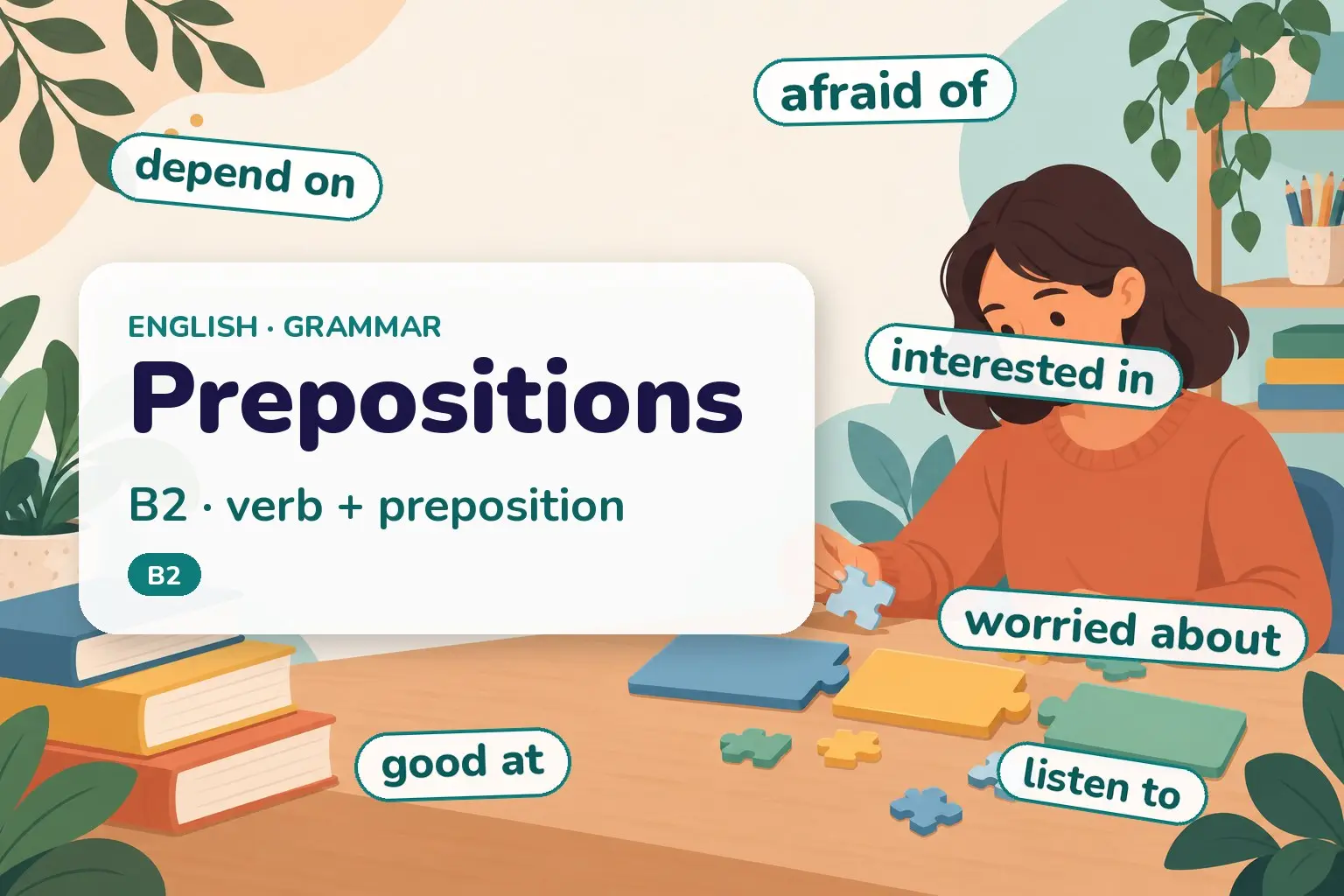
Many English verbs and adjectives take a fixed preposition after them: you depend on someone, listen to music, are good at a skill and afraid of a thing. The pairing is set, so learn each verb or adjective together with its preposition.
Level: B2. Some words simply demand a particular preposition after them. You do not choose it by logic — you learn the pair. This lesson gathers the most common verb + preposition and adjective + preposition combinations and the mistakes they cause.
The rule
A preposition is a small linking word like on, to, at, of, in, for, with, about. A dependent preposition is one that a particular verb or adjective always takes. It is fixed by usage, not by meaning, so depend is followed by on and interested is followed by in — and no reasoning will tell you why. You memorise the combination.
Think of the verb or adjective and its preposition as a single unit. When you learn a new verb, learn the preposition with it: not just rely, but rely on; not just good, but good at. The preposition is then followed by a noun, a pronoun, or an -ing form (never a bare infinitive): good at drawing, afraid of spiders, insist on paying.
Two warnings. First, the same verb can take different prepositions with different meanings: you agree with a person, agree on a plan, and agree to a proposal. Second, some verbs take no preposition even though a translation into another language might add one: you discuss a problem (not discuss about), enter a room (not enter into in the everyday sense), and marry someone (not marry with).
Common patterns
| Pattern | Preposition | Examples |
|---|---|---|
| verb + on | on | depend on, rely on, insist on, concentrate on, spend (money) on |
| verb + to | to | listen to, belong to, refer to, apologise to, object to |
| verb + for | for | wait for, apply for, apologise for, blame for, search for |
| verb + of | of | consist of, approve of, accuse of, remind of, dream of |
| verb + about | about | worry about, complain about, think about, dream about, argue about |
| verb + with | with | agree with, deal with, cope with, provide with, compare with |
| verb + in | in | believe in, succeed in, specialise in, result in, invest in |
| verb + from | from | suffer from, differ from, recover from, benefit from, prevent from |
| adjective + at | at | good at, bad at, brilliant at, hopeless at, surprised at |
| adjective + of | of | afraid of, scared of, proud of, aware of, fond of, capable of, full of |
| adjective + in | in | interested in, experienced in, involved in |
| adjective + about | about | worried about, excited about, anxious about, enthusiastic about |
| adjective + with | with | satisfied with, pleased with, bored with, familiar with |
| adjective + to | to | married to, similar to, kind to, used to, accustomed to |
| adjective + for | for | responsible for, famous for, suitable for, ready for, sorry for |
| adjective + on | on | keen on, dependent on, based on |
Example sentences
- It depends on the weather.'depend on', never 'depend of'.
- You can rely on her to be honest.'rely on' = trust / count on.
- I am not very good at maths.ability: 'good at' + noun or -ing.
- She is afraid of spiders.'afraid of' for fears.
- We are interested in old films.'interested in', never 'interested for'.
- He apologised to me for being late.'apologise to' a person, 'apologise for' a thing.
- The team is worried about the deadline.'worried about' a problem.
- This book belongs to the library.'belong to' = be owned by.
- They accused him of stealing.'accuse of' + -ing.
- I agree with you about the plan.'agree with' a person; 'agree about' a topic.
- The committee agreed on a new rule.'agree on' = reach a decision.
- She finally agreed to help us.'agree to' = consent to do.
- Our profits depend on summer sales.a second 'depend on'.
- He is proud of his daughter.'proud of' someone or something.
- Are you aware of the risks?'aware of' = knowing about.
- The town is famous for its cheese.'famous for' a quality.
- Who is responsible for this mess?'responsible for' a duty or fault.
- This phone is similar to mine.'similar to', never 'similar with'.
- She is married to a doctor.'married to', never 'married with'.
- I am used to the noise now.'used to' + noun/-ing = accustomed to.
- We must deal with the problem today.'deal with' = handle.
- The report consists of three parts.'consist of' = be made up of.
- They succeeded in raising the money.'succeed in' + -ing.
- He suffers from hay fever every spring.'suffer from' an illness.
- Let's discuss the budget tomorrow.'discuss' takes NO preposition: not 'discuss about'.
Common mistakes
- ❌ It depends of the price. → ✅ It depends on the price. The verb depend always takes on.
- ❌ I am interested for music. → ✅ I am interested in music. Interested takes in.
- ❌ She is good in cooking. → ✅ She is good at cooking. Ability is good at, not good in.
- ❌ He is married with a teacher. → ✅ He is married to a teacher. You are married to a person.
- ❌ We discussed about the plan. → ✅ We discussed the plan. Discuss takes no preposition.
- ❌ Listen the radio. → ✅ Listen to the radio. Listen needs to before its object.
A short conversation
A: I’m a bit worried about the exam. I’m hopeless at grammar. B: You can’t rely on luck, but you’re good at practising. Just concentrate on the prepositions. A: True. I keep writing ‘depend of’. B: Everyone does at first. It depends on repetition — learn the verb with its preposition.
Usage notes
- A preposition is followed by a noun, pronoun or -ing form, never a bare infinitive: interested in learning (not interested in to learn), good at drawing, insist on paying.
- Angry with / about / at. You are angry with a person but angry about a situation; angry at is also heard, more in American English.
- The same verb, different prepositions. Think about = consider; think of = have an opinion or recall. Apply for a job but apply to a company. Learn each meaning as its own pair.
- Preposition kept at the end. In questions and relative clauses the preposition often stays put: What are you waiting for?, the person I was talking to. It still belongs to the verb.
Compared with phrasal verbs
A phrasal verb is a verb plus a small particle (up, off, out, down, away) where the particle changes the meaning: give up (stop), take off (remove, or depart), look after (care for), run out (finish). A dependent preposition does not change the meaning of the verb — listen to still means listen; wait for still means wait. The preposition is simply required to connect the verb to its object.
A quick test: with many phrasal verbs you can move the object before a particle (turn the light off / turn off the light); with a dependent preposition you cannot (listen the radio to is impossible). See Phrasal Verbs: an Introduction.
How to say it
- Prepositions are usually unstressed. In depend on the stress is on pend; on is reduced to a quick /ən/. Say “dePEND-ən”, not two equally heavy words.
- of sounds like /əv/ — the f is a soft v sound: “afraid-əv”, “proud-əv”. It is never “off”.
- to before a consonant reduces to /tə/: “listen-tə music”. Keep it short and light.
- at reduces to /ət/: “good-ət maths”. Linking the words smoothly is what makes it sound natural.
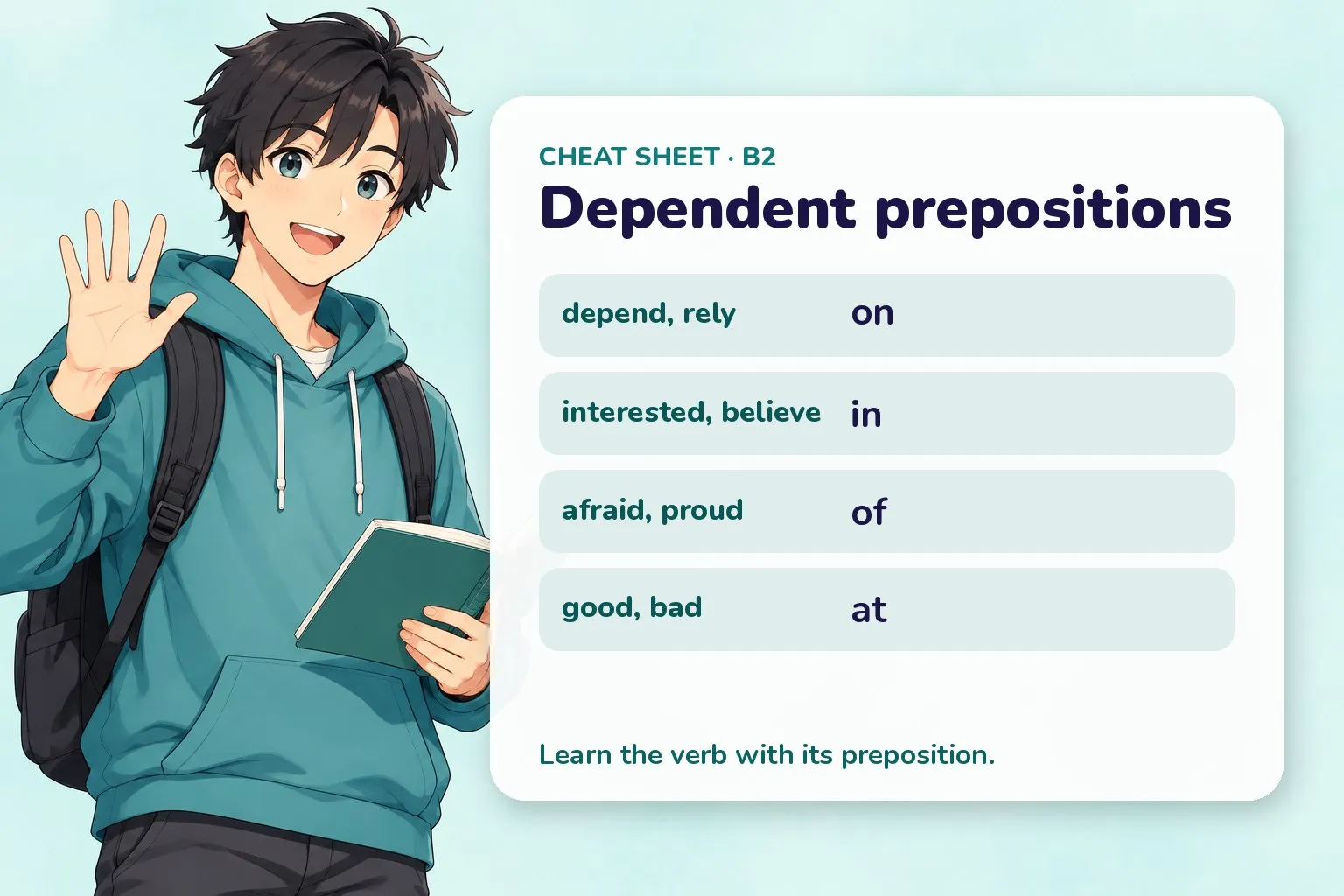
Quick recap before you practise.
Practice
Dependent prepositions practice
Try each one, then press Check. No sign-up, nothing is sent anywhere — it all runs in your browser.
Hint: ability
Show answer
at — 'Good at' is used for skills and abilities.
Hint: not 'for'
Show answer
in — 'Interested in' is the fixed pair; 'interested for' is wrong.
4 Match each word with its preposition.
- afraid
- married
- responsible
- worried
Show answer
- afraid → of
- married → to
- responsible → for
- worried → about
afraid of, married to, responsible for, worried about are all fixed pairs.
6 Put the words in order.
Show answer
You should listen to her advice — 'Listen' needs 'to' before its object: listen to her advice.
Hint: apologise ___ a thing
Show answer
for — You apologise 'to' a person but apologise 'for' a thing you did.
Quiz
Dependent prepositions quiz
12 questions · pick an answer and you'll see straight away if it's right.
-
Show answer
on — 'Rely on' = trust or depend on.
-
Show answer
I'm afraid of dogs. — 'Afraid of' is the fixed pair for fears.
-
Show answer
to — 'Similar to', never 'similar with'.
-
Show answer
She is married with a pilot. — You are 'married to' a person; 'married with' is wrong.
-
Show answer
of — 'Consist of' = be made up of.
-
Show answer
in — 'Succeed in' + -ing form.
-
Show answer
I must deal with this problem. — 'Deal with' = handle a problem.
-
Show answer
from — 'Suffer from' an illness or condition.
-
Show answer
He discussed ___ the plan. — 'Discuss' takes no preposition: discuss the plan. The others need to/for/for.
-
Show answer
about — 'Worried about' a problem or event.
-
Show answer
for — 'Responsible for' a task or a fault.
-
Show answer
give up — 'Give up' = stop; the particle changes the meaning, so it is a phrasal verb.
Recap cheat-sheet
| Word | Preposition | Example |
|---|---|---|
| depend, rely, insist | on | It depends on you. |
| listen, belong | to | Listen to me. |
| interested, believe | in | interested in art |
| afraid, proud, aware | of | afraid of the dark |
| good, bad | at | good at chess |
| worried, excited | about | worried about work |
| responsible, famous | for | famous for its food |
Next
- Next grammar topic: Relative Clauses: whose, where, when, quantifier + whom
- Prerequisites: Prepositions of Place · Prepositions of Time
- Back to the English grammar section
All English grammar topics
Every grammar point in order, from your first sentence to advanced structures. Pick one and go straight to it. New lessons go live every day, so topics marked Coming soon fill in over the next weeks.
Grammar path
A1 30 topics · 30 ready
- 01 Verb 'To Be' in the Present (am, is, are)
- 02 Subject Pronouns: I, You, He, She, It, We, They
- 03 Present Simple: Affirmative and the -s Ending
- 04 Present Simple: Negatives and Questions (do/does)
- 05 Articles: a / an and When to Use Each
- 06 The Definite Article 'The': When to Use It
- 07 Zero Article: When to Use No Article
- 08 Plural Nouns: Regular and Irregular Forms
- 09 This, That, These, Those (Demonstratives)
- 10 Possessive Adjectives: my, your, his, her
- 11 Possessive 's and s' (Showing Belonging)
- 12 There Is / There Are (Saying What Exists)
- 13 Have Got: Talking About Possession
- 14 Can and Can't for Ability
- 15 Present Continuous (am/is/are + -ing)
- 16 Imperatives: Giving Orders and Instructions
- 17 Adjectives: Position and Basic Use
- 18 Prepositions of Place: in, on, at
- 19 Prepositions of Time: in, on, at
- 20 Question Words: What, Where, When, Who, Why, How
- 21 How Much vs How Many
- 22 Countable and Uncountable Nouns
- 23 Some and Any: Which One to Use
- 24 Object Pronouns: me, you, him, her, us, them
- 25 Adverbs of Frequency and Their Position
- 26 Like, Love, Hate + -ing (Expressing Preferences)
- 27 Would Like: Polite Wants and Offers
- 28 Making Requests: Can, Could, May I
- 29 Past Simple of 'To Be' (was / were)
- 30 Let's and Shall We: Making Suggestions
A2 25 topics · 25 ready
- 31 Past Simple: Regular Verbs and -ed Spelling
- 32 Past Simple: Irregular Verbs (go, see, have)
- 33 Past Simple: Negatives and Questions (did)
- 34 Comparative Adjectives (bigger, more expensive)
- 35 Superlative Adjectives (the biggest, the most)
- 36 Going To: Plans and Predictions
- 37 Will: Predictions, Decisions and Offers
- 38 Present Continuous for Future Arrangements
- 39 Present Perfect for Experience (ever / never)
- 40 Present Perfect with just, already, yet
- 41 Present Perfect vs Past Simple
- 42 Have To and Don't Have To (Obligation)
- 43 Should and Shouldn't for Advice
- 44 Could: Past Ability and Polite Use
- 45 Much, Many, A Lot Of
- 46 A Few, A Little, Few, Little
- 47 Adverbs of Manner (quickly, well, hard)
- 48 Verb + -ing or Verb + to (Introduction)
- 49 Zero Conditional (Facts and Rules)
- 50 First Conditional (Real Future Possibility)
- 51 Prepositions of Movement (to, into, through)
- 52 Possessive Pronouns: mine, yours, hers
- 53 Past Continuous (was/were + -ing)
- 54 Too and Enough (Degree)
- 55 Order of Adjectives Before a Noun
B1 27 topics · 27 ready
- 56 Past Continuous vs Past Simple
- 57 Used To and Would for Past Habits
- 58 Present Perfect Continuous (have been -ing)
- 59 Present Perfect: Simple vs Continuous
- 60 Past Perfect (had + past participle)
- 61 Second Conditional (Unreal Present/Future)
- 62 Third Conditional (Unreal Past)
- 63 Reported Speech: Statements (Backshift)
- 64 Reported Questions
- 65 Reported Commands and Requests
- 66 Passive Voice: Present and Past Simple
- 67 Must and Mustn't (Strong Obligation)
- 68 May, Might, Could for Possibility
- 69 Defining Relative Clauses (who, which, that)
- 70 Non-Defining Relative Clauses (with commas)
- 71 Gerunds and Infinitives: Full Verb Patterns
- 72 Verbs Where -ing vs to Changes Meaning
- 73 Future Continuous (will be -ing)
- 74 So and Such (Emphasis)
- 75 As...As Comparisons (equality)
- 76 Question Tags (isn't it? do you?)
- 77 Phrasal Verbs: Separable and Inseparable
- 78 Linking Words: because, so, although, but
- 79 Infinitive of Purpose (to / in order to)
- 80 Indirect Questions (Can you tell me...)
- 81 Make, Let, Allow, Help (Causatives Intro)
- 82 Be Used To and Get Used To (+ -ing)
B2 25 topics · 25 ready
- 83 Narrative Tenses for Storytelling
- 84 Past Perfect Continuous (had been -ing)
- 85 Mixed Conditionals
- 86 Wish and If Only (Regrets and Wishes)
- 87 Wish/If Only + would (Complaints)
- 88 Passive Voice: All Tenses and Modals
- 89 Reporting Passive (It is said that / is said to)
- 90 Causative: Have/Get Something Done
- 91 Reduced Relative Clauses (Participles)
- 92 Modals of Deduction: Present and Past
- 93 Needn't Have vs Didn't Need To
- 94 Future Perfect (will have done)
- 95 Participle Clauses (-ing / -ed / having done)
- 96 Advanced Comparatives (far/much + er, the more)
- 97 Conditional Alternatives: unless, as long as, provided
- 98 Advanced Determiners: each, every, either, neither
- 99 Intensifiers and Adverbs of Degree
- 100 Advanced Contrast: despite, in spite of, however
- 101 Advanced Linkers: therefore, moreover, consequently
- 102 Advanced Article Use (generalisations, names)
- 103 Verb + Preposition and Adjective + Preposition You are here
- 104 Relative Clauses: whose, where, when, quantifier + whom
- 105 Subject-Verb Agreement: Tricky Cases
- 106 Emphatic Do (I do like it)
- 107 Would for Past Habits (Formal Narrative)
C1 18 topics · 18 ready
- 108 Inversion with Negative Adverbials
- 109 Inversion in Conditionals (Had I known)
- 110 Cleft Sentences (It was... / What I need is...)
- 111 Fronting and Emphasis (Word Order)
- 112 Subjunctive and Mandative (I suggest he be)
- 113 Ellipsis and Substitution (so, do, one)
- 114 Hedging and Cautious Language
- 115 Nominalisation (Academic Noun Style)
- 116 Advanced Discourse Markers (Spoken & Written)
- 117 Advanced Passive (passive + infinitive, get-passive)
- 118 Advanced Comparative Structures (no sooner...than)
- 119 Future in the Past (was going to / would)
- 120 Advanced Modals (may well, might as well, would rather)
- 121 Advanced Reported Speech (Reporting Verbs + Patterns)
- 122 Advanced and Idiomatic Phrasal Verbs
- 123 Collocation and Colligation (Natural Combinations)
- 124 Advanced Concession (much as, whatever, however + adj)
- 125 Absolute and Non-Finite Clauses (Formal)