Verb 'To Be' in the Present (am, is, are)
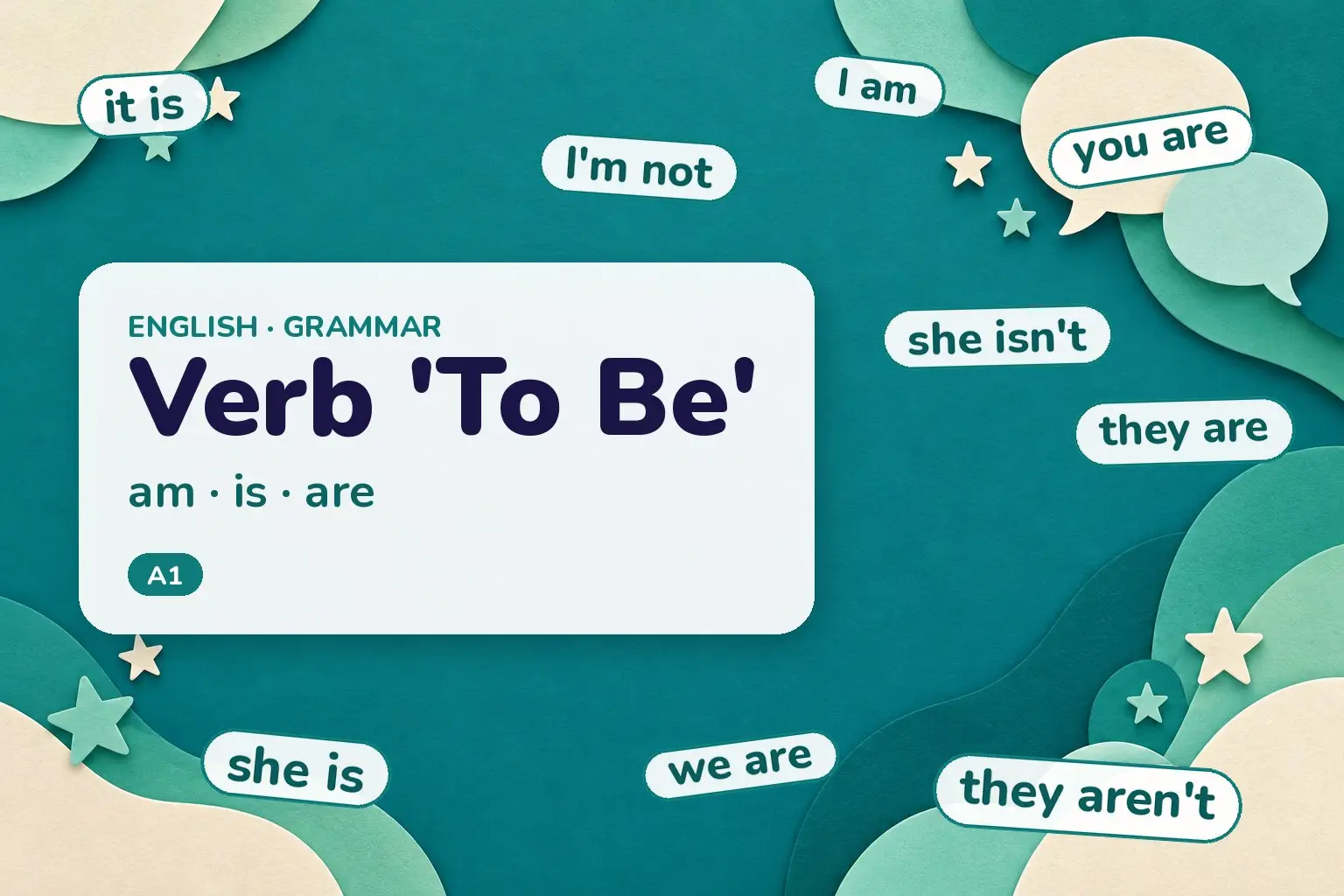
English 'to be' has three present-tense forms: I am, he/she/it is, and you/we/they are. Use it to link a subject to a description, job, age, feeling or place — for example, 'I am a student' or 'She is tired.' In everyday English these forms are usually contracted: I'm, you're, he's, she's, it's, we're, they're.
Level: A1. The verb to be is the first verb most learners need, because it links a subject to who or what it is. You can say “I am a teacher”, “the coffee is hot”, or “they are at work” — all with to be.
The rule
A verb is a word for an action or a state. To be describes a state: what someone or something is. In the present tense it changes shape depending on the subject (the person or thing the sentence is about):
- I → am
- he / she / it (one person or thing) → is
- you / we / they (or any plural) → are. They can mean more than one person, or one person when singular they is used — it still takes are.
The full present tense
| Subject | Positive | Negative | Contraction (negative) |
|---|---|---|---|
| I | I am | I am not | I’m not |
| you | you are | you are not | you aren’t / you’re not |
| he / she / it | he is | he is not | he isn’t / he’s not |
| we | we are | we are not | we aren’t / we’re not |
| they | they are | they are not | they aren’t / they’re not |
Positive contractions: I’m, you’re, he’s, she’s, it’s, we’re, they’re.
Questions put the verb first: Am I late? Is she a nurse? Are you ready?
Example sentences
Each example below was written for this lesson (not copied from a third-party corpus).
- I am a student. — a simple identity statement.
- She is a doctor. — someone’s job.
- He is twelve years old. — age.
- You are my best friend.
- We are at home now. — place.
- They are from Canada. — origin.
- It is cold today. — weather / a thing’s state.
- I am not hungry. — negative.
- The children are tired.
- Is he your brother? — a question.
- Are you happy? — a question.
- We are not late. — negative.
Common mistakes
- ❌ I happy. → ✅ I am happy. Don’t drop the verb; English needs to be.
- ❌ He are tired. → ✅ He is tired. Use is for he/she/it.
- ❌ You is nice. → ✅ You are nice. You always takes are.
- ❌ I no am ready. → ✅ I am not ready. Make negatives with not, not no.
- ❌ She happy is? → ✅ Is she happy? In questions the verb comes first.
Compared with other verbs
In ordinary active sentences, other verbs in the present simple (like work, live, play) do not use am/is/are — you say “I work”, not “I am work”. (Passive sentences such as “it is made” are a different structure that does use is.) The -s on he/she/it (he works) marks the present simple here. See the present simple (affirmative) topic in the English grammar section for that pattern.
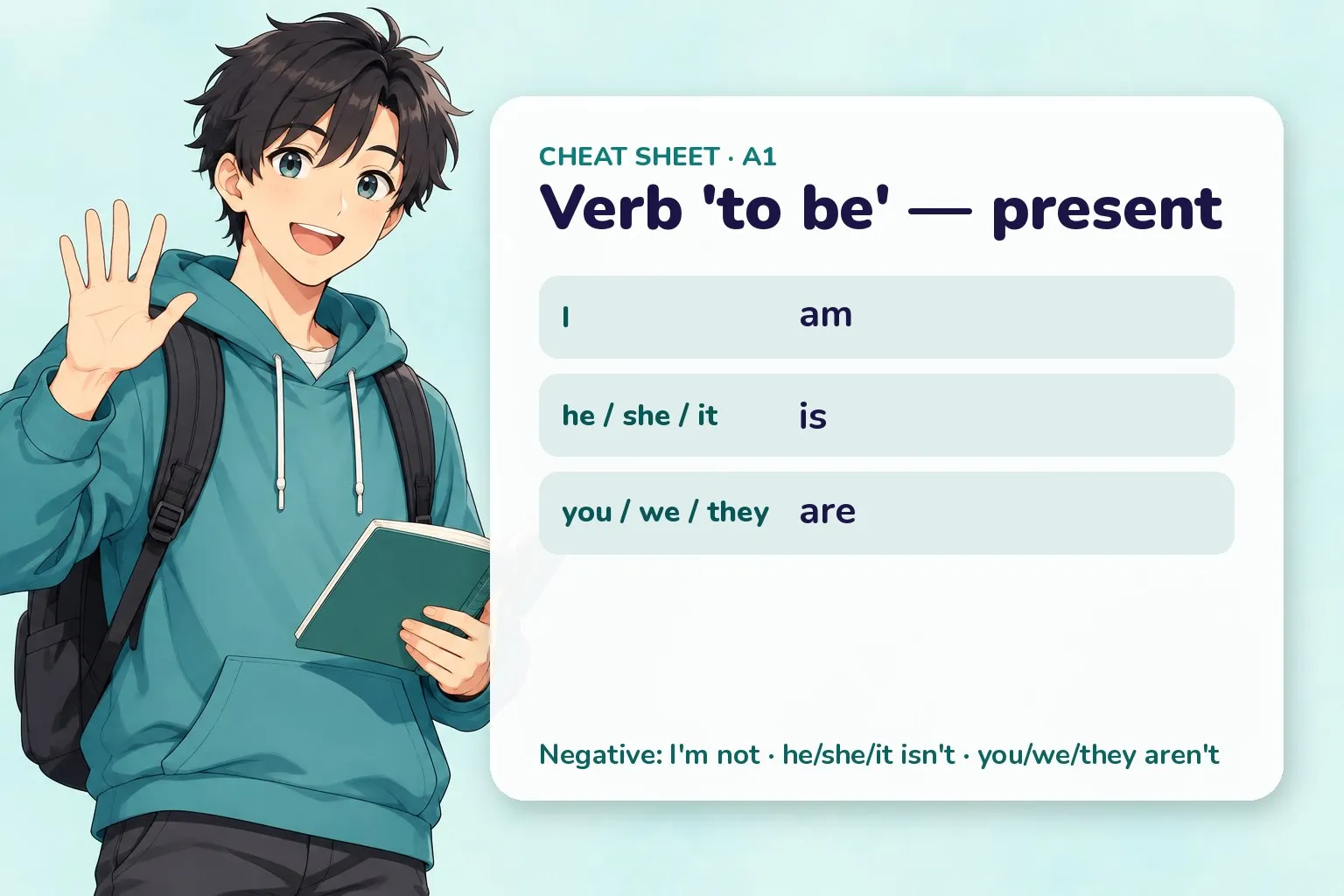
Quick recap before the quiz.
Mini quiz
- I ___ a teacher.
- She ___ from Spain.
- ___ you ready?
- They ___ not at school today.
- He ___ tired. (contraction)
Answers
- am — the subject is I.
- is — she takes is.
- Are — question with you; verb first.
- are — they takes are (they aren’t / they are not).
- ’s → He’s tired. — contraction of he is.
Sources & licensing
- Forms cross-checked with Wiktionary (CC BY-SA 4.0).
- Example sentences were written for this lesson; no third-party sentences were copied.
- This topic sits at beginner level (A1) in common course sequencing; the CEFR and Cambridge grammar are used as general references, not as a topic-by-topic level ruling.
Next
- Back to the English grammar section
- New here? Start with Start Learning English Here
Sources
- be — conjugation and forms — Wiktionary (CC BY-SA 4.0) (as of October 2026)
- British Grammar: be — Cambridge University Press (as of October 2026)
- CEFR level descriptions (A1) — Council of Europe (as of October 2026)