Absolute and Non-Finite Clauses (Formal)
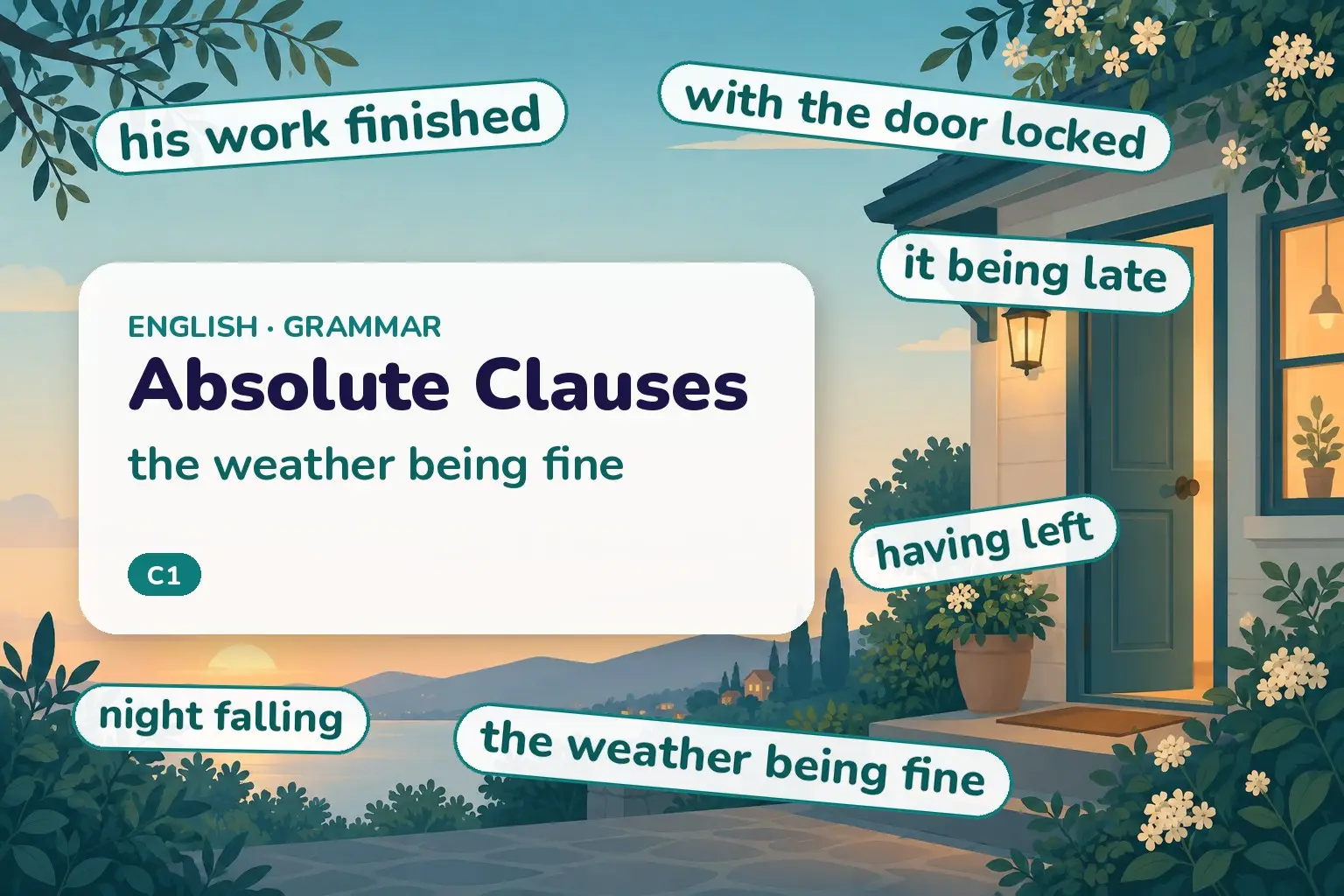
An absolute clause is a non-finite clause with its own subject, usually a noun plus a participle, that sets a background for the main clause: The weather being fine, we went out. Unlike a plain participle clause, it never dangles.
On this page10 sections · tap to jump
Level: C1. You already shorten clauses with participles (Opening the door, she smiled). This lesson adds the formal step: a participle clause that keeps its own subject, so you can glue two different subjects into one tidy, written sentence.
The rule
A finite clause has a subject and a tensed verb (the weather was fine). A non-finite clause drops the tense and uses a participle instead (the weather being fine). An absolute clause (also called a nominative absolute) is a non-finite clause that keeps its own subject — a subject different from the main clause — and sets a background of reason, time or circumstance for the whole sentence.
Compare the two. In a plain participle clause the subject is shared: Feeling tired, she went to bed (she feels, she goes). In an absolute clause the subject is its own: The children being asleep, she finally sat down (the children sleep, she sits). Because the absolute clause states its own subject, it is the one participle clause that cannot dangle.
The core shape is noun + participle. Use the -ing form for an active or ongoing background (The weather being fine …), the past participle for a completed or passive one (His work finished …), and having + past participle for something clearly earlier (The guests having left …). You can drop being before an adjective, a noun or a place phrase: The meeting over, we left; His arms folded, he waited.
The easiest and least formal version adds with: with + noun + participle / adjective / phrase — With the door locked, we felt safe; With night falling, we hurried home. All of these are set off from the main clause by a comma, and all belong to careful writing far more than to speech.
Forms
| Form | Structure | Meaning | Example |
|---|---|---|---|
| present participle | noun + -ing | active / ongoing reason | The weather being fine, we walked. |
| past participle | noun + past participle | completed / passive | His work finished, he left. |
| perfect | noun + having + past participle | an earlier action | The sun having set, it grew cold. |
| no participle (being dropped) | noun + adjective / noun / phrase | a state | The meeting over, we went home. |
| with-clause | with + noun + participle / phrase | accompanying circumstance | With the door locked, we felt safe. |
| negative | noun + not + participle | the action does not happen | The rain not stopping, we stayed in. |
Example sentences
- The weather being fine, we decided to eat outside.noun (the weather) + being: a reason for the main clause.
- It being late, nobody wanted to start a new topic.the empty subject it carries the being clause.
- There being no further questions, the chair closed the meeting.there + being for 'since there were none'.
- The road being closed, we had to turn back.an active -ing background giving the reason.
- His work finished, he switched off the computer.noun + past participle (finished): a completed action.
- The decision made, there was nothing left to discuss.past participle; being is understood and dropped.
- The guests having left, we finally sat down to rest.having + past participle for an earlier action.
- The sun having set, the air grew cold very quickly.perfect participle: first the sun set, then it cooled.
- The meeting over, everyone hurried off to lunch.noun + adjective (over): being is omitted.
- Dinner ready at last, she called the children to the table.noun + adjective; a state, no participle needed.
- The rain not stopping, we abandoned the picnic.a negative absolute: not goes before the participle.
- With the children asleep, the house was finally quiet.with + noun + adjective: the least formal version.
- With night falling, we quickened our pace towards home.with + noun + present participle for an ongoing circumstance.
- He listened to the whole story, his arms folded.a trailing absolute after the main clause.
- She waited by the door, her coat over her arm.noun + prepositional phrase; being is understood.
- The engine still running, he dashed into the shop.an absolute clause describing the scene.
- All things considered, the plan worked out rather well.a fixed absolute phrase (past participle).
- Weather permitting, the match will go ahead on Saturday.a fixed absolute phrase (present participle).
- The letter having been posted, there was no way to recall it.having been + past participle: earlier and passive.
- Money being short that year, the family cancelled the trip.being + adjective giving the reason.
- With the deadline approaching, the team worked late into the night.with + noun + present participle: a common, natural pattern.
Common mistakes
- ❌ Being Sunday, the shops were closed. → ✅ It being Sunday, the shops were closed. An absolute clause needs its own subject; add it.
- ❌ The weather was fine, we ate outside. → ✅ The weather being fine, we ate outside. To join the two ideas in one sentence, use the participle being, not a finite verb (that would be a comma splice).
- ❌ With the baby was sleeping, she tidied up. → ✅ With the baby sleeping, she tidied up. After with, use a participle, not a finite verb.
- ❌ His work finished he went home. → ✅ His work finished, he went home. Set the absolute clause off with a comma.
- ❌ Having finished the meal, the plates were cleared. → ✅ The meal finished, the plates were cleared. The plates did not finish the meal; give the clause its own subject so it cannot dangle.
- ❌ The sun set, it grew cold. → ✅ The sun having set, it grew cold. For an action that clearly came first, use having + past participle.
A short conversation
A: You left the party early? B: The last train leaving at eleven, I had no choice. A: Fair enough. And with the rain coming down, a taxi would have cost a fortune. B: Exactly. All things considered, an early night suited me fine.
Usage notes
- Register. Absolute clauses are formal and literary. They are common in reports, narrative and news (The vote counted, the result was announced), but rare in casual speech, where people use because, when or so with full clauses.
- The with-version is friendlier. With the door locked, we felt safe sounds far more natural in modern English than the bare The door locked, we felt safe. Reach for with when the plain absolute feels stiff.
- Dropping being. Before an adjective, noun or prepositional phrase, being is usually left out: The job [being] done, we rested; His face [being] pale, he said nothing. Keep being when it adds clarity.
- Fixed expressions. Weather permitting, all things considered, present company excepted and God willing are frozen absolute phrases — learn them whole; do not change the word order.
Compared with…
- Participle clauses are the starting point: they drop the subject because it is shared with the main clause (Opening the door, she smiled). An absolute clause is the same shape but keeps its own subject, which is why it never dangles. See Participle Clauses (-ing / -ed / having done).
- Nominalisation is the other great tool of formal written English: turning a verb or adjective into a noun (decide → decision, fail → failure) to pack more into the subject. Where an absolute clause compresses a clause, nominalisation compresses an idea into a noun phrase. See Nominalisation in Formal Writing.
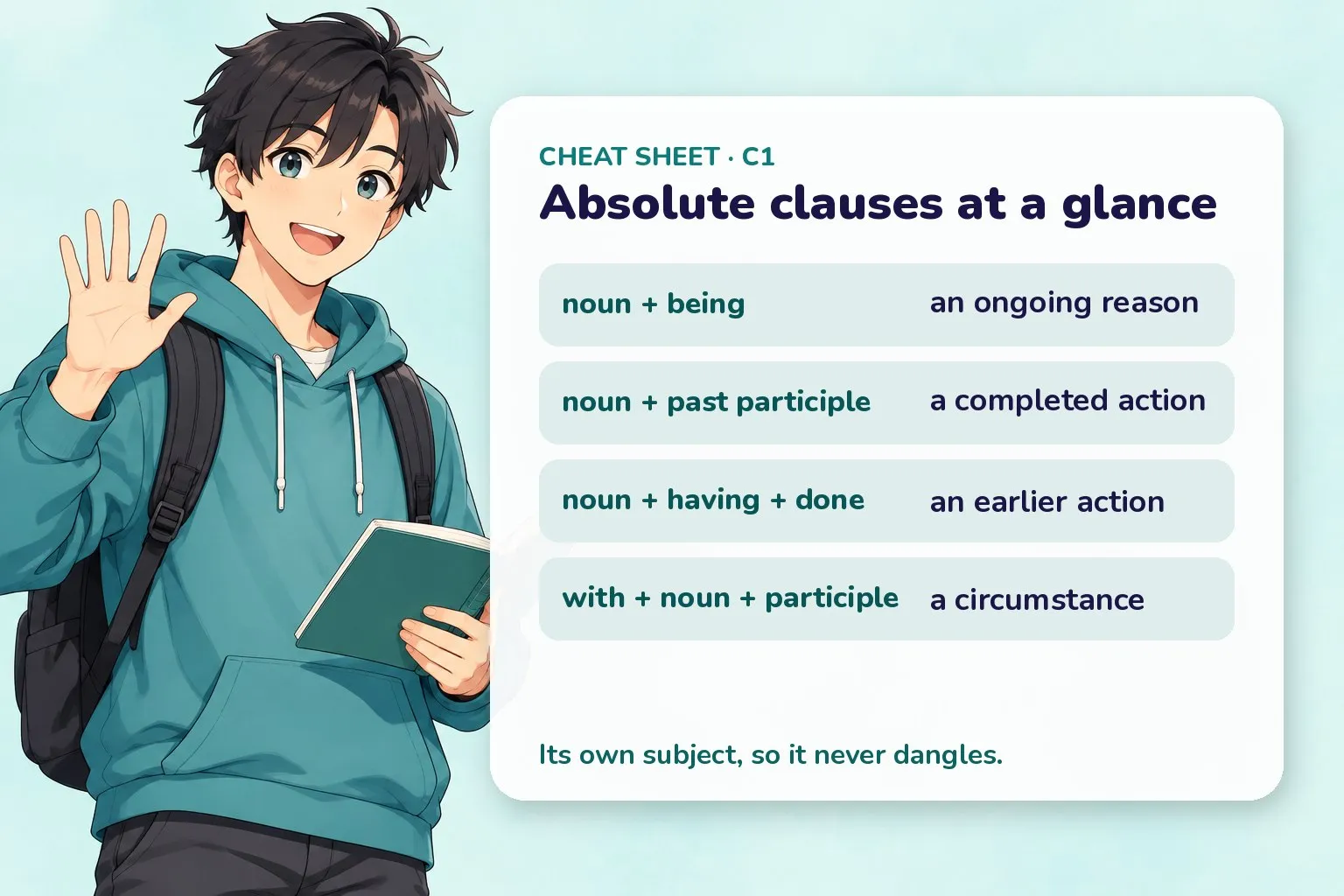
Quick recap before you practise.
Practice
Absolute clauses practice
Try each one, then press Check. No sign-up, nothing is sent anywhere — it all runs in your browser.
Hint: noun + ___ + adjective
Show answer
being — Use the participle being, not a finite verb: The weather being fine.
4 Put the words in order to make an absolute clause with a comma.
Show answer
The guests having left, we relaxed. — Noun + having + past participle, then a comma, then the main clause.
5 Match each form to its example.
- present participle
- past participle
- perfect participle
- with-clause
Show answer
- present participle → The weather being fine, we walked.
- past participle → His work finished, he left.
- perfect participle → The sun having set, it grew cold.
- with-clause → With the door locked, we felt safe.
-ing = ongoing, past participle = completed, having done = earlier, with = accompanying circumstance.
Hint: give the clause its own subject
Show answer
His — An explicit subject stops it dangling: His work finished, he went home.
Quiz
Absolute clauses quiz
12 questions · pick an answer and you'll see straight away if it's right.
-
Show answer
It keeps its own subject, different from the main clause. — An absolute clause has its own subject, separate from the main clause, so it never dangles.
-
Show answer
There being no bus, we walked. — There + being supplies the subject: There being no bus, we walked.
-
Show answer
finished — A completed action takes the past participle: His work finished.
-
Show answer
The guests having left, we rested. — For a clearly earlier action use having + past participle: The guests having left.
-
Show answer
Being fine, we went out. — Being fine has no subject of its own, so the reader cannot tell what was fine; add one (The weather being fine).
-
Show answer
falling — After with use a participle for an ongoing circumstance: With night falling.
-
Show answer
The meeting over, everyone left. — Set the absolute clause off with a comma: The meeting over, everyone left.
-
Show answer
The rain not stopping, we stayed in. — Not goes before the participle: The rain not stopping.
-
Show answer
The children being asleep, she read a book. — Only the third has its own subject (the children), different from she; the others share the main subject.
-
Show answer
Weather permitting — Weather permitting is a frozen absolute phrase meaning if the weather allows.
-
Show answer
having — Having + past participle marks the earlier action: The sun having set.
-
Show answer
The road being closed, we turned back. — Keep the subject and use being: The road being closed, we turned back.
Recap cheat-sheet
| Form | Use | Example |
|---|---|---|
| noun + being | an ongoing reason | The weather being fine… |
| noun + past participle | a completed action | His work finished… |
| noun + having + past participle | an earlier action | The guests having left… |
| noun + adjective/phrase | a state (being dropped) | The meeting over… |
| with + noun + participle | accompanying circumstance | With the door locked… |
Next
- Next grammar topic: Participle Clauses (-ing / -ed / having done)
- Back to the English grammar section
- New here? Start with Start Learning English Here
All English grammar topics
Every grammar point in order, from your first sentence to advanced structures. Pick one and go straight to it. New lessons go live every day, so topics marked Coming soon fill in over the next weeks.
Grammar path
A1 30 topics · 30 ready
- 01 Verb 'To Be' in the Present (am, is, are)
- 02 Subject Pronouns: I, You, He, She, It, We, They
- 03 Present Simple: Affirmative and the -s Ending
- 04 Present Simple: Negatives and Questions (do/does)
- 05 Articles: a / an and When to Use Each
- 06 The Definite Article 'The': When to Use It
- 07 Zero Article: When to Use No Article
- 08 Plural Nouns: Regular and Irregular Forms
- 09 This, That, These, Those (Demonstratives)
- 10 Possessive Adjectives: my, your, his, her
- 11 Possessive 's and s' (Showing Belonging)
- 12 There Is / There Are (Saying What Exists)
- 13 Have Got: Talking About Possession
- 14 Can and Can't for Ability
- 15 Present Continuous (am/is/are + -ing)
- 16 Imperatives: Giving Orders and Instructions
- 17 Adjectives: Position and Basic Use
- 18 Prepositions of Place: in, on, at
- 19 Prepositions of Time: in, on, at
- 20 Question Words: What, Where, When, Who, Why, How
- 21 How Much vs How Many
- 22 Countable and Uncountable Nouns
- 23 Some and Any: Which One to Use
- 24 Object Pronouns: me, you, him, her, us, them
- 25 Adverbs of Frequency and Their Position
- 26 Like, Love, Hate + -ing (Expressing Preferences)
- 27 Would Like: Polite Wants and Offers
- 28 Making Requests: Can, Could, May I
- 29 Past Simple of 'To Be' (was / were)
- 30 Let's and Shall We: Making Suggestions
A2 25 topics · 25 ready
- 31 Past Simple: Regular Verbs and -ed Spelling
- 32 Past Simple: Irregular Verbs (go, see, have)
- 33 Past Simple: Negatives and Questions (did)
- 34 Comparative Adjectives (bigger, more expensive)
- 35 Superlative Adjectives (the biggest, the most)
- 36 Going To: Plans and Predictions
- 37 Will: Predictions, Decisions and Offers
- 38 Present Continuous for Future Arrangements
- 39 Present Perfect for Experience (ever / never)
- 40 Present Perfect with just, already, yet
- 41 Present Perfect vs Past Simple
- 42 Have To and Don't Have To (Obligation)
- 43 Should and Shouldn't for Advice
- 44 Could: Past Ability and Polite Use
- 45 Much, Many, A Lot Of
- 46 A Few, A Little, Few, Little
- 47 Adverbs of Manner (quickly, well, hard)
- 48 Verb + -ing or Verb + to (Introduction)
- 49 Zero Conditional (Facts and Rules)
- 50 First Conditional (Real Future Possibility)
- 51 Prepositions of Movement (to, into, through)
- 52 Possessive Pronouns: mine, yours, hers
- 53 Past Continuous (was/were + -ing)
- 54 Too and Enough (Degree)
- 55 Order of Adjectives Before a Noun
B1 27 topics · 27 ready
- 56 Past Continuous vs Past Simple
- 57 Used To and Would for Past Habits
- 58 Present Perfect Continuous (have been -ing)
- 59 Present Perfect: Simple vs Continuous
- 60 Past Perfect (had + past participle)
- 61 Second Conditional (Unreal Present/Future)
- 62 Third Conditional (Unreal Past)
- 63 Reported Speech: Statements (Backshift)
- 64 Reported Questions
- 65 Reported Commands and Requests
- 66 Passive Voice: Present and Past Simple
- 67 Must and Mustn't (Strong Obligation)
- 68 May, Might, Could for Possibility
- 69 Defining Relative Clauses (who, which, that)
- 70 Non-Defining Relative Clauses (with commas)
- 71 Gerunds and Infinitives: Full Verb Patterns
- 72 Verbs Where -ing vs to Changes Meaning
- 73 Future Continuous (will be -ing)
- 74 So and Such (Emphasis)
- 75 As...As Comparisons (equality)
- 76 Question Tags (isn't it? do you?)
- 77 Phrasal Verbs: Separable and Inseparable
- 78 Linking Words: because, so, although, but
- 79 Infinitive of Purpose (to / in order to)
- 80 Indirect Questions (Can you tell me...)
- 81 Make, Let, Allow, Help (Causatives Intro)
- 82 Be Used To and Get Used To (+ -ing)
B2 25 topics · 25 ready
- 83 Narrative Tenses for Storytelling
- 84 Past Perfect Continuous (had been -ing)
- 85 Mixed Conditionals
- 86 Wish and If Only (Regrets and Wishes)
- 87 Wish/If Only + would (Complaints)
- 88 Passive Voice: All Tenses and Modals
- 89 Reporting Passive (It is said that / is said to)
- 90 Causative: Have/Get Something Done
- 91 Reduced Relative Clauses (Participles)
- 92 Modals of Deduction: Present and Past
- 93 Needn't Have vs Didn't Need To
- 94 Future Perfect (will have done)
- 95 Participle Clauses (-ing / -ed / having done)
- 96 Advanced Comparatives (far/much + er, the more)
- 97 Conditional Alternatives: unless, as long as, provided
- 98 Advanced Determiners: each, every, either, neither
- 99 Intensifiers and Adverbs of Degree
- 100 Advanced Contrast: despite, in spite of, however
- 101 Advanced Linkers: therefore, moreover, consequently
- 102 Advanced Article Use (generalisations, names)
- 103 Verb + Preposition and Adjective + Preposition
- 104 Relative Clauses: whose, where, when, quantifier + whom
- 105 Subject-Verb Agreement: Tricky Cases
- 106 Emphatic Do (I do like it)
- 107 Would for Past Habits (Formal Narrative)
C1 18 topics · 18 ready
- 108 Inversion with Negative Adverbials
- 109 Inversion in Conditionals (Had I known)
- 110 Cleft Sentences (It was... / What I need is...)
- 111 Fronting and Emphasis (Word Order)
- 112 Subjunctive and Mandative (I suggest he be)
- 113 Ellipsis and Substitution (so, do, one)
- 114 Hedging and Cautious Language
- 115 Nominalisation (Academic Noun Style)
- 116 Advanced Discourse Markers (Spoken & Written)
- 117 Advanced Passive (passive + infinitive, get-passive)
- 118 Advanced Comparative Structures (no sooner...than)
- 119 Future in the Past (was going to / would)
- 120 Advanced Modals (may well, might as well, would rather)
- 121 Advanced Reported Speech (Reporting Verbs + Patterns)
- 122 Advanced and Idiomatic Phrasal Verbs
- 123 Collocation and Colligation (Natural Combinations)
- 124 Advanced Concession (much as, whatever, however + adj)
- 125 Absolute and Non-Finite Clauses (Formal) You are here