Collocation and Colligation (Natural Combinations)
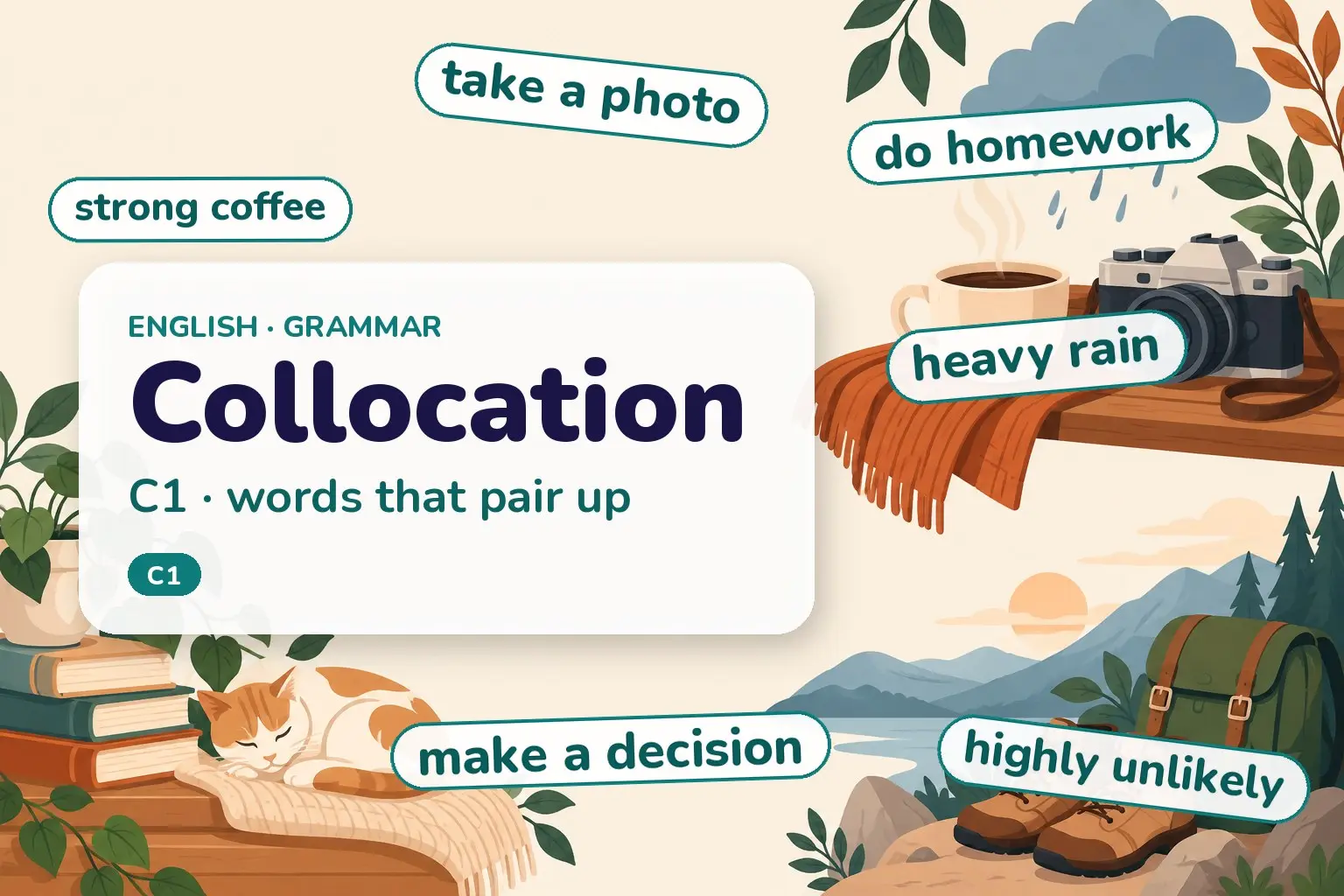
Collocation is which words naturally pair up — you make a decision and have heavy rain, never 'do a decision' or 'strong rain'. Colligation is the grammar a word habitually keeps, such as 'interested in doing' or 'suggest that'. Both are learned as fixed partnerships, not rules.
Level: C1. Your grammar can be flawless and your sentences still read as “foreign” — because the words do not keep their usual company. Make a decision, not do a decision; heavy rain, not strong rain. Choosing words that naturally combine, and giving them the grammar they expect, is what separates advanced writing from merely correct writing.
The rule
A collocation is a pair or group of words that habitually occur together and sound natural to fluent speakers: make a decision, heavy rain, strong coffee, highly unlikely. Nothing in the grammar forbids do a decision or powerful coffee; they are simply not what English speakers say. Collocations are about word choice, not rules, so they are learned, not derived.
A colligation is the companion idea on the grammar side: the regular grammatical pattern a particular word keeps. Depend colligates with the preposition on; interested colligates with in + -ing; suggest colligates with a that-clause or an -ing form but never a to-infinitive; tendency colligates with a to-infinitive (a tendency to overspend). Where collocation asks “which word?”, colligation asks “which structure?”.
Collocations are often graded by strength. A strong collocation allows almost no substitution (shrug your shoulders, foot the bill); a weak one is more open (a big house / a large house / a huge house). The stronger the collocation, the more you must memorise it exactly.
Types of collocation
| Type | Pattern | Examples |
|---|---|---|
| verb + noun | do / make / take / have / pay | make a decision, do research, take a photo, pay attention |
| adjective + noun | fixed descriptive pair | heavy rain, strong coffee, deep sleep, broad daylight |
| adverb + adjective | intensifier + quality | highly unlikely, bitterly disappointed, fully aware |
| verb + adverb | action + manner | strongly recommend, flatly refuse, firmly believe |
| noun + noun | fixed grouping | a round of applause, a flock of birds |
| colligation | word + its grammar | interested in + -ing, depend on, worth + -ing |
Make, do, take and have
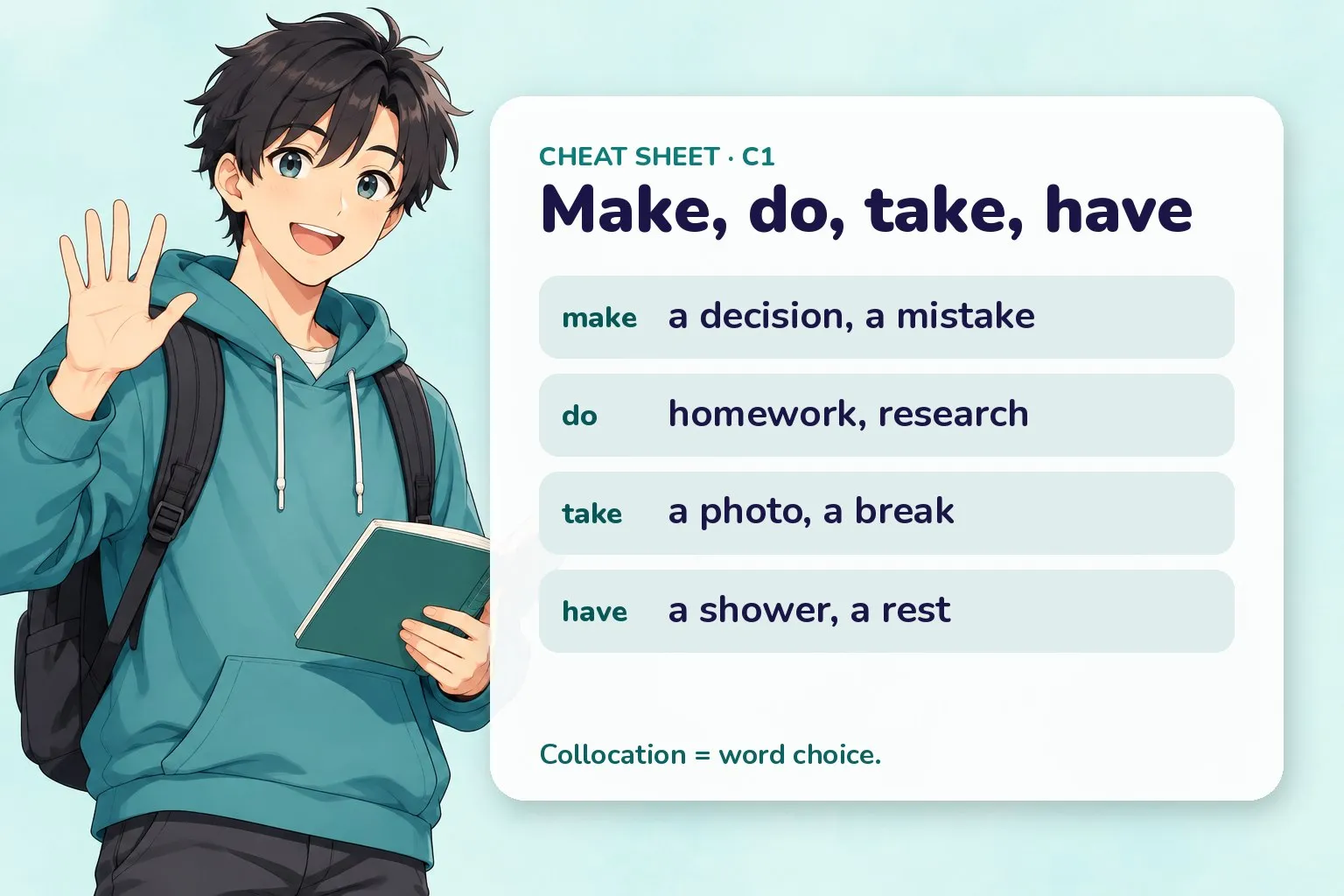
These four “light” verbs cause the most errors because other languages map them differently:
| Verb | Typical partners |
|---|---|
| make | a decision, a mistake, an effort, progress, a suggestion, an appointment, a noise |
| do | homework, research, business, a favour, the washing-up, damage, your best |
| take | a photo, a break, a risk, a seat, responsibility, your time |
| have | a shower, a rest, a go, an argument, a dream, breakfast |
Example sentences
- We need to make a decision by Friday.make a decision (not do a decision).
- I made a silly mistake in the report.make a mistake (not do a mistake).
- She does her homework before dinner.do homework (not make homework).
- They do a lot of research into climate.do research.
- Could you take a photo of us?take a photo (not make a photo).
- Let's take a short break.take a break.
- He always pays attention in meetings.pay attention — a fixed verb-noun pair.
- We're having an argument about money.have an argument.
- There was heavy rain all weekend.heavy rain (not strong rain).
- I'd love a strong coffee right now.strong coffee (not powerful coffee).
- He fell into a deep sleep.deep sleep — fixed adjective-noun pair.
- It's highly unlikely to snow in May.adverb + adjective: highly unlikely.
- She was bitterly disappointed by the result.bitterly disappointed — a strong collocation.
- I'm fully aware of the risks.fully aware.
- I strongly recommend this book.verb + adverb: strongly recommend.
- He flatly refused to apologise.flatly refuse — fixed pairing.
- The outcome depends on the weather.colligation: depend on.
- She's interested in studying medicine.colligation: interested in + -ing.
- It's worth reading the whole chapter.colligation: worth + -ing.
- There's a strong tendency to overspend at sales.colligation: tendency + to-infinitive.
Common mistakes
- ❌ I did a mistake. → ✅ I made a mistake. Errors collocate with make, not do.
- ❌ She must make her homework. → ✅ She must do her homework. Homework and routine tasks take do.
- ❌ He said a joke. → ✅ He told a joke. Jokes, stories and lies collocate with tell.
- ❌ There was strong rain. → ✅ There was heavy rain. Rain, traffic and smokers are heavy, not strong.
- ❌ I’m interested on photography. → ✅ I’m interested in photography. Interested colligates with in.
- ❌ It depends of the price. → ✅ It depends on the price. Depend colligates with on.
- ❌ It’s worth to read it. → ✅ It’s worth reading it. Worth colligates with the -ing form.
A short conversation
A: Have you made a decision about the course? B: Not yet — it depends on the fees. I did some research but I keep making mistakes in the budget. A: Take your time. It’s worth getting it right. B: True. I’m strongly tempted to apply anyway.
Usage notes
- Dictionaries show collocations. A learner’s dictionary lists the typical partners of each word (often in bold or a dedicated box). When you meet a new noun, note the verb and adjective it travels with, not just its meaning.
- Intensifiers are collocational too. You can be bitterly disappointed but not bitterly happy; something can be highly likely but not highly big. Each intensifier keeps its own set of adjectives — see the related lesson on intensifiers.
- Regional variation. Take a decision is standard in British English alongside make a decision; have a shower (BrE) corresponds to take a shower (AmE). State the variant you mean rather than treating one as an error.
- Colligation drives accuracy. Recording the grammar a word keeps — succeed in + -ing, capable of + -ing, the ability to + infinitive — prevents the preposition and complement errors that most often betray an advanced learner.
Compared with…
- Colligation includes the fixed prepositions after verbs and adjectives; the core set is drilled in Verb and Preposition Collocations.
- The adverb-plus-adjective type (highly unlikely, bitterly cold) overlaps with the grammar of degree; compare how intensity words combine in Intensifiers (absolutely, utterly, highly).
Quick recap before you practise.
Practice
Collocation and colligation practice
Try each one, then press Check. No sign-up, nothing is sent anywhere — it all runs in your browser.
Hint: fixed preposition
Show answer
on — 'Depend' colligates with the preposition 'on'.
4 Put the words in order to make a natural collocation.
Show answer
There was heavy rain — Rain collocates with 'heavy', not 'strong': heavy rain.
5 Match each noun to the verb it collocates with.
- a photo
- a mistake
- research
- a shower
Show answer
- a photo → take
- a mistake → make
- research → do
- a shower → have
These are fixed verb-noun partnerships learned as units.
Quiz
Collocation and colligation quiz
12 questions · pick an answer and you'll see straight away if it's right.
-
Show answer
make a mistake — Errors collocate with 'make': make a mistake.
-
Show answer
take — Photos collocate with 'take': take a photo.
-
Show answer
pay — 'Pay attention' is a fixed verb-noun collocation.
-
Show answer
heavy — Rain is 'heavy', not 'strong' or 'powerful'.
-
Show answer
tell a joke — Jokes, stories and lies collocate with 'tell'.
-
Show answer
depend on — 'Depend' colligates with 'on'.
-
Show answer
reading — 'Worth' colligates with the -ing form: worth reading.
-
Show answer
bitterly disappointed — 'Bitterly disappointed' is a fixed strong collocation.
-
Show answer
do — 'Do research' is the standard pairing.
-
Show answer
a tendency to overspend — 'Tendency' colligates with a to-infinitive: a tendency to overspend.
-
Show answer
I took a short break. — 'Take a break' is the correct collocation; the others mix up make/do/take.
-
Show answer
of — 'Capable' colligates with 'of + -ing': capable of running.
Recap cheat-sheet
| Combination | Right | Wrong |
|---|---|---|
| decision | make a decision | do a decision |
| homework | do homework | make homework |
| rain | heavy rain | strong rain |
| joke | tell a joke | say a joke |
| interested | interested in | interested on |
| worth | worth doing | worth to do |
Next
- Back to the English grammar section
- Review Verb and Preposition Collocations
- New here? Start with Start Learning English Here
All English grammar topics
Every grammar point in order, from your first sentence to advanced structures. Pick one and go straight to it. New lessons go live every day, so topics marked Coming soon fill in over the next weeks.
Grammar path
A1 30 topics · 30 ready
- 01 Verb 'To Be' in the Present (am, is, are)
- 02 Subject Pronouns: I, You, He, She, It, We, They
- 03 Present Simple: Affirmative and the -s Ending
- 04 Present Simple: Negatives and Questions (do/does)
- 05 Articles: a / an and When to Use Each
- 06 The Definite Article 'The': When to Use It
- 07 Zero Article: When to Use No Article
- 08 Plural Nouns: Regular and Irregular Forms
- 09 This, That, These, Those (Demonstratives)
- 10 Possessive Adjectives: my, your, his, her
- 11 Possessive 's and s' (Showing Belonging)
- 12 There Is / There Are (Saying What Exists)
- 13 Have Got: Talking About Possession
- 14 Can and Can't for Ability
- 15 Present Continuous (am/is/are + -ing)
- 16 Imperatives: Giving Orders and Instructions
- 17 Adjectives: Position and Basic Use
- 18 Prepositions of Place: in, on, at
- 19 Prepositions of Time: in, on, at
- 20 Question Words: What, Where, When, Who, Why, How
- 21 How Much vs How Many
- 22 Countable and Uncountable Nouns
- 23 Some and Any: Which One to Use
- 24 Object Pronouns: me, you, him, her, us, them
- 25 Adverbs of Frequency and Their Position
- 26 Like, Love, Hate + -ing (Expressing Preferences)
- 27 Would Like: Polite Wants and Offers
- 28 Making Requests: Can, Could, May I
- 29 Past Simple of 'To Be' (was / were)
- 30 Let's and Shall We: Making Suggestions
A2 25 topics · 25 ready
- 31 Past Simple: Regular Verbs and -ed Spelling
- 32 Past Simple: Irregular Verbs (go, see, have)
- 33 Past Simple: Negatives and Questions (did)
- 34 Comparative Adjectives (bigger, more expensive)
- 35 Superlative Adjectives (the biggest, the most)
- 36 Going To: Plans and Predictions
- 37 Will: Predictions, Decisions and Offers
- 38 Present Continuous for Future Arrangements
- 39 Present Perfect for Experience (ever / never)
- 40 Present Perfect with just, already, yet
- 41 Present Perfect vs Past Simple
- 42 Have To and Don't Have To (Obligation)
- 43 Should and Shouldn't for Advice
- 44 Could: Past Ability and Polite Use
- 45 Much, Many, A Lot Of
- 46 A Few, A Little, Few, Little
- 47 Adverbs of Manner (quickly, well, hard)
- 48 Verb + -ing or Verb + to (Introduction)
- 49 Zero Conditional (Facts and Rules)
- 50 First Conditional (Real Future Possibility)
- 51 Prepositions of Movement (to, into, through)
- 52 Possessive Pronouns: mine, yours, hers
- 53 Past Continuous (was/were + -ing)
- 54 Too and Enough (Degree)
- 55 Order of Adjectives Before a Noun
B1 27 topics · 27 ready
- 56 Past Continuous vs Past Simple
- 57 Used To and Would for Past Habits
- 58 Present Perfect Continuous (have been -ing)
- 59 Present Perfect: Simple vs Continuous
- 60 Past Perfect (had + past participle)
- 61 Second Conditional (Unreal Present/Future)
- 62 Third Conditional (Unreal Past)
- 63 Reported Speech: Statements (Backshift)
- 64 Reported Questions
- 65 Reported Commands and Requests
- 66 Passive Voice: Present and Past Simple
- 67 Must and Mustn't (Strong Obligation)
- 68 May, Might, Could for Possibility
- 69 Defining Relative Clauses (who, which, that)
- 70 Non-Defining Relative Clauses (with commas)
- 71 Gerunds and Infinitives: Full Verb Patterns
- 72 Verbs Where -ing vs to Changes Meaning
- 73 Future Continuous (will be -ing)
- 74 So and Such (Emphasis)
- 75 As...As Comparisons (equality)
- 76 Question Tags (isn't it? do you?)
- 77 Phrasal Verbs: Separable and Inseparable
- 78 Linking Words: because, so, although, but
- 79 Infinitive of Purpose (to / in order to)
- 80 Indirect Questions (Can you tell me...)
- 81 Make, Let, Allow, Help (Causatives Intro)
- 82 Be Used To and Get Used To (+ -ing)
B2 25 topics · 25 ready
- 83 Narrative Tenses for Storytelling
- 84 Past Perfect Continuous (had been -ing)
- 85 Mixed Conditionals
- 86 Wish and If Only (Regrets and Wishes)
- 87 Wish/If Only + would (Complaints)
- 88 Passive Voice: All Tenses and Modals
- 89 Reporting Passive (It is said that / is said to)
- 90 Causative: Have/Get Something Done
- 91 Reduced Relative Clauses (Participles)
- 92 Modals of Deduction: Present and Past
- 93 Needn't Have vs Didn't Need To
- 94 Future Perfect (will have done)
- 95 Participle Clauses (-ing / -ed / having done)
- 96 Advanced Comparatives (far/much + er, the more)
- 97 Conditional Alternatives: unless, as long as, provided
- 98 Advanced Determiners: each, every, either, neither
- 99 Intensifiers and Adverbs of Degree
- 100 Advanced Contrast: despite, in spite of, however
- 101 Advanced Linkers: therefore, moreover, consequently
- 102 Advanced Article Use (generalisations, names)
- 103 Verb + Preposition and Adjective + Preposition
- 104 Relative Clauses: whose, where, when, quantifier + whom
- 105 Subject-Verb Agreement: Tricky Cases
- 106 Emphatic Do (I do like it)
- 107 Would for Past Habits (Formal Narrative)
C1 18 topics · 18 ready
- 108 Inversion with Negative Adverbials
- 109 Inversion in Conditionals (Had I known)
- 110 Cleft Sentences (It was... / What I need is...)
- 111 Fronting and Emphasis (Word Order)
- 112 Subjunctive and Mandative (I suggest he be)
- 113 Ellipsis and Substitution (so, do, one)
- 114 Hedging and Cautious Language
- 115 Nominalisation (Academic Noun Style)
- 116 Advanced Discourse Markers (Spoken & Written)
- 117 Advanced Passive (passive + infinitive, get-passive)
- 118 Advanced Comparative Structures (no sooner...than)
- 119 Future in the Past (was going to / would)
- 120 Advanced Modals (may well, might as well, would rather)
- 121 Advanced Reported Speech (Reporting Verbs + Patterns)
- 122 Advanced and Idiomatic Phrasal Verbs
- 123 Collocation and Colligation (Natural Combinations) You are here
- 124 Advanced Concession (much as, whatever, however + adj)
- 125 Absolute and Non-Finite Clauses (Formal)