Nominalisation (Academic Noun Style)
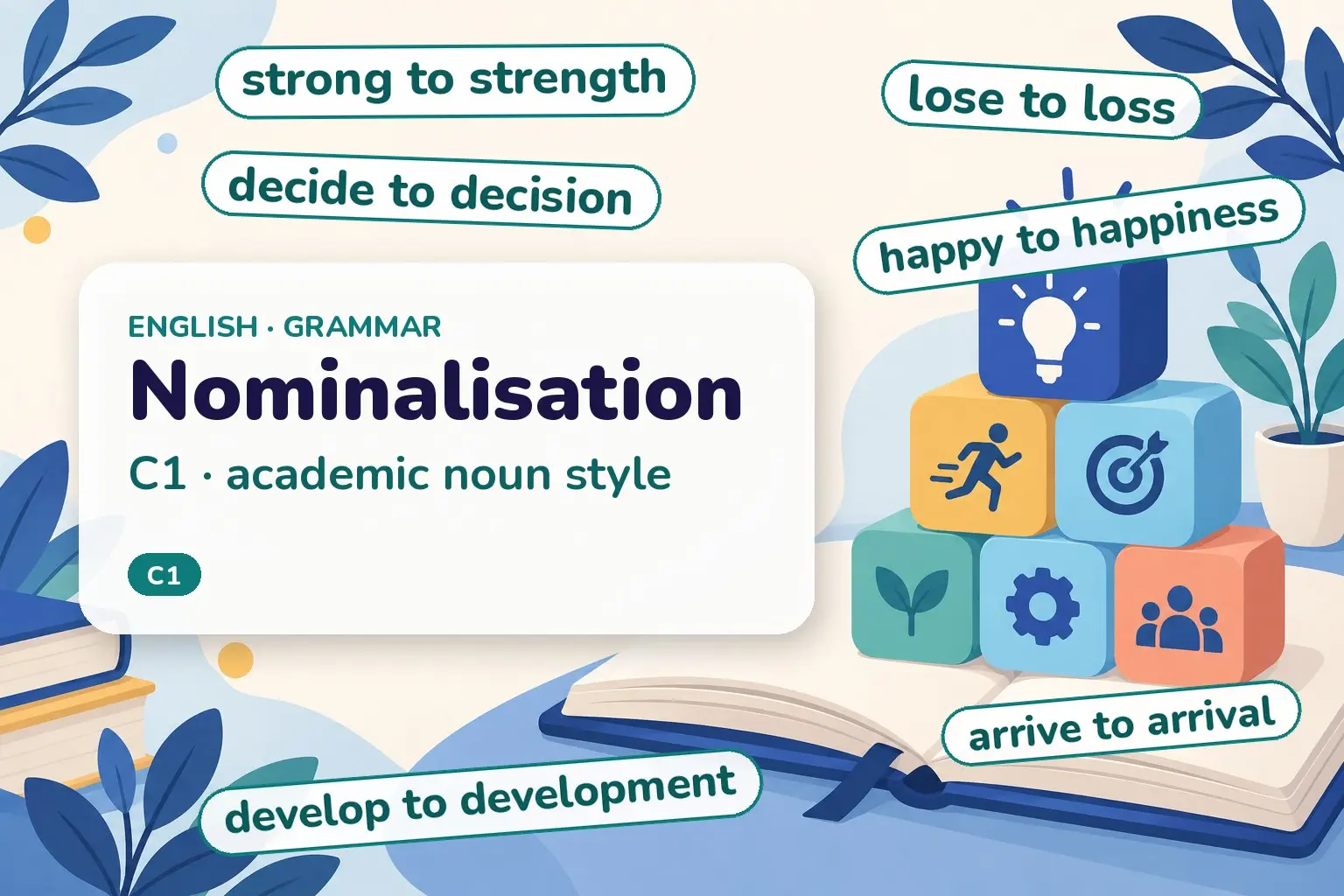
Nominalisation turns a verb or adjective into a noun — decide becomes decision, happy becomes happiness — so an idea can head the sentence. It makes writing denser and more formal, which suits academic and official texts.
Level: C1. You already write clear sentences with verbs. Nominalisation is the next move up: you turn the verb or adjective into a noun so the idea becomes a thing you can name, count and build a formal sentence around.
The rule
Nominalisation means making a noun out of a word that is normally a verb or an adjective. Decide (verb) becomes decision (noun); happy (adjective) becomes happiness (noun). The action or quality is still there, but it is now packaged as a noun phrase — a group of words that works as a single noun.
Why bother? Because a noun can sit in the subject slot and carry a lot of information. Compare They decided to close the factory, and this made many people angry with The decision to close the factory caused anger. The second version is shorter, more abstract and more impersonal. That density is exactly what academic, scientific, legal and official writing wants.
Most nominalisations are built with a suffix: an ending added to the base word. The commonest are -tion/-sion (react → reaction), -ment (develop → development), -ance/-ence (refer → reference), -ity (able → ability), -ness (happy → happiness) and -al (arrive → arrival). Some words change their vowel or stem instead (strong → strength, lose → loss, choose → choice).
The cost is clarity. A noun hides who did what: A decision was taken does not tell you who decided. Good C1 writers use nominalisation to sound formal and to connect ideas, but they stop before the sentence becomes a wall of abstract nouns that no reader can unpack.
Transformation forms
| Base word | Word class | Nominalised noun | Typical ending |
|---|---|---|---|
| decide | verb | decision | -sion |
| develop | verb | development | -ment |
| arrive | verb | arrival | -al |
| fail | verb | failure | -ure |
| argue | verb | argument | -ment |
| analyse | verb | analysis | stem change |
| lose | verb | loss | irregular |
| happy | adjective | happiness | -ness |
| able | adjective | ability | -ity |
| strong | adjective | strength | vowel change |
| wide | adjective | width | vowel change |
| poor | adjective | poverty | -ty |
Example sentences
- The decision was made after a long discussion.decide to decision, discuss to discussion: two nouns carry the action.
- Her analysis of the data was thorough.analyse to analysis, heading the subject of the sentence.
- The failure of the experiment surprised no one.fail to failure lets the idea become the subject.
- Government investment in housing has increased.invest to investment packs the action into one noun.
- The refusal to cooperate delayed the project.refuse to refusal; note the following to-infinitive.
- There has been a significant improvement in air quality.improve to improvement, with the preposition in.
- The development of the vaccine took years.develop to development, a classic -ment noun.
- His arrival went unnoticed.arrive to arrival, an -al noun as subject.
- The assessment of risk is central to the study.assess to assessment.
- Their reaction to the news was calm.react to reaction; the preposition is to.
- The width of the bridge was measured first.wide to width: an adjective turned into a noun with a vowel change.
- Poverty remains the main obstacle to growth.poor to poverty, grow to growth: two nominalisations.
- The accuracy of the results was questioned.accurate to accuracy, an -acy noun.
- Her happiness was obvious to everyone.happy to happiness, an -ness noun.
- The strength of the argument lies in its evidence.strong to strength, argue to argument.
- An explanation was given for the delay.explain to explanation; the agent is hidden on purpose.
- The introduction of the policy caused debate.introduce to introduction.
- The loss of data was a serious problem.lose to loss, an irregular form.
- Knowledge of the subject is assumed.know to knowledge, an irregular noun.
- The choice between the two options was difficult.choose to choice, an irregular form.
- The reduction in costs followed a review of spending.reduce to reduction, review and spend nominalised: dense but still readable.
Common mistakes
- ❌ The implementation of the reduction of the allocation of resources was slow. → ✅ Resources were allocated more slowly after the cuts. Three stacked nouns are unreadable; unpack them into verbs.
- ❌ the analyse of the data → ✅ the analysis of the data. You need the noun analysis, not the verb analyse.
- ❌ He gave an explainment. → ✅ He gave an explanation. Use the correct suffix; explainment is not a word.
- ❌ a big improvement of the situation → ✅ a big improvement in the situation. Many nominalisations take a fixed preposition (improvement in, reaction to, increase in).
- ❌ A decision was taken, which upset everyone, so nobody knew who was responsible. → ✅ The board took the decision, which upset everyone. If the reader needs the agent, name it rather than hiding it in a passive nominal.
- ❌ The developmentation of the plan… → ✅ The development of the plan… Do not double-mark a word that is already a noun.
A short conversation
A: Your report keeps saying we decided and we found. Can you make it sound more academic? B: So I turn the verbs into nouns? A: Exactly. We decided becomes the decision was taken, and we found becomes the findings show. B: Got it — but you warned me not to overdo it. A: Right. One clear noun phrase beats three stacked nouns that nobody can read.
Usage notes
- Where it belongs. Nominalisation is a feature of written, formal registers: research articles, reports, policy, law. In conversation, English strongly prefers verbs — They cut the budget, not The budget reduction was effected.
- Choosing the agent. Nominalisation often lets you drop the agent, like the passive. That is useful for an impersonal tone, but dishonest if you hide responsibility that the reader has a right to know.
- Fixed prepositions. Learn the preposition with the noun: an increase in, a reaction to, a solution to, a reason for, knowledge of, an effect on.
- Linking ideas. A nominalisation can repackage a whole previous sentence as the subject of the next: The factory closed. This closure cost 300 jobs. This is a key tool for cohesion in academic prose.
Compared with…
- Hedging and cautious language is the other main academic-style tool. Where nominalisation compresses information into nouns, hedging softens a claim so you do not overstate it, using modals and adverbs: This may suggest that…, The results appear to indicate…. The two often work together in the same formal sentence. See Hedging and Cautious Language.
- Prerequisite — articles. Nominalised nouns need the right article: the decision (specific), a decision (one of several), decisions in general (zero article). Review Advanced Article Use.
- Prerequisite — subject–verb agreement. A long noun-phrase subject still has to agree with its verb: The analysis of the samples was completed (head noun analysis, singular). See Subject–Verb Agreement.
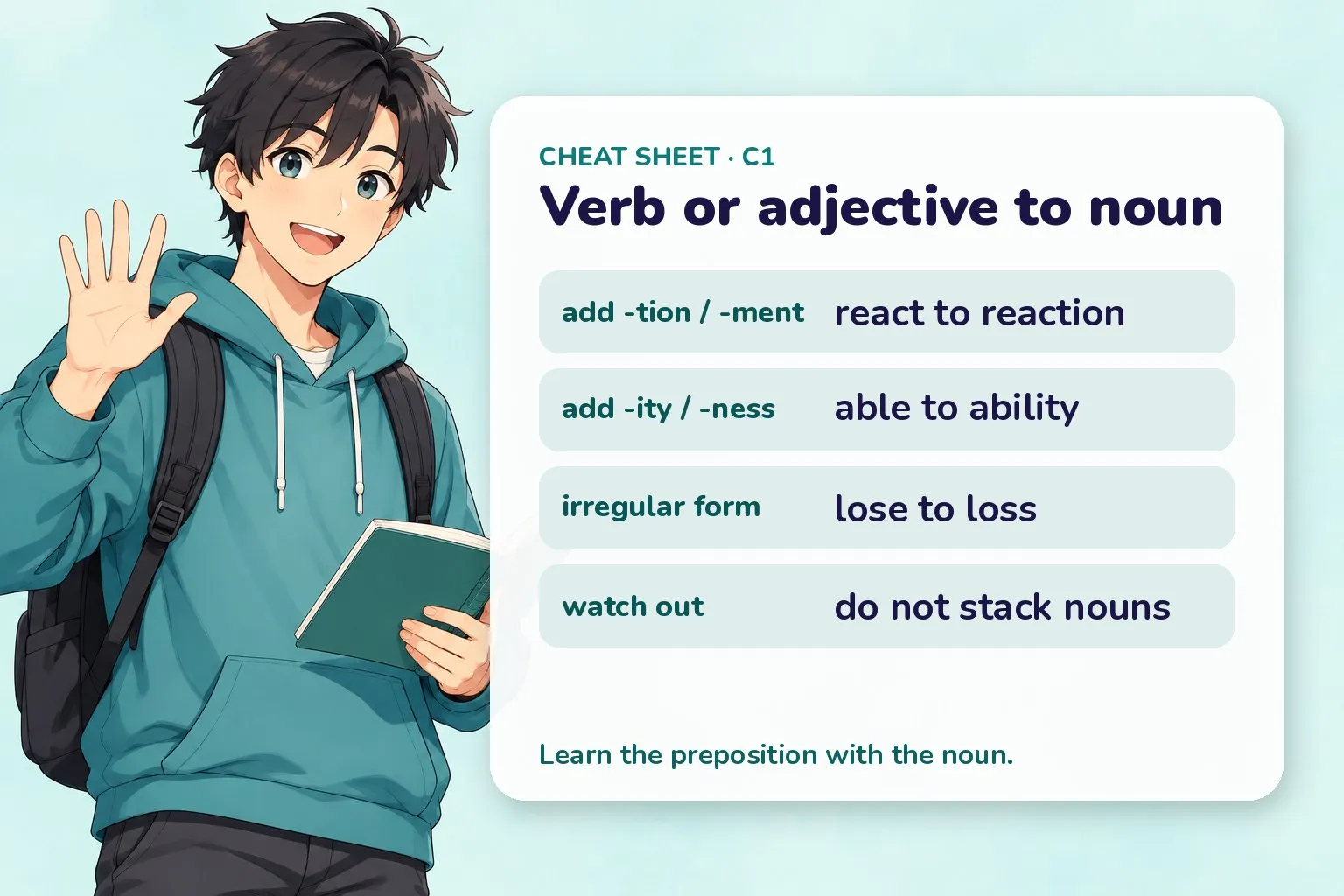
Quick recap before you practise.
Practice
Nominalisation practice
Try each one, then press Check. No sign-up, nothing is sent anywhere — it all runs in your browser.
Hint: decide + -sion
Show answer
decision — decide becomes the noun decision.
Hint: strong, with a vowel change
Show answer
strength — strong becomes strength.
4 Put the words in order to make a nominalised sentence.
Show answer
The development of the app took a year . — develop becomes the noun development, which heads the subject.
5 Match each base word to its noun form.
- arrive
- fail
- able
- lose
Show answer
- arrive → arrival
- fail → failure
- able → ability
- lose → loss
Different bases take different endings; some are irregular.
Quiz
Nominalisation quiz
12 questions · pick an answer and you'll see straight away if it's right.
-
Show answer
refusal — refuse becomes refusal (-al).
-
Show answer
happiness — happy becomes happiness; the y changes to i.
-
Show answer
The closure of the shop caused anger. — close to closure and anger pack the idea into a dense noun phrase.
-
Show answer
development — develop takes -ment: development.
-
Show answer
The analyse of the sample was clear. — You need the noun analysis, not the verb analyse.
-
Show answer
in — The fixed pattern is an increase in.
-
Show answer
ability — able becomes ability (-ity).
-
Show answer
The company reduced staff numbers. — Unpacking the nouns into a verb (reduced) is clearer.
-
Show answer
loss — lose has the irregular noun loss.
-
Show answer
choice — choose has the irregular noun choice.
-
Show answer
assessment — assess becomes assessment.
-
Show answer
To make writing denser, more abstract and impersonal. — It compresses information and gives a formal, impersonal tone.
Recap cheat-sheet
| Move | How | Example |
|---|---|---|
| verb to noun | add -tion/-ment/-al/-ure | react to reaction, arrive to arrival |
| adjective to noun | add -ity/-ness or change the vowel | able to ability, strong to strength |
| irregular | learn the form | lose to loss, choose to choice |
| watch out | do not stack too many nouns | unpack back into a verb |
| preposition | learn it with the noun | increase in, reaction to |
Next
- Next grammar topic: Advanced Discourse Markers (Spoken & Written)
- Back to the English grammar section
- New here? Start with Start Learning English Here
All English grammar topics
Every grammar point in order, from your first sentence to advanced structures. Pick one and go straight to it. New lessons go live every day, so topics marked Coming soon fill in over the next weeks.
Grammar path
A1 30 topics · 30 ready
- 01 Verb 'To Be' in the Present (am, is, are)
- 02 Subject Pronouns: I, You, He, She, It, We, They
- 03 Present Simple: Affirmative and the -s Ending
- 04 Present Simple: Negatives and Questions (do/does)
- 05 Articles: a / an and When to Use Each
- 06 The Definite Article 'The': When to Use It
- 07 Zero Article: When to Use No Article
- 08 Plural Nouns: Regular and Irregular Forms
- 09 This, That, These, Those (Demonstratives)
- 10 Possessive Adjectives: my, your, his, her
- 11 Possessive 's and s' (Showing Belonging)
- 12 There Is / There Are (Saying What Exists)
- 13 Have Got: Talking About Possession
- 14 Can and Can't for Ability
- 15 Present Continuous (am/is/are + -ing)
- 16 Imperatives: Giving Orders and Instructions
- 17 Adjectives: Position and Basic Use
- 18 Prepositions of Place: in, on, at
- 19 Prepositions of Time: in, on, at
- 20 Question Words: What, Where, When, Who, Why, How
- 21 How Much vs How Many
- 22 Countable and Uncountable Nouns
- 23 Some and Any: Which One to Use
- 24 Object Pronouns: me, you, him, her, us, them
- 25 Adverbs of Frequency and Their Position
- 26 Like, Love, Hate + -ing (Expressing Preferences)
- 27 Would Like: Polite Wants and Offers
- 28 Making Requests: Can, Could, May I
- 29 Past Simple of 'To Be' (was / were)
- 30 Let's and Shall We: Making Suggestions
A2 25 topics · 25 ready
- 31 Past Simple: Regular Verbs and -ed Spelling
- 32 Past Simple: Irregular Verbs (go, see, have)
- 33 Past Simple: Negatives and Questions (did)
- 34 Comparative Adjectives (bigger, more expensive)
- 35 Superlative Adjectives (the biggest, the most)
- 36 Going To: Plans and Predictions
- 37 Will: Predictions, Decisions and Offers
- 38 Present Continuous for Future Arrangements
- 39 Present Perfect for Experience (ever / never)
- 40 Present Perfect with just, already, yet
- 41 Present Perfect vs Past Simple
- 42 Have To and Don't Have To (Obligation)
- 43 Should and Shouldn't for Advice
- 44 Could: Past Ability and Polite Use
- 45 Much, Many, A Lot Of
- 46 A Few, A Little, Few, Little
- 47 Adverbs of Manner (quickly, well, hard)
- 48 Verb + -ing or Verb + to (Introduction)
- 49 Zero Conditional (Facts and Rules)
- 50 First Conditional (Real Future Possibility)
- 51 Prepositions of Movement (to, into, through)
- 52 Possessive Pronouns: mine, yours, hers
- 53 Past Continuous (was/were + -ing)
- 54 Too and Enough (Degree)
- 55 Order of Adjectives Before a Noun
B1 27 topics · 27 ready
- 56 Past Continuous vs Past Simple
- 57 Used To and Would for Past Habits
- 58 Present Perfect Continuous (have been -ing)
- 59 Present Perfect: Simple vs Continuous
- 60 Past Perfect (had + past participle)
- 61 Second Conditional (Unreal Present/Future)
- 62 Third Conditional (Unreal Past)
- 63 Reported Speech: Statements (Backshift)
- 64 Reported Questions
- 65 Reported Commands and Requests
- 66 Passive Voice: Present and Past Simple
- 67 Must and Mustn't (Strong Obligation)
- 68 May, Might, Could for Possibility
- 69 Defining Relative Clauses (who, which, that)
- 70 Non-Defining Relative Clauses (with commas)
- 71 Gerunds and Infinitives: Full Verb Patterns
- 72 Verbs Where -ing vs to Changes Meaning
- 73 Future Continuous (will be -ing)
- 74 So and Such (Emphasis)
- 75 As...As Comparisons (equality)
- 76 Question Tags (isn't it? do you?)
- 77 Phrasal Verbs: Separable and Inseparable
- 78 Linking Words: because, so, although, but
- 79 Infinitive of Purpose (to / in order to)
- 80 Indirect Questions (Can you tell me...)
- 81 Make, Let, Allow, Help (Causatives Intro)
- 82 Be Used To and Get Used To (+ -ing)
B2 25 topics · 25 ready
- 83 Narrative Tenses for Storytelling
- 84 Past Perfect Continuous (had been -ing)
- 85 Mixed Conditionals
- 86 Wish and If Only (Regrets and Wishes)
- 87 Wish/If Only + would (Complaints)
- 88 Passive Voice: All Tenses and Modals
- 89 Reporting Passive (It is said that / is said to)
- 90 Causative: Have/Get Something Done
- 91 Reduced Relative Clauses (Participles)
- 92 Modals of Deduction: Present and Past
- 93 Needn't Have vs Didn't Need To
- 94 Future Perfect (will have done)
- 95 Participle Clauses (-ing / -ed / having done)
- 96 Advanced Comparatives (far/much + er, the more)
- 97 Conditional Alternatives: unless, as long as, provided
- 98 Advanced Determiners: each, every, either, neither
- 99 Intensifiers and Adverbs of Degree
- 100 Advanced Contrast: despite, in spite of, however
- 101 Advanced Linkers: therefore, moreover, consequently
- 102 Advanced Article Use (generalisations, names)
- 103 Verb + Preposition and Adjective + Preposition
- 104 Relative Clauses: whose, where, when, quantifier + whom
- 105 Subject-Verb Agreement: Tricky Cases
- 106 Emphatic Do (I do like it)
- 107 Would for Past Habits (Formal Narrative)
C1 18 topics · 18 ready
- 108 Inversion with Negative Adverbials
- 109 Inversion in Conditionals (Had I known)
- 110 Cleft Sentences (It was... / What I need is...)
- 111 Fronting and Emphasis (Word Order)
- 112 Subjunctive and Mandative (I suggest he be)
- 113 Ellipsis and Substitution (so, do, one)
- 114 Hedging and Cautious Language
- 115 Nominalisation (Academic Noun Style) You are here
- 116 Advanced Discourse Markers (Spoken & Written)
- 117 Advanced Passive (passive + infinitive, get-passive)
- 118 Advanced Comparative Structures (no sooner...than)
- 119 Future in the Past (was going to / would)
- 120 Advanced Modals (may well, might as well, would rather)
- 121 Advanced Reported Speech (Reporting Verbs + Patterns)
- 122 Advanced and Idiomatic Phrasal Verbs
- 123 Collocation and Colligation (Natural Combinations)
- 124 Advanced Concession (much as, whatever, however + adj)
- 125 Absolute and Non-Finite Clauses (Formal)