Used To and Would for Past Habits
Use used to + base verb for past habits and past states that are no longer true: I used to smoke; we used to live abroad. Would + base verb also works for repeated past actions, but not for states.
On this page10 sections · tap to jump
Level: B1. Both used to and would describe things that happened repeatedly in the past but don’t happen now. They overlap a lot — but there is one key difference: used to can describe past states, while would cannot. Get that straight and you can use either naturally.
The rule
A habit is something you did regularly; a state is a situation that simply existed (owning something, a feeling, a fact about you).
Used to + base verb describes a past habit or a past state that is finished — true before, but not now:
- I used to smoke, but I quit years ago. (past habit)
- We used to live in Spain. (past state — a situation, not an action)
- She used to have long hair. (past state)
Would + base verb describes a repeated action in the past — something that happened again and again. It does not work for states:
- Every summer we would go to the beach. ✓ (repeated action)
- My grandmother would tell us stories. ✓ (repeated action)
- I would have a car. ✗ — have here is a state, so use used to: I used to have a car.
Because would needs a clear past setting to make sense, it usually comes after used to or a past time phrase has established that you are telling a past-habit story. Starting cold with I would walk to school can sound unfinished; When I was young, I would walk to school is clear.
Forms
| Form | Used to | Would |
|---|---|---|
| Positive | I used to walk | I would walk |
| Negative | I didn’t use to walk | I wouldn’t walk |
| Question | Did you use to walk? | Would you walk? |
| Past states? | Yes (used to have) | No |
| Repeated actions? | Yes | Yes |
Note the spelling: after did / didn’t, the ending loses its d — did you use to…?, I didn’t use to… — because did already carries the past tense.
Example sentences
- I used to smoke, but I stopped last year.A finished past habit.
- We used to live in a small village.A past state (situation), so used to only.
- She used to have very long hair.A past state with 'have' — not 'would'.
- Did you use to play a musical instrument?Question form drops the d: use to.
- I didn't use to like coffee, but now I love it.Negative form: didn't use to.
- When I was a child, I would walk to school every day.A repeated past action, with a clear past setting.
- Every Sunday my father would cook a big breakfast.A repeated action: would is fine.
- My grandmother would tell us stories before bed.A regular past action.
- We used to go camping every summer.Repeated action — used to also works here.
- There used to be a cinema on this street.A past state of existence: used to be.
- He used to be very shy at school.A past state with 'be' — not 'would'.
- In those days, people would write letters by hand.A general repeated past action.
- I used to believe in ghosts when I was young.A past state (believe), so used to only.
- We would spend hours playing in the garden.A repeated past action.
- Did there use to be a shop here?Question about a past state of existence.
- She used to work in a bank before she retired.A finished past situation.
- On holiday we would get up late and swim all morning.Repeated past actions in a past setting.
- I didn't use to understand English films.Past state (understand) in the negative.
- My parents used to own a restaurant.A past state with 'own' — used to only.
- After dinner he would always fall asleep in his chair.A repeated past action with 'always'.
Common mistakes
- ❌ I use to smoke. → ✅ I used to smoke. In the positive it is used to with a d.
- ❌ I didn’t used to like it. → ✅ I didn’t use to like it. After didn’t the ending loses its d: use to.
- ❌ I would have a bike when I was young. → ✅ I used to have a bike when I was young. Have is a state here, so would is wrong.
- ❌ She would be shy at school. → ✅ She used to be shy at school. Be is a state; use used to.
- ❌ I am used to smoke. → ✅ I used to smoke. Used to + base is a past habit; be used to means something different (see below).
- ❌ Do you used to play tennis? → ✅ Did you use to play tennis? Questions use did + use to.
A short conversation
A: This town has changed so much. B: It has. There used to be a market right here. A: I remember. Every Saturday we would come and buy fruit. B: And there used to be a little bakery too. I didn’t use to cook much back then.
Usage notes
- The past simple also works. You can often use the plain past simple instead: I smoked for years. Used to and would simply stress that the habit or state has now ended.
- Would needs a time frame. Because would has other meanings (conditionals, polite requests), it needs a past-habit context to be understood. Set the scene first: When I lived there, I would….
- Mix them for natural stories. A good narrative opens with used to (including any states) and then uses would for the repeated actions: We used to live by the sea, and every morning my dad would swim before work.
- Both are for the past only. There is no present form: for present habits, use the present simple with a frequency adverb (I usually walk to work), not used to.
Compared with…
- Past continuous vs past simple. Those tenses describe a specific moment in the past — one action in progress when another happened (I was cooking when the phone rang). Used to and would instead describe things that were generally true or repeated over a long period. See Past Continuous vs Past Simple.
- Be / get used to + -ing. This looks similar but means something completely different: to be used to something is to be accustomed to it, and it takes a noun or the -ing form, not the base verb. Compare I used to drive on the left (a past habit) with I am used to driving on the left (I am comfortable with it now). See Be / Get Used To (+ -ing).
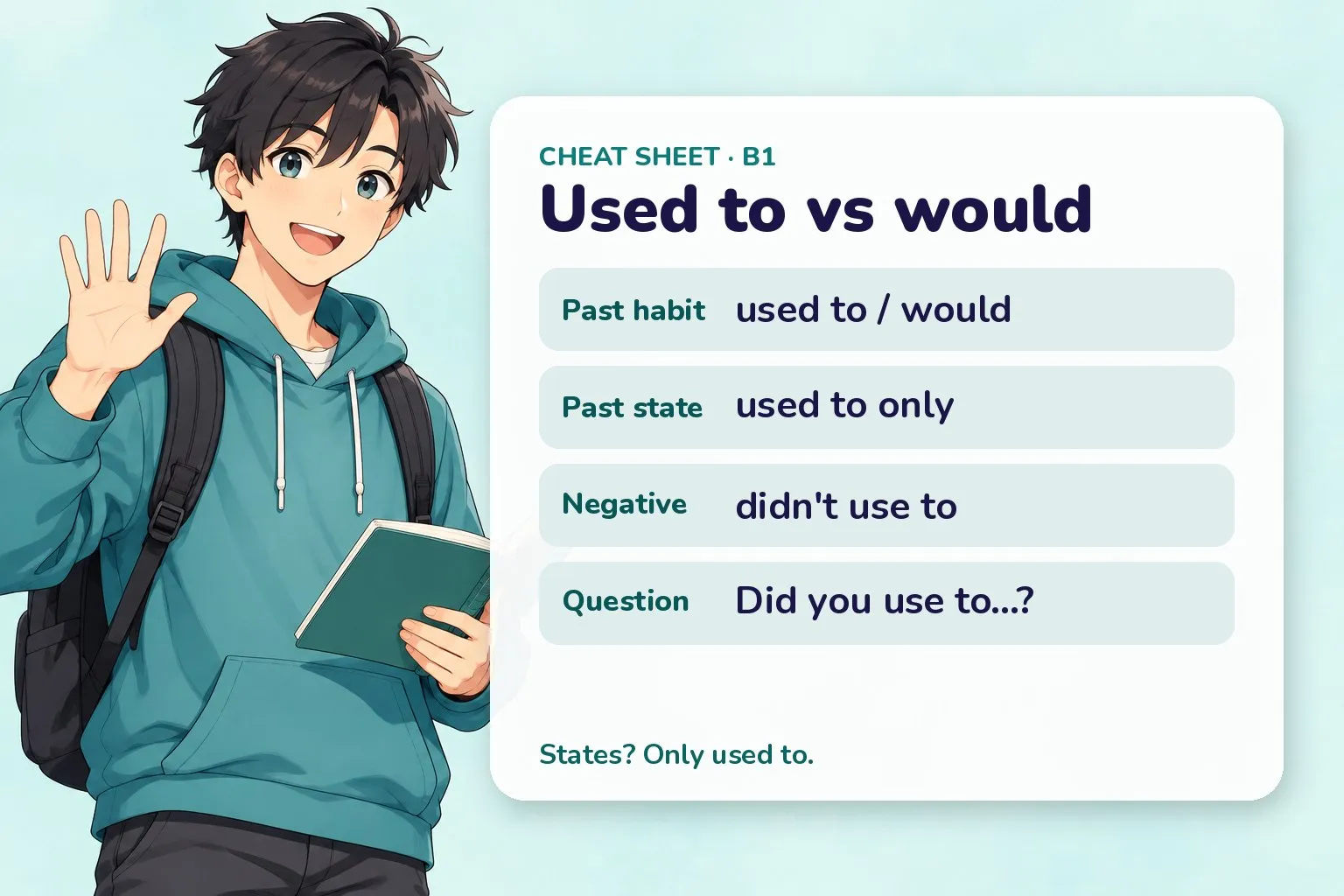
Quick recap before you practise.
Practice
Used to and would practice
Try each one, then press Check. No sign-up, nothing is sent anywhere — it all runs in your browser.
Hint: didn't + use to
Show answer
didn't use to — After didn't the ending drops the d: didn't use to.
4 Put the words in order (question).
Show answer
Did you use to play a sport — Questions use 'did' + 'use to' (no d): Did you use to play a sport?
5 Match each sentence to what it describes.
- I used to have a bike
- We would go to the beach
- There used to be a shop
- He would read to us
Show answer
- I used to have a bike → past state
- We would go to the beach → repeated action
- There used to be a shop → past state
- He would read to us → repeated action
States need 'used to'; repeated actions allow 'would' or 'used to'.
Hint: be = a state
Show answer
used to — 'Be' is a state, so only 'used to' works: She used to be very quiet.
Quiz
Used to and would quiz
12 questions · pick an answer and you'll see straight away if it's right.
-
Show answer
used to only — Only 'used to' describes past states; 'would' is for repeated actions.
-
Show answer
used to — The positive form is 'used to' with a d.
-
Show answer
didn't use to — After didn't the ending loses its d: didn't use to.
-
Show answer
Did — Questions use 'Did' + 'use to': Did you use to live here?
-
Show answer
I used to have a motorbike. — 'Have' is a state, so use 'used to have'.
-
Show answer
would — A repeated past action allows 'would' (or 'used to'): would build.
-
Show answer
It has other meanings, so it needs a past-habit context — 'Would' also marks conditionals and requests, so a past setting makes the habit meaning clear.
-
Show answer
There used to be a lake here. — 'Be' (there used to be) is a state, so only 'used to' works.
-
Show answer
I didn't use to drive. — After didn't, drop the d: didn't use to drive.
-
Show answer
to be accustomed to something — 'Be/get used to + -ing' means to be accustomed to something — a different structure from 'used to + base'.
-
Show answer
used to — A past state of existence: there used to be.
-
Show answer
We used to live by the sea, and every day I would swim. — Open with 'used to' (the state), then use 'would' for the repeated action.
Recap cheat-sheet
| Meaning | Used to | Would |
|---|---|---|
| Past habit (action) | ✓ used to play | ✓ would play |
| Past state (have, be) | ✓ used to have | ✗ |
| Negative | didn’t use to | wouldn’t |
| Question | Did you use to…? | Would you…? |
| Present habits | ✗ (use present simple) | ✗ |
Next
- Next topic: Present Perfect Continuous (have been -ing)
- Review first: Past Simple: Regular Verbs and -ed Spelling
- Back to the English grammar section
All English grammar topics
Every grammar point in order, from your first sentence to advanced structures. Pick one and go straight to it. New lessons go live every day, so topics marked Coming soon fill in over the next weeks.
Grammar path
A1 30 topics · 30 ready
- 01 Verb 'To Be' in the Present (am, is, are)
- 02 Subject Pronouns: I, You, He, She, It, We, They
- 03 Present Simple: Affirmative and the -s Ending
- 04 Present Simple: Negatives and Questions (do/does)
- 05 Articles: a / an and When to Use Each
- 06 The Definite Article 'The': When to Use It
- 07 Zero Article: When to Use No Article
- 08 Plural Nouns: Regular and Irregular Forms
- 09 This, That, These, Those (Demonstratives)
- 10 Possessive Adjectives: my, your, his, her
- 11 Possessive 's and s' (Showing Belonging)
- 12 There Is / There Are (Saying What Exists)
- 13 Have Got: Talking About Possession
- 14 Can and Can't for Ability
- 15 Present Continuous (am/is/are + -ing)
- 16 Imperatives: Giving Orders and Instructions
- 17 Adjectives: Position and Basic Use
- 18 Prepositions of Place: in, on, at
- 19 Prepositions of Time: in, on, at
- 20 Question Words: What, Where, When, Who, Why, How
- 21 How Much vs How Many
- 22 Countable and Uncountable Nouns
- 23 Some and Any: Which One to Use
- 24 Object Pronouns: me, you, him, her, us, them
- 25 Adverbs of Frequency and Their Position
- 26 Like, Love, Hate + -ing (Expressing Preferences)
- 27 Would Like: Polite Wants and Offers
- 28 Making Requests: Can, Could, May I
- 29 Past Simple of 'To Be' (was / were)
- 30 Let's and Shall We: Making Suggestions
A2 25 topics · 25 ready
- 31 Past Simple: Regular Verbs and -ed Spelling
- 32 Past Simple: Irregular Verbs (go, see, have)
- 33 Past Simple: Negatives and Questions (did)
- 34 Comparative Adjectives (bigger, more expensive)
- 35 Superlative Adjectives (the biggest, the most)
- 36 Going To: Plans and Predictions
- 37 Will: Predictions, Decisions and Offers
- 38 Present Continuous for Future Arrangements
- 39 Present Perfect for Experience (ever / never)
- 40 Present Perfect with just, already, yet
- 41 Present Perfect vs Past Simple
- 42 Have To and Don't Have To (Obligation)
- 43 Should and Shouldn't for Advice
- 44 Could: Past Ability and Polite Use
- 45 Much, Many, A Lot Of
- 46 A Few, A Little, Few, Little
- 47 Adverbs of Manner (quickly, well, hard)
- 48 Verb + -ing or Verb + to (Introduction)
- 49 Zero Conditional (Facts and Rules)
- 50 First Conditional (Real Future Possibility)
- 51 Prepositions of Movement (to, into, through)
- 52 Possessive Pronouns: mine, yours, hers
- 53 Past Continuous (was/were + -ing)
- 54 Too and Enough (Degree)
- 55 Order of Adjectives Before a Noun
B1 27 topics · 27 ready
- 56 Past Continuous vs Past Simple
- 57 Used To and Would for Past Habits You are here
- 58 Present Perfect Continuous (have been -ing)
- 59 Present Perfect: Simple vs Continuous
- 60 Past Perfect (had + past participle)
- 61 Second Conditional (Unreal Present/Future)
- 62 Third Conditional (Unreal Past)
- 63 Reported Speech: Statements (Backshift)
- 64 Reported Questions
- 65 Reported Commands and Requests
- 66 Passive Voice: Present and Past Simple
- 67 Must and Mustn't (Strong Obligation)
- 68 May, Might, Could for Possibility
- 69 Defining Relative Clauses (who, which, that)
- 70 Non-Defining Relative Clauses (with commas)
- 71 Gerunds and Infinitives: Full Verb Patterns
- 72 Verbs Where -ing vs to Changes Meaning
- 73 Future Continuous (will be -ing)
- 74 So and Such (Emphasis)
- 75 As...As Comparisons (equality)
- 76 Question Tags (isn't it? do you?)
- 77 Phrasal Verbs: Separable and Inseparable
- 78 Linking Words: because, so, although, but
- 79 Infinitive of Purpose (to / in order to)
- 80 Indirect Questions (Can you tell me...)
- 81 Make, Let, Allow, Help (Causatives Intro)
- 82 Be Used To and Get Used To (+ -ing)
B2 25 topics · 25 ready
- 83 Narrative Tenses for Storytelling
- 84 Past Perfect Continuous (had been -ing)
- 85 Mixed Conditionals
- 86 Wish and If Only (Regrets and Wishes)
- 87 Wish/If Only + would (Complaints)
- 88 Passive Voice: All Tenses and Modals
- 89 Reporting Passive (It is said that / is said to)
- 90 Causative: Have/Get Something Done
- 91 Reduced Relative Clauses (Participles)
- 92 Modals of Deduction: Present and Past
- 93 Needn't Have vs Didn't Need To
- 94 Future Perfect (will have done)
- 95 Participle Clauses (-ing / -ed / having done)
- 96 Advanced Comparatives (far/much + er, the more)
- 97 Conditional Alternatives: unless, as long as, provided
- 98 Advanced Determiners: each, every, either, neither
- 99 Intensifiers and Adverbs of Degree
- 100 Advanced Contrast: despite, in spite of, however
- 101 Advanced Linkers: therefore, moreover, consequently
- 102 Advanced Article Use (generalisations, names)
- 103 Verb + Preposition and Adjective + Preposition
- 104 Relative Clauses: whose, where, when, quantifier + whom
- 105 Subject-Verb Agreement: Tricky Cases
- 106 Emphatic Do (I do like it)
- 107 Would for Past Habits (Formal Narrative)
C1 18 topics · 18 ready
- 108 Inversion with Negative Adverbials
- 109 Inversion in Conditionals (Had I known)
- 110 Cleft Sentences (It was... / What I need is...)
- 111 Fronting and Emphasis (Word Order)
- 112 Subjunctive and Mandative (I suggest he be)
- 113 Ellipsis and Substitution (so, do, one)
- 114 Hedging and Cautious Language
- 115 Nominalisation (Academic Noun Style)
- 116 Advanced Discourse Markers (Spoken & Written)
- 117 Advanced Passive (passive + infinitive, get-passive)
- 118 Advanced Comparative Structures (no sooner...than)
- 119 Future in the Past (was going to / would)
- 120 Advanced Modals (may well, might as well, would rather)
- 121 Advanced Reported Speech (Reporting Verbs + Patterns)
- 122 Advanced and Idiomatic Phrasal Verbs
- 123 Collocation and Colligation (Natural Combinations)
- 124 Advanced Concession (much as, whatever, however + adj)
- 125 Absolute and Non-Finite Clauses (Formal)