Advanced Article Use (generalisations, names)
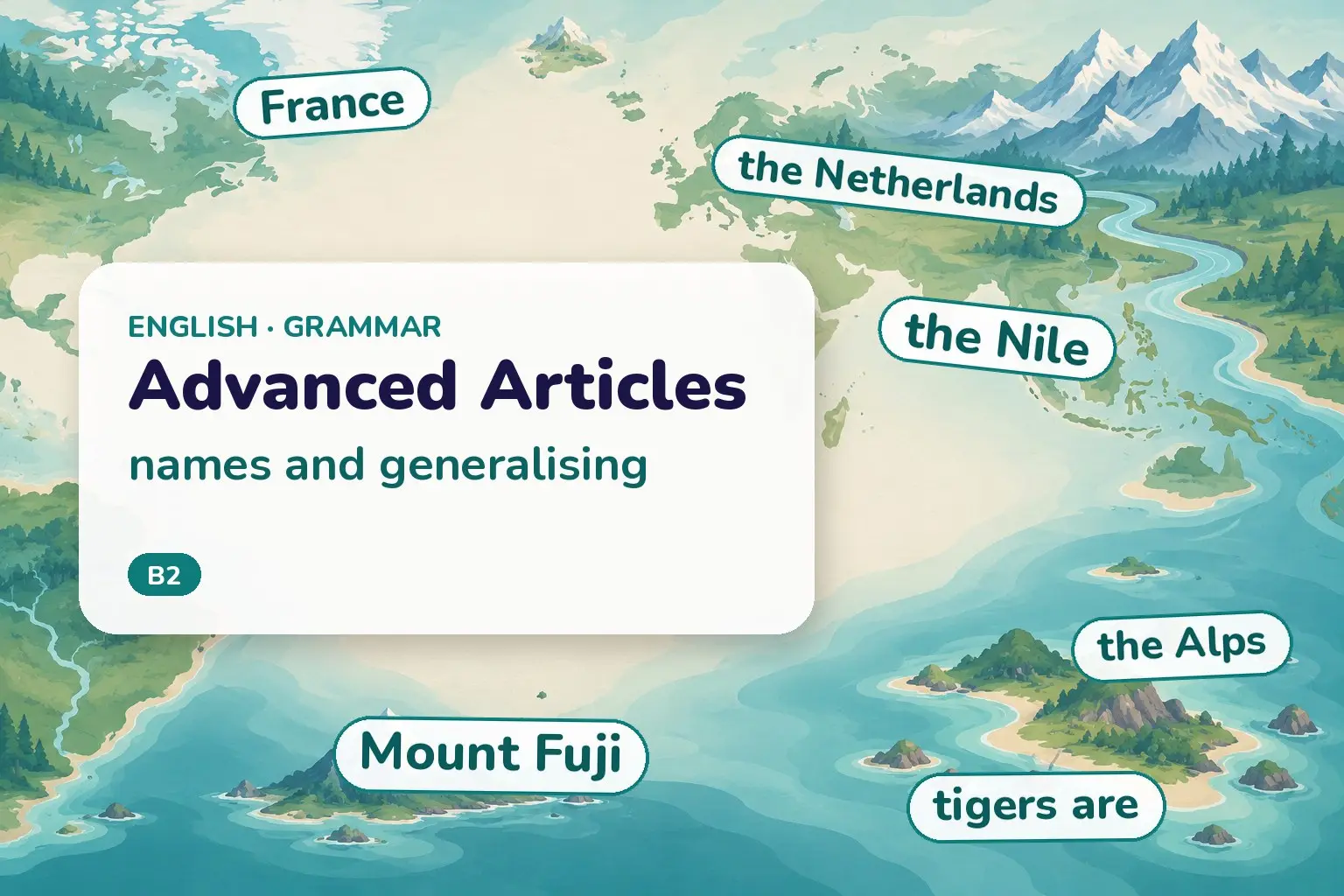
Use the with rivers, seas, mountain ranges and plural country names, but no article with most single countries, cities and abstract nouns. To generalise, choose the + singular, a + singular, or zero article + plural.
On this page10 sections · tap to jump
Level: B2. You know a, the and the zero article for everyday nouns. This lesson handles the harder cases: proper names of places, and the three ways English makes a general statement about a whole class of things.
The rule
An article is a small word (a, an, the) or its absence (the zero article) that marks a noun. At B2 the difficulty is no longer counting; it is names and generalisations.
Place names follow patterns. Use the before names that are built on a common noun or that are plural: rivers (the Thames), seas and oceans (the Pacific), canals (the Suez Canal), mountain ranges (the Alps), island groups (the Maldives), deserts (the Sahara), and plural or “united” country names (the Netherlands, the United States, the United Kingdom, the Philippines). Use no article for most single countries (France, Japan), continents (Asia), cities (Tokyo), single mountains (Mount Fuji), single lakes (Lake Como) and single islands (Cyprus).
Generalisations — talking about a whole class, not one example — can be made three ways. Zero article + plural is the most common and neutral: Tigers are endangered. The + singular treats the class as a single representative type, common in science and formal definitions: The tiger is a nocturnal hunter. A/an + singular means “any one example of the class”: A tiger hunts alone. A countable noun can use all three; an uncountable or abstract noun generalises only with the zero article: Music is powerful, not the music for the general idea.
Forms
| Case | Article | Example |
|---|---|---|
| single country / city | zero | We visited France and Rome. |
| plural / “united” country | the | the Netherlands, the United States |
| river / sea / ocean / canal | the | the Nile, the Atlantic, the Panama Canal |
| mountain range / island group | the | the Andes, the Canary Islands |
| single mountain / lake / island | zero | Mount Everest, Lake Geneva, Bali |
| general class (plural) | zero | Dogs are loyal. |
| general class (type) | the + singular | The dog is a loyal animal. |
| abstract / uncountable, general | zero | Honesty matters. Water is life. |
Example sentences
- The Amazon flows through several countries.Rivers take the: the Amazon.
- We sailed across the Mediterranean last summer.Seas take the.
- The Himalayas include the world's highest peaks.Mountain ranges (plural) take the.
- She has climbed Mount Kilimanjaro twice.A single mountain takes no article.
- The Netherlands is famous for its canals.A plural country name takes the (verb stays singular).
- He has worked in France, Japan and Brazil.Single countries take no article.
- The United Kingdom includes four nations.United + noun name takes the.
- The Philippines has thousands of islands.An -s country name takes the.
- They crossed the Sahara by truck.Deserts take the.
- We spent a week on Cyprus.A single island takes no article.
- The Maldives is a chain of coral islands.An island group takes the.
- Tigers are endangered across much of Asia.Zero + plural for a general statement.
- The tiger is a solitary hunter.The + singular defines the whole species.
- A smartphone is useless without a signal.A + singular means any example of the class.
- Honesty is the best policy.Abstract noun, general: no article.
- Life is short, so travel while you can.Uncountable idea in general: no the.
- Nature always finds a way.Nature in the general sense takes no the.
- The nature of the problem is financial.Here the nature means a specific aspect, so it takes the.
- Children learn languages quickly.General plural + general uncountable, both zero.
- The Thames runs through the heart of London.River the Thames; city London has no article.
- The Alps attract skiers from around the world.Range the Alps; world idea takes the here.
- Water boils at one hundred degrees at sea level.General scientific fact: water with no the.
Common mistakes
- ❌ I love the nature. → ✅ I love nature. For the general idea, abstract and uncountable nouns take no article. The nature means a specific aspect (the nature of the dispute).
- ❌ We visited the France last year. → ✅ We visited France last year. Single countries take no article. Only plural or “united” names take the.
- ❌ She climbed the Mount Everest. → ✅ She climbed Mount Everest. A single mountain has no article; only ranges (the Himalayas) take the.
- ❌ Netherlands is flat. → ✅ The Netherlands is flat. A plural country name keeps the, even though the verb is singular.
- ❌ The life is hard. (for the general idea) → ✅ Life is hard. Use no article for a general truth; the life points to one specific life (the life of a nurse).
- ❌ The dogs are loyal animals. (meaning dogs in general) → ✅ Dogs are loyal animals. For a whole class, use zero + plural; the dogs means particular, known dogs.
A short conversation
A: Have you ever crossed the Atlantic by ship? B: No, but I’ve sailed around the Greek islands. Have you been to Greece? A: Once. We drove from Athens up to Mount Olympus. B: Nice. For me, travel is the best education there is.
Usage notes
- The for the general when it means “the whole world of”. The internet, the environment, the weather and the countryside take the even in general statements, because they are treated as unique shared things.
- Institutions. Say go to school / hospital / university / church / prison with no article when you mean the activity; use the when you mean the building (the school was closed).
- Hotels, museums, newspapers. Many take the: the Ritz, the British Museum, the Times. Shops, companies and airports usually do not: Harrods, Google, Heathrow.
- Verb after plural country names. The Netherlands, the United States and the Philippines are grammatically singular: The United States is large.
Compared with…
- The definite article the gives the core rule — the for a specific, known thing. Advanced use extends that to names and unique shared nouns. See The Definite Article ‘The’: When to Use It.
- The zero article covers the everyday cases of no article — general plurals, uncountables, meals and languages. This lesson adds the harder place names and the type-generalisation with the + singular. See Zero Article: When to Use No Article.
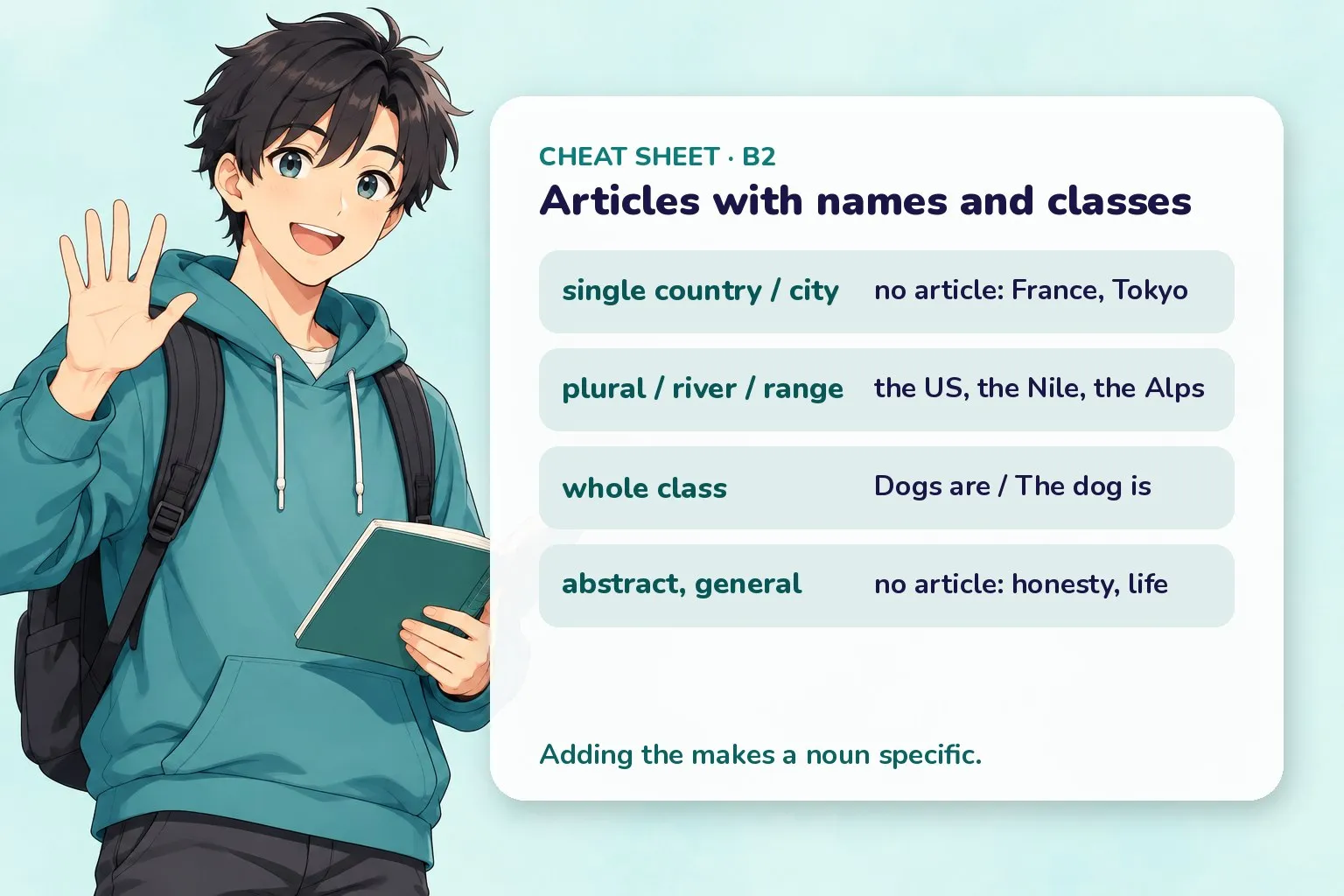
Quick recap before you practise.
Practice
Advanced article practice
Try each one, then press Check. No sign-up, nothing is sent anywhere — it all runs in your browser.
Hint: plural country name
Show answer
The — A plural/-s country name takes the: the Netherlands.
Hint: single country
Show answer
none — A single country takes no article: Japan.
5 Match each place to its article.
- Thames
- France
- Alps
- Mount Fuji
Show answer
- Thames → the
- France → no article
- Alps → the
- Mount Fuji → no article
Rivers and ranges take the; single countries and single mountains take none.
6 Order the words into a correct sentence.
Show answer
The United States is large. — The before a united/plural country name, with a singular verb.
Quiz
Advanced articles quiz
12 questions · pick an answer and you'll see straight away if it's right.
-
Show answer
the — Oceans take the: the Pacific.
-
Show answer
She climbed Mount Everest. — A single mountain takes no article: Mount Everest.
-
Show answer
The — A plural country name takes the: the Netherlands.
-
Show answer
Dogs are loyal. — Zero + plural generalises about the whole class; the dogs means specific dogs.
-
Show answer
I love the history in general. — For the general subject, use no article: I love history.
-
Show answer
the — Deserts take the: the Sahara.
-
Show answer
no article / no article — Cities and single countries both take no article.
-
Show answer
The computer changed the way we work. — The + singular treats the class as one representative type.
-
Show answer
The United Kingdom includes four nations. — The + United Kingdom, with a singular verb (includes).
-
Show answer
the environment — The environment is treated as a unique shared thing and keeps the.
-
Show answer
the — Here the clouds are the specific ones around the mountain, so the fits.
-
Show answer
one particular organisation — Adding the makes it specific: the society is one named organisation.
Recap cheat-sheet
| Case | Article | Example |
|---|---|---|
| single country / city / mountain | zero | France, Tokyo, Mount Fuji |
| plural country / river / sea / range | the | the US, the Nile, the Alps |
| whole class (neutral) | zero + plural | Dogs are loyal. |
| whole class (type) | the + singular | The dog is loyal. |
| abstract / uncountable, general | zero | Honesty matters. |
Next
- Next grammar topic: Verb + Preposition and Adjective + Preposition
- Back to the English grammar section
- New here? Start with Start Learning English Here
All English grammar topics
Every grammar point in order, from your first sentence to advanced structures. Pick one and go straight to it. New lessons go live every day, so topics marked Coming soon fill in over the next weeks.
Grammar path
A1 30 topics · 30 ready
- 01 Verb 'To Be' in the Present (am, is, are)
- 02 Subject Pronouns: I, You, He, She, It, We, They
- 03 Present Simple: Affirmative and the -s Ending
- 04 Present Simple: Negatives and Questions (do/does)
- 05 Articles: a / an and When to Use Each
- 06 The Definite Article 'The': When to Use It
- 07 Zero Article: When to Use No Article
- 08 Plural Nouns: Regular and Irregular Forms
- 09 This, That, These, Those (Demonstratives)
- 10 Possessive Adjectives: my, your, his, her
- 11 Possessive 's and s' (Showing Belonging)
- 12 There Is / There Are (Saying What Exists)
- 13 Have Got: Talking About Possession
- 14 Can and Can't for Ability
- 15 Present Continuous (am/is/are + -ing)
- 16 Imperatives: Giving Orders and Instructions
- 17 Adjectives: Position and Basic Use
- 18 Prepositions of Place: in, on, at
- 19 Prepositions of Time: in, on, at
- 20 Question Words: What, Where, When, Who, Why, How
- 21 How Much vs How Many
- 22 Countable and Uncountable Nouns
- 23 Some and Any: Which One to Use
- 24 Object Pronouns: me, you, him, her, us, them
- 25 Adverbs of Frequency and Their Position
- 26 Like, Love, Hate + -ing (Expressing Preferences)
- 27 Would Like: Polite Wants and Offers
- 28 Making Requests: Can, Could, May I
- 29 Past Simple of 'To Be' (was / were)
- 30 Let's and Shall We: Making Suggestions
A2 25 topics · 25 ready
- 31 Past Simple: Regular Verbs and -ed Spelling
- 32 Past Simple: Irregular Verbs (go, see, have)
- 33 Past Simple: Negatives and Questions (did)
- 34 Comparative Adjectives (bigger, more expensive)
- 35 Superlative Adjectives (the biggest, the most)
- 36 Going To: Plans and Predictions
- 37 Will: Predictions, Decisions and Offers
- 38 Present Continuous for Future Arrangements
- 39 Present Perfect for Experience (ever / never)
- 40 Present Perfect with just, already, yet
- 41 Present Perfect vs Past Simple
- 42 Have To and Don't Have To (Obligation)
- 43 Should and Shouldn't for Advice
- 44 Could: Past Ability and Polite Use
- 45 Much, Many, A Lot Of
- 46 A Few, A Little, Few, Little
- 47 Adverbs of Manner (quickly, well, hard)
- 48 Verb + -ing or Verb + to (Introduction)
- 49 Zero Conditional (Facts and Rules)
- 50 First Conditional (Real Future Possibility)
- 51 Prepositions of Movement (to, into, through)
- 52 Possessive Pronouns: mine, yours, hers
- 53 Past Continuous (was/were + -ing)
- 54 Too and Enough (Degree)
- 55 Order of Adjectives Before a Noun
B1 27 topics · 27 ready
- 56 Past Continuous vs Past Simple
- 57 Used To and Would for Past Habits
- 58 Present Perfect Continuous (have been -ing)
- 59 Present Perfect: Simple vs Continuous
- 60 Past Perfect (had + past participle)
- 61 Second Conditional (Unreal Present/Future)
- 62 Third Conditional (Unreal Past)
- 63 Reported Speech: Statements (Backshift)
- 64 Reported Questions
- 65 Reported Commands and Requests
- 66 Passive Voice: Present and Past Simple
- 67 Must and Mustn't (Strong Obligation)
- 68 May, Might, Could for Possibility
- 69 Defining Relative Clauses (who, which, that)
- 70 Non-Defining Relative Clauses (with commas)
- 71 Gerunds and Infinitives: Full Verb Patterns
- 72 Verbs Where -ing vs to Changes Meaning
- 73 Future Continuous (will be -ing)
- 74 So and Such (Emphasis)
- 75 As...As Comparisons (equality)
- 76 Question Tags (isn't it? do you?)
- 77 Phrasal Verbs: Separable and Inseparable
- 78 Linking Words: because, so, although, but
- 79 Infinitive of Purpose (to / in order to)
- 80 Indirect Questions (Can you tell me...)
- 81 Make, Let, Allow, Help (Causatives Intro)
- 82 Be Used To and Get Used To (+ -ing)
B2 25 topics · 25 ready
- 83 Narrative Tenses for Storytelling
- 84 Past Perfect Continuous (had been -ing)
- 85 Mixed Conditionals
- 86 Wish and If Only (Regrets and Wishes)
- 87 Wish/If Only + would (Complaints)
- 88 Passive Voice: All Tenses and Modals
- 89 Reporting Passive (It is said that / is said to)
- 90 Causative: Have/Get Something Done
- 91 Reduced Relative Clauses (Participles)
- 92 Modals of Deduction: Present and Past
- 93 Needn't Have vs Didn't Need To
- 94 Future Perfect (will have done)
- 95 Participle Clauses (-ing / -ed / having done)
- 96 Advanced Comparatives (far/much + er, the more)
- 97 Conditional Alternatives: unless, as long as, provided
- 98 Advanced Determiners: each, every, either, neither
- 99 Intensifiers and Adverbs of Degree
- 100 Advanced Contrast: despite, in spite of, however
- 101 Advanced Linkers: therefore, moreover, consequently
- 102 Advanced Article Use (generalisations, names) You are here
- 103 Verb + Preposition and Adjective + Preposition
- 104 Relative Clauses: whose, where, when, quantifier + whom
- 105 Subject-Verb Agreement: Tricky Cases
- 106 Emphatic Do (I do like it)
- 107 Would for Past Habits (Formal Narrative)
C1 18 topics · 18 ready
- 108 Inversion with Negative Adverbials
- 109 Inversion in Conditionals (Had I known)
- 110 Cleft Sentences (It was... / What I need is...)
- 111 Fronting and Emphasis (Word Order)
- 112 Subjunctive and Mandative (I suggest he be)
- 113 Ellipsis and Substitution (so, do, one)
- 114 Hedging and Cautious Language
- 115 Nominalisation (Academic Noun Style)
- 116 Advanced Discourse Markers (Spoken & Written)
- 117 Advanced Passive (passive + infinitive, get-passive)
- 118 Advanced Comparative Structures (no sooner...than)
- 119 Future in the Past (was going to / would)
- 120 Advanced Modals (may well, might as well, would rather)
- 121 Advanced Reported Speech (Reporting Verbs + Patterns)
- 122 Advanced and Idiomatic Phrasal Verbs
- 123 Collocation and Colligation (Natural Combinations)
- 124 Advanced Concession (much as, whatever, however + adj)
- 125 Absolute and Non-Finite Clauses (Formal)