Hedging and Cautious Language
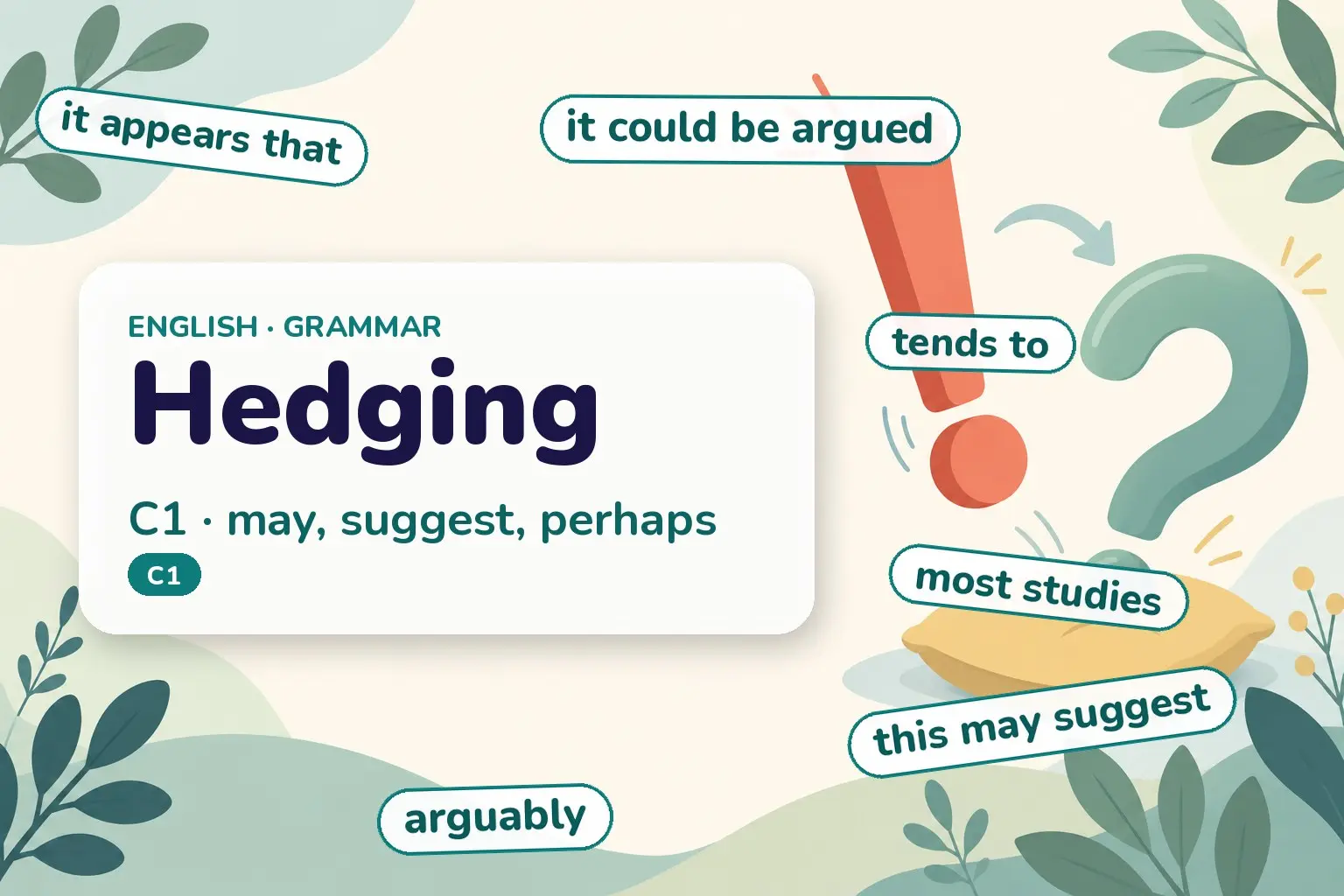
Hedging softens a claim so it sounds cautious rather than absolute, using modals (may, might), tentative verbs (seem, suggest), adverbs (possibly, arguably) and impersonal frames (it could be argued that): This may indicate a link, rather than This proves a link.
On this page10 sections · tap to jump
Level: C1. Academic and professional English rarely says this proves or everyone agrees. It says this suggests and it is widely held that. Softening a claim so you do not overstate it is called hedging, and it is a core C1 writing skill.
The rule
Hedging means using language that makes a statement cautious and tentative instead of absolute. You hedge to be honest about the limits of your evidence, to stay polite, and to leave room for other views. The opposite fault, overclaiming, states more than your data support (this proves) and sounds naive or arrogant in academic writing.
English hedges with several families of devices. Modal verbs are the commonest: may, might, could, would, can. Smoking may increase the risk claims far less than Smoking increases the risk. Tentative lexical verbs do the same job through meaning: seem, appear, tend, suggest, indicate, point to, assume. The results suggest a link is weaker — and safer — than The results prove a link.
Cautious adverbs and adjectives adjust the strength of a whole statement: possibly, probably, perhaps, arguably, apparently, relatively, generally, largely, to some extent, and adjectives like likely, possible, unlikely. This is arguably the best solution signals that others might disagree.
Impersonal and reporting structures remove the writer from the claim, making it sound objective: It could be argued that…, It has been suggested that…, It appears that…, There is a tendency for…, Research indicates that… These let you avoid I think, which sounds too personal in formal prose.
Approximators and quantifiers hedge amounts and scope: some, many, most, often, approximately, around, a number of, in most cases. Many studies claims less than All studies.
Forms
| Device | Examples | Softened claim |
|---|---|---|
| modal verbs | may, might, could, would | This may explain the fall. |
| tentative verbs | seem, appear, suggest, tend | Prices tend to rise. |
| cautious adverbs | possibly, arguably, perhaps | It is arguably flawed. |
| cautious adjectives | likely, possible, unlikely | A possible cause is… |
| impersonal frames | it could be argued that | It could be argued that … |
| reporting verbs | indicate, suggest, imply | The data indicate a trend. |
| approximators | some, most, around, generally | Most experts agree. |
Example sentences
- These findings may indicate a wider problem.Modal 'may' softens a flat claim of fact.
- The evidence suggests that the policy had little effect.'Suggests' is weaker and safer than 'proves'.
- Prices tend to rise in the winter months.'Tend to' marks a general trend, not a rule.
- This is arguably the most important factor.'Arguably' admits that others might disagree.
- It could be argued that the study was too small.Impersonal frame distances the writer from the claim.
- It has been suggested that stress plays a role.Passive reporting structure, no named author needed.
- The results appear to support the hypothesis.'Appear to' is more cautious than 'support'.
- There is a tendency for costs to be underestimated.Nominal hedge 'a tendency for' softens the claim.
- Smoking is likely to increase the risk of disease.Adjective 'likely' replaces a bald prediction.
- Most participants reported some improvement.'Most' and 'some' hedge scope and degree.
- The data indicate a possible link between the two.'Indicate' plus 'possible' keeps the claim tentative.
- Perhaps the clearest example is the 2008 crisis.'Perhaps' softens an otherwise strong assertion.
- This approach may, to some extent, reduce waste.'May' plus 'to some extent' limits the claim twice, used sparingly.
- Such a view would seem to overlook the costs.'Would seem to' is a doubly cautious reporting form.
- Research generally points to a positive effect.'Generally' and 'points to' both hedge.
- It appears that the sample was not representative.'It appears that' reports cautiously.
- The relationship is relatively weak in older groups.'Relatively' softens the adjective 'weak'.
- One possible explanation is a change in diet.'One possible explanation' leaves room for others.
- These results should be treated with some caution.A direct hedge about the reliability of the findings.
- Around half of the respondents disagreed.'Around' hedges an approximate figure.
Common mistakes
- ❌ This experiment proves that sugar causes the disease. → ✅ This experiment suggests that sugar may contribute to the disease. Match the claim to the evidence; a single study rarely proves anything.
- ❌ Everyone knows that the plan failed. → ✅ It is widely held that the plan failed. / The plan appears to have failed. Avoid absolute, unsupported generalisations.
- ❌ The results may possibly perhaps suggest a slight tendency. → ✅ The results suggest a slight tendency. Do not stack hedges; one device per idea is enough.
- ❌ I think the policy is bad. → ✅ The policy could be seen as counterproductive. In formal writing, prefer impersonal structures to I think.
- ❌ Smoking will definitely cause cancer in all cases. → ✅ Smoking is likely to increase the risk in most cases. Hedge both the certainty and the scope.
- ❌ This data proves my point completely. → ✅ This evidence lends some support to my argument. Weaken proves and completely to fit real data.
A short conversation
A: Can we say the campaign caused the sales rise? B: I would be careful. The figures suggest a link, but they do not prove one. A: So how should we word the report? B: Something like: the campaign may have contributed to the increase. That is about as far as the data let us go.
Usage notes
- Why hedge. In academic and professional writing, hedging shows intellectual honesty: it signals that you know the difference between what the evidence shows and what you merely suspect.
- Avoid I think. Impersonal frames (it could be argued, it seems, there is reason to believe) sound more objective than first-person opinion in essays and reports.
- Reporting verbs carry strength. Prove > demonstrate > show > indicate > suggest > hint at. Choose the one that matches your evidence; do not default to the strongest.
- Combine with care. You can pair a modal with an adverb (may well, might possibly) for fine control, but never pile three or four softeners onto one claim.
- Numbers. Hedge figures honestly with approximately, around, just over, roughly when the exact value is not the point — but give the exact value when it is.
Compared with…
- Nominalisation turns verbs and adjectives into nouns (decide → decision, fail → failure) to pack formal writing densely and shift focus onto concepts. It changes the structure of a sentence; hedging changes its certainty. The two often appear together in academic prose, but they solve different problems. See Nominalisation.
- Advanced discourse markers (admittedly, having said that, on balance) connect and weigh ideas across a text, whereas hedging devices sit inside a single claim to soften it. A discourse marker concedes or contrasts; a hedge limits how strongly you assert. See Advanced Discourse Markers.
Quick recap before you practise.
Practice
Hedging and cautious language practice
Try each one, then press Check. No sign-up, nothing is sent anywhere — it all runs in your browser.
Hint: a modal of possibility
Show answer
may — A possibility modal (may/might/could) hedges the claim of cause.
3 Reorder into a cautious impersonal claim.
Show answer
It could be argued that ... — The impersonal frame 'It could be argued that …' distances the writer.
4 Match each strong word to its hedged replacement.
- proves
- everyone
- always
- will
Show answer
- proves → suggests
- everyone → many people
- always → generally
- will → is likely to
Each pair swaps an absolute term for a cautious, calibrated one.
Hint: weaker than prove
Show answer
indicate — Verbs like 'indicate' or 'suggest' match evidence that shows but does not prove.
Quiz
Hedging and cautious language quiz
12 questions · pick an answer and you'll see straight away if it's right.
-
Show answer
This may support the theory. — 'May support' hedges both the certainty and the strength of the claim.
-
Show answer
suggest — 'Suggest' is tentative and matches evidence that is not conclusive.
-
Show answer
arguably — 'Arguably' admits that others may hold a different view.
-
Show answer
It has been suggested that… — The passive frame 'It has been suggested that' sounds objective and tentative.
-
Show answer
Smoking always causes disease in everyone. — 'Always' and 'everyone' claim far more than evidence can support.
-
Show answer
The study may perhaps possibly hint at a tendency. — Too many softeners stacked together make the prose vague.
-
Show answer
Most — 'Most' hedges scope; 'all' and 'every single' overclaim.
-
Show answer
some — 'Some caution' is a standard hedge about reliability.
-
Show answer
It could be argued that — 'It could be argued that' is the impersonal, academic alternative to 'I think'.
-
Show answer
suggests — On the strength scale, 'suggests' is weaker than show, demonstrate or prove.
-
Show answer
may — A possibility modal (may/might/could) hedges the claim of explanation.
-
Show answer
This evidence lends some support to my argument. — Weaken 'proves' and 'completely' to 'lends some support to' to fit real evidence.
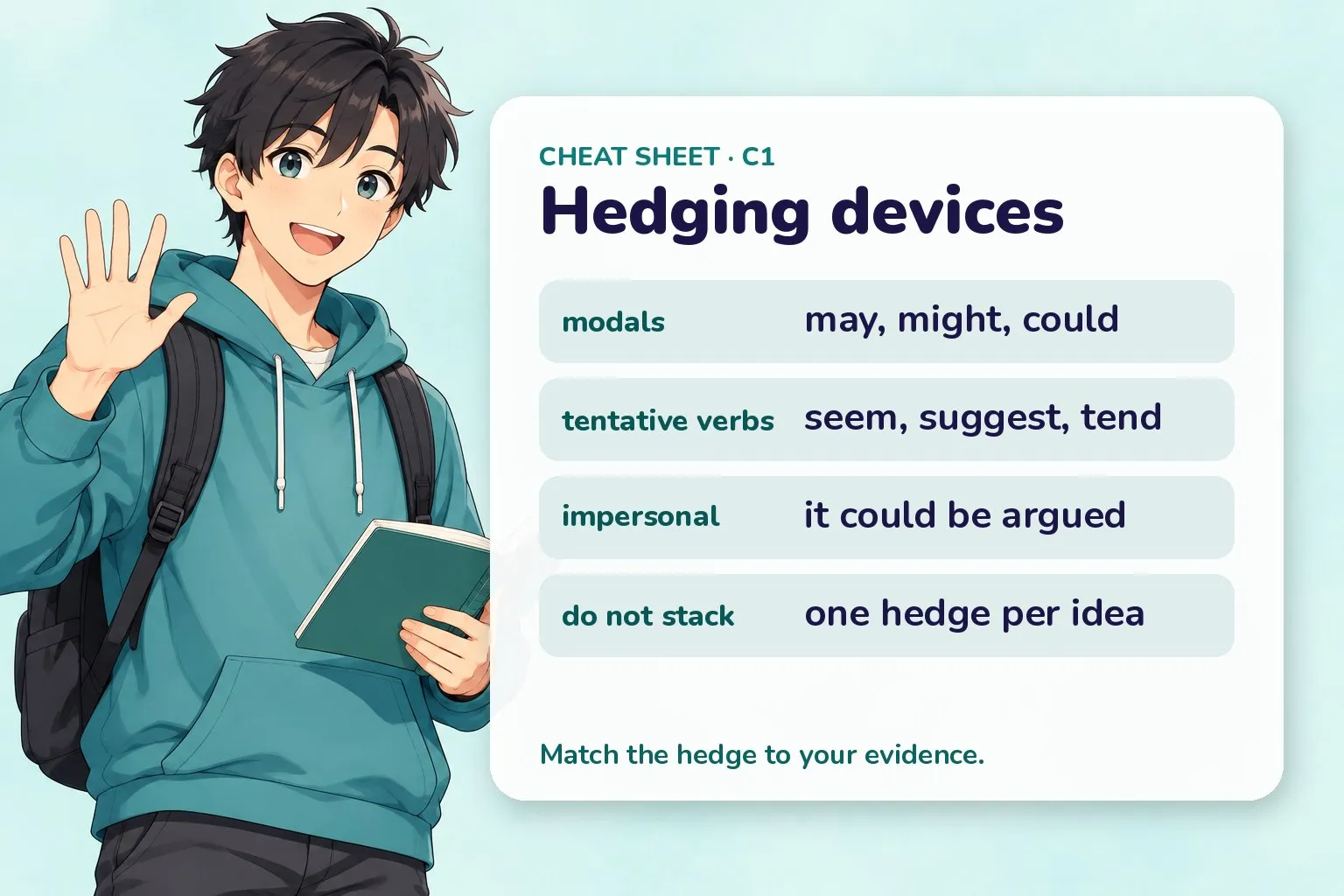
Recap cheat-sheet
| Point | Rule | Example |
|---|---|---|
| modals | may, might, could soften claims | This may explain it. |
| tentative verbs | seem, suggest, tend, indicate | Prices tend to rise. |
| impersonal frames | it could be argued that | It appears that… |
| do not stack | one hedge per idea | Not: may possibly perhaps. |
Next
- Back to the English grammar section
- Related: Nominalisation and May, Might, Could for Possibility
- New here? Start with Start Learning English Here
All English grammar topics
Every grammar point in order, from your first sentence to advanced structures. Pick one and go straight to it. New lessons go live every day, so topics marked Coming soon fill in over the next weeks.
Grammar path
A1 30 topics · 30 ready
- 01 Verb 'To Be' in the Present (am, is, are)
- 02 Subject Pronouns: I, You, He, She, It, We, They
- 03 Present Simple: Affirmative and the -s Ending
- 04 Present Simple: Negatives and Questions (do/does)
- 05 Articles: a / an and When to Use Each
- 06 The Definite Article 'The': When to Use It
- 07 Zero Article: When to Use No Article
- 08 Plural Nouns: Regular and Irregular Forms
- 09 This, That, These, Those (Demonstratives)
- 10 Possessive Adjectives: my, your, his, her
- 11 Possessive 's and s' (Showing Belonging)
- 12 There Is / There Are (Saying What Exists)
- 13 Have Got: Talking About Possession
- 14 Can and Can't for Ability
- 15 Present Continuous (am/is/are + -ing)
- 16 Imperatives: Giving Orders and Instructions
- 17 Adjectives: Position and Basic Use
- 18 Prepositions of Place: in, on, at
- 19 Prepositions of Time: in, on, at
- 20 Question Words: What, Where, When, Who, Why, How
- 21 How Much vs How Many
- 22 Countable and Uncountable Nouns
- 23 Some and Any: Which One to Use
- 24 Object Pronouns: me, you, him, her, us, them
- 25 Adverbs of Frequency and Their Position
- 26 Like, Love, Hate + -ing (Expressing Preferences)
- 27 Would Like: Polite Wants and Offers
- 28 Making Requests: Can, Could, May I
- 29 Past Simple of 'To Be' (was / were)
- 30 Let's and Shall We: Making Suggestions
A2 25 topics · 25 ready
- 31 Past Simple: Regular Verbs and -ed Spelling
- 32 Past Simple: Irregular Verbs (go, see, have)
- 33 Past Simple: Negatives and Questions (did)
- 34 Comparative Adjectives (bigger, more expensive)
- 35 Superlative Adjectives (the biggest, the most)
- 36 Going To: Plans and Predictions
- 37 Will: Predictions, Decisions and Offers
- 38 Present Continuous for Future Arrangements
- 39 Present Perfect for Experience (ever / never)
- 40 Present Perfect with just, already, yet
- 41 Present Perfect vs Past Simple
- 42 Have To and Don't Have To (Obligation)
- 43 Should and Shouldn't for Advice
- 44 Could: Past Ability and Polite Use
- 45 Much, Many, A Lot Of
- 46 A Few, A Little, Few, Little
- 47 Adverbs of Manner (quickly, well, hard)
- 48 Verb + -ing or Verb + to (Introduction)
- 49 Zero Conditional (Facts and Rules)
- 50 First Conditional (Real Future Possibility)
- 51 Prepositions of Movement (to, into, through)
- 52 Possessive Pronouns: mine, yours, hers
- 53 Past Continuous (was/were + -ing)
- 54 Too and Enough (Degree)
- 55 Order of Adjectives Before a Noun
B1 27 topics · 27 ready
- 56 Past Continuous vs Past Simple
- 57 Used To and Would for Past Habits
- 58 Present Perfect Continuous (have been -ing)
- 59 Present Perfect: Simple vs Continuous
- 60 Past Perfect (had + past participle)
- 61 Second Conditional (Unreal Present/Future)
- 62 Third Conditional (Unreal Past)
- 63 Reported Speech: Statements (Backshift)
- 64 Reported Questions
- 65 Reported Commands and Requests
- 66 Passive Voice: Present and Past Simple
- 67 Must and Mustn't (Strong Obligation)
- 68 May, Might, Could for Possibility
- 69 Defining Relative Clauses (who, which, that)
- 70 Non-Defining Relative Clauses (with commas)
- 71 Gerunds and Infinitives: Full Verb Patterns
- 72 Verbs Where -ing vs to Changes Meaning
- 73 Future Continuous (will be -ing)
- 74 So and Such (Emphasis)
- 75 As...As Comparisons (equality)
- 76 Question Tags (isn't it? do you?)
- 77 Phrasal Verbs: Separable and Inseparable
- 78 Linking Words: because, so, although, but
- 79 Infinitive of Purpose (to / in order to)
- 80 Indirect Questions (Can you tell me...)
- 81 Make, Let, Allow, Help (Causatives Intro)
- 82 Be Used To and Get Used To (+ -ing)
B2 25 topics · 25 ready
- 83 Narrative Tenses for Storytelling
- 84 Past Perfect Continuous (had been -ing)
- 85 Mixed Conditionals
- 86 Wish and If Only (Regrets and Wishes)
- 87 Wish/If Only + would (Complaints)
- 88 Passive Voice: All Tenses and Modals
- 89 Reporting Passive (It is said that / is said to)
- 90 Causative: Have/Get Something Done
- 91 Reduced Relative Clauses (Participles)
- 92 Modals of Deduction: Present and Past
- 93 Needn't Have vs Didn't Need To
- 94 Future Perfect (will have done)
- 95 Participle Clauses (-ing / -ed / having done)
- 96 Advanced Comparatives (far/much + er, the more)
- 97 Conditional Alternatives: unless, as long as, provided
- 98 Advanced Determiners: each, every, either, neither
- 99 Intensifiers and Adverbs of Degree
- 100 Advanced Contrast: despite, in spite of, however
- 101 Advanced Linkers: therefore, moreover, consequently
- 102 Advanced Article Use (generalisations, names)
- 103 Verb + Preposition and Adjective + Preposition
- 104 Relative Clauses: whose, where, when, quantifier + whom
- 105 Subject-Verb Agreement: Tricky Cases
- 106 Emphatic Do (I do like it)
- 107 Would for Past Habits (Formal Narrative)
C1 18 topics · 18 ready
- 108 Inversion with Negative Adverbials
- 109 Inversion in Conditionals (Had I known)
- 110 Cleft Sentences (It was... / What I need is...)
- 111 Fronting and Emphasis (Word Order)
- 112 Subjunctive and Mandative (I suggest he be)
- 113 Ellipsis and Substitution (so, do, one)
- 114 Hedging and Cautious Language You are here
- 115 Nominalisation (Academic Noun Style)
- 116 Advanced Discourse Markers (Spoken & Written)
- 117 Advanced Passive (passive + infinitive, get-passive)
- 118 Advanced Comparative Structures (no sooner...than)
- 119 Future in the Past (was going to / would)
- 120 Advanced Modals (may well, might as well, would rather)
- 121 Advanced Reported Speech (Reporting Verbs + Patterns)
- 122 Advanced and Idiomatic Phrasal Verbs
- 123 Collocation and Colligation (Natural Combinations)
- 124 Advanced Concession (much as, whatever, however + adj)
- 125 Absolute and Non-Finite Clauses (Formal)