English: Sightseeing & Tourism
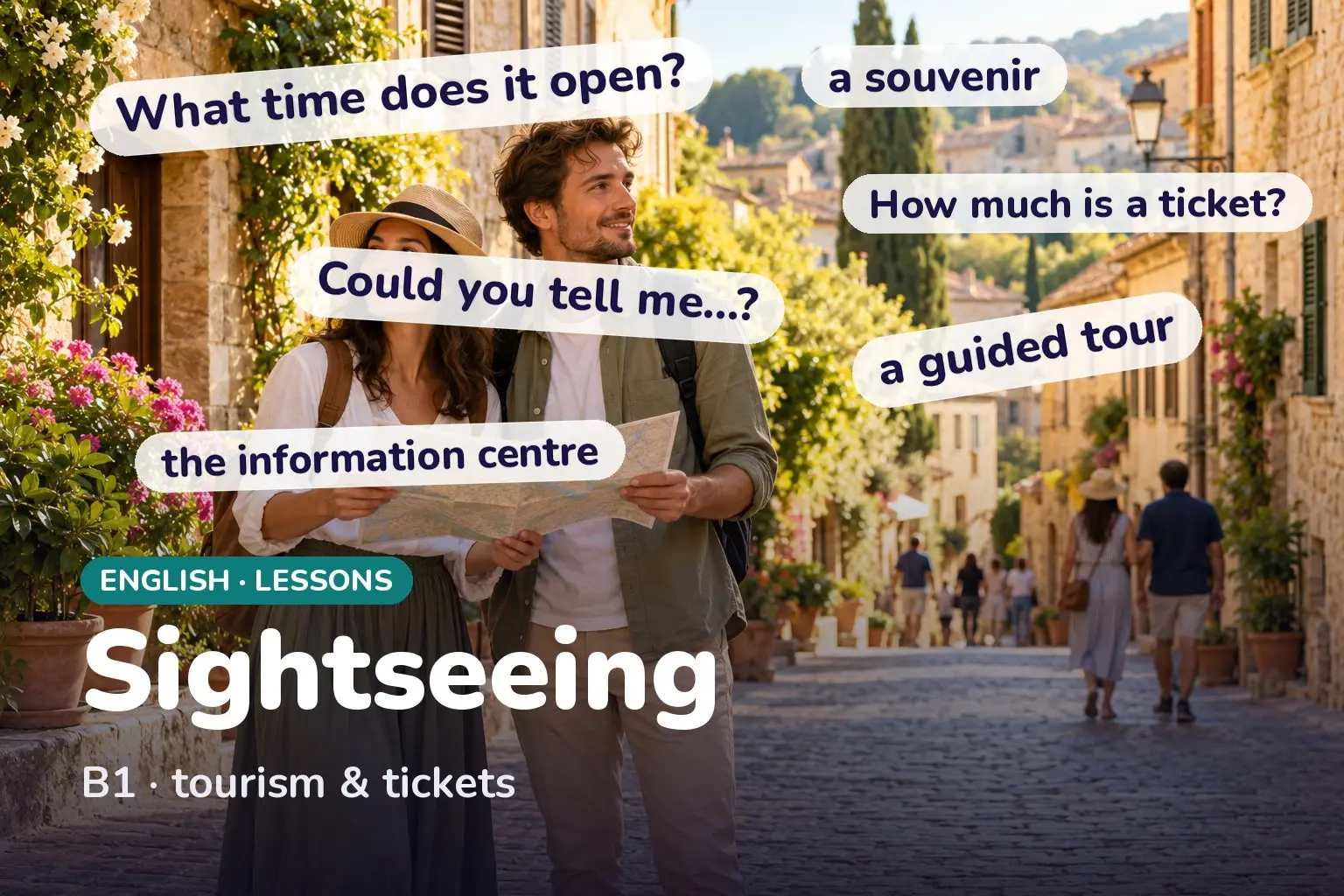
To go sightseeing in English, ask for information with 'Could you tell me…?' and 'What time does it open?', buy tickets with 'How much is a ticket?', and learn the core words — attraction, guided tour, admission and opening hours — so you can plan and enjoy any visit.
Level: B1. Sightseeing in another country means two things in English: knowing the words for what you are visiting, and asking for information politely. This lesson gives you the tourist vocabulary, the polite question patterns, and the phrases for buying tickets — so you can plan a day out and handle the ticket desk with confidence.
By the end of this page you can…
…name the main tourist words, ask for information at a visitor centre, check opening times and prices, and buy the right ticket for yourself or your group.
Tourist vocabulary
Start with the words you will see on signs and hear from guides. An attraction or a sight is any place worth visiting; a famous building or monument is a landmark. You might visit a museum, an art gallery, a castle, a cathedral, or a viewpoint (a high spot with a good view).
The activity of visiting these places is sightseeing: We spent the morning sightseeing. A tourist is the visitor; a guide is the person who explains things; a tour is the organised visit. The plan for your day or trip is your itinerary, and a small gift you buy to remember a place is a souvenir.
| English | What it means |
|---|---|
| attraction / sight | a place worth visiting |
| landmark | a famous, easily recognised building or place |
| guided tour | a visit led by a guide who explains things |
| audio guide | a recorded commentary you listen to alone |
| admission / entry fee | the money you pay to go in |
| opening hours | the times a place is open |
| information centre | where staff answer tourists’ questions |
Asking for information politely
At a B1 level, the key upgrade is the indirect question. Instead of the direct Where is the museum?, you soften it:
- Could you tell me where the museum is?
- Do you know what time it opens?
Notice the word order. In an indirect question the subject and verb go back to normal statement order (where the museum is, not where is the museum), and you drop do/does from the inner question. This small change makes you sound noticeably more polite and fluent.
Checking times and prices
Two questions solve most planning problems. For time, ask What time does it open? and What time do you close? For money, ask How much is a ticket? or Is there an entry fee? Some places are free (no charge); others ask for a donation (you give what you want).
Buying tickets
At the ticket desk or box office, say how many and what type you need. Tickets come in types: an adult ticket, a child ticket, and a concession (a cheaper ticket for students, children or older visitors). A combined or combo ticket covers several sights; a family ticket covers two adults and some children.
- Two adults and one child, please.
- Could I have a student ticket? Here’s my student card.
- Is there a discount for seniors?
Booking online in advance often lets you skip the queue (BrE) or the line (AmE). If a place is popular, you may need to book a time slot.
A short conversation
Tourist: Excuse me, could you tell me where the castle is? Assistant: Of course. It’s a ten-minute walk up the hill, on your right. Tourist: Thank you. Do you know what time it closes? Assistant: At five, but the last entry is four thirty. Tourist: And how much is a ticket? Assistant: Twelve for adults, eight with a student card. There’s also a guided tour at two.
Usage notes
- sightseeing is one word and has no plural: We went sightseeing (not sightseeings). The verb pair is go sightseeing.
- trip vs travel vs journey: a trip is the whole visit, travel is the general activity, and a journey is the act of getting from A to B.
- ticket vs entry: you buy a ticket; the money itself is the entry fee or admission. Both are common on signs.
- queue (BrE) / line (AmE): join the queue and wait in line mean the same thing; use whichever you like, but stay consistent.
Example sentences
Press play and say each line out loud — these are the exact phrases you will use on a day of sightseeing.
- We spent the whole day sightseeing.Go sightseeing is the natural verb pair.
- The old town has a lot of attractions.Attraction = a place worth visiting.
- That tower is the city's most famous landmark.Landmark = a famous, recognisable place.
- Could you tell me where the museum is?A polite indirect question.
- Do you know what time it opens?Normal word order after the question word.
- What time do you close?Checking the closing time before you go.
- Is there an entry fee?Asking whether you have to pay.
- How much is a ticket?The core price question.
- Two adults and one child, please.Saying how many tickets and what type.
- Could I have a student ticket?Asking for a concession ticket.
- Is there a discount for seniors?Checking for a cheaper rate.
- Does the ticket include the guided tour?Checking what the ticket covers.
- Where can I buy tickets?Finding the box office.
- I booked the tickets in advance online.Booking ahead to save time.
- Can we skip the queue with these tickets?Asking about the fast entry.
- Is there an audio guide in English?Asking for a recorded commentary.
- What time is the next guided tour?Asking about tour times.
- I'd like to buy a souvenir for my family.A souvenir is a gift to remember a place.
- Could you recommend a good viewpoint?Asking for advice on the best view.
- Here's our itinerary for tomorrow.Itinerary = the plan for your trip.
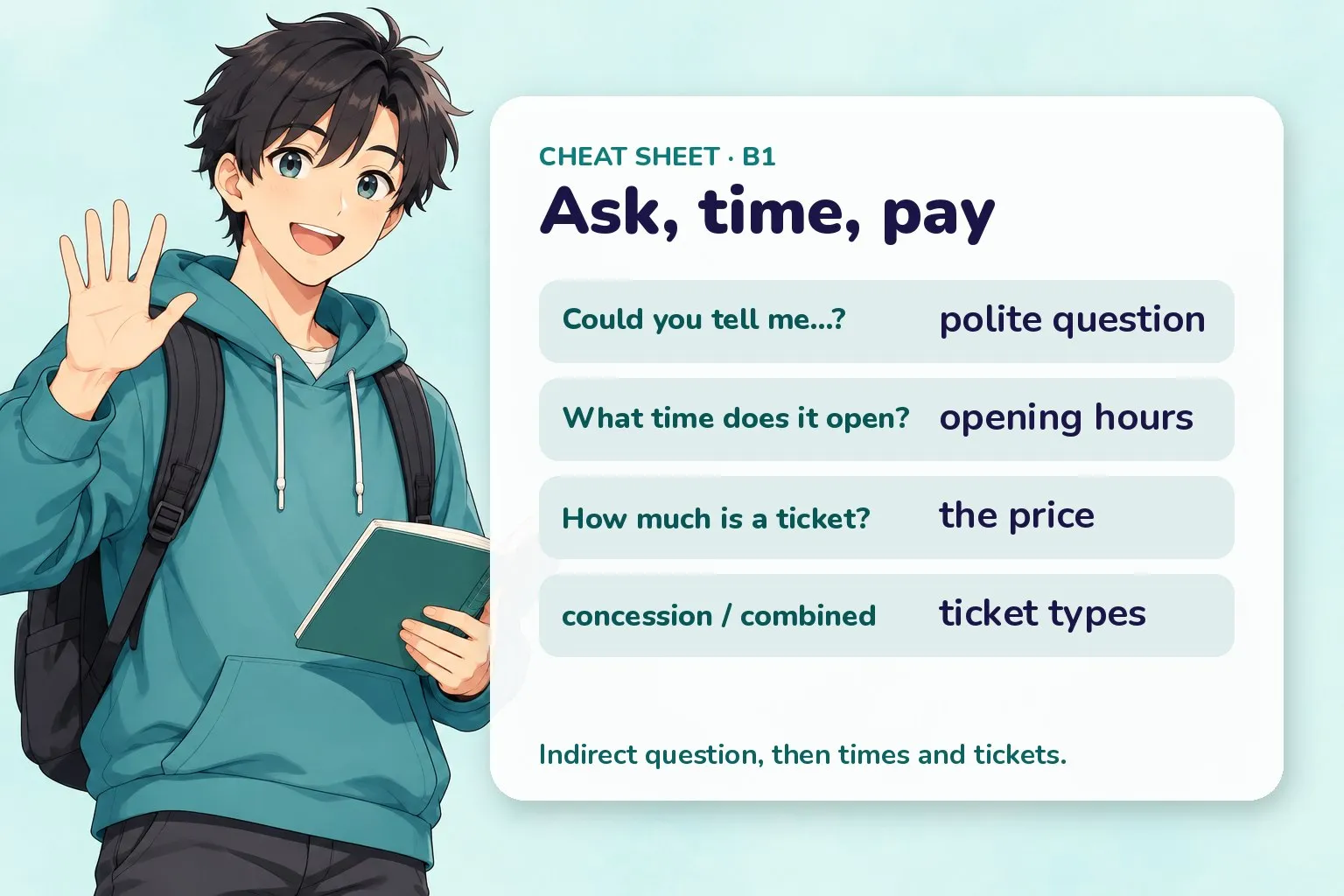
Quick recap before you practise.
Practice
Sightseeing and tourism practice
Try each one, then press Check. No sign-up, nothing is sent anywhere — it all runs in your browser.
Hint: the question word for amount
Show answer
How — How much is a ticket? is the core price question.
Hint: the helper verb for he/she/it questions
Show answer
does — Questions with a singular subject need does: What time does the museum open?
5 Put the words in order to ask what a ticket covers.
Show answer
Does the ticket include the guided tour — Yes/no question order: Does the ticket include the guided tour?
6 Match each tourist word to its meaning.
- landmark
- admission
- itinerary
- souvenir
Show answer
- landmark → famous recognisable place
- admission → the entry fee
- itinerary → the plan for your trip
- souvenir → a gift to remember a place
These are the core sightseeing words you will meet on signs and tickets.
How to say it
A few sightseeing words trip up English learners — copy the sounds, not the spelling.
- museum has the stress in the middle and ends in a soft sound: myoo-ZEE-um, three beats.
- tour rhymes with poor for many speakers — toor — not tower.
- itinerary has four beats with the stress on the second: eye-TIN-er-uh-ree.
- souvenir stresses the last part: soo-vuh-NEER.
Quiz
Sightseeing and tourism quiz
8 questions · pick an answer and you'll see straight away if it's right.
-
Show answer
Could you tell me where the information centre is? — An indirect question keeps statement order: where the information centre is.
-
Show answer
landmark — A landmark is a famous, recognisable place.
-
Show answer
concession ticket — A concession is a reduced ticket for students, children or older visitors.
-
Show answer
do — With you, use do: What time do you close?
-
Show answer
How much is the ticket? — A singular ticket takes is: How much is the ticket?
-
Show answer
a recorded commentary you listen to alone — An audio guide is a recording; a guided tour has a live guide.
-
Show answer
reserve before you arrive — To book in advance is to reserve ahead of time, often to skip the queue.
-
Show answer
go sightseeing — The fixed pair is go sightseeing.
Recap cheat-sheet
| Idea | Pattern | Example |
|---|---|---|
| Polite question | Could you tell me + statement order | Could you tell me where it is? |
| Opening time | What time does it open/close? | What time does the museum close? |
| Price | How much is a ticket? / Is there an entry fee? | How much is a ticket? |
| Ticket type | adult / child / concession / combined | Two adults and a concession, please. |
| Save time | book in advance, skip the queue | I booked in advance online. |
| Core words | attraction, landmark, guided tour, souvenir | The tower is the main landmark. |
Next
- Previous lesson: English: Travel & the Airport
- Next lesson: English: Emergencies & Safety
- New here? Start with Start Learning English Here
All English lessons topics
Vocabulary, pronunciation, phrases, practice and exam help, ordered by level. Pick a topic and go straight to it. New lessons go live every day, so topics marked Coming soon fill in over the next weeks.
Lessons
A1 9 topics · 9 ready
A2 14 topics · 14 ready
- 10 English: Describing People
- 11 English: Ordering at a Cafe
- 12 English: Shopping & Prices
- 13 English: Clothing & Sizes
- 14 English: Asking for Directions
- 15 English: Using Public Transport
- 16 English: At the Hotel
- 17 English: Weather & Seasons
- 18 English: Hobbies & Free Time
- 19 English: Daily Routine
- 20 English: Housing & Rooms
- 21 English: Parts of the Body
- 22 English: Emotions & Feelings
- 23 English: Supermarket & Groceries
B1 19 topics · 19 ready
- 24 English: Household Chores
- 25 English: At the Doctor
- 26 English: Making Appointments
- 27 English: Making Plans & Invitations
- 28 English: Phone & Messaging
- 29 English: Expressing Opinions
- 30 English: Talking About Past Experiences
- 31 English: Future Plans & Goals
- 32 English: School & Education
- 33 English: Jobs & Professions
- 34 English: Money & Banking
- 35 English: Restaurant & Dining Out
- 36 English: Travel & the Airport
- 37 English: Sightseeing & Tourism You are here
- 38 English: Emergencies & Safety
- 39 English: Technology & the Internet
- 40 English: Complaints & Solving Problems
- 41 English: Small Talk & Networking
- 42 English Small-Talk & Politeness Culture
B2 11 topics · 11 ready
- 43 English: At the Office
- 44 English: The Job Interview
- 45 English: Formal Writing & Emails
- 46 English: News & Current Affairs
- 47 English: Environment & Nature
- 48 English: Health & Lifestyle
- 49 English: Culture & Traditions
- 50 English: Describing Trends & Data
- 51 English: Storytelling & Narration
- 52 English: Giving a Short Presentation
- 53 Writing Business Emails in English