English: Household Chores
To talk about household chores, learn the fixed verbs (do the washing-up, make the bed, take out the rubbish) and say who has to do what with have to, must and need to. Give frequency with once a week, twice a month or every day.
Level: B1. Housework comes up constantly — sharing a flat, living with family, or just explaining your week. This lesson gives you the fixed chore phrases (they are not always what you would guess), then the language of obligation — have to, must, need to — so you can say who does what, and how often.
By the end of this page you can…
…name the common household chores with their correct verbs, say what you have to and don’t have to do, give advice with should, and describe how often chores get done.
The chore phrases
Chores are the clearest example of English collocations — fixed verb + noun pairs. The verb is usually do or make, and swapping them sounds wrong to a native ear.
- do the washing-up / wash the dishes — clean the plates after a meal.
- do the laundry / do the washing — wash clothes.
- do the ironing / iron the shirts — press clothes flat.
- do the vacuuming / vacuum / hoover (BrE) — clean the floor with a machine.
- do the housework — the general word for all of it.
- make the bed — pull the sheets straight.
- take out the rubbish (BrE) / trash (AmE) — carry it outside.
- tidy up / clean up — put things back in place.
- Also: sweep the floor, mop the floor, dust the shelves, water the plants, load / empty the dishwasher.
Obligation: have to, must, need to
To say something is necessary, English uses have to, must and need to. In everyday speech, have to is the most common.
| Meaning | Form | Example |
|---|---|---|
| It is necessary | have to / has to | I have to clean the kitchen. |
| It is necessary (stronger, formal or a rule) | must | You must wash your hands. |
| It is necessary | need to | I need to do the laundry. |
| It is NOT necessary | don’t have to | You don’t have to iron socks. |
| It is forbidden | must not (mustn’t) | You mustn’t leave the gas on. |
Two things to watch. First, after must (and should) you use the plain verb with no to: I must clean — never I must to clean. Second, the negatives are not opposites: don’t have to means it is not necessary (you can if you want), while must not means it is forbidden.
Giving advice: should
For advice rather than obligation, use should + plain verb: You should clean the fridge once a month. The negative is shouldn’t: You shouldn’t leave dirty dishes overnight.
How often: frequency expressions
To say how often a chore gets done, use a number phrase:
- once a week, twice a week, three times a week (not one time, two times — say once, twice).
- every day / every morning / every other day (= every second day).
- from time to time, hardly ever.
Example sentences
Press play and say each chore out loud with its natural verb.
- I do the washing-up after dinner.Do the washing-up, not make the washing-up.
- She makes the bed every morning.Make the bed is the fixed exception.
- We do the laundry twice a week.Do the laundry plus a frequency phrase.
- You have to take out the rubbish tonight.Have to for an obligation.
- He has to vacuum the stairs.Has to for he, she and it.
- I need to iron my shirt for work.Need to for a personal necessity.
- You must wash your hands before cooking.Must for a strong rule; plain verb after it.
- You mustn't put metal in the microwave.Mustn't means it is forbidden.
- You don't have to dry the dishes.Don't have to means it is not necessary.
- We should clean the fridge once a month.Should for advice, plain verb, once a month.
- You shouldn't leave crumbs on the table.Shouldn't for advice against something.
- I sweep the kitchen floor every day.Sweep plus every day.
- My brother dusts the shelves on Sundays.Dust the shelves, with a day.
- Could you load the dishwasher, please?A polite request to share a chore.
- Whose turn is it to mop the floor?Asking who should do the chore.
- I hardly ever do the ironing.Hardly ever means almost never.
- We take turns cleaning the bathroom.Take turns for sharing a chore.
- Do you have to tidy your room every day?A have to question in the present.
- The bins are collected every other week.Every other week means every second week.
- Let's split the housework fairly.Split the housework for dividing chores.
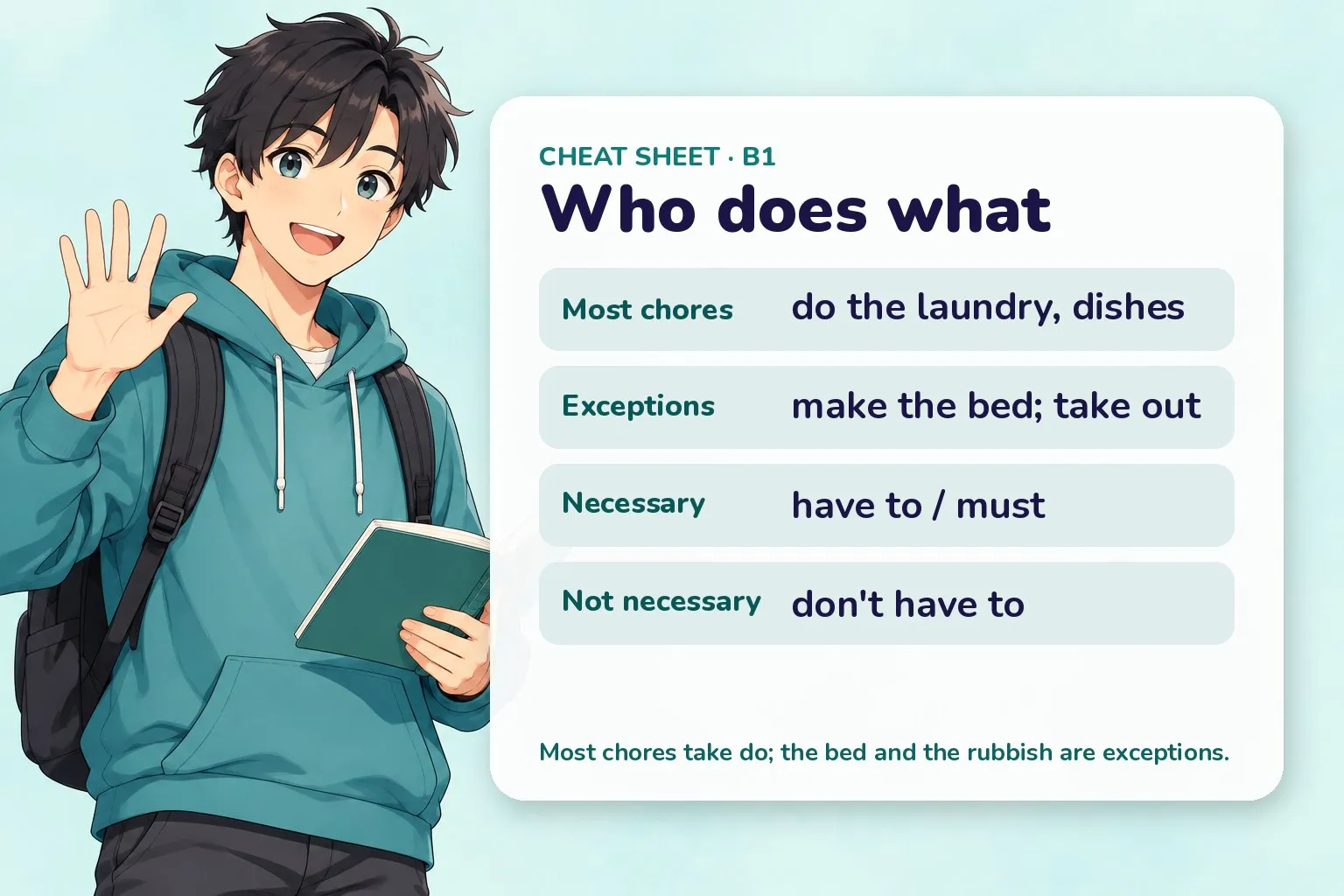
Quick recap before you practise.
A short conversation
Sam: We should make a cleaning plan for the flat. Who does what? Priya: I’ll do the laundry if you take out the rubbish. Sam: Deal. And we take turns with the washing-up? Priya: Yes. But you don’t have to vacuum every day — twice a week is enough. Sam: Great. We mustn’t let the bins pile up again, though.
Usage notes
- have to vs must: have to is far more common in speech; must sounds stronger or more official, and is used for rules and written notices. In the past, both become had to — there is no past of must for obligation.
- do the + chore: most chores take do with the (do the washing-up), but make the bed and take out the rubbish break the pattern — memorise them.
- washing-up (BrE) vs doing the dishes (AmE): British English often says do the washing-up; American English says do the dishes. Both are standard.
- chores vs housework: chores are the individual tasks (countable: three chores); housework is the whole uncountable idea (some housework, not a housework).
Practice
Household chores practice
Try each one, then press Check. No sign-up, nothing is sent anywhere — it all runs in your browser.
Hint: plain verb, no to, after must
Show answer
clean — After must, use the plain verb with no to: I must clean.
Hint: the special word for two times
Show answer
twice — English uses twice, not two times: twice a week.
4 Put the words in order to make an obligation.
Show answer
You have to take out the rubbish — Have to shows obligation: You have to take out the rubbish.
5 Match each form to its meaning.
- must
- don't have to
- mustn't
- should
Show answer
- must → a strong obligation or rule
- don't have to → it is not necessary
- mustn't → it is forbidden
- should → advice
Don't have to and mustn't are not the same: optional vs forbidden.
How to say it
A few chore words sound different from how they look. Copy the audio.
- vacuum is said with two beats, roughly “VAK-yoom” — don’t try to pronounce every letter.
- iron sounds like “EYE-ern”; the middle r almost disappears and it is not “eye-ron”.
- clothes stays one syllable, “klohz”, ending in a z — no extra -iz.
- rubbish has the stress on the first syllable: “RUB-ish”.
Quiz
Household chores quiz
8 questions · pick an answer and you'll see straight away if it's right.
-
Show answer
do the housework — Housework takes do and is uncountable: do the housework.
-
Show answer
I must clean the oven. — After must, use the plain verb with no to: I must clean.
-
Show answer
It is not necessary to iron them. — Don't have to means it is not necessary.
-
Show answer
once a week — English says once a week, not one time a week.
-
Show answer
I make my bed every day. — The fixed phrase is make the bed.
-
Show answer
You should clean the fridge. — Should takes the plain verb with no to.
-
Show answer
You mustn't leave the gas on. — Mustn't means it is forbidden.
-
Show answer
has — For he, she and it, use has to: he has to vacuum.
Recap cheat-sheet
| Idea | Pattern | Example |
|---|---|---|
| Most chores | do the … | do the laundry, do the dishes |
| The exceptions | make / take out | make the bed, take out the rubbish |
| Necessary | have to / must (+ plain verb) | I have to clean; you must wash |
| Not necessary | don’t have to | You don’t have to iron. |
| Forbidden | mustn’t | You mustn’t block the exit. |
| How often | once / twice / 3 times a week | twice a week |
Next
- Previous lesson: English: Housing & Rooms
- Next lesson: English: At the Doctor
- New here? Start with Start Learning English Here
- Build the sounds: English Pronunciation Overview
All English lessons topics
Vocabulary, pronunciation, phrases, practice and exam help, ordered by level. Pick a topic and go straight to it. New lessons go live every day, so topics marked Coming soon fill in over the next weeks.
Lessons
A1 9 topics · 9 ready
A2 14 topics · 14 ready
- 10 English: Describing People
- 11 English: Ordering at a Cafe
- 12 English: Shopping & Prices
- 13 English: Clothing & Sizes
- 14 English: Asking for Directions
- 15 English: Using Public Transport
- 16 English: At the Hotel
- 17 English: Weather & Seasons
- 18 English: Hobbies & Free Time
- 19 English: Daily Routine
- 20 English: Housing & Rooms
- 21 English: Parts of the Body
- 22 English: Emotions & Feelings
- 23 English: Supermarket & Groceries
B1 19 topics · 19 ready
- 24 English: Household Chores You are here
- 25 English: At the Doctor
- 26 English: Making Appointments
- 27 English: Making Plans & Invitations
- 28 English: Phone & Messaging
- 29 English: Expressing Opinions
- 30 English: Talking About Past Experiences
- 31 English: Future Plans & Goals
- 32 English: School & Education
- 33 English: Jobs & Professions
- 34 English: Money & Banking
- 35 English: Restaurant & Dining Out
- 36 English: Travel & the Airport
- 37 English: Sightseeing & Tourism
- 38 English: Emergencies & Safety
- 39 English: Technology & the Internet
- 40 English: Complaints & Solving Problems
- 41 English: Small Talk & Networking
- 42 English Small-Talk & Politeness Culture
B2 11 topics · 11 ready
- 43 English: At the Office
- 44 English: The Job Interview
- 45 English: Formal Writing & Emails
- 46 English: News & Current Affairs
- 47 English: Environment & Nature
- 48 English: Health & Lifestyle
- 49 English: Culture & Traditions
- 50 English: Describing Trends & Data
- 51 English: Storytelling & Narration
- 52 English: Giving a Short Presentation
- 53 Writing Business Emails in English