English: Introducing Yourself
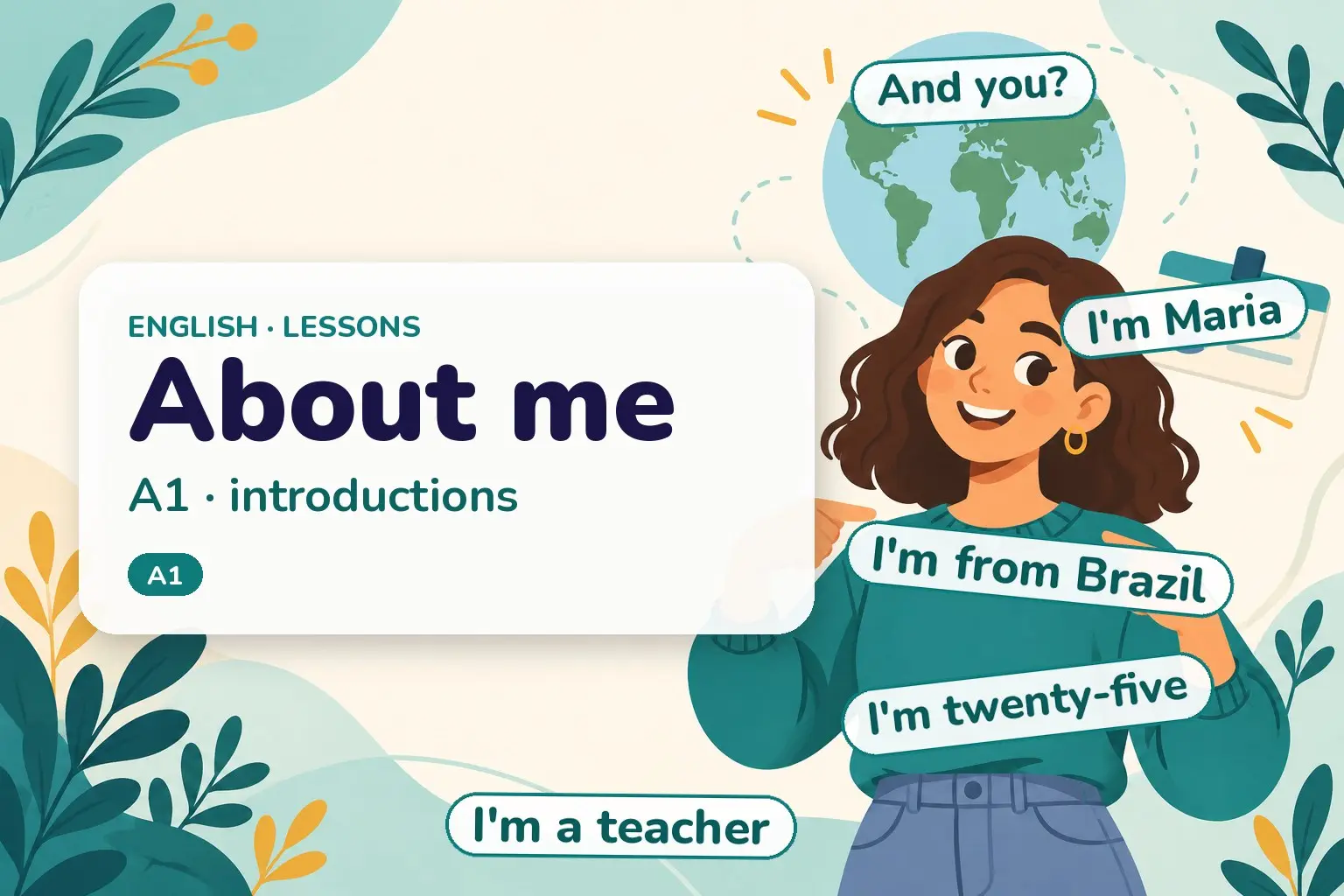
Introduce yourself with a few fixed frames: 'I'm …' or 'My name is …' for your name, 'I'm from …' for your country, 'I'm a …' for your job, and 'I'm … years old' for your age. End with 'Nice to meet you.'
Level: A1. Introducing yourself is one of the first real conversations you will have in English. A small set of sentence frames lets you give your name, where you are from, what you do and how old you are — and then ask the same back.
By the end of this page you can…
…introduce yourself clearly with your name, country, job and age, and keep the conversation going by asking the other person about themselves.
Your name
Two frames cover almost every situation:
- I’m Maria. — relaxed and the most common.
- My name is Maria Garcia. — a little more formal, good for a full name.
If someone asks What’s your name?, you can answer with just your name — Maria — or the full frame.
Where you are from
Use I’m from + country or city to give your origin:
- I’m from Brazil.
- I’m from Seoul.
You can also use a nationality adjective with I’m + nationality:
- I’m Brazilian.
- I’m Korean.
Both are correct — just don’t mix them. I’m from Brazil names the place; I’m Brazilian uses the adjective.
What you do
Give your job with I’m a / an + job. English needs the article a (or an before a vowel sound):
- I’m a teacher.
- I’m an engineer.
- I’m a student.
Leaving out the article — I’m teacher — is one of the most common beginner mistakes.
Your age
In English, age uses the verb be, not have:
- I’m twenty-five.
- I’m twenty-five years old.
Both are correct; years old is optional. Saying I have twenty-five years is a direct translation from many languages and sounds wrong in English.
A short conversation
Ben: Hi, I’m Ben. Nice to meet you. Lena: Nice to meet you too. I’m Lena. Where are you from? Ben: I’m from Canada. And you? Lena: I’m German. I’m a nurse here in London. What do you do? Ben: I’m a student. I’m twenty, and I study music.
Example sentences
Play each line and say it aloud. These are the frames you will reuse in every introduction.
- Hi, I'm Maria.The most common way to give your name.
- My name is David Chen.A more formal full-name introduction.
- What's your name?Asking someone else's name.
- I'm from Brazil.Giving your country with 'I'm from'.
- I'm from a small town near Rome.Giving a place in more detail.
- I'm Brazilian.Using a nationality adjective.
- Where are you from?Asking about the other person's origin.
- I'm a teacher.A job needs the article 'a'.
- I'm an engineer.'An' before a vowel sound.
- I'm a student at the university.Giving your role plus a detail.
- What do you do?The usual way to ask about someone's job.
- I'm twenty-five years old.Age uses 'be', not 'have'.
- I'm thirty.You can drop 'years old'.
- How old are you?Asking someone's age.
- Nice to meet you.Said at a first introduction.
- Nice to meet you too. And you?Replying and handing the turn back.
- I live in London now.Adding where you live.
- I work in a hospital.Describing your workplace.
- This is my first time here.A friendly extra line.
- What about you?A simple question to continue the chat.
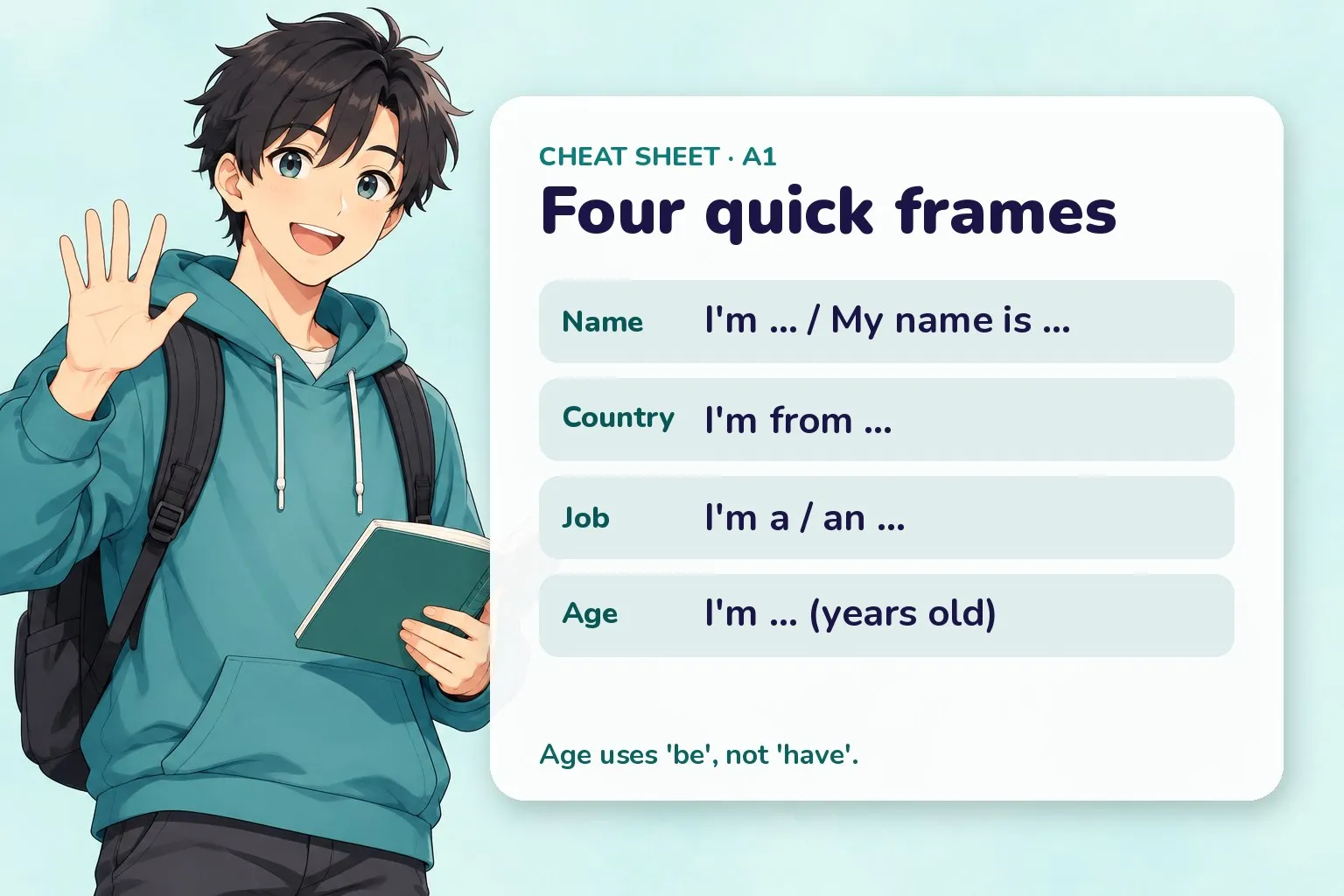
Quick recap before you practise.
Practice
Introducing yourself practice
Try each one, then press Check. No sign-up, nothing is sent anywhere — it all runs in your browser.
Hint: a short word before the country name
Show answer
from — Use 'I'm from + country' to give your origin.
4 Put the words in order to introduce your name.
Show answer
My name is Lena — The formal frame: My name is Lena.
5 Match each question to a natural answer.
- What's your name?
- Where are you from?
- What do you do?
- How old are you?
Show answer
- What's your name? → I'm Ben.
- Where are you from? → I'm from Canada.
- What do you do? → I'm a nurse.
- How old are you? → I'm twenty.
Each introduction question has its own answer frame.
How to say it
A few words in these frames blur together in natural speech.
- I’m is one quick sound, “ime”, rhyming with time — not two separate words.
- What’s your links into “wots-yor”, and what do you often sounds like “wot-dya”.
- Years old joins up as “yee-rzold”; copy the link rather than pausing between the words.
- An engineer links the n straight into the next word: “a-nenjineer”.
Quiz
Introducing yourself quiz
8 questions · pick an answer and you'll see straight away if it's right.
-
Show answer
I'm Maria. — 'I'm …' is the common, natural self-introduction.
-
Show answer
I'm an engineer. — Use 'an' before a vowel sound: I'm an engineer.
-
Show answer
I'm thirty. — English uses 'be' for age: I'm thirty (years old).
-
Show answer
I'm from Spain. — 'I'm from + country': I'm from Spain. ('I'm Spanish' uses the adjective.)
-
Show answer
I'm Japanese. — Nationalities take no article here: I'm Japanese.
-
Show answer
What do you do? — 'What do you do?' is the standard question about someone's job.
-
Show answer
And you? / What about you? — A short question hands the turn back and keeps the conversation going.
-
Show answer
I'm twenty years old. — Answer age with 'be': I'm twenty years old.
Next
- Previous lesson: English: Numbers 0 to 100
- Next lesson: English: Days, Months & Dates
- New here? Start with Start Learning English Here
All English lessons topics
Vocabulary, pronunciation, phrases, practice and exam help, ordered by level. Pick a topic and go straight to it. New lessons go live every day, so topics marked Coming soon fill in over the next weeks.
Lessons
A1 9 topics · 9 ready
- 01 English: Greetings & Introductions
- 02 English: Numbers 0 to 100
- 03 English: Introducing Yourself You are here
- 04 English: Days, Months & Dates
- 05 English: Telling the Time
- 06 English: Giving Personal Information
- 07 English: Family Members
- 08 English: Colours & Shapes
- 09 English: Food & Drink Basics
A2 14 topics · 14 ready
- 10 English: Describing People
- 11 English: Ordering at a Cafe
- 12 English: Shopping & Prices
- 13 English: Clothing & Sizes
- 14 English: Asking for Directions
- 15 English: Using Public Transport
- 16 English: At the Hotel
- 17 English: Weather & Seasons
- 18 English: Hobbies & Free Time
- 19 English: Daily Routine
- 20 English: Housing & Rooms
- 21 English: Parts of the Body
- 22 English: Emotions & Feelings
- 23 English: Supermarket & Groceries
B1 19 topics · 19 ready
- 24 English: Household Chores
- 25 English: At the Doctor
- 26 English: Making Appointments
- 27 English: Making Plans & Invitations
- 28 English: Phone & Messaging
- 29 English: Expressing Opinions
- 30 English: Talking About Past Experiences
- 31 English: Future Plans & Goals
- 32 English: School & Education
- 33 English: Jobs & Professions
- 34 English: Money & Banking
- 35 English: Restaurant & Dining Out
- 36 English: Travel & the Airport
- 37 English: Sightseeing & Tourism
- 38 English: Emergencies & Safety
- 39 English: Technology & the Internet
- 40 English: Complaints & Solving Problems
- 41 English: Small Talk & Networking
- 42 English Small-Talk & Politeness Culture
B2 11 topics · 11 ready
- 43 English: At the Office
- 44 English: The Job Interview
- 45 English: Formal Writing & Emails
- 46 English: News & Current Affairs
- 47 English: Environment & Nature
- 48 English: Health & Lifestyle
- 49 English: Culture & Traditions
- 50 English: Describing Trends & Data
- 51 English: Storytelling & Narration
- 52 English: Giving a Short Presentation
- 53 Writing Business Emails in English