English: Emotions & Feelings
To talk about feelings, use 'I am' plus a feeling adjective (I am happy, I am tired, I am nervous). Ask why with 'Why are you …?' and answer with 'because …'. Watch the -ed and -ing pair: a person is bored, but a thing is boring.
On this page13 sections · tap to jump
Level: A2. Talking about how you feel is one of the warmest things you can do in a new language. English builds it from a simple pattern — the verb be plus a feeling word — and asks about it with ‘why’. The one real trap is the -ed and -ing pair, and this lesson makes it clear.
By the end of this page you can…
…say how you feel, ask someone why they feel that way, answer with ‘because’, and choose correctly between the -ed and -ing form of a feeling adjective.
The basic pattern: be + feeling
English describes a feeling with the verb be and an adjective. The pattern is subject + be + feeling: I am happy, she is tired, they are excited.
Note that English uses be, not have, for most feelings and states. Many languages say the equivalent of I have hunger or I have cold; English says I am hungry and I am cold.
- I am happy today.
- She is a bit nervous.
- We are really excited.
Common feeling adjectives
Here are the feelings you will use most, grouped from good to difficult.
| Good feelings | Hard feelings |
|---|---|
| happy | sad |
| glad | upset |
| excited | worried |
| calm | nervous |
| relaxed | stressed |
| proud | angry |
| grateful | scared / afraid |
Two everyday states sit alongside these: tired (you need rest) and bored (you have nothing interesting to do).
The big trap: -ed vs -ing
This is the mistake almost every learner makes, so slow down here. Many feeling adjectives come in a pair, one ending in -ed and one in -ing.
- The -ed form describes the person who feels it: I am bored. She is interested.
- The -ing form describes the thing that causes the feeling: The lesson is boring. The book is interesting.
| -ed (the person) | -ing (the cause) |
|---|---|
| I am bored. | The film is boring. |
| I am interested. | The topic is interesting. |
| I am tired. | The trip was tiring. |
| I am excited. | The news is exciting. |
| I am worried. | The situation is worrying. |
Asking and answering: why + because
To ask about a feeling, use How do you feel? or, for the reason, Why are you …? The answer almost always starts with because.
- Why are you sad? — Because I failed my test.
- Why is he so happy? — Because he got the job.
Making a feeling stronger or softer
You can turn the volume up or down with a small word before the adjective.
- Softer: a bit, a little, slightly — I’m a bit nervous.
- Stronger: really, very, so — I’m really angry.
- Strongest: absolutely with extreme adjectives — I’m absolutely terrified.
Note that some adjectives are already extreme and do not take very: say absolutely terrified, not very terrified; terrified already means very scared.
A short conversation
Ana: You look worried. What’s wrong? Leo: I have a job interview tomorrow. I’m really nervous. Ana: Why are you nervous? You’re perfect for it. Leo: Because I always forget my words when I’m stressed. Ana: Take a deep breath. You’ll be fine — I’m sure you’ll be great. Leo: Thanks. I feel a bit calmer now.
Example sentences
Play each line and say it aloud with the right feeling in your voice.
- I am very happy today.The basic pattern: be + feeling.
- She is tired after work.Tired describes the person.
- We are really excited about the trip.Excited (person) with a strong 'really'.
- He is a bit nervous before the test.'A bit' softens the feeling.
- They are worried about the weather.Worried + about for the cause.
- I am scared of big dogs.Scared + of for what frightens you.
- My sister is proud of her work.Proud + of for the reason.
- I feel calm now.'Feel' plus a feeling adjective.
- Why are you sad?Asking for the reason behind a feeling.
- Because I lost my keys.A reason answer starting with 'because'.
- The film was boring.The thing is boring (-ing).
- I was bored during the film.The person is bored (-ed).
- This book is really interesting.The thing is interesting (-ing).
- I am interested in history.The person is interested (-ed) + in.
- The long journey was tiring.The cause is tiring (-ing).
- I am grateful for your help.Grateful + for for the reason.
- He gets angry very quickly.A feeling that can change fast.
- I'm absolutely terrified of heights.An extreme adjective with 'absolutely'.
- Don't worry, everything is fine.Reassuring someone who feels bad.
- I feel much better now, thank you.Saying a feeling has improved.
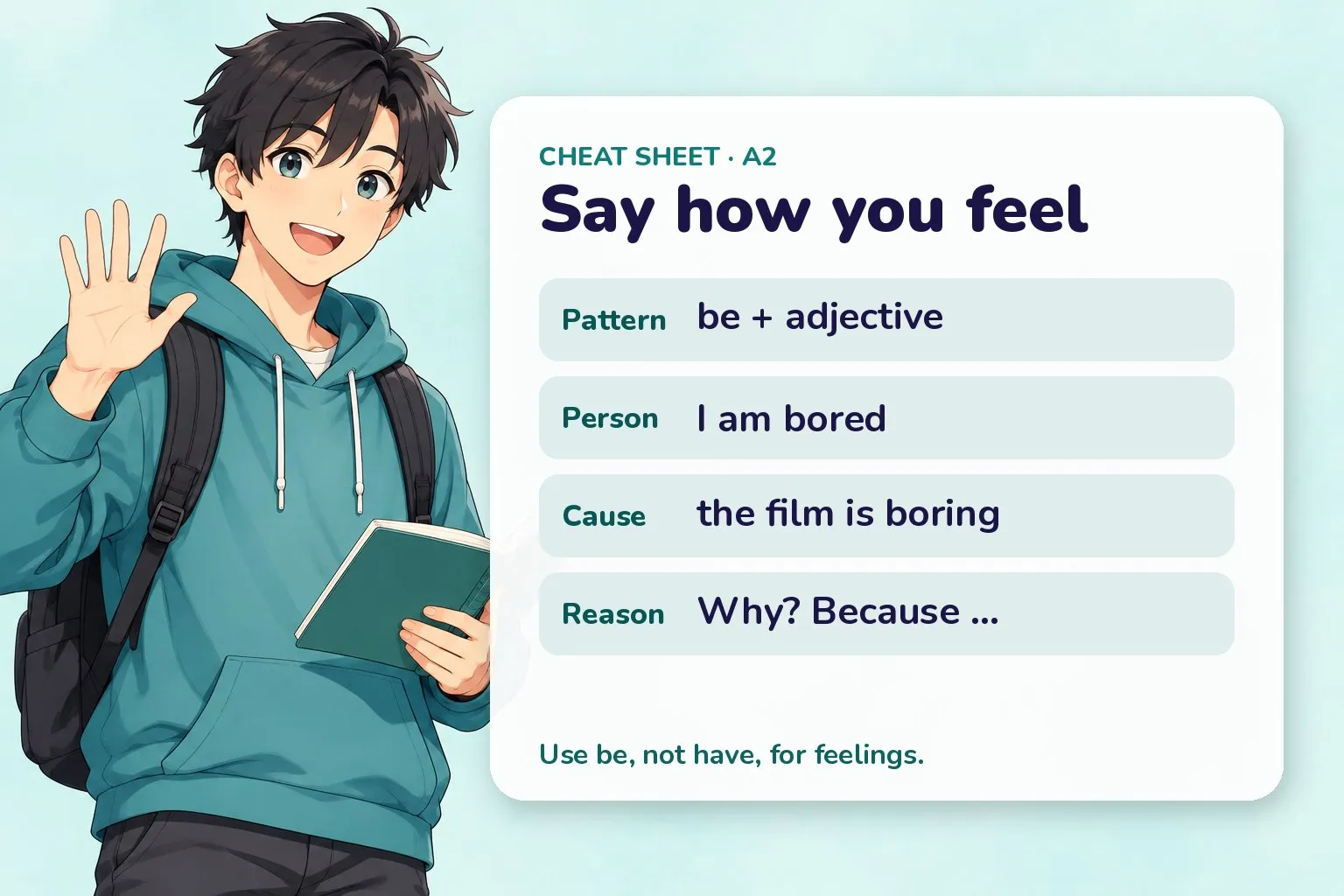
Quick recap before you practise.
Usage notes
- be, not have: English says I am hungry, I am thirsty, I am afraid, I am cold, never I have hungry. This differs from many other languages.
- feel + adjective: you can replace be with feel for a feeling: I feel happy, I feel sick, I feel nervous. After feel you still use an adjective, not an adverb.
- prepositions stick to feelings: worried about, scared of, proud of, interested in, grateful for. Learn each pair as a chunk.
- upset is flexible: upset can mean sad, hurt or a little angry, depending on the situation — it is softer and more polite than angry.
Practice
Emotions and feelings practice
Try each one, then press Check. No sign-up, nothing is sent anywhere — it all runs in your browser.
Hint: the person who feels it
Show answer
bored — The person takes the -ed form: I was bored.
Hint: the word for a reason
Show answer
Because — A reason answer starts with 'because'.
5 Put the words in order to ask about a feeling.
Show answer
Why are you nervous — Why-questions put 'why' first, then the verb: Why are you nervous?
6 Match each feeling to its preposition.
- worried
- scared
- proud
- interested
Show answer
- worried → about
- scared → of
- proud → of
- interested → in
Feeling adjectives take fixed prepositions: worried about, scared of, proud of, interested in.
How to say it
A few feeling words trip up English learners — copy the audio, not the spelling.
- nervous sounds like “NER-vuss”, with the stress on the first part.
- anxious sounds like “ANK-shuss” — the x becomes a ksh sound.
- bored is one syllable, “bord”, and rhymes with “ward”; don’t add an extra -ed beat.
- tired has two soft beats: “TY-urd”, not “ty-red”.
Quiz
Emotions and feelings quiz
8 questions · pick an answer and you'll see straight away if it's right.
-
Show answer
I am cold. — English uses be for states and feelings: I am cold.
-
Show answer
boring — The cause takes -ing: the film was boring.
-
Show answer
bored — The person takes -ed: you were bored.
-
Show answer
interesting — The thing that causes interest is interesting (-ing).
-
Show answer
interested — The person takes -ed and the preposition 'in': interested in.
-
Show answer
Because I failed the test. — A reason answer starts with 'because'.
-
Show answer
a bit — 'A bit' softens: I'm a bit nervous. 'Really/very/so' make it stronger.
-
Show answer
Why are you tired? — Why-questions use 'why' + verb + subject: Why are you tired?
Recap cheat-sheet
| Idea | Rule | Example |
|---|---|---|
| Feeling pattern | be (not have) + adjective | I am happy. |
| Person | -ed form | I am bored. |
| Cause / thing | -ing form | The film is boring. |
| Ask the reason | Why are you …? | Why are you sad? |
| Give the reason | because … | Because I lost my keys. |
| Softer / stronger | a bit / really | a bit nervous; really angry |
Next
- Previous lesson: English: Parts of the Body
- Next lesson: English: Making Appointments
- New here? Start with Start Learning English Here
All English lessons topics
Vocabulary, pronunciation, phrases, practice and exam help, ordered by level. Pick a topic and go straight to it. New lessons go live every day, so topics marked Coming soon fill in over the next weeks.
Lessons
A1 9 topics · 9 ready
A2 14 topics · 14 ready
- 10 English: Describing People
- 11 English: Ordering at a Cafe
- 12 English: Shopping & Prices
- 13 English: Clothing & Sizes
- 14 English: Asking for Directions
- 15 English: Using Public Transport
- 16 English: At the Hotel
- 17 English: Weather & Seasons
- 18 English: Hobbies & Free Time
- 19 English: Daily Routine
- 20 English: Housing & Rooms
- 21 English: Parts of the Body
- 22 English: Emotions & Feelings You are here
- 23 English: Supermarket & Groceries
B1 19 topics · 19 ready
- 24 English: Household Chores
- 25 English: At the Doctor
- 26 English: Making Appointments
- 27 English: Making Plans & Invitations
- 28 English: Phone & Messaging
- 29 English: Expressing Opinions
- 30 English: Talking About Past Experiences
- 31 English: Future Plans & Goals
- 32 English: School & Education
- 33 English: Jobs & Professions
- 34 English: Money & Banking
- 35 English: Restaurant & Dining Out
- 36 English: Travel & the Airport
- 37 English: Sightseeing & Tourism
- 38 English: Emergencies & Safety
- 39 English: Technology & the Internet
- 40 English: Complaints & Solving Problems
- 41 English: Small Talk & Networking
- 42 English Small-Talk & Politeness Culture
B2 11 topics · 11 ready
- 43 English: At the Office
- 44 English: The Job Interview
- 45 English: Formal Writing & Emails
- 46 English: News & Current Affairs
- 47 English: Environment & Nature
- 48 English: Health & Lifestyle
- 49 English: Culture & Traditions
- 50 English: Describing Trends & Data
- 51 English: Storytelling & Narration
- 52 English: Giving a Short Presentation
- 53 Writing Business Emails in English