English: Culture & Traditions
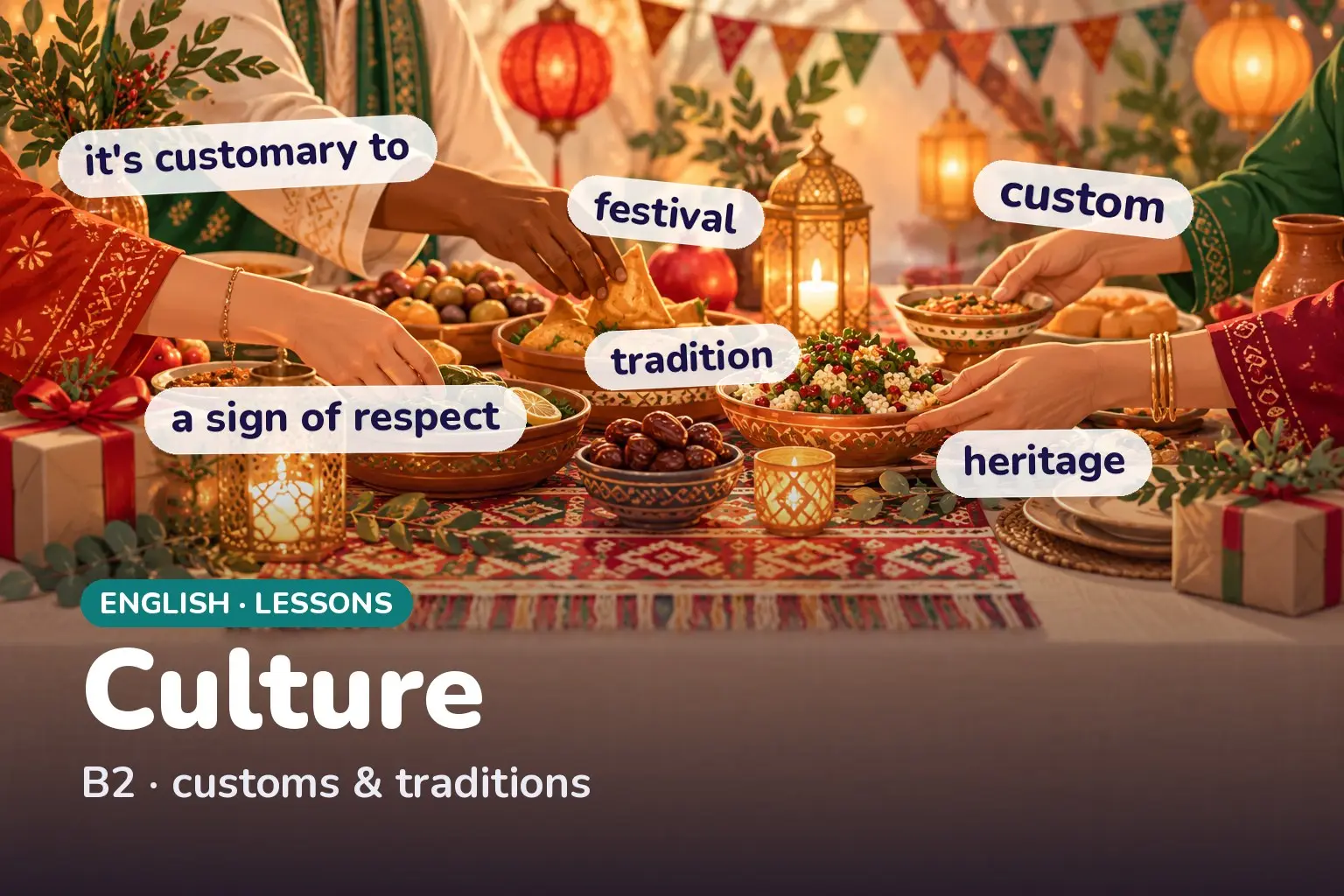
To describe culture and traditions in English, learn the core nouns (custom, tradition, heritage, festival) and phrases that present a custom as normal: 'It's customary to…' and 'It's considered polite to…'. Use the present simple for living customs and 'used to' for traditions that have changed.
On this page14 sections · tap to jump
- 01By the end of this page you can…
- 02Core vocabulary
- 03Presenting a custom as normal
- 04Teaching point 1 — present simple for living customs
- 05Teaching point 2 — “used to” for traditions that have changed
- 06Teaching point 3 — articles with general nouns
- 07Comparing cultures politely
- 08A short conversation
- 09Usage notes
- 10Example sentences
- 11Practice
- 12How to say it
- 13Quiz
- 14Recap cheat-sheet
Level: B2. Talking about culture and traditions needs two things: a set of nouns for the ideas (custom, tradition, heritage, festival) and a set of phrases that present a practice as normal and shared. This lesson gives you both, plus the grammar that makes it sound natural — and the polite, neutral way to compare cultures without judging them.
By the end of this page you can…
…name the key culture words, describe a custom from your own country, explain how traditions change over time, and compare customs across cultures without sounding rude.
Core vocabulary
A custom is something people usually do in a particular place or group (shaking hands, taking off your shoes indoors). A tradition is a custom that has been passed down from one generation to the next — it carries a sense of history. Heritage is everything a group inherits from the past: language, buildings, stories and skills.
| English | What it means |
|---|---|
| custom | what people in a place usually do |
| tradition | a custom passed down over generations |
| heritage | the culture and history a group inherits |
| ceremony | a formal set of actions for an occasion |
| ritual | a fixed set of actions, often with meaning |
| festival | a day or season of public celebration |
| superstition | a belief that an action brings luck or bad luck |
| etiquette | the rules of polite behaviour |
Around these sit the words you use most: a celebration, a ceremony (formal, e.g. a wedding ceremony), a ritual (a fixed set of actions), folklore (traditional stories), values and beliefs (what a group thinks is important or true), and etiquette (the unwritten rules of polite behaviour).
Presenting a custom as normal
The skill at B2 is making a practice sound shared rather than personal. English has a small set of frames for this:
- It’s customary to take off your shoes before entering a home.
- It’s a tradition to eat special food at New Year.
- People traditionally visit family on the first day.
- It’s considered polite / rude to arrive a little late.
- You’re (not) supposed to open a gift in front of the giver.
- It’s a sign of respect to use both hands.
Teaching point 1 — present simple for living customs
A custom that still happens is a general truth, so you describe it with the present simple, not a past or continuous form: People give gifts, We celebrate in spring, Children visit their grandparents. Saying People are giving gifts would mean right now, which is not what you mean. Review this in present simple (affirmative).
Teaching point 2 — “used to” for traditions that have changed
When a tradition was common in the past but is fading, use used to or would: Families used to gather every Sunday, People would light a fire on the hilltop. This shows contrast with now. See used to / would for past habits.
Teaching point 3 — articles with general nouns
When you talk about a custom in general, use the zero article (no the) with plural or uncountable nouns: Traditions change, Respect for elders is important. Add the only when you mean a specific one: the tradition my grandmother started. Review the zero article.
Comparing cultures politely
The highest-value habit at B2 is comparing without ranking. Keep it neutral:
- In my country, …; in yours, … (state both, don’t rank)
- It’s different from what I’m used to, rather than It’s strange.
- It’s considered rude to …, rather than It is rude to … — the first reports a view, the second judges.
A short conversation
Maya: We’re having a big family dinner tonight — it’s a tradition for the harvest festival. Tom: That sounds lovely. Is there anything I’m supposed to bring? Maya: It’s customary to bring a small gift, but honestly your company is enough. Tom: I’ll bring some flowers. Is it rude to arrive early? Maya: Not at all — people usually turn up a little before the meal.
Usage notes
- custom vs costume: a custom is a practice; a costume is clothing you wear (for a festival or play). They are not related.
- tradition vs habit: a habit is personal and often unconscious (I have a habit of biting my nails); a tradition is shared and passed down.
- celebrate vs congratulate: you celebrate an event (We celebrate New Year) but you congratulate a person (I congratulated her on the wedding).
- heritage is uncountable: say our cultural heritage, not our heritages.
Example sentences
Press play and say each line aloud — these are the exact frames you will reuse.
- In my culture, it's customary to take off your shoes indoors.Presenting a custom as normal.
- It's a tradition to eat special food on New Year's Eve.It's a tradition to + base verb.
- People traditionally visit their relatives on the first day.People traditionally + present simple.
- This festival has been passed down for generations.passed down = inherited over time.
- It's considered polite to greet the oldest person first.It's considered polite to + base verb.
- You're not supposed to point at people with your finger.you're supposed to for social rules.
- Giving a gift with both hands is a sign of respect.a sign of respect to show manners.
- We celebrate the harvest with music and dancing.celebrate an event (present simple).
- Our cultural heritage includes old songs and crafts.heritage is uncountable.
- Families used to gather every Sunday for a big meal.used to for a fading tradition.
- People would light a fire on the hilltop at midsummer.would for repeated past custom.
- Respect for elders is very important here.zero article with a general idea.
- It's different from what I'm used to, but I like it.Polite reaction, not judgement.
- There's a superstition that breaking a mirror brings bad luck.superstition = belief about luck.
- The wedding ceremony lasted almost three hours.ceremony for a formal occasion.
- Table etiquette varies a lot from country to country.etiquette = rules of polite behaviour.
- I congratulated them on their new home.congratulate a person, celebrate an event.
- That custom is slowly dying out in the cities.die out = gradually disappear.
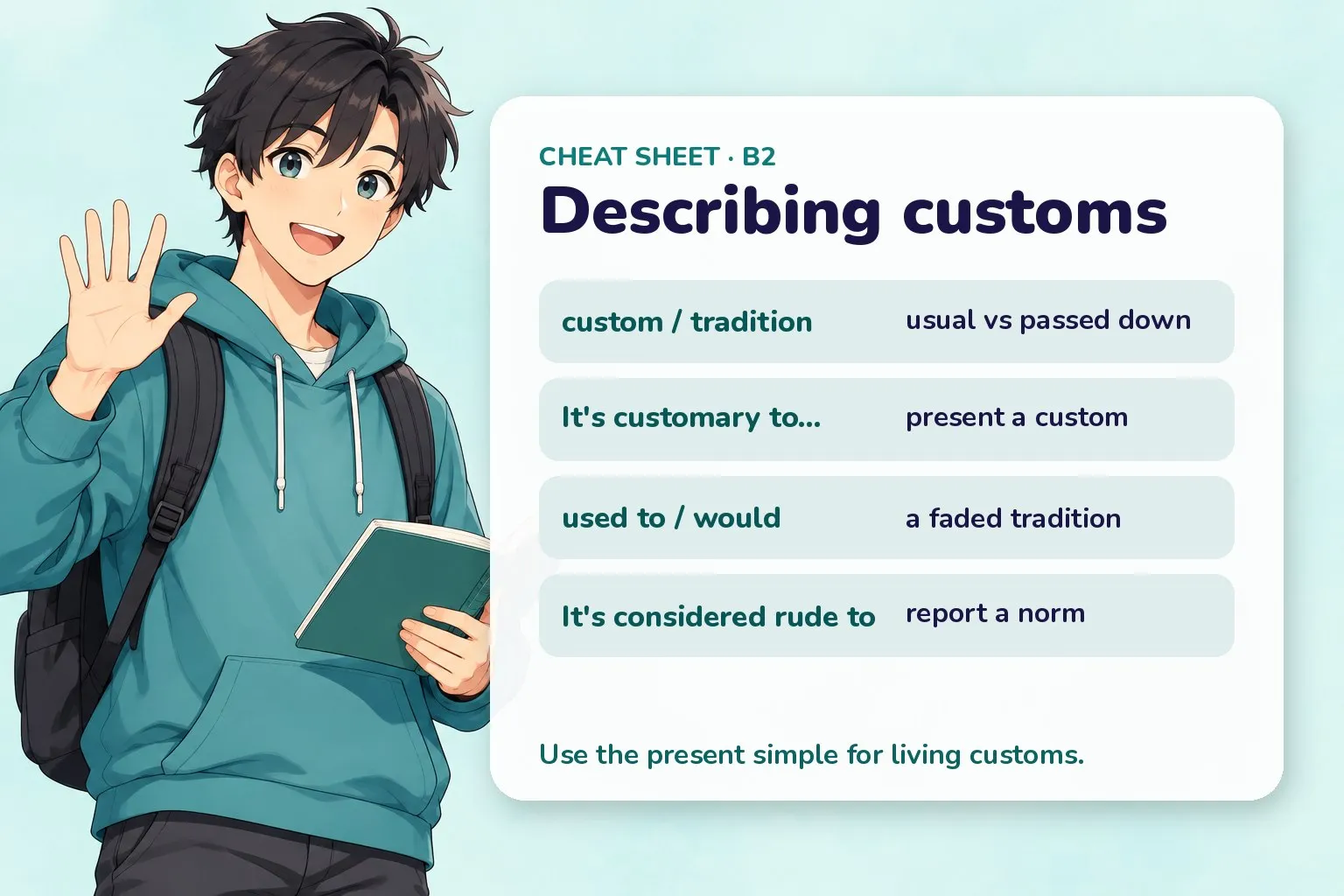
Quick recap before you practise.
Practice
Culture and traditions practice
Try each one, then press Check. No sign-up, nothing is sent anywhere — it all runs in your browser.
Hint: from the word 'custom'
Show answer
customary — It's customary to + base verb presents a practice as normal.
Hint: past habit, now changed
Show answer
used — Used to shows a tradition that was common before but is not now.
4 Put the words in order to report a social rule.
Show answer
It's considered polite to greet the oldest person first — It's considered polite to + base verb reports a norm without judging.
5 Match each word to its meaning.
- custom
- heritage
- superstition
- etiquette
Show answer
- custom → what people usually do
- heritage → what a group inherits
- superstition → a belief about luck
- etiquette → rules of polite behaviour
These are the core culture nouns for this lesson.
How to say it
A few of these words trip up learners — copy the sounds, not the spelling.
- tradition is said truh-DISH-un, with the stress on the middle and a sh sound in -tion.
- ceremony keeps four beats in British English (SERR-uh-mun-ee); the first syllable is stressed.
- heritage is HERR-it-ij, with a soft g like bridge, not a hard g.
- etiquette is ETT-i-ket, stress on the first part; the final -ette sounds like ket.
Quiz
Culture and traditions quiz
11 questions · pick an answer and you'll see straight away if it's right.
-
Show answer
a custom passed down over generations — A tradition is a shared custom passed down; a costume is clothing.
-
Show answer
People celebrate in spring. — A current custom is a general truth, so use the present simple.
-
Show answer
used to — Used to describes a past habit or tradition that has changed.
-
Show answer
That's new to me. — Describe your reaction neutrally rather than judging the culture.
-
Show answer
celebrate / congratulate — You celebrate New Year (an event) and congratulate someone (a person).
-
Show answer
It's considered rude to point. — It's considered rude to… reports a shared view, not a personal judgement.
-
Show answer
Respect for elders is important. — Use the zero article with a general uncountable idea: Respect for elders is important.
-
Show answer
a belief that something brings luck or bad luck — A superstition links an action to good or bad luck.
-
Show answer
heritage — Heritage is uncountable: say our heritage, not our heritages.
-
Show answer
gradually disappearing — Die out means to gradually disappear.
-
Show answer
Is there anything I'm supposed to bring? — Be supposed to is the natural frame for expected social behaviour.
Recap cheat-sheet
| Idea | Pattern | Example |
|---|---|---|
| Key nouns | custom, tradition, heritage, festival | It’s a family tradition. |
| Present a custom | It’s customary / a tradition to + verb | It’s customary to bring a gift. |
| Living custom | present simple | People give gifts at New Year. |
| Faded tradition | used to / would | Families used to gather on Sundays. |
| Report a norm | It’s considered polite / rude to… | It’s considered rude to point. |
| Compare politely | In my country… / different from… | It’s different from what I’m used to. |
Next
- Next lesson: English: Describing Trends & Data
- New here? Start with Start Learning English Here
All English lessons topics
Vocabulary, pronunciation, phrases, practice and exam help, ordered by level. Pick a topic and go straight to it. New lessons go live every day, so topics marked Coming soon fill in over the next weeks.
Lessons
A1 9 topics · 9 ready
A2 14 topics · 14 ready
- 10 English: Describing People
- 11 English: Ordering at a Cafe
- 12 English: Shopping & Prices
- 13 English: Clothing & Sizes
- 14 English: Asking for Directions
- 15 English: Using Public Transport
- 16 English: At the Hotel
- 17 English: Weather & Seasons
- 18 English: Hobbies & Free Time
- 19 English: Daily Routine
- 20 English: Housing & Rooms
- 21 English: Parts of the Body
- 22 English: Emotions & Feelings
- 23 English: Supermarket & Groceries
B1 19 topics · 19 ready
- 24 English: Household Chores
- 25 English: At the Doctor
- 26 English: Making Appointments
- 27 English: Making Plans & Invitations
- 28 English: Phone & Messaging
- 29 English: Expressing Opinions
- 30 English: Talking About Past Experiences
- 31 English: Future Plans & Goals
- 32 English: School & Education
- 33 English: Jobs & Professions
- 34 English: Money & Banking
- 35 English: Restaurant & Dining Out
- 36 English: Travel & the Airport
- 37 English: Sightseeing & Tourism
- 38 English: Emergencies & Safety
- 39 English: Technology & the Internet
- 40 English: Complaints & Solving Problems
- 41 English: Small Talk & Networking
- 42 English Small-Talk & Politeness Culture
B2 11 topics · 11 ready
- 43 English: At the Office
- 44 English: The Job Interview
- 45 English: Formal Writing & Emails
- 46 English: News & Current Affairs
- 47 English: Environment & Nature
- 48 English: Health & Lifestyle
- 49 English: Culture & Traditions You are here
- 50 English: Describing Trends & Data
- 51 English: Storytelling & Narration
- 52 English: Giving a Short Presentation
- 53 Writing Business Emails in English