English: Restaurant & Dining Out
To eat out in English, ask for a table, order with 'I'll have …' or 'Could I get …?', ask about dishes you don't know, and at the end say 'Could we have the bill, please?' Learn the menu words and these polite frames and dining out is easy.
Level: B1. Eating out in English follows a clear order: you get a table, you look at the menu, you order, you eat, and you pay. Each step has a handful of set phrases. Once you know them — and the words for the courses and the people who serve you — you can handle almost any restaurant without switching back to your own language.
By the end of this page you can…
…book or ask for a table, understand the parts of a menu, order food and drink politely, ask about a dish, send something back or report a problem, and ask for the bill.
Getting a table
You can book (or reserve) a table in advance, or just turn up and ask. The person who shows you to your table and brings your food is the waiter or waitress (together, the waiting staff or server).
- I’d like to book a table for two, please. (in advance, usually by phone)
- Do you have a table for four? (when you arrive without booking)
- We have a reservation under Costa. (you booked earlier)
If the restaurant is full, you may have to wait or be put on a waiting list. A quiet restaurant has plenty of free tables.
Reading the menu
A typical menu is divided into courses — the stages of the meal:
| Course | What it is | Also called (US) |
|---|---|---|
| Starter | a small first dish | appetizer |
| Main course | the biggest, central dish | entrée |
| Side / side dish | a small extra (chips, salad) | side |
| Dessert | the sweet dish at the end | dessert |
You will also see the drinks list (or beverages) and sometimes a set menu — a fixed group of courses for one price, often cheaper than ordering each dish à la carte (choosing each item separately).
Ordering politely
English speakers rarely order with a bare command. The natural, polite frames are I’ll have …, Could I get …? and Can I have …? You can add for me or to start to be clear.
- I’ll have the tomato soup to start, please.
- Could I get the grilled chicken for my main course?
- Can we have some still water for the table?
When you are not sure, ask. Useful questions:
- What do you recommend?
- What’s in the seafood pasta?
- Is this dish spicy / vegetarian?
- Could I have it without onions? (to change a dish)
Dietary needs and problems
If you have an allergy or follow a special diet, say so clearly before you order:
- I’m allergic to nuts — does this contain any?
- Do you have any vegetarian / vegan options?
- I can’t eat gluten. Is the sauce gluten-free?
If something is wrong with your food or table, complain politely and indirectly. Start with Excuse me and soften it with I think or I’m afraid:
- Excuse me, I think there’s a problem with my order — this isn’t what I asked for.
- I’m afraid my soup is cold. Could you warm it up?
- Sorry, could we have a clean fork? This one’s a bit dirty.
Paying
At the end, you ask for the bill (British English) or the check (American English). You might pay by card or in cash, and you may leave a tip (extra money for good service).
- Could we have the bill, please?
- Can I pay by card?
- Do you take contactless?
- Can we split the bill? (each person pays their share)
- Keep the change. (the extra is a tip)
Sometimes a service charge is already added to the bill, so check before you add a tip. Tipping is expected in some countries and not in others — when in doubt, ask a local or check online.
Example sentences
Press play and copy the rhythm. Say each line out loud as if you were really at the table.
- I'd like to book a table for two at eight, please.Booking ahead, with the number of people and the time.
- Do you have a table for four?Asking when you arrive without a reservation.
- We have a reservation under Costa.Giving the name your booking is under.
- Could we see the menu, please?A polite request with could.
- What do you recommend?Asking the waiter for a suggestion.
- What's in the seafood pasta?Asking about the ingredients of a dish.
- I'll have the tomato soup to start.Ordering a starter with I'll have.
- Could I get the grilled chicken for my main?Ordering a main course politely.
- Can we have some still water for the table?Still water, not sparkling, for everyone.
- I'm allergic to nuts — does this contain any?Flagging an allergy before ordering.
- Do you have any vegetarian options?Asking about dishes with no meat.
- Could I have it without onions?Changing a dish to suit you.
- Excuse me, I think there's a problem with my order.A polite, indirect complaint.
- I'm afraid my soup is cold.Softening a complaint with I'm afraid.
- That was delicious, thank you.A simple compliment after the meal.
- Could we have the bill, please?Asking to pay, British style.
- Can I pay by card?Checking how you can pay.
- Can we split the bill?Each person pays their share.
- Is service included?Checking whether a tip is already added.
- Keep the change.Leaving the extra as a tip.
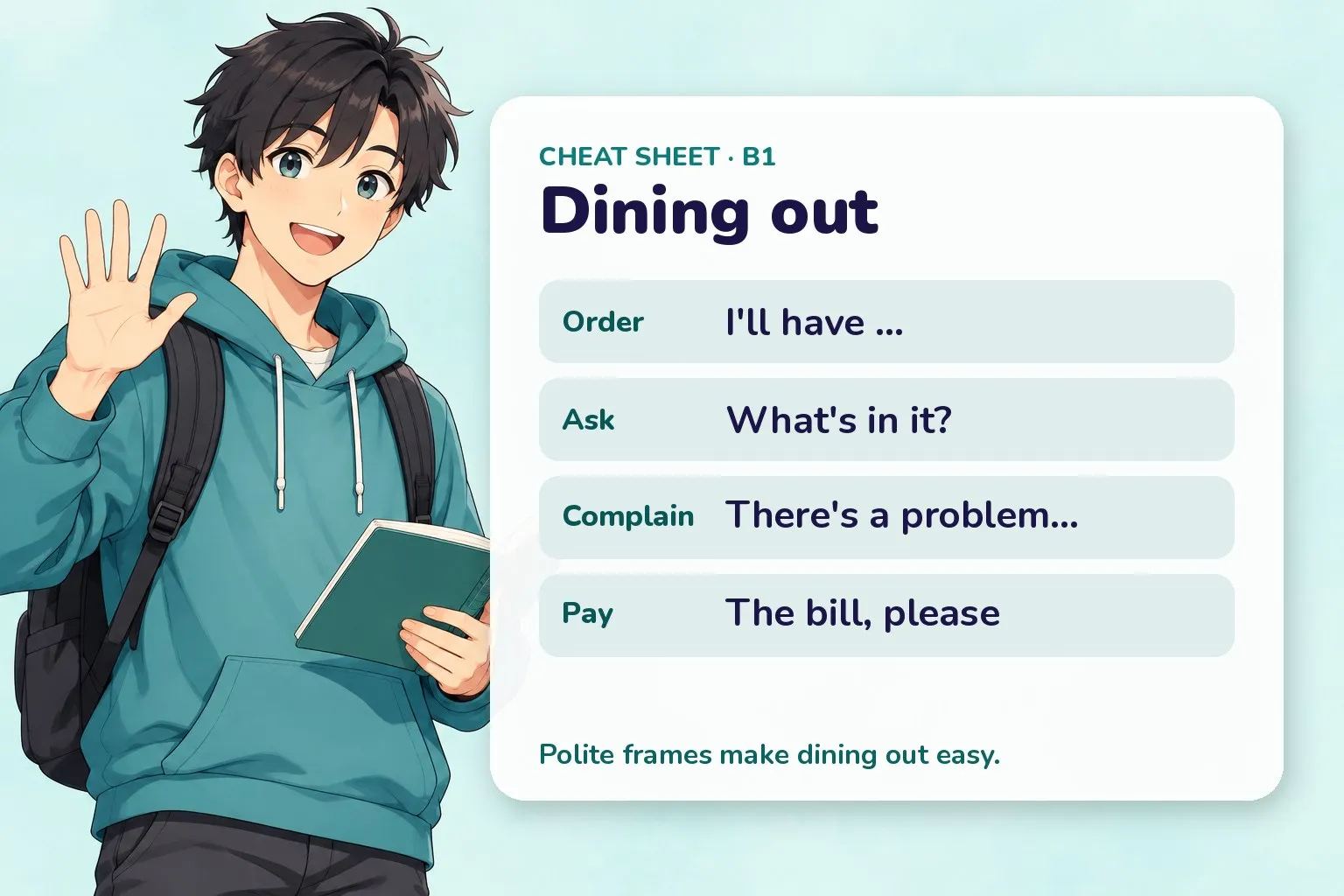
Quick recap before you practise.
A short conversation
Waiter: Good evening. Do you have a reservation? Omar: Yes, a table for two under Omar. Waiter: Perfect, this way. Here are the menus. Can I get you something to drink? Omar: Could we have some still water to start? And what do you recommend? Waiter: The grilled sea bass is very popular tonight. Omar: Sounds great. I’ll have that, and a green salad on the side, please.
Usage notes
- I’ll have vs I’d like: both are polite and natural for ordering. I’ll have is a little more casual; I’d like is slightly more formal. Either is safe.
- starter / main / dessert: in everyday speech people shorten main course to main (“for my main”). Pudding is a common British word for dessert.
- bill vs check: ask for the bill in Britain, Ireland and Australia; ask for the check in the United States. Both are understood almost everywhere.
- a table for + number: always say the number of people, not tables: a table for three means three guests.
- some vs a/an: use some for food you don’t count (some water, some bread) and a/an for single countable items (a coffee, a dessert).
Practice
Restaurant practice
Try each one, then press Check. No sign-up, nothing is sent anywhere — it all runs in your browser.
Hint: British word for the amount to pay
Show answer
bill — In British English you ask for the bill; Americans say the check.
Hint: softens a complaint
Show answer
afraid — 'I'm afraid …' softens a complaint and sounds more polite than a blunt statement.
4 Put the words in order to order a starter.
Show answer
I'll have the soup to start — The natural order is: I'll have the soup to start.
5 Match each course to what it is.
- starter
- main course
- dessert
- side
Show answer
- starter → the small first dish
- main course → the biggest, central dish
- dessert → the sweet dish at the end
- side → a small extra like chips
A meal usually runs starter, main course, dessert, with sides alongside the main.
How to say it
A few restaurant words trip up English learners. Copy the audio rather than reading them letter by letter.
- restaurant is usually two or three quick beats: “RES-tron” or “RES-ter-ont”, with the stress on the first part.
- menu is “MEN-yoo”, stress on the first syllable — not “me-NOO”.
- dessert (the sweet course) has the stress on the second syllable, “di-ZURT”; don’t confuse it with desert (dry sand), stressed on the first.
- bill and meal have a short clear vowel; keep bill short (“bil”) and meal long (“meel”).
Quiz
Restaurant & dining quiz
8 questions · pick an answer and you'll see straight away if it's right.
-
Show answer
Could I have a coffee, please? — 'Could I have …, please?' is the polite, natural frame for ordering.
-
Show answer
main course — In American English the entrée is the main course, not the first dish.
-
Show answer
bill — British English uses 'bill'; American English uses 'check'.
-
Show answer
I'm allergic to nuts — does this contain any? — State the allergy clearly and ask whether the dish contains the ingredient.
-
Show answer
Excuse me, I think there's a problem with my order. — A soft, indirect complaint ('I think there's a problem') gets a friendlier, faster fix.
-
Show answer
Each person pays their share. — Splitting the bill means dividing the total so each person pays their part.
-
Show answer
have — Ask for a table with 'Could we have a table for …?'
-
Show answer
A fixed group of courses for one price. — A set menu offers several courses for a single fixed price, often cheaper than à la carte.
Recap cheat-sheet
| Step | What to say | Note |
|---|---|---|
| Get a table | A table for two, please. | Say the number of people. |
| Order | I’ll have … / Could I get …? | Not “I take”. |
| Ask about a dish | What’s in it? / Is it spicy? | Check before you choose. |
| Complain | Excuse me, I think there’s a problem… | Polite and indirect. |
| Pay | Could we have the bill, please? | “Check” in the US. |
| Tip | Keep the change. / Is service included? | Customs vary by country. |
Next
- Previous lesson: English: Money & Banking
- Next lesson: English: Supermarket & Groceries
- Warm up with: English: Ordering at a Cafe and English: Food & Drink Basics
- New here? Start with Start Learning English Here
All English lessons topics
Vocabulary, pronunciation, phrases, practice and exam help, ordered by level. Pick a topic and go straight to it. New lessons go live every day, so topics marked Coming soon fill in over the next weeks.
Lessons
A1 9 topics · 9 ready
A2 14 topics · 14 ready
- 10 English: Describing People
- 11 English: Ordering at a Cafe
- 12 English: Shopping & Prices
- 13 English: Clothing & Sizes
- 14 English: Asking for Directions
- 15 English: Using Public Transport
- 16 English: At the Hotel
- 17 English: Weather & Seasons
- 18 English: Hobbies & Free Time
- 19 English: Daily Routine
- 20 English: Housing & Rooms
- 21 English: Parts of the Body
- 22 English: Emotions & Feelings
- 23 English: Supermarket & Groceries
B1 19 topics · 19 ready
- 24 English: Household Chores
- 25 English: At the Doctor
- 26 English: Making Appointments
- 27 English: Making Plans & Invitations
- 28 English: Phone & Messaging
- 29 English: Expressing Opinions
- 30 English: Talking About Past Experiences
- 31 English: Future Plans & Goals
- 32 English: School & Education
- 33 English: Jobs & Professions
- 34 English: Money & Banking
- 35 English: Restaurant & Dining Out You are here
- 36 English: Travel & the Airport
- 37 English: Sightseeing & Tourism
- 38 English: Emergencies & Safety
- 39 English: Technology & the Internet
- 40 English: Complaints & Solving Problems
- 41 English: Small Talk & Networking
- 42 English Small-Talk & Politeness Culture
B2 11 topics · 11 ready
- 43 English: At the Office
- 44 English: The Job Interview
- 45 English: Formal Writing & Emails
- 46 English: News & Current Affairs
- 47 English: Environment & Nature
- 48 English: Health & Lifestyle
- 49 English: Culture & Traditions
- 50 English: Describing Trends & Data
- 51 English: Storytelling & Narration
- 52 English: Giving a Short Presentation
- 53 Writing Business Emails in English