English: Asking for Directions
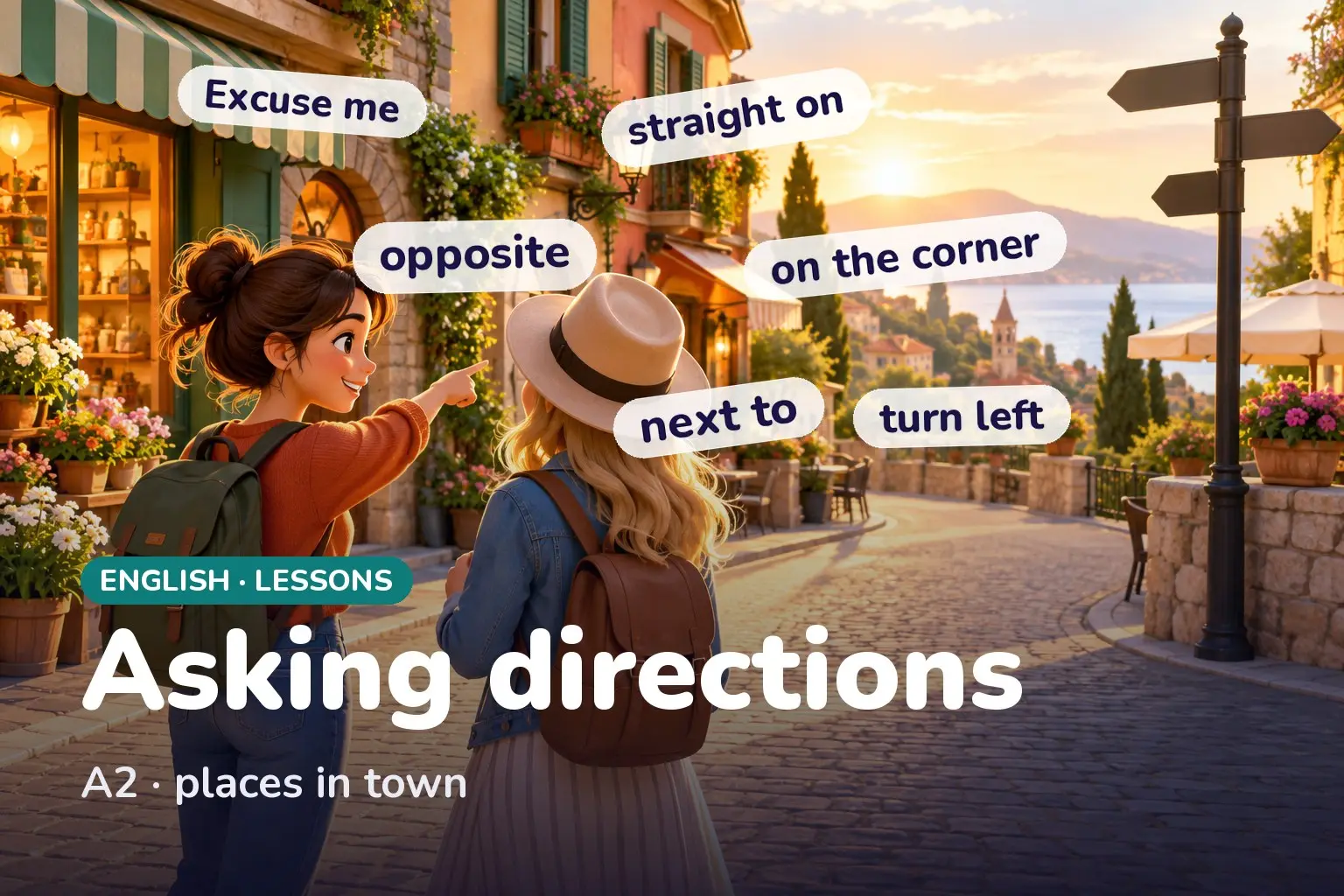
Start with 'Excuse me, how do I get to…?' or 'Is there a bank near here?'. To give directions, use 'Go straight on', 'Turn left/right', and place words like 'next to', 'opposite' and 'on the corner'.
Level: A2. Sooner or later you will be lost in a new town and need to ask a stranger the way. A small set of question forms, place words and direction phrases lets you ask politely and understand the answer.
By the end of this page you can…
…name common places in a town, ask the way politely, understand simple directions, and use place words like ‘next to’, ‘opposite’ and ‘on the corner’.
Places in a town
To ask the way, you first need the word for where you are going. Common places: the bank, the post office, the supermarket, the chemist (American pharmacy or drugstore), the hospital, the station, the bus stop, the library, the museum, the park, the market, the cinema, a restaurant, a café, a hotel, the town centre, a car park (American parking lot), the toilets (American restroom).
Asking the way politely
Begin with Excuse me — it tells a stranger you are about to ask something. Then use one of these:
- Excuse me, how do I get to the station?
- Excuse me, where’s the nearest bank?
- Is there a supermarket near here?
- Can you tell me the way to the museum, please?
Understanding the answer
Directions are built from a few verbs and prepositions. The main ones:
- Go straight on (American go straight ahead) — keep going, don’t turn.
- Turn left / Turn right — change direction at a junction.
- Take the first/second turning on the left (American the first turn).
- Go past the church — pass it and continue.
- It’s on your left / on your right.
- It’s at the end of the road / on the corner.
Place words say where something is in relation to something else: next to (beside), opposite (across the road from), in front of (on the same side, facing it), behind, between … and …, near.
A short conversation
You: Excuse me, how do I get to the train station? Local: Go straight on to the traffic lights, then turn left. You: Is it far? Local: No, about five minutes. It’s on your right, opposite the park. You: Thank you very much!
Example sentences
Press play and repeat. These are the phrases you will both say and hear when you ask the way.
- Excuse me, how do I get to the station?The polite way to ask the way.
- Is there a bank near here?Asking whether a place is nearby.
- Where's the nearest supermarket?'Nearest' = the closest one.
- Can you tell me the way to the museum?A full, polite question form.
- Go straight on to the end of the road.Keep going without turning.
- Turn left at the traffic lights.Change direction at the lights.
- Turn right after the bridge.'After' marks when to turn.
- Take the first turning on the right.British 'turning'; American 'turn'.
- Go past the church and it's on your left.Pass the church, then look left.
- It's next to the post office.Next to = right beside.
- The bank is opposite the café.Opposite = across the road from.
- The car park is behind the hotel.Behind = at the back of.
- It's between the bank and the library.Between … and … = in the middle of two things.
- It's on the corner of King Street.On the corner = where two roads meet.
- Is it far from here?Asking about distance.
- No, it's about a five-minute walk.Giving distance as time on foot.
- You can't miss it.A common phrase meaning it is easy to find.
- Sorry, I'm not from here.A polite way to say you can't help.
- Thank you very much for your help.Thanking someone for directions.
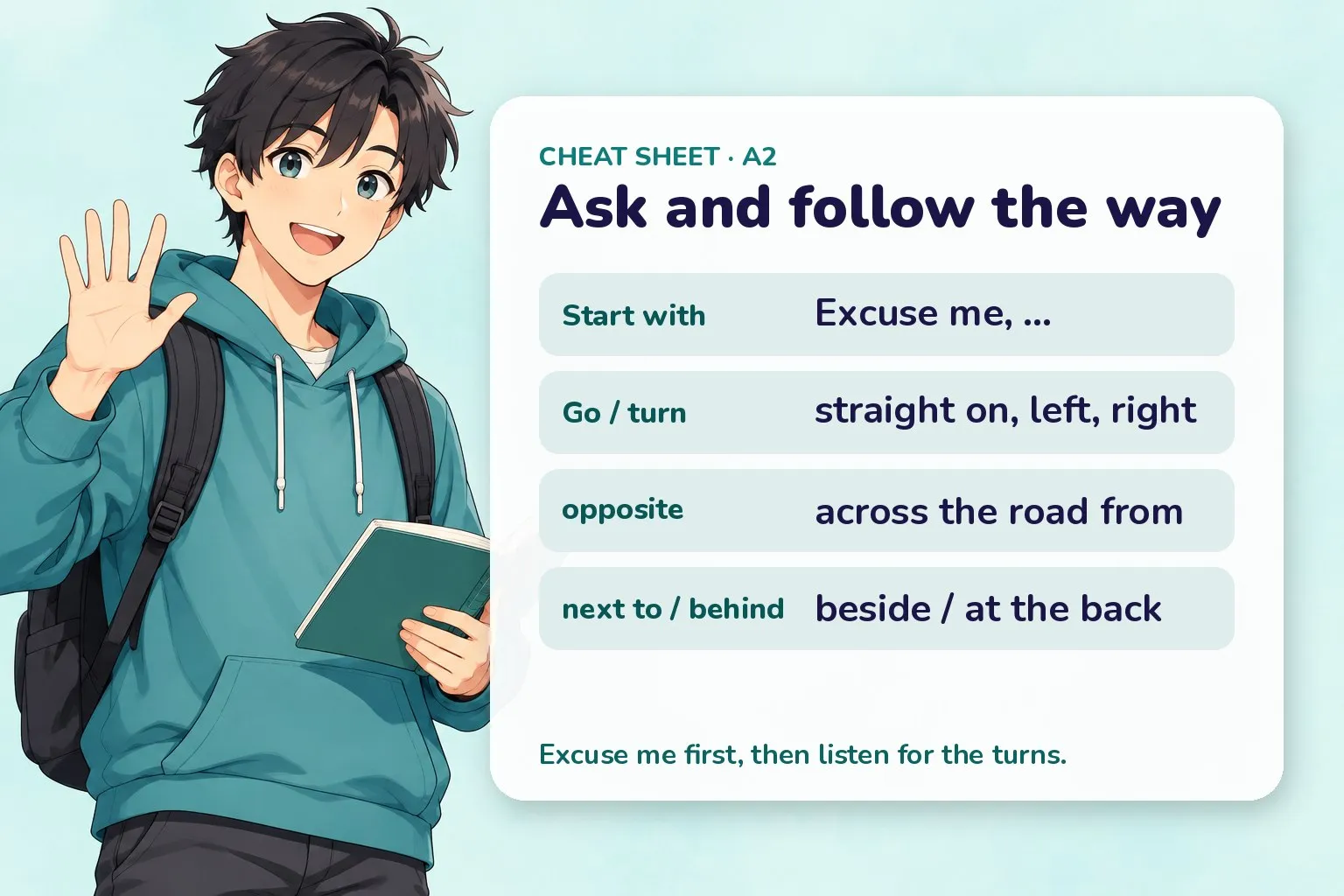
Quick recap before you practise.
Practice
Asking for directions practice
Try each one, then press Check. No sign-up, nothing is sent anywhere — it all runs in your browser.
Hint: across the road from
Show answer
opposite — 'Opposite' means on the other side of the road, facing it.
4 Put the words in order to ask the way to the museum.
Show answer
How do I get to the museum? — A natural question: How do I get to the museum?
5 Match each place word to its meaning.
- next to
- opposite
- behind
- between
Show answer
- next to → right beside
- opposite → across the road from
- behind → at the back of
- between → in the middle of two things
These prepositions say where one place is in relation to another.
How to say it
A few direction words are hard to say — copy the sounds.
- Excuse me sounds like ik-SKYOOZ me — stress the second part of excuse.
- straight has a silent gh: say strayt, one syllable.
- opposite stresses the first part: OPP-uh-zit, and the middle vowel is weak.
- square sounds like skware (/skweə/) — the qu is a kw sound.
Quiz
Asking for directions quiz
8 questions · pick an answer and you'll see straight away if it's right.
-
Show answer
Excuse me — 'Excuse me' politely gets attention before a question.
-
Show answer
keep going, don't turn — It tells you to continue in the same direction.
-
Show answer
opposite — 'Opposite' = on the other side of the road.
-
Show answer
pharmacy — British 'chemist' is American 'pharmacy' (or drugstore).
-
Show answer
turn at the first road on your left — A 'turning' (American 'turn') is a road you can turn into.
-
Show answer
You can't miss it. — 'You can't miss it' means it is obvious and easy to find.
-
Show answer
Sorry, I'm not from here. — 'I'm not from here' politely means they don't know the area.
-
Show answer
where King Street meets another road — A corner is the point where two roads meet.
Next
- Previous lesson: English: Clothing & Sizes
- Next lesson: English: Using Public Transport
- New here? Start with Start Learning English Here
All English lessons topics
Vocabulary, pronunciation, phrases, practice and exam help, ordered by level. Pick a topic and go straight to it. New lessons go live every day, so topics marked Coming soon fill in over the next weeks.
Lessons
A1 9 topics · 9 ready
A2 14 topics · 14 ready
- 10 English: Describing People
- 11 English: Ordering at a Cafe
- 12 English: Shopping & Prices
- 13 English: Clothing & Sizes
- 14 English: Asking for Directions You are here
- 15 English: Using Public Transport
- 16 English: At the Hotel
- 17 English: Weather & Seasons
- 18 English: Hobbies & Free Time
- 19 English: Daily Routine
- 20 English: Housing & Rooms
- 21 English: Parts of the Body
- 22 English: Emotions & Feelings
- 23 English: Supermarket & Groceries
B1 19 topics · 19 ready
- 24 English: Household Chores
- 25 English: At the Doctor
- 26 English: Making Appointments
- 27 English: Making Plans & Invitations
- 28 English: Phone & Messaging
- 29 English: Expressing Opinions
- 30 English: Talking About Past Experiences
- 31 English: Future Plans & Goals
- 32 English: School & Education
- 33 English: Jobs & Professions
- 34 English: Money & Banking
- 35 English: Restaurant & Dining Out
- 36 English: Travel & the Airport
- 37 English: Sightseeing & Tourism
- 38 English: Emergencies & Safety
- 39 English: Technology & the Internet
- 40 English: Complaints & Solving Problems
- 41 English: Small Talk & Networking
- 42 English Small-Talk & Politeness Culture
B2 11 topics · 11 ready
- 43 English: At the Office
- 44 English: The Job Interview
- 45 English: Formal Writing & Emails
- 46 English: News & Current Affairs
- 47 English: Environment & Nature
- 48 English: Health & Lifestyle
- 49 English: Culture & Traditions
- 50 English: Describing Trends & Data
- 51 English: Storytelling & Narration
- 52 English: Giving a Short Presentation
- 53 Writing Business Emails in English