English: Food & Drink Basics
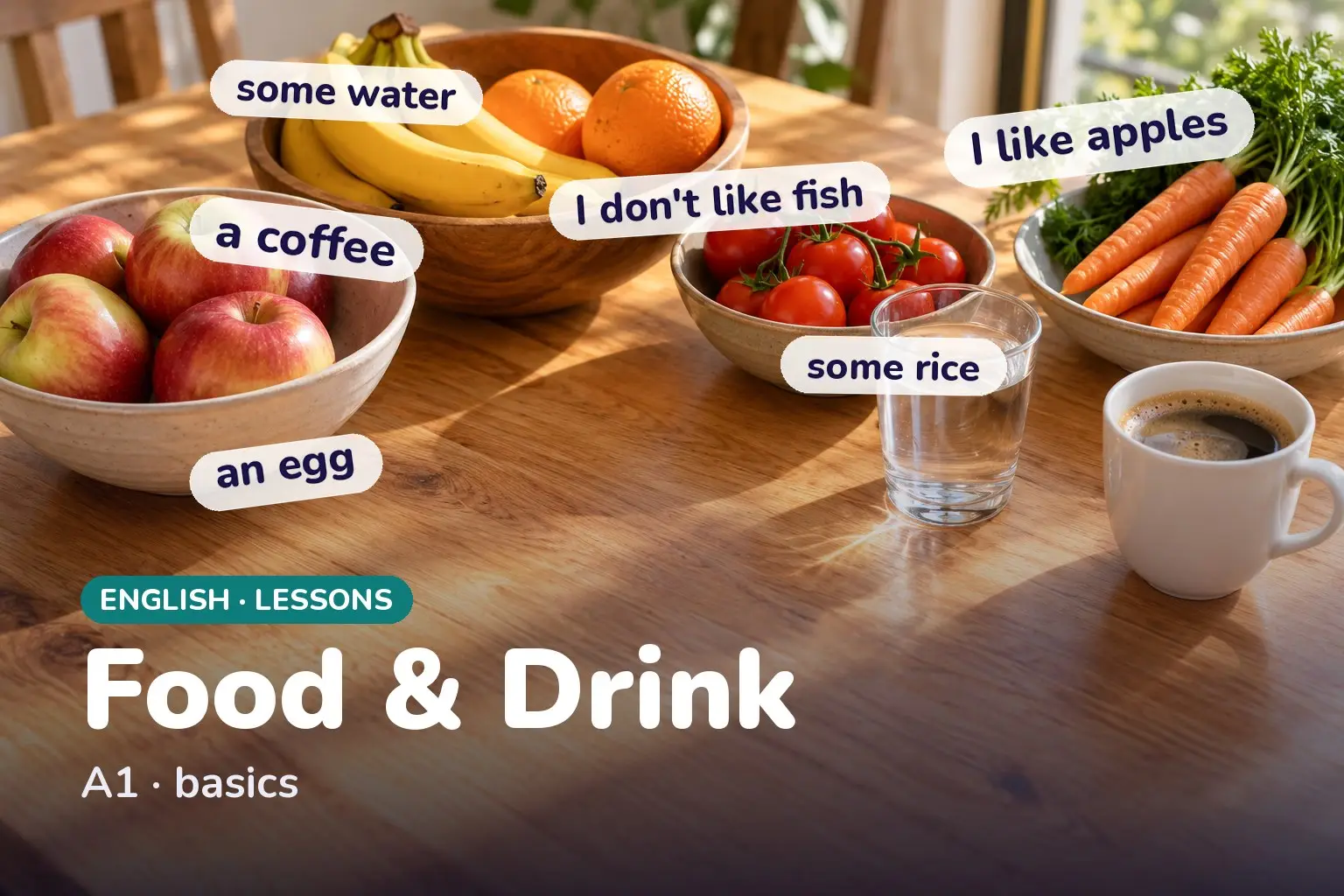
Learn everyday food and drink words, then say what you like with 'I like …', 'I love …', 'I don't like …' and 'I hate …'. Use 'a' or 'an' with one countable item (an apple) and 'some' with food you cannot count (some rice, some water).
Level: A1. Food and drink come up every single day, so these words pay off fast. This page gives you the common items, the simple way to say what you like and dislike, and the one grammar point beginners trip on: when to say ‘a’ and when to say ‘some’.
By the end of this page you can…
…name common foods and drinks, say what you like, love, don’t like and hate, and use ‘a/an’ and ‘some’ correctly when you talk about them.
Common food words
Start with the groups you meet most. Fruit includes an apple, a banana, an orange and a lemon. Common vegetables are a tomato, a potato, a carrot and an onion. Everyday staples are bread, rice, pasta, cheese, meat, chicken, fish and an egg.
Notice something: you can count apples and eggs (one apple, two apples), but you cannot count bread or rice the same way. That difference decides the grammar below.
Common drink words
The drinks you will ask for most are water, coffee, tea, milk, juice and, for a treat, a soft drink. Most drinks are uncountable — you don’t say two waters in careful English — but when you order, a cup or glass makes them countable: a coffee means one cup of coffee, a tea means one cup of tea.
Saying what you like and dislike
To talk about taste, English uses four simple verbs, from most positive to most negative: love, like, don’t like, hate.
- I love chocolate.
- I like coffee.
- I don’t like fish.
- I hate onions.
After these verbs, talk about the food in general. For countable foods that means a plural: say I like apples, not I like an apple. For uncountable foods, use the plain word: I like rice, I like cheese.
‘A / an’ or ‘some’?
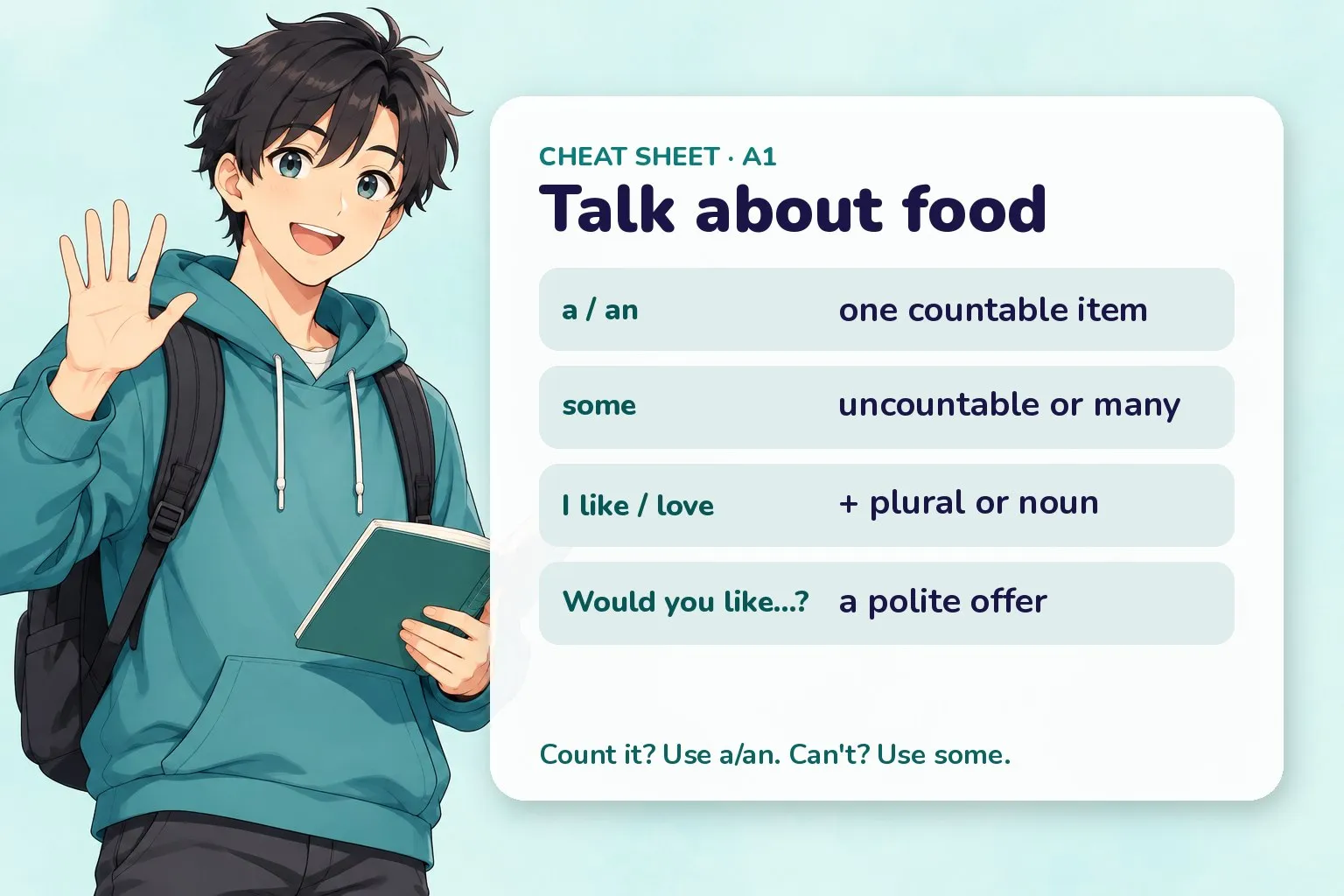
This is the heart of the lesson. Use a or an for one thing you can count, and some for an amount of something you cannot count (or for more than one without a number).
- One countable item: an apple, a sandwich, an egg.
- Uncountable amount: some bread, some rice, some water.
- More than one, no exact number: some apples, some eggs.
Use an (not a) before a vowel sound: an apple, an orange, an egg — but a banana, a carrot.
Offering and asking
Two questions sound similar but do different jobs. Do you like …? asks about someone’s general taste. Would you like …? is a polite offer for right now.
- Do you like tea? — a question about your taste in general.
- Would you like some tea? — an offer of tea at this moment.
Answer an offer with Yes, please or No, thank you.
Example sentences
Play each line, then repeat it aloud. These are the exact patterns you will use when you talk about food.
- I like apples.A general opinion about a countable food — note the plural.Not 'I like an apple'.
- I love chocolate.A strong positive opinion about an uncountable food.
- I don't like fish.A simple way to say you dislike something.
- I hate onions.The strongest way to say you dislike a food.
- Do you like coffee?Asking about someone's general taste.
- Would you like some tea?A polite offer for right now.
- Yes, please.Accepting an offer politely.
- No, thank you.Refusing an offer politely.
- I'd like an apple, please.Asking for one countable item.
- Can I have some water?Asking for an uncountable drink.
- There is some bread on the table.Some with an uncountable food.
- I eat an egg for breakfast.A for one countable item.
- We need some rice and some milk.Some with two uncountable foods.
- She drinks tea every morning.A daily drink habit.
- A banana is a healthy snack.A for one countable fruit.
- I don't eat meat.Saying you avoid a food.
- This soup is delicious.A natural way to praise food.
- Are you hungry?A common question before a meal.
- I'm thirsty. Can I have a glass of water?A unit makes an uncountable drink countable.
- What's your favourite food?Asking about someone's top choice.
Quick recap before you practise.
Practice
Food and drink practice
Try each one, then press Check. No sign-up, nothing is sent anywhere — it all runs in your browser.
1 Match each food to its group.
- banana
- carrot
- chicken
- milk
Show answer
- banana → fruit
- carrot → vegetable
- chicken → meat
- milk → drink
Sorting words into groups helps you remember them.
Hint: orange starts with a vowel sound
Show answer
an — Use 'an' before a vowel sound: an orange, an apple, an egg.
Hint: water cannot be counted
Show answer
some — Water is uncountable, so use 'some', not 'a'.
6 Put the words in order to make a polite request.
Show answer
I'd like an apple, please — A natural request: I'd like an apple, please.
How to say it
A few food and drink words trip up English learners because the spelling hides the real sound. Copy the audio, not the letters.
- vegetable is said in three beats, roughly “vej-tuh-bul” — the middle ‘e’ almost disappears.
- chocolate loses a syllable too: say “chok-lut”, not “choc-o-late”.
- water often sounds like “waw-tuh” (British) or “wah-der” (American); the final ‘r’ is soft or silent.
- fruit rhymes with “boot” — one syllable, a long oo sound, the silent ‘i’.
- coffee has the stress on the first part, “KOF-ee”, not “copy”.
Quiz
Food and drink quiz
8 questions · pick an answer and you'll see straight away if it's right.
-
Show answer
rice — Rice is uncountable; you say 'some rice', never 'two rices'.
-
Show answer
an — Use 'an' before a vowel sound: an egg.
-
Show answer
I want some bread. — Bread is uncountable: use 'some bread'.
-
Show answer
Would you like some water? — 'Would you like …?' is a polite offer for this moment.
-
Show answer
I like tomatoes. — General opinions about countable food use the plural: I like tomatoes.
-
Show answer
one cup of coffee — A unit word makes a drink countable: 'a coffee' is one cup.
-
Show answer
No, thank you. — 'No, thank you' refuses an offer politely.
-
Show answer
an / a — 'Onion' starts with a vowel sound (an onion); 'potato' starts with a consonant sound (a potato).
Next
- Next lesson: English: Ordering at a Cafe
- Previous lesson: English: Colours & Shapes
- New here? Start with Start Learning English Here
All English lessons topics
Vocabulary, pronunciation, phrases, practice and exam help, ordered by level. Pick a topic and go straight to it. New lessons go live every day, so topics marked Coming soon fill in over the next weeks.
Lessons
A1 9 topics · 9 ready
- 01 English: Greetings & Introductions
- 02 English: Numbers 0 to 100
- 03 English: Introducing Yourself
- 04 English: Days, Months & Dates
- 05 English: Telling the Time
- 06 English: Giving Personal Information
- 07 English: Family Members
- 08 English: Colours & Shapes
- 09 English: Food & Drink Basics You are here
A2 14 topics · 14 ready
- 10 English: Describing People
- 11 English: Ordering at a Cafe
- 12 English: Shopping & Prices
- 13 English: Clothing & Sizes
- 14 English: Asking for Directions
- 15 English: Using Public Transport
- 16 English: At the Hotel
- 17 English: Weather & Seasons
- 18 English: Hobbies & Free Time
- 19 English: Daily Routine
- 20 English: Housing & Rooms
- 21 English: Parts of the Body
- 22 English: Emotions & Feelings
- 23 English: Supermarket & Groceries
B1 19 topics · 19 ready
- 24 English: Household Chores
- 25 English: At the Doctor
- 26 English: Making Appointments
- 27 English: Making Plans & Invitations
- 28 English: Phone & Messaging
- 29 English: Expressing Opinions
- 30 English: Talking About Past Experiences
- 31 English: Future Plans & Goals
- 32 English: School & Education
- 33 English: Jobs & Professions
- 34 English: Money & Banking
- 35 English: Restaurant & Dining Out
- 36 English: Travel & the Airport
- 37 English: Sightseeing & Tourism
- 38 English: Emergencies & Safety
- 39 English: Technology & the Internet
- 40 English: Complaints & Solving Problems
- 41 English: Small Talk & Networking
- 42 English Small-Talk & Politeness Culture
B2 11 topics · 11 ready
- 43 English: At the Office
- 44 English: The Job Interview
- 45 English: Formal Writing & Emails
- 46 English: News & Current Affairs
- 47 English: Environment & Nature
- 48 English: Health & Lifestyle
- 49 English: Culture & Traditions
- 50 English: Describing Trends & Data
- 51 English: Storytelling & Narration
- 52 English: Giving a Short Presentation
- 53 Writing Business Emails in English