English: Talking About Past Experiences
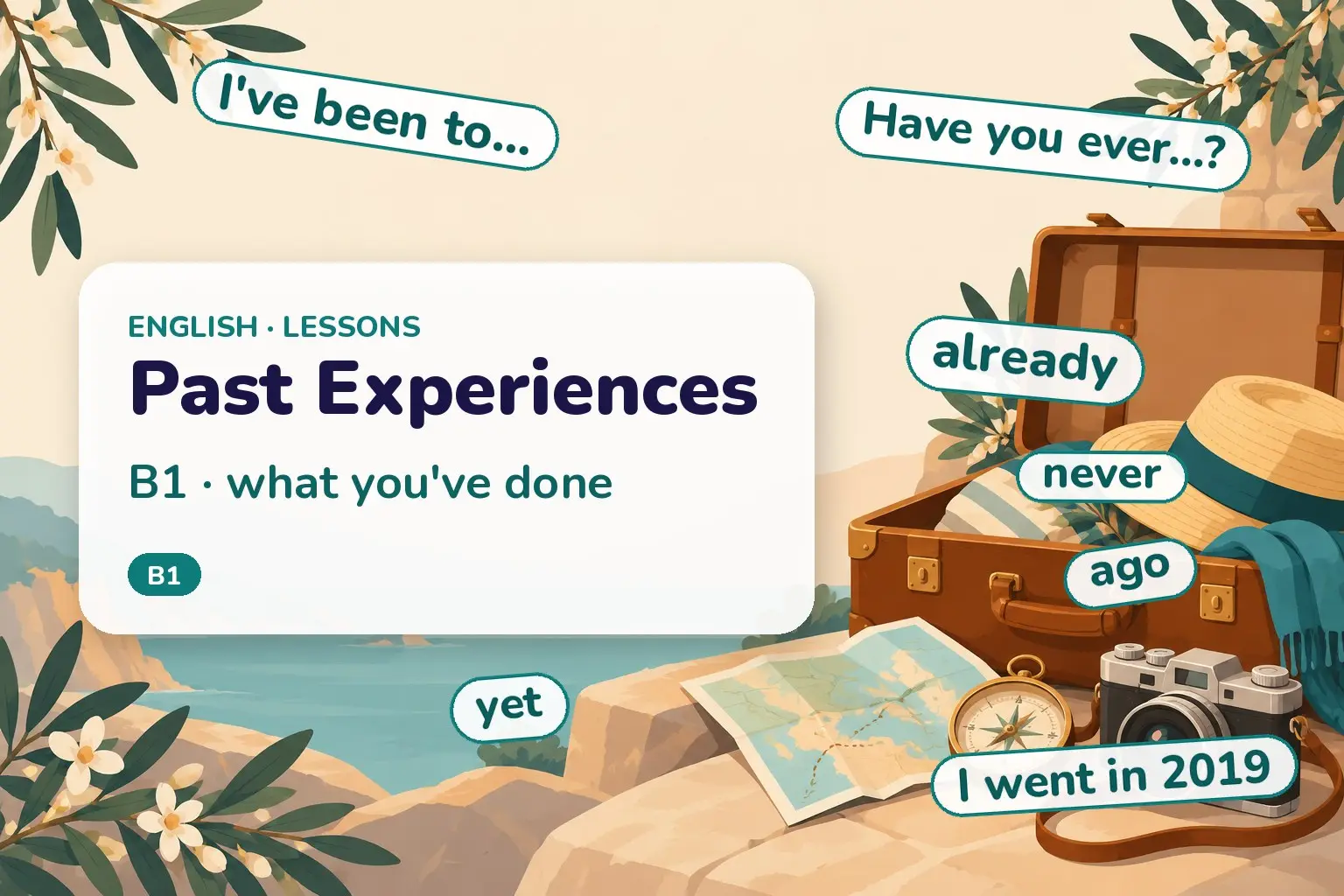
Use the present perfect (have/has + past participle) for life experiences with no fixed time: 'I have been to Japan.' Switch to the past simple when you say when it happened: 'I went to Japan last year.' Ever, never, before and yet go with the present perfect.
On this page13 sections · tap to jump
- 01By the end of this page you can…
- 02Present perfect — for experiences with no time
- 03Past simple — for finished events with a time
- 04Time markers: which tense they go with
- 05ever, never, already and yet
- 06Telling a short past story
- 07Example sentences
- 08A short conversation
- 09Usage notes
- 10Practice
- 11How to say it
- 12Quiz
- 13Recap cheat-sheet
Level: B1. Talking about what you have done in your life is one of the most useful B1 skills — and it depends on one choice: present perfect or past simple. This lesson shows you when to use each, the time markers that go with them, and how to tell a short story about something that happened to you.
By the end of this page you can…
…say what experiences you have had, ask others ‘Have you ever…?’, and tell a short past story in the past simple with the right time words.
Present perfect — for experiences with no time
To talk about an experience at some point in your life, use the present perfect: have/has + past participle (the third form of the verb: be → been, see → seen, try → tried).
You use it when the exact time does not matter — the point is that it happened (or didn’t) in your life up to now.
| Subject | have/has | past participle | Example |
|---|---|---|---|
| I / you / we / they | have (’ve) | been | I have been to Italy. |
| he / she / it | has (’s) | seen | She has seen that film. |
| negative | have/has not | tried | I haven’t tried sushi. |
| question | Have/Has …? | eaten | Have you eaten snails? |
Past simple — for finished events with a time
As soon as you say when something happened, switch to the past simple (regular: -ed; irregular: went, saw, ate). The past simple is for a finished action at a definite past time.
- Present perfect (no time): I have been to Paris.
- Past simple (with a time): I went to Paris in 2019.
Time markers: which tense they go with
Certain words are signposts for the tense.
-
Present perfect: ever, never, before, already, yet, just, so far, recently, in my life.
-
Past simple: yesterday, ago, last (week/year), in + a past year, when, then, at + a past time.
-
Have you ever eaten durian? — I’ve never tried it. (perfect)
-
I ate durian two years ago. (past simple)
-
Note: recently and just can appear with both, but a learner is safe using them with the present perfect.
ever, never, already and yet
These four are the heart of experience questions.
- ever = at any time in your life; used in questions: Have you ever been abroad?
- never = not at any time; a negative answer: I have never been abroad.
- already = sooner than expected; mid-sentence: I have already finished.
- yet = up to now, in questions and negatives, at the end: Have you finished yet? — Not yet.
Telling a short past story
To narrate, use the past simple for the main events and link them with sequence words.
- Open: Last summer, A few years ago, One day…
- Link: first, then, after that, later, in the end, finally.
- Background: use the past continuous (was/were + -ing) for what was happening around the event: While I was walking home, it started to rain.
Example sentences
Press play and copy the rhythm. Notice which tense each time word chooses.
- I have been to three countries.Present perfect for a life experience.
- She has never eaten octopus.never + present perfect, a negative answer.
- Have you ever ridden a camel?Have you ever…? asks about a whole life.
- I've seen that film twice.Twice counts up to now — present perfect.
- We went to the coast last weekend.last weekend forces the past simple.
- I visited my grandmother two days ago.ago always takes the past simple.
- He has just finished his homework.just + present perfect for a recent event.
- Have you finished the report yet?yet goes at the end of a question.
- I haven't tried Thai food yet.yet with a negative present perfect.
- They have already left.already means sooner than expected.
- I lost my keys yesterday.yesterday forces the past simple.
- When I was a child, I lived by the sea.when + past time means past simple.
- Last summer, we travelled around Spain.A story opener in the past simple.
- First we flew to Madrid, then we took a train.Sequence words link past events.
- While I was cooking, the phone rang.Past continuous background + past simple event.
- I have never broken a bone.never for a life experience you haven't had.
- She has worked here since 2020.since + a start point with the present perfect.
- I have lived here for five years.for + a length of time, present perfect.
- We saw a great concert on Friday.A finished event on a named day — past simple.
- Have you been to the new museum?been to means visited and come back.
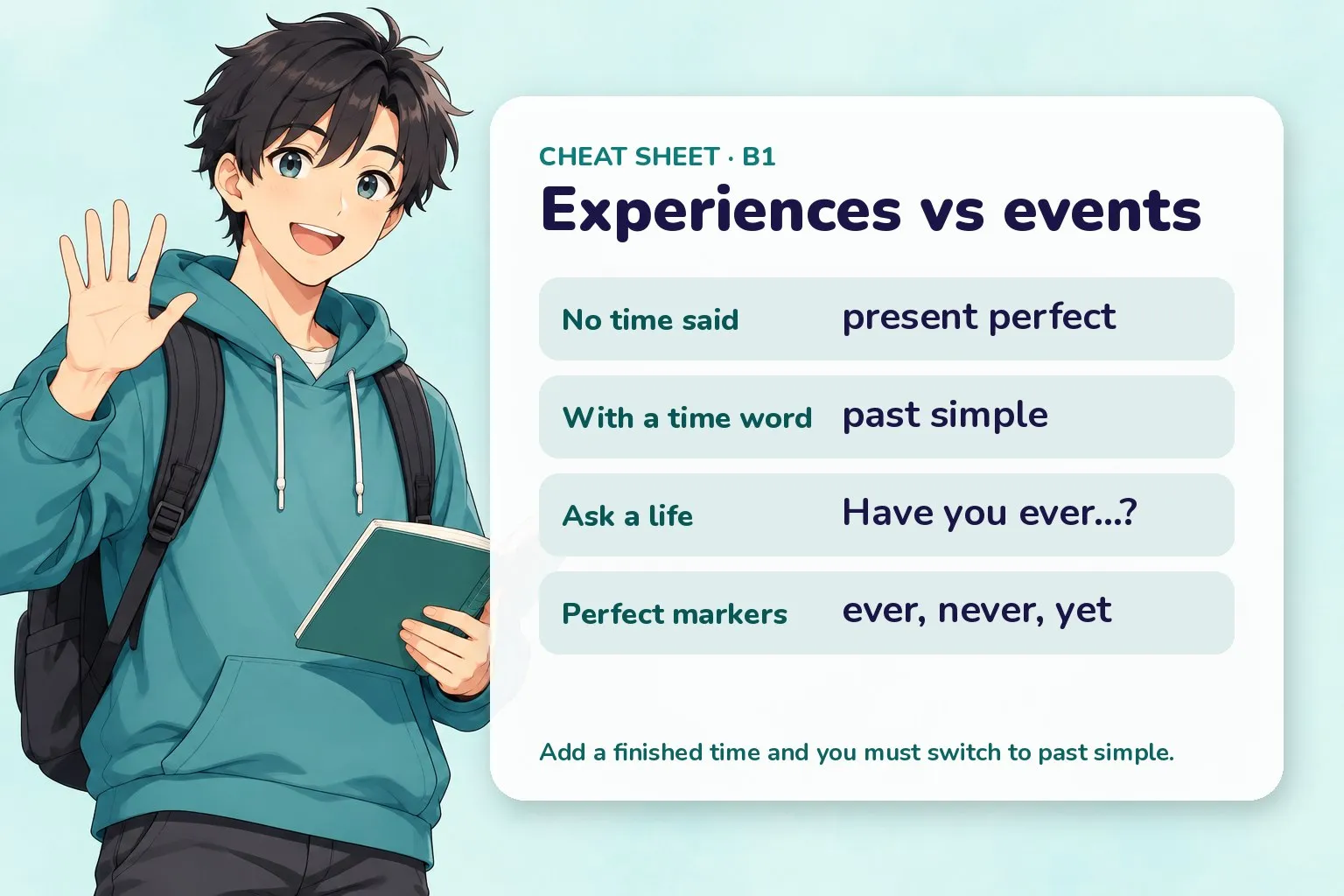
Quick recap before you practise.
A short conversation
Priya: Have you ever been to Vietnam? Leo: Yes, I have. I went there two years ago. Priya: Lucky you! I’ve never travelled in Asia. Leo: You should go. While I was travelling, I tried so much amazing food. Priya: That sounds great. I haven’t booked a trip yet, but I’d love to.
Usage notes
- been to vs gone to: I have been to Rome = I went and came back. He has gone to Rome = he is still there now.
- for vs since: for + a length of time (for three years); since + a start point (since 2020). Both go with the present perfect.
- American vs British: Americans often use the past simple where British speakers use the present perfect (Did you eat yet? vs Have you eaten yet?). Both are understood; this site keeps the present perfect with yet/already.
- Irregular participles: many common verbs are irregular (go → gone, see → seen, do → done, eat → eaten). Learn them in the set base – past – participle.
Practice
Past experiences practice
Try each one, then press Check. No sign-up, nothing is sent anywhere — it all runs in your browser.
Hint: at any time in your life
Show answer
ever — 'Have you ever…?' asks about a whole life.
Hint: goes after a length of time, with the past simple
Show answer
ago — 'ago' always takes the past simple: two days ago.
4 Put the words in order to ask about a life experience.
Show answer
Have you ever been to Japan? — The pattern is 'Have you ever been to Japan?'
5 Match each time word to its tense.
- yet
- ago
- already
- yesterday
Show answer
- yet → present perfect
- ago → past simple
- already → present perfect
- yesterday → past simple
yet/already go with the present perfect; ago/yesterday with the past simple.
Hint: used with a start point
Show answer
since — since + a start point (2020); for + a length of time.
How to say it
A few of these forms are hard to hear and say. Copy the audio.
- been sounds like “bin” in fast British speech and “ben” in American — both short, never “bean”.
- ’ve and ’s contractions are tiny: I’ve is “ive”, she’s is “sheez”; don’t drop them in speech.
- ever and never rhyme: “EV-er”, “NEV-er”, stress on the first syllable.
- ago stresses the second syllable: “uh-GOH”.
Quiz
Past experiences quiz
10 questions · pick an answer and you'll see straight away if it's right.
-
Show answer
I saw her yesterday. — A finished time (yesterday) needs the past simple: I saw her.
-
Show answer
Have you ever been abroad? — 'Have you ever been…?' uses the present perfect with the participle 'been'.
-
Show answer
yet — yet, already, ever and never go with the present perfect.
-
Show answer
for — for + a length of time (five years); since + a start point.
-
Show answer
He is in London now. — 'has gone to' means he is still there; 'has been to' means visited and returned.
-
Show answer
I have never tried it. — 'never' with the present perfect gives a life-experience negative.
-
Show answer
While I was walking home, it started to rain. — Past continuous (was walking) for background + past simple (started) for the event.
-
Show answer
Have you finished yet? — 'yet' goes at the end of a question or negative.
-
Show answer
I have eaten sushi. — The past participle of eat is eaten.
-
Show answer
We travelled to Spain in 2019. — A named past year (in 2019) forces the past simple.
Recap cheat-sheet
| Idea | Pattern | Example |
|---|---|---|
| Experience, no time | have/has + past participle | I have been to Japan. |
| Finished event, with time | past simple | I went to Japan in 2019. |
| Ask about a life | Have you ever + participle? | Have you ever flown? |
| Negative experience | have/has never + participle | She has never driven. |
| Up to now / sooner | yet, already | Have you finished yet? |
| Story background | was/were + -ing | While I was cooking, it rang. |
Next
- Previous lesson: English: Expressing Opinions
- Next lesson: English: Future Plans & Goals
- New here? Start with Start Learning English Here
- Build the sounds: English Pronunciation Overview
All English lessons topics
Vocabulary, pronunciation, phrases, practice and exam help, ordered by level. Pick a topic and go straight to it. New lessons go live every day, so topics marked Coming soon fill in over the next weeks.
Lessons
A1 9 topics · 9 ready
A2 14 topics · 14 ready
- 10 English: Describing People
- 11 English: Ordering at a Cafe
- 12 English: Shopping & Prices
- 13 English: Clothing & Sizes
- 14 English: Asking for Directions
- 15 English: Using Public Transport
- 16 English: At the Hotel
- 17 English: Weather & Seasons
- 18 English: Hobbies & Free Time
- 19 English: Daily Routine
- 20 English: Housing & Rooms
- 21 English: Parts of the Body
- 22 English: Emotions & Feelings
- 23 English: Supermarket & Groceries
B1 19 topics · 19 ready
- 24 English: Household Chores
- 25 English: At the Doctor
- 26 English: Making Appointments
- 27 English: Making Plans & Invitations
- 28 English: Phone & Messaging
- 29 English: Expressing Opinions
- 30 English: Talking About Past Experiences You are here
- 31 English: Future Plans & Goals
- 32 English: School & Education
- 33 English: Jobs & Professions
- 34 English: Money & Banking
- 35 English: Restaurant & Dining Out
- 36 English: Travel & the Airport
- 37 English: Sightseeing & Tourism
- 38 English: Emergencies & Safety
- 39 English: Technology & the Internet
- 40 English: Complaints & Solving Problems
- 41 English: Small Talk & Networking
- 42 English Small-Talk & Politeness Culture
B2 11 topics · 11 ready
- 43 English: At the Office
- 44 English: The Job Interview
- 45 English: Formal Writing & Emails
- 46 English: News & Current Affairs
- 47 English: Environment & Nature
- 48 English: Health & Lifestyle
- 49 English: Culture & Traditions
- 50 English: Describing Trends & Data
- 51 English: Storytelling & Narration
- 52 English: Giving a Short Presentation
- 53 Writing Business Emails in English