English: Small Talk & Networking

Small talk is light, friendly chat that opens a conversation. Start with a safe topic (the place, the weather, the event), ask open questions and react ('Oh really? That's interesting'), take turns, and exit politely ('It was great to meet you — let's keep in touch').
On this page14 sections · tap to jump
- 01By the end of this page you can…
- 02Starting: safe openers
- 03Safe topics (and ones to avoid)
- 04Keeping it going: react and bounce back
- 05Taking turns and showing you listen
- 06Exiting politely
- 07Common mistakes
- 08A short conversation
- 09Usage notes
- 10Example sentences
- 11How to say it
- 12Practice
- 13Quiz
- 14Recap cheat-sheet
Level: B1. Small talk is the light, friendly chat that happens before the “real” conversation — at a party, in a lift, at a work event. It feels like nothing, but it does a big job: it shows you are warm and easy to talk to. The good news is that small talk follows set patterns. Learn the openers, the safe topics, the reactions and a polite exit, and you can hold a short chat with almost anyone.
By the end of this page you can…
…start a conversation with a stranger, choose a safe topic, keep the chat going with questions and reactions, take turns, and leave politely — in person or at a networking event.
Starting: safe openers
The first line just needs to be friendly and easy to answer. Use the situation you share.
| Situation | Opener |
|---|---|
| General | How’s it going? / How are you finding the event? |
| The place | Have you been here before? |
| The weather | Lovely weather today, isn’t it? |
| At work / networking | So, what do you do? / Which company are you with? |
The isn’t it? ending above is a question tag — it turns a statement into a friendly question. See question tags for how they are formed.
Safe topics (and ones to avoid)
Small talk stays light. Stick to shared, low-risk subjects until you know someone better.
- ✅ Safe: the event or venue, travel to get there, the weather, food and drink, hobbies, films and sport, work in general terms.
- ⚠️ Handle with care: health, age, relationships — fine with friends, too personal with strangers.
- ❌ Avoid at first: money and salary, politics, religion, and anything negative about the host or other guests.
Keeping it going: react and bounce back
A conversation dies if one person just answers and stops. Two habits keep it alive: react, then bounce the question back.
- React: Oh really? / That sounds great. / How interesting. / No way! (informal)
- Bounce back: How about you? / What about you? / And yourself?
So the pattern is: answer → react to them → ask them back.
Taking turns and showing you listen
English conversation shares the floor. Show you are listening with short signals, and don’t interrupt — wait for a small pause.
- Backchannel sounds: mm-hmm, right, I see, exactly, of course. These say “I’m with you” without taking the floor.
- Follow-up questions: pick a word they said and ask about it — You said you’d just moved — where from?
- Agreeing softly: I know what you mean. / That’s a good point.
These reactions use the present simple and present continuous naturally — if those feel shaky, review present continuous and adverbs of frequency.
Exiting politely
Ending a chat is a skill. Signal that you are closing, give a warm reason, and leave the door open.
- Signal: Anyway,… / Well, it’s been great talking to you.
- Reason: I should let you get on / I need to catch someone before they leave.
- Warm close: It was lovely to meet you.
- Networking follow-up: Could we swap details? Let’s keep in touch.
Common mistakes
- ❌ How much is your salary? → ✅ So, what do you do? (Ask about the job, not the pay.)
- ❌ Did you have good weekend? → ✅ Did you have a good weekend? (Don’t drop the article a.)
- ❌ Nice to meet you (when leaving) → ✅ It was nice to meet you. (Use the past when the meeting is ending.)
- ❌ And you? said flatly as your only reply → ✅ I’m well, thanks — how about you? (Give a little first, then bounce back.)
- ❌ I am agree with you. → ✅ I agree with you. (Agree is a verb; no am.)
A short conversation
Priya: Hi, how’s it going? Have you been to one of these events before? Marco: First time, actually. It’s bigger than I expected. How about you? Priya: I come most years. So, what do you do, Marco? Marco: I’m a software developer. And yourself? Priya: I work in design — so we probably end up on the same projects! That sounds like interesting work. Marco: It can be. Anyway, I should let you mingle, but it was great to meet you. Shall we swap details? Priya: Definitely. Let’s keep in touch.
Usage notes
- How are you? as a greeting: often it’s a hello, not a real question — a short Fine, thanks, you? is enough.
- meet vs know: use meet for the first time (Nice to meet you); use see again later (Good to see you). Say Nice to meet you once per person.
- BrE vs AmE: British How are you getting on? / Are you all right?; American How’s it going? / How are you doing? All are friendly openers.
- swap / exchange details: swap details (informal) and exchange contact details (neutral) both mean trade phone numbers or cards.
Example sentences
Play each line and say it aloud. These are the phrases that carry a friendly chat from hello to goodbye.
- Hi, how's it going?A warm, easy opener.
- Have you been here before?Small talk about the shared place.
- Lovely weather today, isn't it?A classic opener using a question tag.
- How are you finding the event?An open question about the occasion.
- So, what do you do?The standard networking question about work.
- Which company are you with?A polite way to ask where someone works.
- Oh really? That sounds great.React warmly to keep the chat going.
- How interesting — tell me more.Inviting the other person to continue.
- I'm a teacher. How about you?Answer, then bounce the question back.
- What about you — where are you from?Bouncing back with a follow-up.
- I know what you mean.Showing you agree and are listening.
- You said you'd just moved — where from?A follow-up question that shows you listened.
- That's a good point.Agreeing softly.
- Right, I see.A backchannel signal that says 'go on'.
- Anyway, it's been great talking to you.Signalling a polite exit.
- I should let you get on.A kind way to end the chat.
- It was lovely to meet you.Past tense, because the meeting is ending.
- Could we swap details?Asking for contact details at a networking event.
- Let's keep in touch.Leaving the door open.
- I'll drop you an email next week.Promising a follow-up.
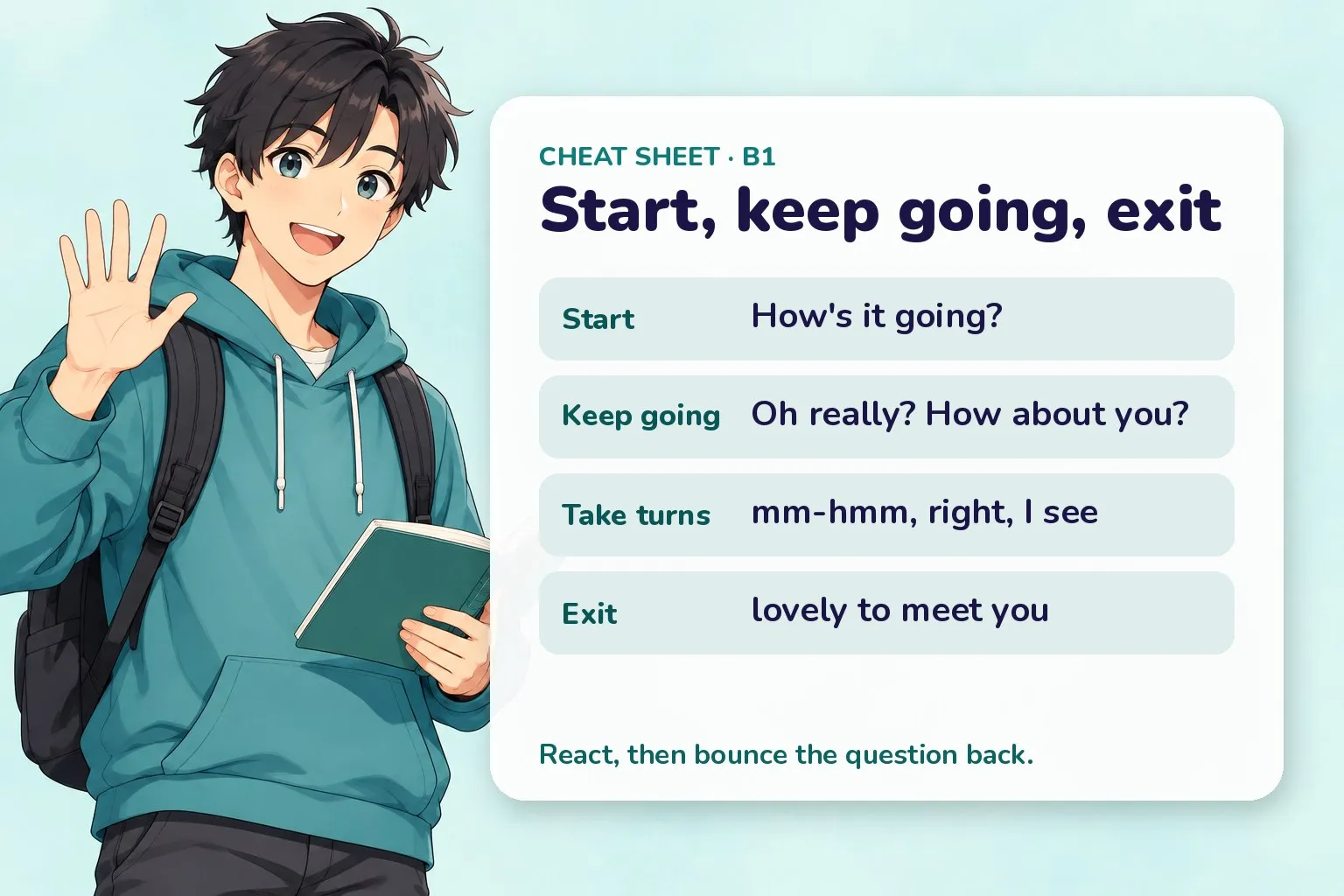
Quick recap before you practise.
How to say it
A few small-talk words trip up English learners — copy the audio, not the spelling.
- weather has the th as in this: “WEH-ther”, not “wezzer”.
- colleague is two syllables: “KOL-eeg”.
- genuinely is “JEN-yoo-in-lee”, a useful reaction word.
- mingle (to move around chatting) sounds like “MING-gl”.
Practice
Small talk practice
Try each one, then press Check. No sign-up, nothing is sent anywhere — it all runs in your browser.
Hint: How ___ you?
Show answer
about — 'How about you?' hands the floor back to the other person.
Hint: the meeting is ending
Show answer
was — Use the past 'was' when you are leaving: It was lovely to meet you.
5 Put the words in order for a warm reaction.
Show answer
That sounds really great — A reaction like 'That sounds really great' keeps the chat alive.
6 Match each phrase to its job.
- How's it going?
- Oh really?
- How about you?
- Let's keep in touch.
Show answer
- How's it going? → start a chat
- Oh really? → react
- How about you? → bounce back
- Let's keep in touch. → exit and follow up
These four moves cover a whole small-talk exchange.
Quiz
Small talk and networking quiz
10 questions · pick an answer and you'll see straight away if it's right.
-
Show answer
How's it going? — 'How's it going?' is warm and easy to answer.
-
Show answer
They invite a longer answer — Open questions (how/what/where) get a story, not a one-word reply.
-
Show answer
Their salary — Money and salary are considered too personal in early small talk.
-
Show answer
about — 'How about you?' passes the turn back to the other person.
-
Show answer
Mm-hmm, right, I see — Backchannel signals like 'mm-hmm' and 'I see' say 'go on'.
-
Show answer
I agree with you. — 'Agree' is a verb, so no 'am': I agree with you.
-
Show answer
It was lovely to meet you. — Use the past when leaving: It was lovely to meet you.
-
Show answer
I should let you get on. — 'I should let you get on' is a kind, standard way to exit.
-
Show answer
Could we swap details? Let's keep in touch. — Swapping details and 'let's keep in touch' opens a follow-up.
-
Show answer
isn't it — A positive statement with 'is' takes the negative tag 'isn't it?'.
Recap cheat-sheet
| Move | Job | Phrase |
|---|---|---|
| Start | open the chat | How’s it going? / What do you do? |
| Topic | stay safe | the event, weather, travel, hobbies |
| Keep going | react + bounce | Oh really? How about you? |
| Take turns | show you listen | mm-hmm, right, I see |
| Exit | leave warmly | It was lovely to meet you. |
Next
- Previous lesson: English: Giving a Short Presentation
- Related grammar: question tags · question words
- New here? Start with Start Learning English Here
All English lessons topics
Vocabulary, pronunciation, phrases, practice and exam help, ordered by level. Pick a topic and go straight to it. New lessons go live every day, so topics marked Coming soon fill in over the next weeks.
Lessons
A1 9 topics · 9 ready
A2 14 topics · 14 ready
- 10 English: Describing People
- 11 English: Ordering at a Cafe
- 12 English: Shopping & Prices
- 13 English: Clothing & Sizes
- 14 English: Asking for Directions
- 15 English: Using Public Transport
- 16 English: At the Hotel
- 17 English: Weather & Seasons
- 18 English: Hobbies & Free Time
- 19 English: Daily Routine
- 20 English: Housing & Rooms
- 21 English: Parts of the Body
- 22 English: Emotions & Feelings
- 23 English: Supermarket & Groceries
B1 19 topics · 19 ready
- 24 English: Household Chores
- 25 English: At the Doctor
- 26 English: Making Appointments
- 27 English: Making Plans & Invitations
- 28 English: Phone & Messaging
- 29 English: Expressing Opinions
- 30 English: Talking About Past Experiences
- 31 English: Future Plans & Goals
- 32 English: School & Education
- 33 English: Jobs & Professions
- 34 English: Money & Banking
- 35 English: Restaurant & Dining Out
- 36 English: Travel & the Airport
- 37 English: Sightseeing & Tourism
- 38 English: Emergencies & Safety
- 39 English: Technology & the Internet
- 40 English: Complaints & Solving Problems
- 41 English: Small Talk & Networking You are here
- 42 English Small-Talk & Politeness Culture
B2 11 topics · 11 ready
- 43 English: At the Office
- 44 English: The Job Interview
- 45 English: Formal Writing & Emails
- 46 English: News & Current Affairs
- 47 English: Environment & Nature
- 48 English: Health & Lifestyle
- 49 English: Culture & Traditions
- 50 English: Describing Trends & Data
- 51 English: Storytelling & Narration
- 52 English: Giving a Short Presentation
- 53 Writing Business Emails in English