English: Days, Months & Dates

The seven days run Monday to Sunday and the twelve months January to December, all with a capital letter. Say dates with ordinal numbers: British 'the fifth of May', American 'May fifth'. Use 'on' for days and dates, 'in' for months and years.
Level: A1. Days, months and dates come up every time you make a plan, book a ticket or fill in a form. The words are short and fixed — the only tricky parts are the capital letters, the ordinal numbers and the British–American order.
By the end of this page you can…
…name the days and months, say and write any date, and use ‘on’ and ‘in’ correctly when you talk about time.
The days of the week
There are seven days. In English they all start with a capital letter, and most people count the week from Monday.
| Day | Short form |
|---|---|
| Monday | Mon |
| Tuesday | Tue |
| Wednesday | Wed |
| Thursday | Thu |
| Friday | Fri |
| Saturday | Sat |
| Sunday | Sun |
Saturday and Sunday together are the weekend; Monday to Friday are weekdays.
The months of the year
There are twelve months, also with a capital letter.
| Month | Short form |
|---|---|
| January | Jan |
| February | Feb |
| March | Mar |
| April | Apr |
| May | May |
| June | Jun |
| July | Jul |
| August | Aug |
| September | Sep |
| October | Oct |
| November | Nov |
| December | Dec |
Saying and writing the date
To say the day of the month you use an ordinal number (first, second, third…), not a plain number. So you write 5 but say the fifth.
- 1st – first, 2nd – second, 3rd – third, 4th – fourth, 5th – fifth
- 12th – twelfth, 20th – twentieth, 21st – twenty-first, 31st – thirty-first
There are two natural ways to say a full date, and both are correct:
- British: the fifth of May — written 5 May or 5th May.
- American: May fifth — written May 5 or May 5th.
For the year, say it in two halves up to 1999 (nineteen ninety-nine), and from 2000 either as two thousand (and) nine or, from 2010, as twenty ten, twenty twenty-six.
British and American order
When a date is written only in numbers, the order changes between the two main varieties of English:
- British (and most of the world): day / month / year → 05/06/2026 = 5 June 2026.
- American: month / day / year → 05/06/2026 = June 5, 2026.
The same six digits mean two different days. When it matters — a flight, a deadline, a contract — write the month as a word.
‘On’, ‘in’ and other time words
- on + a day or a date: on Monday, on 5 May, on my birthday.
- in + a month, a season or a year: in May, in summer, in 2026.
- at + the weekend (British) / on the weekend (American): at the weekend / on the weekend.
- To ask, say What day is it today? or What’s the date today?
Example sentences
Press play, then say each line out loud.
- Today is Monday.Naming the day of the week.
- The meeting is on Tuesday.Use 'on' before a day.
- I don't work on Sundays.A plural day means 'every Sunday'.
- We're closed at the weekend.British: 'at the weekend'.
- My birthday is in March.Use 'in' before a month.
- It's cold in January.Months take 'in'.
- School starts in September.A month with 'in'.
- What's the date today?Asking for today's date.
- It's the first of April.British way: the + ordinal + of + month.
- The exam is on the fifth of May.A date after 'on'.
- Her flight is on May the tenth.A common spoken order.
- The report is due on 5 June.Written British style, day before month.
- We met on June fifth.American spoken order: month first.
- The shop opened in 2019.Use 'in' before a year.
- He was born in nineteen ninety-nine.Say a year in two halves.
- The concert is on the twenty-first of July.A two-word ordinal date.
- See you on Friday!A friendly plan with a day.
- Christmas is on the twenty-fifth of December.A fixed yearly date.
- My appointment is next Thursday.'Next' points to the coming week.
- The year starts on the first of January.The first day of the year.
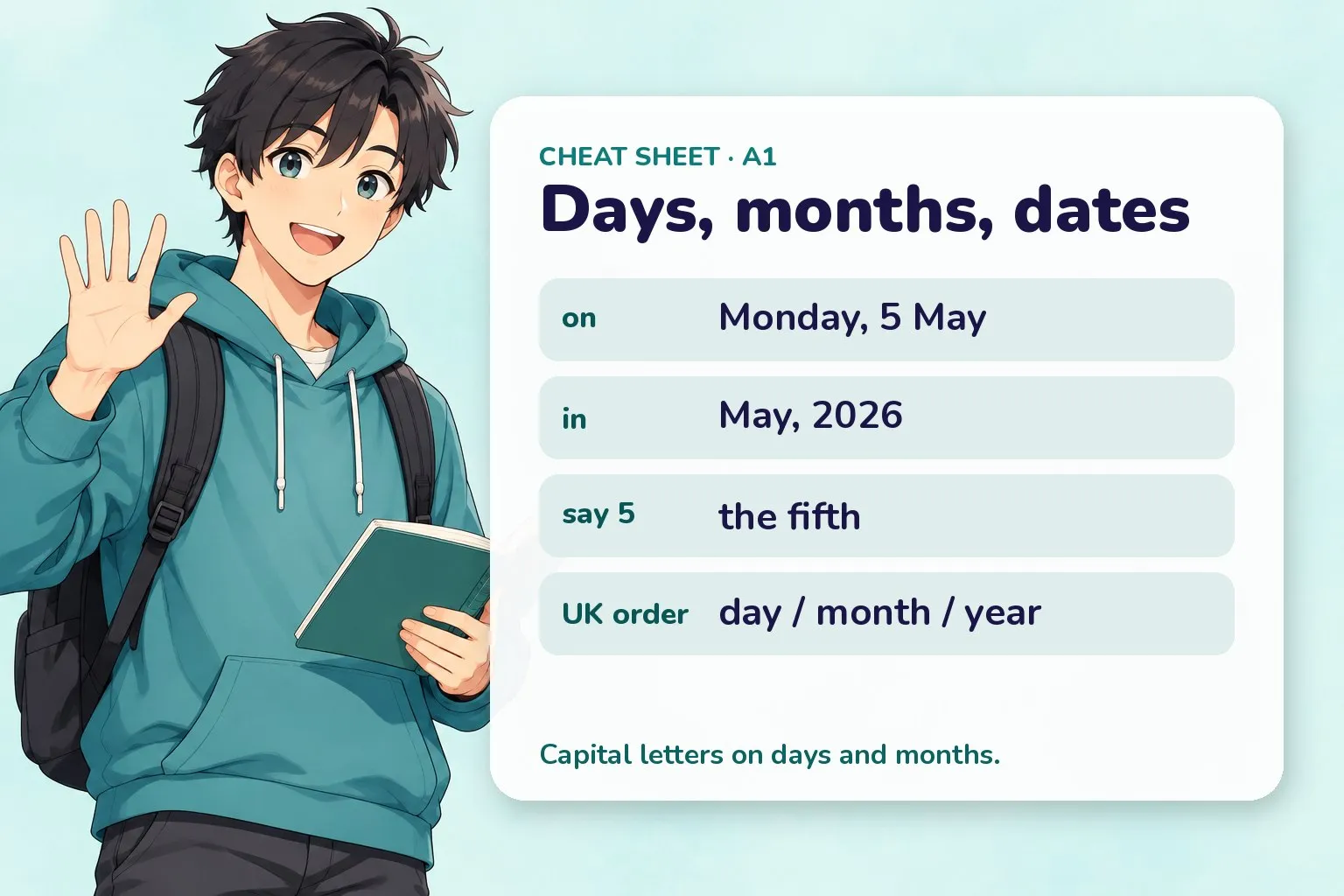
Quick recap before you practise.
Practice
Days, months and dates practice
Try each one, then press Check. No sign-up, nothing is sent anywhere — it all runs in your browser.
1 Match each time word to the right example.
- on
- in
- in
- at
Show answer
- on → Monday
- in → May
- in → 2026
- at → the weekend
Days and dates take 'on', months and years take 'in', the weekend takes 'at' in British English.
Hint: months take this word
Show answer
in — Use 'in' before a month: in July.
Hint: days take this word
Show answer
on — Use 'on' before a day of the week: on Monday.
6 Put the words in order to say today's date the British way.
Show answer
the first of May — British spoken dates follow: the + ordinal + of + month.
How to say it
A few of these words trip up English learners — copy the sounds, not the spelling.
- Wednesday drops the first d: say “WENZ-day”, not “wed-nes-day”.
- February is usually said “FEB-you-ree” — many speakers skip the first r.
- Tuesday starts with a “tyoo-” (British) or “too-” (American) sound.
- th in fifth, sixth and twelfth is the soft, tongue-between-teeth sound — not an f or a t.
Quiz
Days, months and dates quiz
8 questions · pick an answer and you'll see straight away if it's right.
-
Show answer
see you on Monday — Days are proper nouns and take a capital letter: Monday.
-
Show answer
Saturday and Sunday — The weekend is Saturday and Sunday; Monday to Friday are weekdays.
-
Show answer
in — Months take 'in': in September.
-
Show answer
on — Days take 'on': on Friday.
-
Show answer
21st — Twenty-first ends in -st, so it is 21st.
-
Show answer
March 4, 2026 — American order is month/day/year, so 03/04 is March 4.
-
Show answer
the first of January — Use the ordinal with 'of': the first of January.
-
Show answer
nineteen ninety-nine — Years before 2000 are said in two halves: nineteen ninety-nine.
Next
- Previous lesson: English: Introducing Yourself
- Next lesson: English: Telling the Time
- New here? Start with Start Learning English Here
All English lessons topics
Vocabulary, pronunciation, phrases, practice and exam help, ordered by level. Pick a topic and go straight to it. New lessons go live every day, so topics marked Coming soon fill in over the next weeks.
Lessons
A1 9 topics · 9 ready
- 01 English: Greetings & Introductions
- 02 English: Numbers 0 to 100
- 03 English: Introducing Yourself
- 04 English: Days, Months & Dates You are here
- 05 English: Telling the Time
- 06 English: Giving Personal Information
- 07 English: Family Members
- 08 English: Colours & Shapes
- 09 English: Food & Drink Basics
A2 14 topics · 14 ready
- 10 English: Describing People
- 11 English: Ordering at a Cafe
- 12 English: Shopping & Prices
- 13 English: Clothing & Sizes
- 14 English: Asking for Directions
- 15 English: Using Public Transport
- 16 English: At the Hotel
- 17 English: Weather & Seasons
- 18 English: Hobbies & Free Time
- 19 English: Daily Routine
- 20 English: Housing & Rooms
- 21 English: Parts of the Body
- 22 English: Emotions & Feelings
- 23 English: Supermarket & Groceries
B1 19 topics · 19 ready
- 24 English: Household Chores
- 25 English: At the Doctor
- 26 English: Making Appointments
- 27 English: Making Plans & Invitations
- 28 English: Phone & Messaging
- 29 English: Expressing Opinions
- 30 English: Talking About Past Experiences
- 31 English: Future Plans & Goals
- 32 English: School & Education
- 33 English: Jobs & Professions
- 34 English: Money & Banking
- 35 English: Restaurant & Dining Out
- 36 English: Travel & the Airport
- 37 English: Sightseeing & Tourism
- 38 English: Emergencies & Safety
- 39 English: Technology & the Internet
- 40 English: Complaints & Solving Problems
- 41 English: Small Talk & Networking
- 42 English Small-Talk & Politeness Culture
B2 11 topics · 11 ready
- 43 English: At the Office
- 44 English: The Job Interview
- 45 English: Formal Writing & Emails
- 46 English: News & Current Affairs
- 47 English: Environment & Nature
- 48 English: Health & Lifestyle
- 49 English: Culture & Traditions
- 50 English: Describing Trends & Data
- 51 English: Storytelling & Narration
- 52 English: Giving a Short Presentation
- 53 Writing Business Emails in English