English: Describing Trends & Data
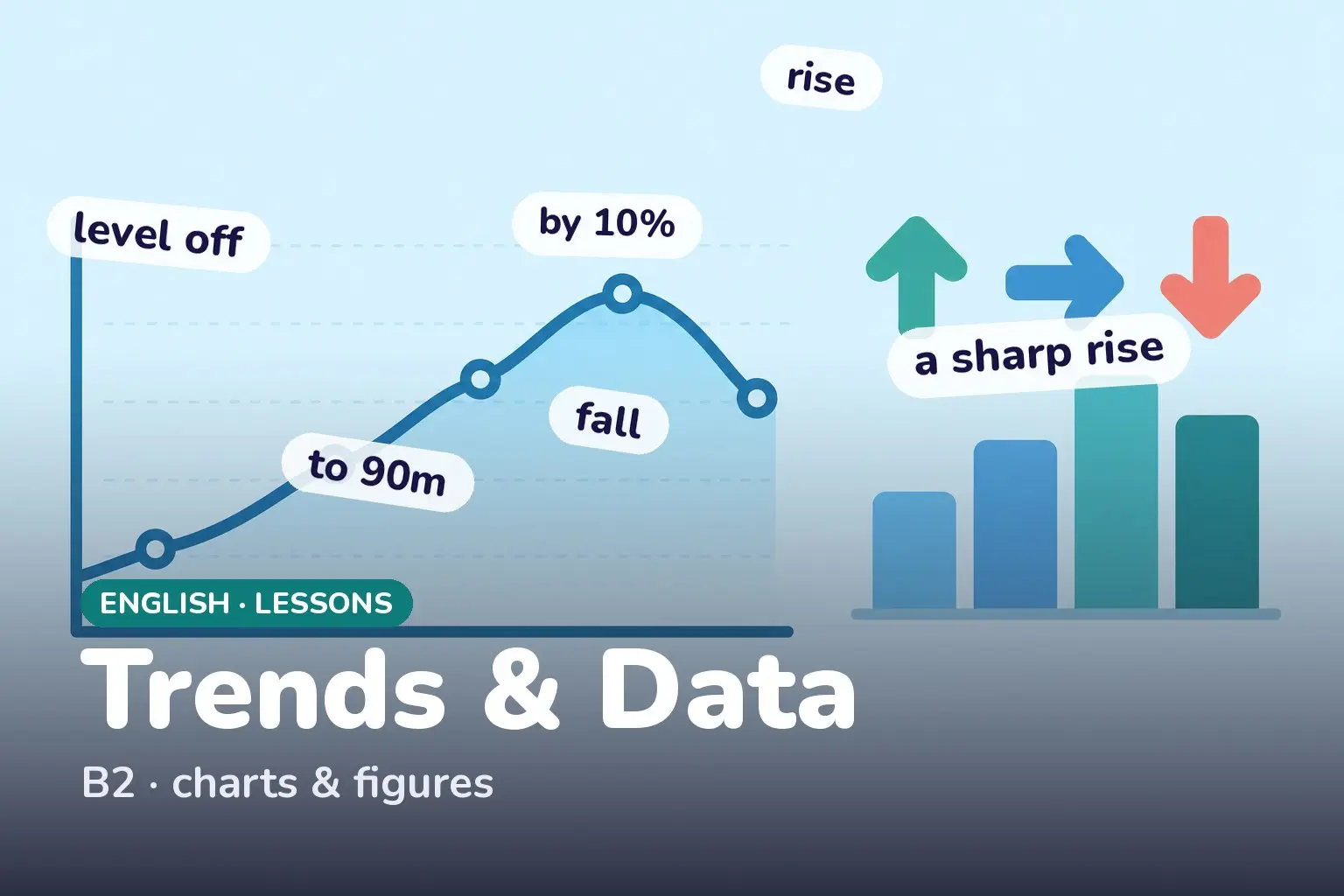
To describe trends and data in English, pair a movement verb with an adverb of degree: prices 'rose sharply', sales 'fell slightly'. Use 'by' for the size of a change (rose by 10%) and 'to' for the final figure (rose to 90%).
On this page14 sections · tap to jump
- 01By the end of this page you can…
- 02Movement verbs — up, down, and no change
- 03How big, how fast — adverbs and adjectives of degree
- 04Teaching point 1 — the right adverb form
- 05Prepositions with figures — by vs to vs from
- 06Teaching point 2 — comparing the figures
- 07Teaching point 3 — the passive for the data itself
- 08A short conversation
- 09Usage notes
- 10Example sentences
- 11Practice
- 12How to say it
- 13Quiz
- 14Recap cheat-sheet
Level: B2. Describing a chart or a set of figures uses a small, reliable kit: a verb for the movement (rise, fall, stay the same), an adverb for how big or fast the movement is (sharply, slightly, steadily), and the right preposition for the numbers (by, to, from). Learn the kit and you can describe any graph, report or exam task clearly.
By the end of this page you can…
…choose the right verb for up, down and no change, say how big and how fast a change is, use by and to with figures correctly, and compare data points with comparatives and superlatives.
Movement verbs — up, down, and no change
Group the verbs by direction. Each has a matching noun you can also use.
| Direction | Verbs | Noun |
|---|---|---|
| Up | rise, increase, grow, climb, go up | a rise, an increase |
| Up (fast) | surge, soar, rocket | a surge |
| Down | fall, decrease, drop, decline, go down | a fall, a decrease |
| Down (fast) | plunge, plummet, crash | a plunge |
| No change | remain stable, stay the same, level off, plateau | a plateau |
| Up and down | fluctuate | a fluctuation |
The top and bottom points have their own words: a line reaches a peak (the highest point), hits a low (the lowest point), or bottoms out (falls to a low and then stops falling).
How big, how fast — adverbs and adjectives of degree
A bare verb (sales rose) tells the direction but not the size. Add an adverb after the verb, or an adjective before the noun:
- Big change: rose sharply / dramatically / significantly → a sharp / dramatic / significant rise
- Small change: fell slightly / marginally → a slight / marginal fall
- Speed: grew rapidly / steadily / gradually / slowly → a rapid / steady / gradual rise
Teaching point 1 — the right adverb form
The words after a verb are adverbs of manner, usually ending in -ly: rose sharply, grew steadily. Watch the irregulars: fast stays fast (not fastly), and the figure stayed high uses the adjective because stay links to the subject. Review adverbs of manner.
Prepositions with figures — by vs to vs from
This is where learners lose marks. The preposition tells the reader whether a number is the change or the final value:
- by = the size of the change: Sales rose by 10%. (the gap)
- to = the final figure: Sales rose to 90 million. (where it ended)
- from … to … = start and end: Sales rose from 80 to 90 million.
- at = a value that is not moving: Unemployment stood at 4%.
- of = the size of a change as a noun: a rise of 10%.
Teaching point 2 — comparing the figures
Charts are about comparison, so comparatives and superlatives do a lot of work: Exports were higher than imports, Group A spent twice as much as Group B, This was the steepest fall of the decade, Sales hit the highest figure on record. Strengthen a comparison with far, much or significantly: far higher than, significantly lower than. Review comparative adjectives and superlative adjectives.
Teaching point 3 — the passive for the data itself
When you describe how figures were produced, the passive keeps the focus on the data, not the people: The figures were collected over five years, The data is shown in Table 2, The results were based on a survey of 500 adults. Review the passive (present and past).
A short conversation
Presenter: As you can see, sales rose sharply in the first quarter. Colleague: By how much? Presenter: By about 15%, to just over four million. Colleague: And then they levelled off? Presenter: Exactly — they stayed stable for the rest of the year, with a slight dip in the summer.
Usage notes
- rise (verb) vs raise (verb): rise has no object (Prices rise); raise needs one (The shop raised its prices). The noun a rise is common in British English; American English often prefers a raise for pay.
- percent vs percentage point: a change from 10% to 12% is a rise of 2 percentage points, not 2 percent. Use percentage point to avoid confusion in exams.
- trend: an upward / downward trend is the overall direction over time; a single month going up is not a trend.
- roughly, approximately, just over / under: soften exact numbers: just over 4 million, approximately a third, around 50%.
Example sentences
Press play and read each line as if you were presenting a chart.
- Sales rose sharply in the first three months.verb + adverb for a big change.
- There was a slight fall in demand over the summer.adjective + noun pattern.
- Prices increased by 10% last year.by = the size of the change.
- The figure rose to 90 million.to = the final value.
- Exports grew from 80 to 95 million tonnes.from X to Y for start and end.
- Unemployment stood at just under 4%.stand at for a static value.
- After the peak in March, the line levelled off.reach a peak, then level off.
- Numbers plunged after the new rule came in.plunge = fall very fast.
- The market fluctuated throughout the year.fluctuate = go up and down.
- Costs remained stable for the next six months.remain stable = no change.
- This was the steepest drop of the decade.superlative: the steepest drop.
- Group A spent twice as much as Group B.twice as much as for a ratio.
- Imports were far higher than exports.far + comparative for emphasis.
- The figures were collected over five years.passive to focus on the data.
- The data is shown in the chart below.passive, present tense.
- Revenue grew steadily before it plateaued.steady growth, then a plateau.
- The rate hit a record low in 2019.hit a low = reach the lowest point.
- Overall, the trend was clearly upward.trend = the direction over time.
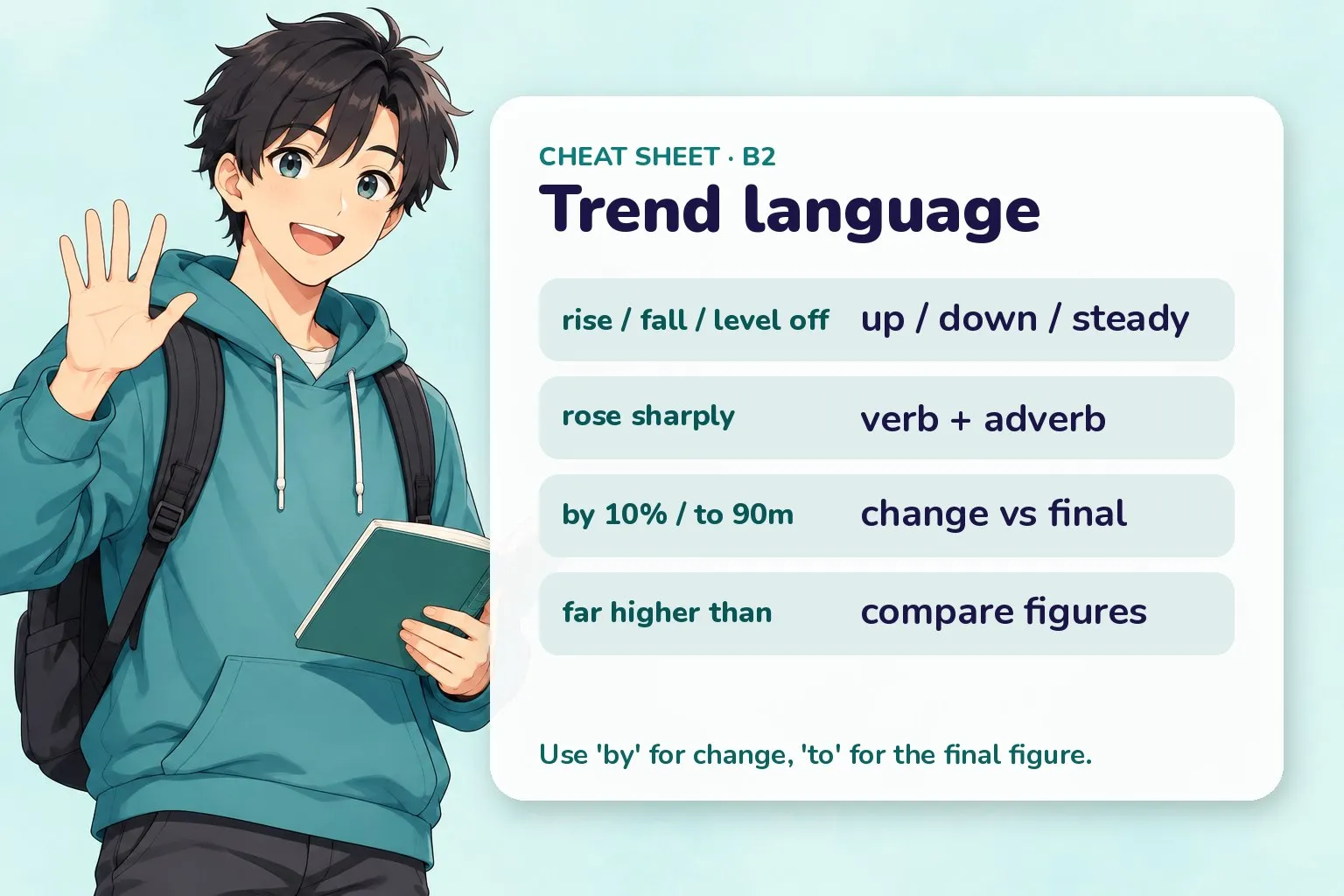
Quick recap before you practise.
Practice
Describing trends and data practice
Try each one, then press Check. No sign-up, nothing is sent anywhere — it all runs in your browser.
Hint: the gap, not the final figure
Show answer
by — Use 'by' for the amount of change: rose by 10%.
Hint: where it ended up
Show answer
to — Use 'to' for the final value: climbed to 90 million.
4 Put the words in order (verb + adverb pattern).
Show answer
Demand fell sharply in the winter — Verb + adverb: Demand fell sharply in the winter.
5 Match each verb to its meaning.
- plateau
- plunge
- fluctuate
- peak
Show answer
- plateau → stop rising and stay level
- plunge → fall very fast
- fluctuate → go up and down
- peak → reach the highest point
These are the movement verbs for this lesson.
How to say it
Some of these words are easy to misread — copy the sounds.
- rise has a long i and a z sound: RYZE; its past form rose rhymes with nose.
- increase moves its stress: the verb is in-KREESS, the noun is IN-kreess.
- data is said DAY-tuh or DAH-tuh; both are accepted in English.
- fluctuate is FLUK-choo-ate, with a ch in the middle, stress on the first syllable.
Quiz
Describing trends and data quiz
11 questions · pick an answer and you'll see straight away if it's right.
-
Show answer
by — Use 'by' for the size of a change: fell by 5%.
-
Show answer
to — Use 'to' for the value a figure reaches: dropped to 2%.
-
Show answer
fluctuate — Fluctuate = rise and fall repeatedly.
-
Show answer
rose sharply — A verb takes an adverb: rose sharply.
-
Show answer
a sharp rise — A noun takes an adjective: a sharp rise.
-
Show answer
stopped changing and stayed steady — Level off = stop rising or falling and stay steady.
-
Show answer
2 percentage points — The gap between two percentages is measured in percentage points.
-
Show answer
This was the steepest fall of the decade. — Superlative with 'the': the steepest fall.
-
Show answer
ever measured — On record means the highest ever measured.
-
Show answer
The data were collected over five years. — The passive keeps the focus on the data, not the people.
-
Show answer
raise — Raise needs an object (raise prices); rise does not (prices rise).
Recap cheat-sheet
| Idea | Pattern | Example |
|---|---|---|
| Up / down | rise, fall, grow, decline | Sales rose in spring. |
| How big | verb + adverb / adj + noun | rose sharply / a sharp rise |
| Size of change | by + figure | increased by 10% |
| Final value | to + figure | increased to 90m |
| No change | level off, remain stable | Costs levelled off. |
| Compare | far higher than, the steepest | far higher than imports |
Next
- Previous lesson: English: Culture & Traditions
- Next lesson: English: Debating & Argumentation
- New here? Start with Start Learning English Here
All English lessons topics
Vocabulary, pronunciation, phrases, practice and exam help, ordered by level. Pick a topic and go straight to it. New lessons go live every day, so topics marked Coming soon fill in over the next weeks.
Lessons
A1 9 topics · 9 ready
A2 14 topics · 14 ready
- 10 English: Describing People
- 11 English: Ordering at a Cafe
- 12 English: Shopping & Prices
- 13 English: Clothing & Sizes
- 14 English: Asking for Directions
- 15 English: Using Public Transport
- 16 English: At the Hotel
- 17 English: Weather & Seasons
- 18 English: Hobbies & Free Time
- 19 English: Daily Routine
- 20 English: Housing & Rooms
- 21 English: Parts of the Body
- 22 English: Emotions & Feelings
- 23 English: Supermarket & Groceries
B1 19 topics · 19 ready
- 24 English: Household Chores
- 25 English: At the Doctor
- 26 English: Making Appointments
- 27 English: Making Plans & Invitations
- 28 English: Phone & Messaging
- 29 English: Expressing Opinions
- 30 English: Talking About Past Experiences
- 31 English: Future Plans & Goals
- 32 English: School & Education
- 33 English: Jobs & Professions
- 34 English: Money & Banking
- 35 English: Restaurant & Dining Out
- 36 English: Travel & the Airport
- 37 English: Sightseeing & Tourism
- 38 English: Emergencies & Safety
- 39 English: Technology & the Internet
- 40 English: Complaints & Solving Problems
- 41 English: Small Talk & Networking
- 42 English Small-Talk & Politeness Culture
B2 11 topics · 11 ready
- 43 English: At the Office
- 44 English: The Job Interview
- 45 English: Formal Writing & Emails
- 46 English: News & Current Affairs
- 47 English: Environment & Nature
- 48 English: Health & Lifestyle
- 49 English: Culture & Traditions
- 50 English: Describing Trends & Data You are here
- 51 English: Storytelling & Narration
- 52 English: Giving a Short Presentation
- 53 Writing Business Emails in English