English: Environment & Nature
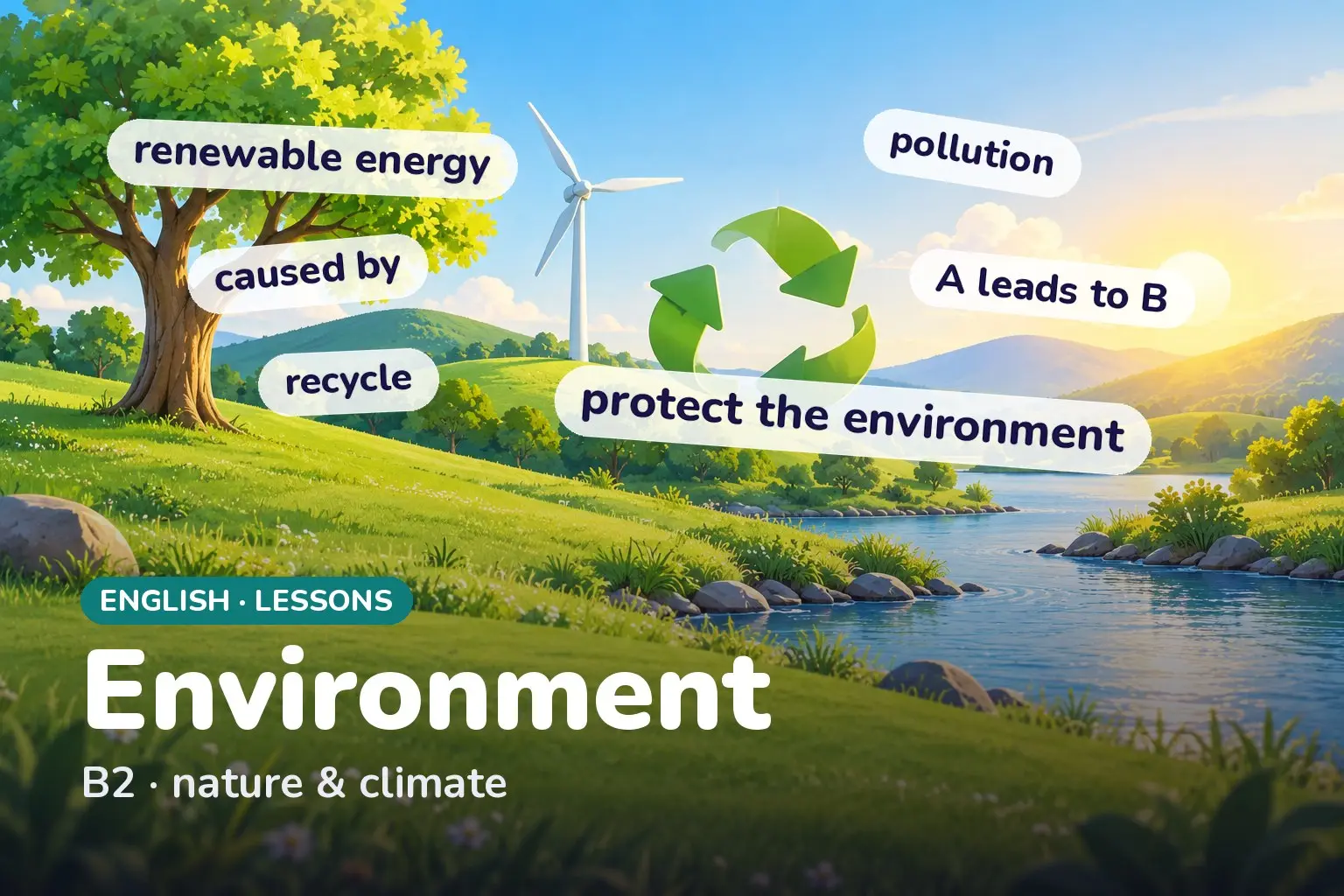
To talk about the environment in English, learn the key nouns (climate change, pollution, waste, emissions) and the cause-and-effect language that links them. Most discussion sentences follow a cause → effect pattern: 'Burning fossil fuels leads to global warming'.
On this page10 sections · tap to jump
Level: B2. The environment is a favourite exam and conversation topic, and it rewards two things: a clear set of themed vocabulary and the cause-and-effect language that joins problems to their causes and solutions. This lesson gives you both, plus the small grammar traps (uncountable nouns, the passive) that trip learners up.
By the end of this page you can…
…use climate and conservation vocabulary accurately, explain a cause and its effect in a full sentence, and take part in a short discussion about an environmental problem.
Vocabulary — grouped by problem, cause, and solution
Learning these in three groups makes them far easier to recall in a discussion:
| Group | English words |
|---|---|
| Problems | pollution, waste, climate change, global warming, drought, flooding |
| Causes | emissions, deforestation, fossil fuels, plastic, traffic |
| Solutions | recycle, reuse, conserve, renewable energy, public transport |
| Nature | wildlife, species, habitat, forest, ocean, ecosystem |
A habitat is where a plant or animal naturally lives; a species is one kind of living thing (the word is the same in singular and plural: one species, many species). Renewable energy comes from sources that do not run out, such as wind and solar; fossil fuels (coal, oil, gas) do run out and release emissions when burned.
Cause-and-effect language — the heart of the topic
To discuss the environment you must link a cause to an effect. English gives you several patterns; learn one from each row and you can say almost anything:
- cause → effect: A causes / leads to / results in B. — Burning fuel leads to global warming.
- effect ← cause: B is caused by A. / B is due to A. — The flood was caused by heavy rain.
- reason: because of / due to + noun. — Crops failed because of the drought.
- result: so / therefore / as a result. — It rained for weeks, so the river flooded.
For the more formal connectors, see connectors of cause and contrast and advanced result linkers.
The passive keeps the focus on the problem
Environmental English uses the passive a lot, because the problem matters more than who caused it:
- Forests are being destroyed at an alarming rate.
- The river has been polluted by the factory.
- Thousands of species are threatened with extinction.
A short conversation
A: Our city is banning single-use plastic next year. B: Good. Plastic waste ends up in the ocean and harms wildlife. A: Exactly. And it’s mostly due to packaging we don’t even need. B: So if shops cut the packaging, there’d be far less waste. A: That’s the idea. Small changes, but they add up.
Usage notes
- weather vs climate: weather is today’s conditions (rain, sun); climate is the long-term pattern of a place. Climate change is the long-term shift.
- affect vs effect: affect is the verb (pollution affects our health); effect is the noun (the effects of pollution). The one exception — to effect change (formal, = to bring it about) — is rare.
- global warming vs climate change: global warming is the rise in temperature; climate change is the broader set of changes that follow. They are related but not identical.
- environment: nearly always with the when it means the natural world (protect the environment), but nature takes no article (be kind to nature).
Example sentences
Press play and say each cause-and-effect line out loud — notice how the two halves join.
- Pollution affects everyone's health.Affect = the verb.
- The flooding was caused by heavy rain.B is caused by A.
- Burning fossil fuels leads to global warming.A leads to B.
- We should recycle more and waste less.Waste here is a verb; waste (noun) is uncountable.
- Deforestation results in the loss of habitats.A results in B.
- Many species are threatened with extinction.Passive: focus on the species.
- The river has been polluted by the factory.Present perfect passive.
- Crops failed because of the drought.Because of + noun.
- It rained for weeks, so the river flooded.So links result to cause.
- Renewable energy produces fewer emissions.Renewable sources don't run out.
- There is too much plastic in the ocean.Plastic is uncountable: much, not many.
- Forests are being destroyed every day.Present continuous passive.
- Switching off lights saves a lot of energy.Energy is uncountable.
- Public transport reduces traffic in the city.A reduces B.
- The damage was due to years of pollution.Due to + noun.
- We must protect the environment.The environment = the natural world.
- Climate change affects the whole planet.Climate = long-term pattern.
- Wildlife is disappearing from the area.Wildlife is uncountable: is, not are.
- If we recycle, we create less waste.Less + uncountable noun.
- Protecting habitats helps rare species survive.Species is the same in singular and plural.
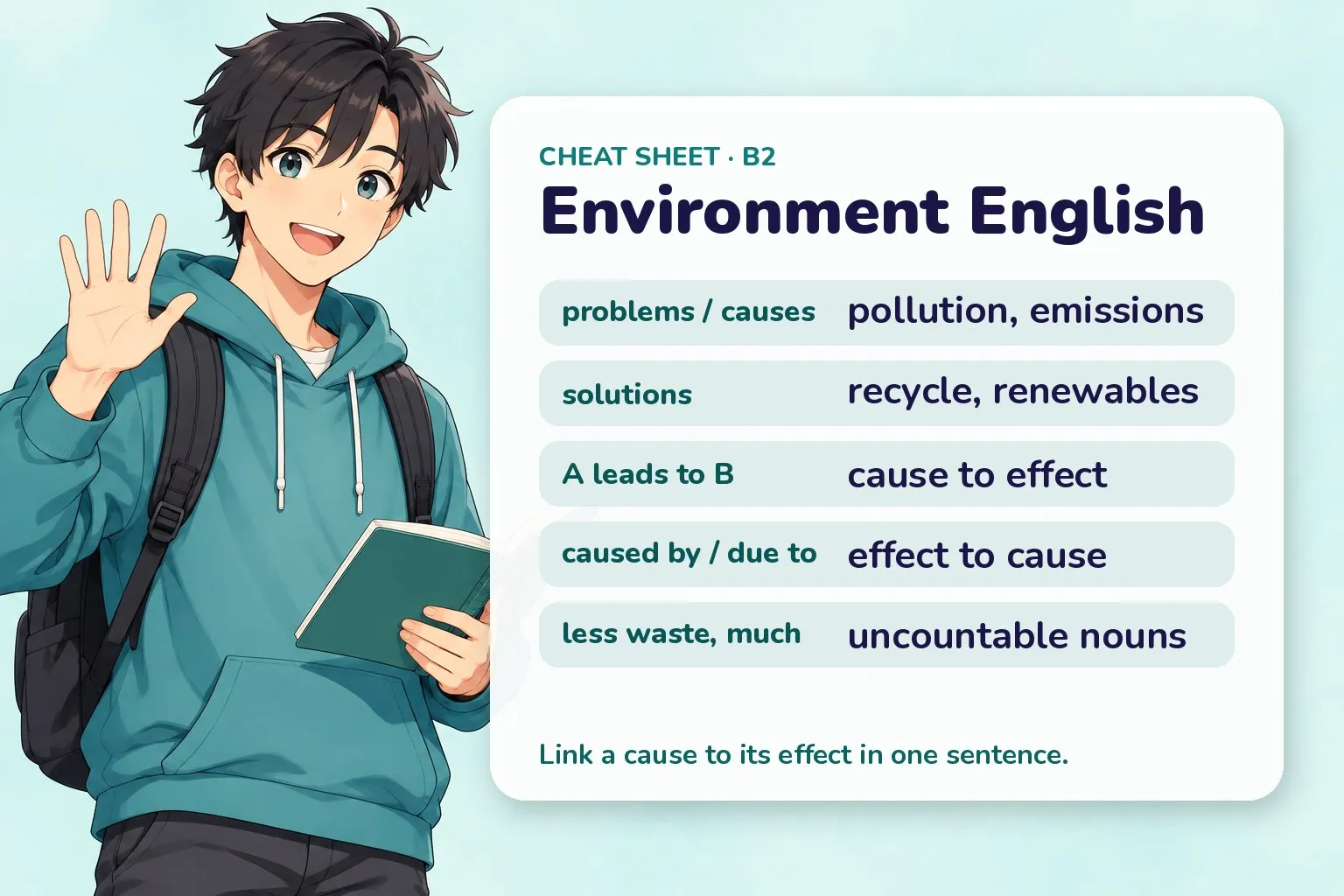
Quick recap before you practise.
Practice
Environment and nature practice
Try each one, then press Check. No sign-up, nothing is sent anywhere — it all runs in your browser.
Hint: A ___ to B
Show answer
leads — 'A leads to B' is a core cause-and-effect pattern.
Hint: B is ___ by A
Show answer
caused — 'B is caused by A' puts the effect first and names the cause after 'by'.
5 Put the words in order to make a cause-and-effect sentence.
Show answer
Deforestation results in the loss of habitats — 'A results in B' links a cause to its effect.
6 Match each word to its group.
- emissions
- recycle
- drought
- habitat
Show answer
- emissions → a cause
- recycle → a solution
- drought → a problem
- habitat → nature
Grouping vocabulary by problem, cause, solution and nature makes it easier to recall.
Quiz
Environment and nature quiz
11 questions · pick an answer and you'll see straight away if it's right.
-
Show answer
waste — Waste is uncountable: say 'less waste', not 'wastes' or 'a waste' (in this meaning).
-
Show answer
passive voice — Passive: 'was polluted' + 'by' + the cause.
-
Show answer
because of — 'Because of' is followed by a noun (the drought); 'because' needs a full clause.
-
Show answer
pollution affects us — Affect is the verb; effect is the noun.
-
Show answer
where a plant or animal naturally lives — A habitat is the natural home of a species.
-
Show answer
comes from sources that don't run out — Renewable sources, like wind and solar, do not run out.
-
Show answer
Wildlife is disappearing. — Wildlife is uncountable, so it takes 'is'.
-
Show answer
the long-term weather pattern of a place — Climate is the long-term pattern; weather is the day-to-day conditions.
-
Show answer
Many — Species is countable here, so use 'many'.
-
Show answer
It rained, so the river flooded. — 'so' introduces the result: cause, so result.
-
Show answer
protect the environment — It is 'the environment' (en-viron-ment); 'nature' takes no 'the'.
Recap cheat-sheet
| Idea | Pattern | Example |
|---|---|---|
| Vocabulary groups | problems / causes / solutions / nature | pollution, emissions, recycle, habitat |
| Cause → effect | A leads to / results in B | Fuel leads to warming. |
| Effect ← cause | B is caused by / due to A | Flood caused by rain. |
| Reason / result | because of + noun; so / therefore | Failed because of drought. |
| Uncountable nouns | less / much + noun | less waste, much pollution |
| Passive focus | is / has been + past participle | Forests are being destroyed. |
Next
- Previous lesson: English: News & Current Affairs
- Next lesson: English: Health & Lifestyle
- New here? Start with Start Learning English Here
All English lessons topics
Vocabulary, pronunciation, phrases, practice and exam help, ordered by level. Pick a topic and go straight to it. New lessons go live every day, so topics marked Coming soon fill in over the next weeks.
Lessons
A1 9 topics · 9 ready
A2 14 topics · 14 ready
- 10 English: Describing People
- 11 English: Ordering at a Cafe
- 12 English: Shopping & Prices
- 13 English: Clothing & Sizes
- 14 English: Asking for Directions
- 15 English: Using Public Transport
- 16 English: At the Hotel
- 17 English: Weather & Seasons
- 18 English: Hobbies & Free Time
- 19 English: Daily Routine
- 20 English: Housing & Rooms
- 21 English: Parts of the Body
- 22 English: Emotions & Feelings
- 23 English: Supermarket & Groceries
B1 19 topics · 19 ready
- 24 English: Household Chores
- 25 English: At the Doctor
- 26 English: Making Appointments
- 27 English: Making Plans & Invitations
- 28 English: Phone & Messaging
- 29 English: Expressing Opinions
- 30 English: Talking About Past Experiences
- 31 English: Future Plans & Goals
- 32 English: School & Education
- 33 English: Jobs & Professions
- 34 English: Money & Banking
- 35 English: Restaurant & Dining Out
- 36 English: Travel & the Airport
- 37 English: Sightseeing & Tourism
- 38 English: Emergencies & Safety
- 39 English: Technology & the Internet
- 40 English: Complaints & Solving Problems
- 41 English: Small Talk & Networking
- 42 English Small-Talk & Politeness Culture
B2 11 topics · 11 ready
- 43 English: At the Office
- 44 English: The Job Interview
- 45 English: Formal Writing & Emails
- 46 English: News & Current Affairs
- 47 English: Environment & Nature You are here
- 48 English: Health & Lifestyle
- 49 English: Culture & Traditions
- 50 English: Describing Trends & Data
- 51 English: Storytelling & Narration
- 52 English: Giving a Short Presentation
- 53 Writing Business Emails in English