English: Idioms & Colloquialisms
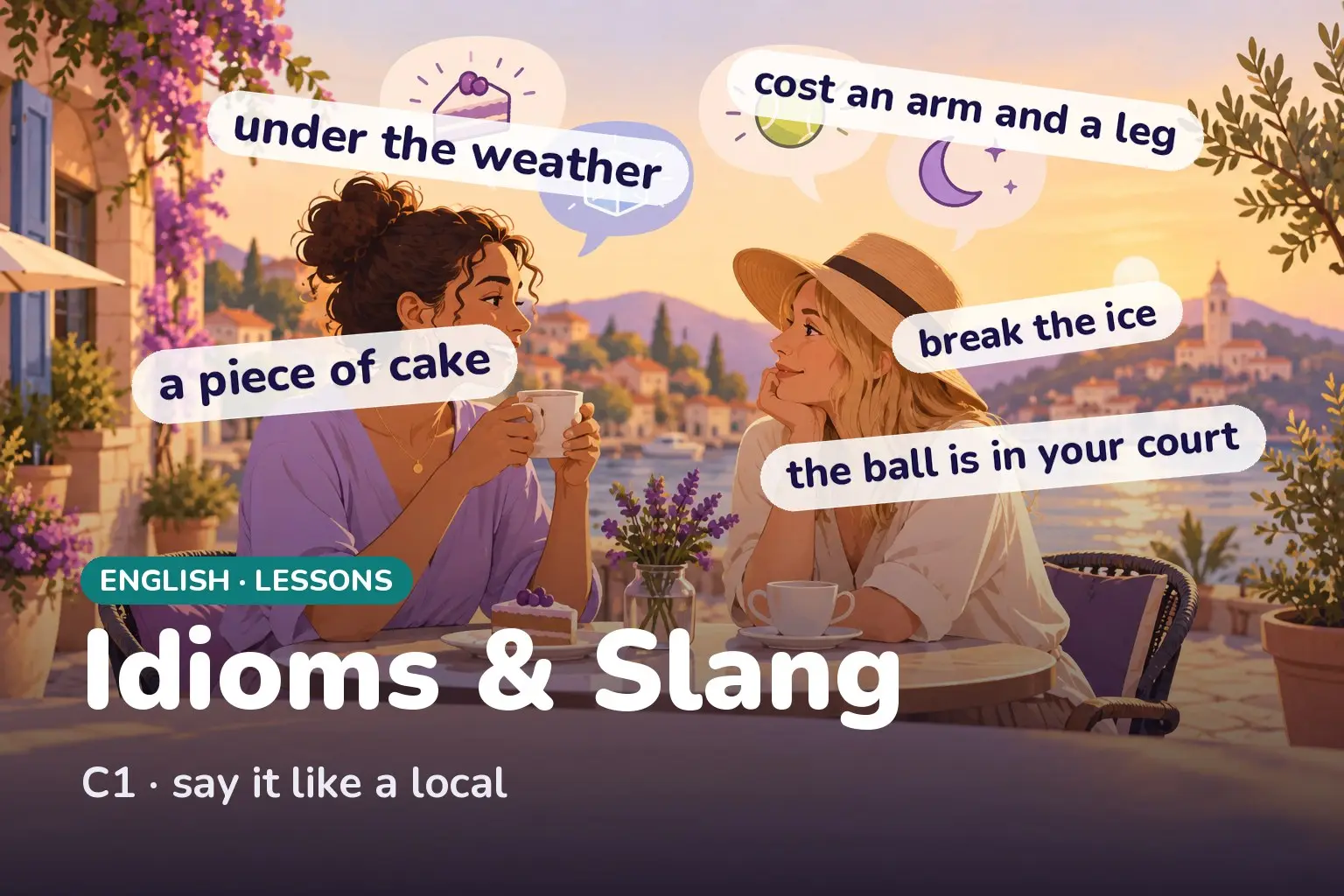
An idiom is a fixed phrase whose meaning you cannot guess from the single words: 'a piece of cake' means very easy, not a dessert. This lesson teaches the most useful everyday idioms and colloquial phrases, plus a clear warning about when they are too informal for writing or exams.
Level: C1. Idioms are where strong English starts to sound natural — and where literal translation fails hardest. This lesson gives you a core set of high-frequency idioms and colloquial phrases, the exact meaning of each, and a clear rule for when they fit and when they don’t.
By the end of this page you can…
…understand and use about twenty common English idioms, tell an idiom from a literal phrase, and judge whether a phrase is too informal for the situation you are writing or speaking in.
What an idiom actually is
An idiom is a group of words with a fixed, agreed meaning that you cannot work out from the individual words. A piece of cake has nothing to do with cake — it means very easy. Because the meaning is stored in the whole phrase, you learn it as one chunk, the way you learned a single word.
Idioms are also fixed in form. You usually cannot swap a word, change the number, or re-order the parts. People say spill the beans (reveal a secret), never spill the bean or pour the beans. Treat the words and the grammar as locked together.
A colloquialism is slightly different: it is any word or phrase that belongs to relaxed, everyday speech rather than careful writing — kids for children, a bit for somewhat, grab a coffee for meet for a drink. Slang is the most informal and often the most short-lived layer (knackered, mate, dodgy). All three are worth knowing; the risk is only in using them in the wrong place.
A core set of everyday idioms
Learn these as whole phrases with the situation in mind. They are common across British and American English.
| Idiom | Meaning | Typical use |
|---|---|---|
| a piece of cake | very easy | The test was a piece of cake. |
| break the ice | start a conversation / ease tension | A joke to break the ice. |
| hit the nail on the head | be exactly right | You’ve hit the nail on the head. |
| once in a blue moon | very rarely | We meet once in a blue moon. |
| under the weather | slightly ill | I’m feeling under the weather. |
| cost an arm and a leg | be very expensive | The repair cost an arm and a leg. |
| cut corners | do something carelessly to save time or money | Don’t cut corners on safety. |
| bite the bullet | force yourself to do something hard | I bit the bullet and apologised. |
| the ball is in your court | it is now your decision | I’ve made my offer; the ball is in your court. |
| get the hang of (something) | learn how to do it | You’ll get the hang of it soon. |
| a blessing in disguise | a good thing that first seemed bad | Losing that job was a blessing in disguise. |
| let the cat out of the bag | reveal a secret by accident | He let the cat out of the bag about the party. |
Register: the real danger with idioms
Most idioms sit between neutral and informal. That makes them perfect for conversation, friendly emails and spoken exams, and usually wrong for academic essays, formal reports and official letters. An examiner wants to see you control register, not just know colourful phrases.
- Fine in speech / informal writing: It cost an arm and a leg. Let’s call it a day.
- Better for formal writing: It was very expensive. Let’s stop here for today.
Colloquialisms and slang you will hear
These mark very casual English. Understand them all; use them only with people you’d speak casually to.
- gonna / wanna / gotta — spoken reductions of going to / want to / have got to. Never write them in formal text.
- mate / pal — informal for friend (British mate, also a friendly way to address a stranger).
- knackered / shattered — British informal for exhausted.
- dodgy — British informal for suspect, unreliable (a dodgy website).
- no worries / no problem — relaxed replies to thanks or an apology.
- a quid / a buck — informal for a pound / a dollar.
Example sentences
Play each line and say it aloud. Notice how casual each one feels.
- The exam was a piece of cake.a piece of cake = very easy.
- She told a joke to break the ice.break the ice = start a conversation or ease tension.
- You've hit the nail on the head.hit the nail on the head = be exactly right.
- We only see each other once in a blue moon.once in a blue moon = very rarely.
- I'm feeling a bit under the weather today.under the weather = slightly ill.
- That holiday cost an arm and a leg.cost an arm and a leg = be very expensive.
- They cut corners and the product broke.cut corners = do something carelessly to save time or money.
- I finally bit the bullet and booked the flight.bite the bullet = force yourself to do something hard.
- I've made my offer, so the ball is in your court.the ball is in your court = it is your decision now.
- Don't worry, you'll get the hang of it.get the hang of it = learn how to do it.
- Missing that train was a blessing in disguise.a blessing in disguise = a good thing that seemed bad.
- He let the cat out of the bag about the surprise party.let the cat out of the bag = reveal a secret by accident.
- Let's call it a day and finish tomorrow.call it a day = stop working for now.
- Are you pulling my leg?pull someone's leg = joke or tease.
- We're finally on the same page about the plan.on the same page = in full agreement.
- Speak of the devil — here she comes now.speak of the devil = the person we just mentioned appears.
- That was the last straw, so I complained.the last straw = the final problem that ends your patience.
- I'm absolutely knackered after that shift.knackered = British informal for exhausted.
- No worries, I'll sort it out.no worries = a relaxed 'that's fine'.
- That website looks a bit dodgy to me.dodgy = British informal for suspect or unreliable.
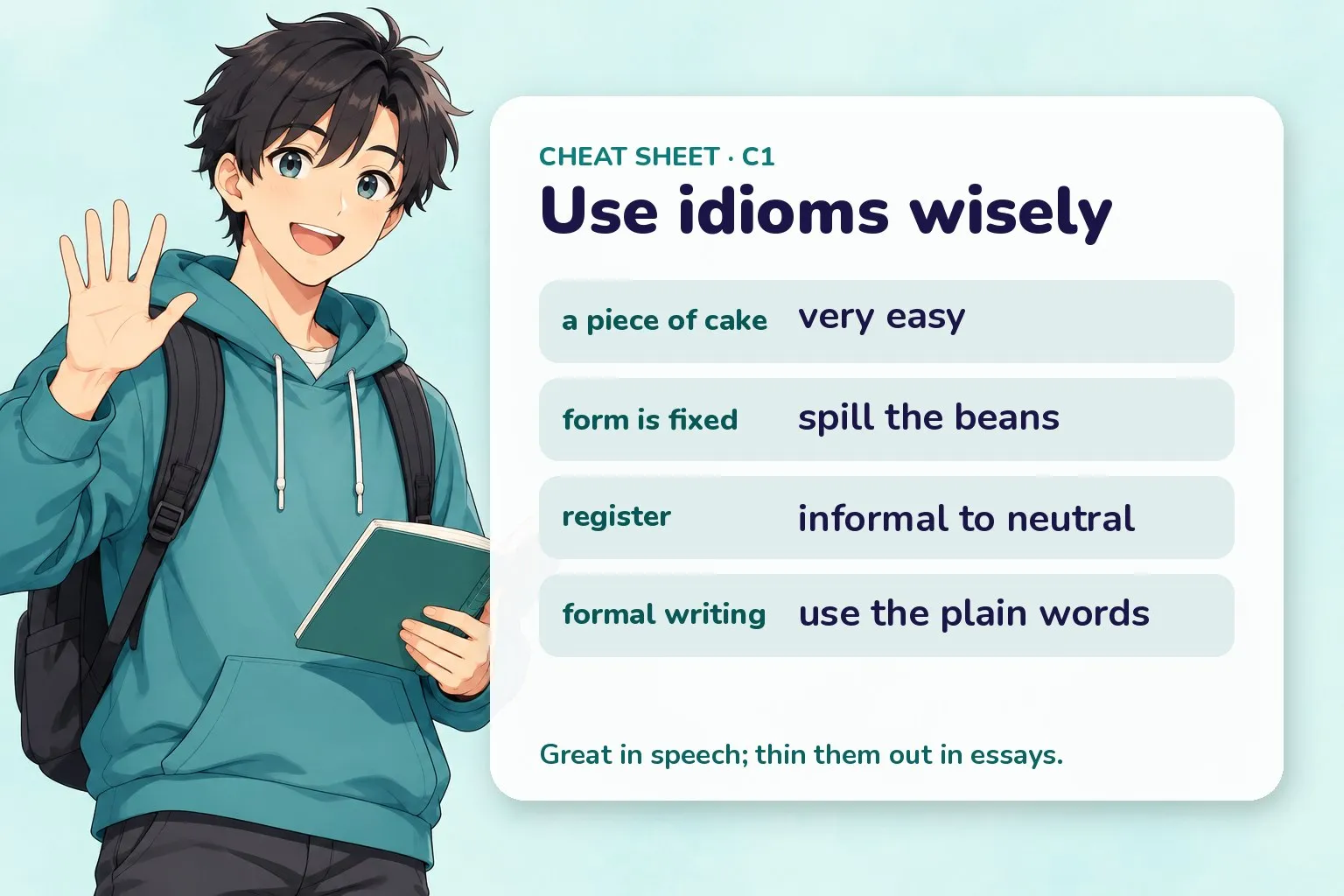
Quick recap before you practise.
Usage notes
- Idiom vs literal: context decides. It’s a piece of cake at a meeting is the idiom; at a bakery it may be literal. Listen for whether the plain meaning makes sense.
- Transparency varies: some idioms are guessable once you know one word (cost an arm and a leg → expensive); others are opaque (the last straw). Opaque ones must simply be memorised.
- British vs American: knackered, dodgy, mate and quid are mainly British; buck is mainly American. The core idioms in the table are shared.
- Keep a small, active set: it is better to use five idioms correctly and naturally than to scatter twenty you half-know. Collect the ones you actually hear.
Practice
Idioms and colloquialisms practice
Try each one, then press Check. No sign-up, nothing is sent anywhere — it all runs in your browser.
Hint: a small animal
Show answer
cat — The fixed idiom is 'let the cat out of the bag'.
Hint: a tennis word
Show answer
court — 'The ball is in your court' means the decision is now yours.
5 Put the words in order to make a common idiom.
Show answer
hit the nail on the head — 'Hit the nail on the head' means to be exactly right.
6 Match each idiom to its meaning.
- under the weather
- break the ice
- bite the bullet
- once in a blue moon
Show answer
- under the weather → slightly ill
- break the ice → start a conversation
- bite the bullet → face something hard
- once in a blue moon → very rarely
These are high-frequency idioms worth knowing as whole chunks.
How to say it
A few of these phrases link together in speech — copy the audio, not the spelling.
- a piece of cake runs together as “a-piece-a-cake”; the of almost disappears.
- cost an arm and a leg — the and reduces to “n”: “arm-n-a-leg”.
- gonna / wanna are “going to” and “want to” said fast; use them only when speaking casually.
- knackered is British: “NAK-erd”, stress on the first syllable, the final -ed is a soft d.
Quiz
Idioms and colloquialisms quiz
10 questions · pick an answer and you'll see straight away if it's right.
-
Show answer
do it carelessly to save time or money — Cut corners = do something carelessly or cheaply, skipping proper steps.
-
Show answer
very expensive — Cost an arm and a leg is a fixed idiom for very expensive.
-
Show answer
spill the beans — The idiom is fixed: 'spill the beans' (reveal a secret), always plural.
-
Show answer
made myself do the hard thing — Bite the bullet = force yourself to do something difficult or unpleasant.
-
Show answer
make the next decision — It means the next move or decision is yours.
-
Show answer
casual speech and texts — Gonna/wanna are spoken reductions; never use them in formal writing.
-
Show answer
seemed bad but turned out well — A blessing in disguise is a good outcome that first appeared to be bad.
-
Show answer
We're on the same page. — The fixed preposition is 'on the same page' (in agreement).
-
Show answer
exhausted — Knackered is British informal for very tired/exhausted.
-
Show answer
That's the end of my questions. — The neutral, formal choice fits an official email; the others are colloquial.
Recap cheat-sheet
| Idea | Rule of thumb | Example |
|---|---|---|
| What an idiom is | fixed phrase, meaning ≠ the words | a piece of cake = very easy |
| Form is locked | don’t change words or number | spill the beans (not bean) |
| Register | mostly informal to neutral | fine in speech, risky in essays |
| Formal swap | use the plain meaning | very expensive, not cost an arm and a leg |
| Slang | understand first, use with care | knackered, mate, dodgy |
Next
- Next lesson: English: Formal vs Informal Register
- New here? Start with Start Learning English Here
All English lessons topics
Vocabulary, pronunciation, phrases, practice and exam help, ordered by level. Pick a topic and go straight to it. New lessons go live every day, so topics marked Coming soon fill in over the next weeks.
Lessons
A1 9 topics · 9 ready
A2 14 topics · 14 ready
- 10 English: Describing People
- 11 English: Ordering at a Cafe
- 12 English: Shopping & Prices
- 13 English: Clothing & Sizes
- 14 English: Asking for Directions
- 15 English: Using Public Transport
- 16 English: At the Hotel
- 17 English: Weather & Seasons
- 18 English: Hobbies & Free Time
- 19 English: Daily Routine
- 20 English: Housing & Rooms
- 21 English: Parts of the Body
- 22 English: Emotions & Feelings
- 23 English: Supermarket & Groceries
B1 19 topics · 19 ready
- 24 English: Household Chores
- 25 English: At the Doctor
- 26 English: Making Appointments
- 27 English: Making Plans & Invitations
- 28 English: Phone & Messaging
- 29 English: Expressing Opinions
- 30 English: Talking About Past Experiences
- 31 English: Future Plans & Goals
- 32 English: School & Education
- 33 English: Jobs & Professions
- 34 English: Money & Banking
- 35 English: Restaurant & Dining Out
- 36 English: Travel & the Airport
- 37 English: Sightseeing & Tourism
- 38 English: Emergencies & Safety
- 39 English: Technology & the Internet
- 40 English: Complaints & Solving Problems
- 41 English: Small Talk & Networking
- 42 English Small-Talk & Politeness Culture
B2 11 topics · 11 ready
- 43 English: At the Office
- 44 English: The Job Interview
- 45 English: Formal Writing & Emails
- 46 English: News & Current Affairs
- 47 English: Environment & Nature
- 48 English: Health & Lifestyle
- 49 English: Culture & Traditions
- 50 English: Describing Trends & Data
- 51 English: Storytelling & Narration
- 52 English: Giving a Short Presentation
- 53 Writing Business Emails in English
C1 3 topics · 3 ready
- 54 English: Debating & Argumentation
- 55 English: Idioms & Colloquialisms You are here
- 56 English: Formal vs Informal Register