English: Supermarket & Groceries
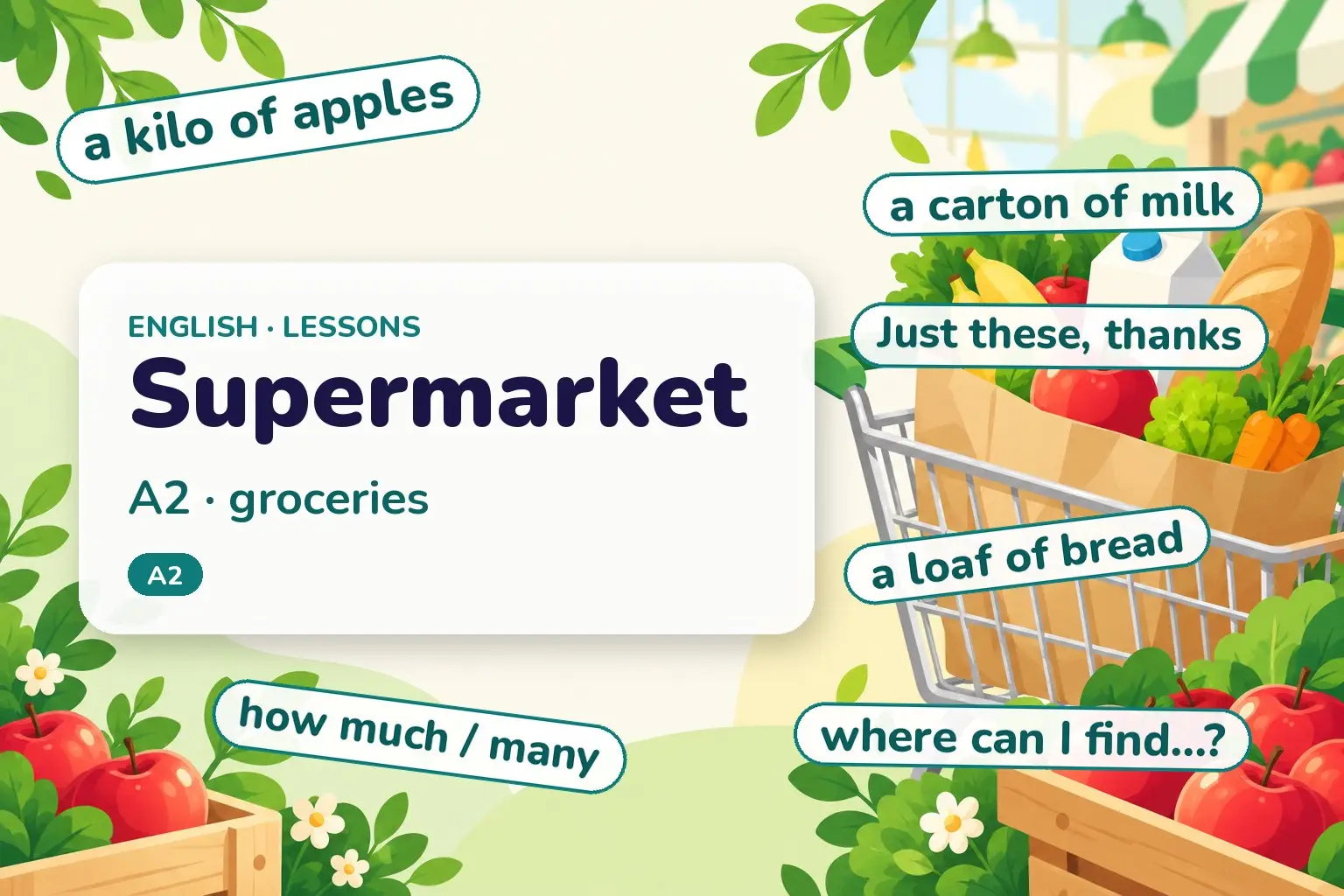
To shop for groceries in English, say the quantity (a kilo of rice, a carton of milk, two tins of beans), ask staff 'Excuse me, where can I find …?', and at the till say 'Just these, thanks.' Learn the quantity words and shopping is simple.
On this page13 sections · tap to jump
Level: A2. A supermarket trip in English needs three things: the names of the food, the right word for how much of it you want, and a few phrases to find things and to pay. The tricky part for most learners is counting food — you don’t buy “a milk”, you buy “a carton of milk”. This lesson builds all three.
By the end of this page you can…
…name common groceries and the aisle they are in, say the quantity with the right container or unit, write a shopping list, ask staff where something is, and get through the checkout.
Groceries and aisles
Supermarkets group food into aisles (the long rows between shelves). You push a trolley (British) or cart (American), or carry a basket for a few items.
- Fruit and vegetables: apples, bananas, tomatoes, onions, potatoes, salad.
- Dairy: milk, butter, cheese, yoghurt, eggs.
- Bakery: bread, rolls, cakes.
- Meat and fish: chicken, beef, mince, salmon.
- Tins and jars: beans, tomatoes, soup, jam.
- Frozen / freezer: frozen peas, ice cream, pizza.
- Drinks: water, juice, tea, coffee.
- Household: soap, washing-up liquid, bin bags.
Countable and uncountable food
This is the heart of the lesson. Some food you can count one by one (countable): an egg, two apples, three bananas. Other food you cannot count directly (uncountable): milk, rice, bread, sugar, cheese. You never say a milk or two rices.
To count uncountable food, add a container or unit word, then of:
| Pattern | Example | For |
|---|---|---|
| a carton of | a carton of milk / juice | liquids in card packs |
| a bottle of | a bottle of water | liquids in bottles |
| a bag of | a bag of rice / sugar | loose dry food |
| a tin / can of | a tin of beans | canned food |
| a jar of | a jar of jam | food in glass jars |
| a packet of | a packet of biscuits | wrapped dry food |
| a loaf of | a loaf of bread | whole bread |
| a kilo of | a kilo of apples | food sold by weight |
So you buy a carton of milk, two tins of tomatoes, a kilo of potatoes and a loaf of bread.
How much or how many?
Use how much with uncountable food and how many with countable items:
- How much rice do we need? (rice is uncountable)
- How many eggs are left? (eggs are countable)
The same split works for some, any, a lot of and a little / a few:
- some bread, some apples (some works for both)
- a little sugar (uncountable) · a few eggs (countable)
- Is there any milk? · Are there any tomatoes?
Making a shopping list
A list keeps your trip short. Write the quantity first, then the item:
- 1 loaf of bread
- 2 cartons of milk
- a dozen eggs (a dozen = twelve)
- 1 kg of apples
- a bag of rice
- a jar of coffee
Asking for help and paying
If you can’t find something, ask a member of staff politely:
- Excuse me, where can I find the rice?
- Which aisle is the bread in?
- Have you got any fresh basil?
- Is this on offer / on sale? (reduced price)
At the end you pay at the checkout (also the till in Britain, the register in America). The person there is the cashier.
- Just these, thanks. (you only have what’s on the belt)
- Do you need a bag? — Yes, please, two bags.
- Can I pay by card?
- Would you like a receipt? — Yes, please.
Example sentences
Press play and copy the rhythm. Say each line out loud as if you were really shopping.
- I need a loaf of bread.Bread is uncountable, so use 'a loaf of'.
- Can you get two cartons of milk?Count milk with cartons, not 'two milks'.
- We're out of eggs — buy a dozen.A dozen means twelve.
- I'll take a kilo of apples, please.Food sold by weight uses 'a kilo of'.
- Where are the trolleys?Trolley is the British word for a cart.
- This basket is heavy.A basket is for a small shop.
- How much rice do we need?How much with uncountable food.
- How many bananas are left?How many with countable items.
- Is there any butter in the fridge?Any in a question with uncountable food.
- Are there any tomatoes left?Any with countable items in a question.
- Let's get a bag of rice and a jar of coffee.Two containers in one sentence.
- Excuse me, where can I find the pasta?The polite way to ask staff for an item.
- Which aisle is the bread in?Asking for the right row.
- Is this on offer?Checking for a reduced price.
- The milk is in the dairy aisle.Dairy is the milk-and-cheese section.
- Just these, thanks.You have only what's on the belt.
- Do you need a bag?A common question at the till.
- Can I pay by card?Checking how you can pay.
- Could I have a receipt, please?Asking for proof of payment.
- We've got everything on the list.Finishing the shop.
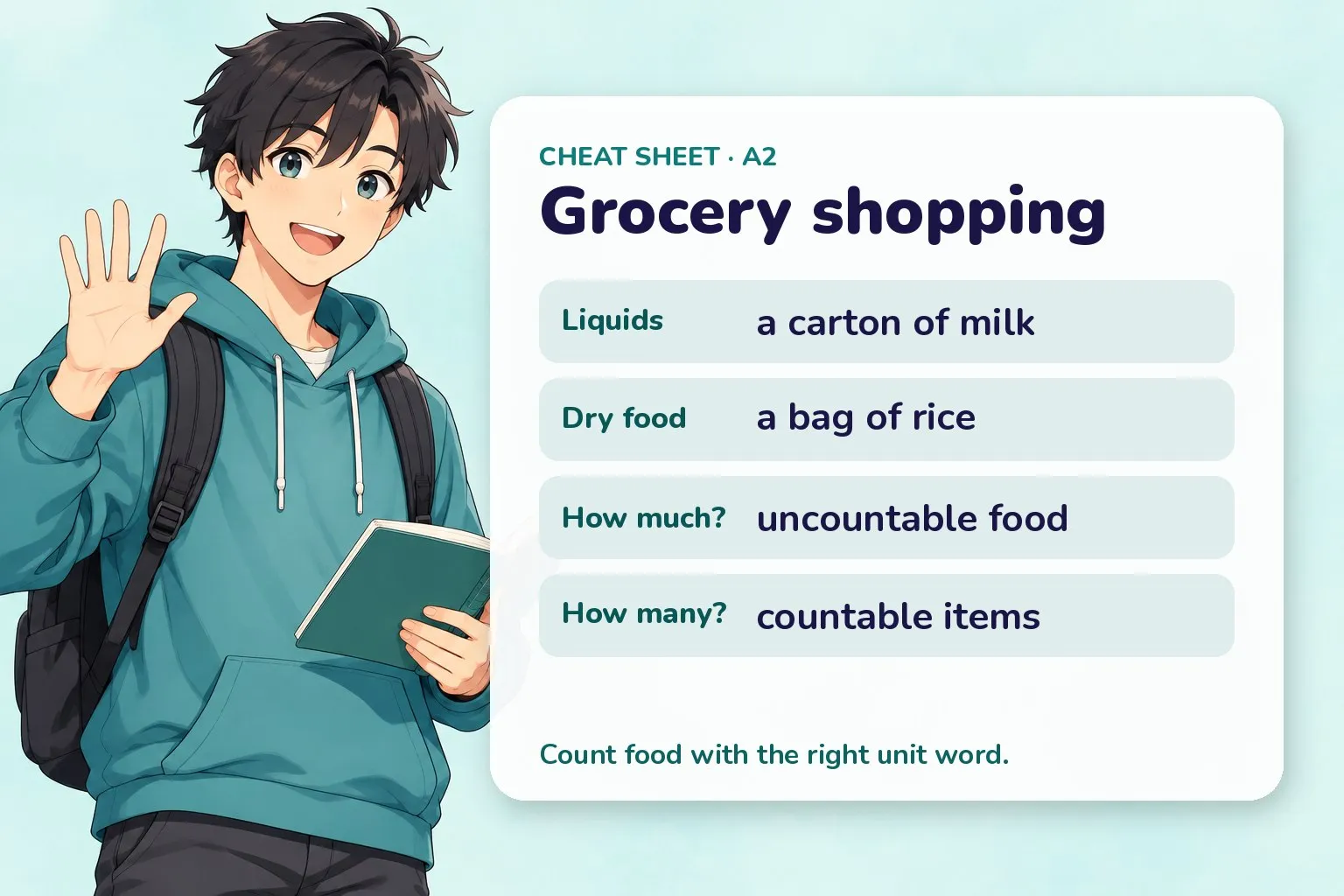
Quick recap before you practise.
A short conversation
Sara: Excuse me, where can I find the rice? Staff: It’s in aisle four, next to the pasta. Sara: Thanks. And is the orange juice on offer today? Staff: Yes, two cartons for the price of one. Sara: Great, I’ll take two, then.
Usage notes
- trolley / cart, till / register: the first in each pair is British, the second American; both are widely understood.
- a dozen: means twelve, most often used for eggs: a dozen eggs. Half a dozen is six.
- some in offers: in a polite request, use some even in a question: Can I have some bread? Keep any for ordinary yes/no questions and negatives: Is there any bread? — There isn’t any.
- on offer / on sale: both mean a reduced price. Buy one get one free (often shortened to BOGOF) is a common supermarket deal.
- fresh / frozen / tinned: describe how food is kept: fresh peas (just picked), frozen peas (from the freezer), tinned/canned peas (in a tin).
Practice
Supermarket practice
Try each one, then press Check. No sign-up, nothing is sent anywhere — it all runs in your browser.
Hint: used with countable items
Show answer
How many — Eggs are countable, so use 'how many'.
Hint: used with uncountable food
Show answer
How much — Milk is uncountable, so use 'how much'.
4 Put the words in order to ask for help.
Show answer
Excuse me, where can I find the rice — The polite pattern is: Excuse me, where can I find the rice?
5 Match each food to its quantity word.
- milk
- beans
- bread
- apples
Show answer
- milk → a carton of
- beans → a tin of
- bread → a loaf of
- apples → a kilo of
Each uncountable food takes the container or unit that suits how it's sold.
How to say it
A few grocery words catch out English learners. Copy the audio rather than spelling them out.
- vegetables is three quick beats in speech, roughly “VEJ-tuh-bulz”, not four clear ones.
- aisle sounds exactly like “I’ll” — “eye-ul”; the s is silent.
- receipt is “ri-SEET”; the p is silent.
- dozen rhymes with “cousin”: “DUZ-un”, not “doe-zen”.
Quiz
Supermarket & groceries quiz
8 questions · pick an answer and you'll see straight away if it's right.
-
Show answer
Two cartons of milk, please. — Milk is uncountable; count it with cartons: two cartons of milk.
-
Show answer
How much — Sugar is uncountable, so use 'how much'.
-
Show answer
How many — Apples are countable, so use 'how many'.
-
Show answer
trolley — British English says 'trolley'; American English says 'cart'.
-
Show answer
twelve — A dozen is twelve; half a dozen is six.
-
Show answer
Excuse me, where can I find the rice? — Use the full polite question: Excuse me, where can I find …?
-
Show answer
a reduced price — 'On offer' (or 'on sale') means the item has a reduced price.
-
Show answer
the cashier — The person at the till/checkout is the cashier.
Recap cheat-sheet
| Idea | Pattern | Example |
|---|---|---|
| Count liquids | a carton / bottle of | a carton of milk |
| Count dry food | a bag / packet of | a bag of rice |
| Count canned food | a tin / jar of | a tin of beans |
| Sold by weight | a kilo of | a kilo of apples |
| Uncountable amount | how much / a little | How much rice? |
| Countable amount | how many / a few | How many eggs? |
| Ask for help | Excuse me, where can I find …? | …find the pasta? |
| Pay | Just these, thanks. | at the checkout |
Next
- Previous lesson: English: Restaurant & Dining Out
- Next lesson: English: Travel & the Airport
- Related: English: Shopping & Prices
- New here? Start with Start Learning English Here
All English lessons topics
Vocabulary, pronunciation, phrases, practice and exam help, ordered by level. Pick a topic and go straight to it. New lessons go live every day, so topics marked Coming soon fill in over the next weeks.
Lessons
A1 9 topics · 9 ready
A2 14 topics · 14 ready
- 10 English: Describing People
- 11 English: Ordering at a Cafe
- 12 English: Shopping & Prices
- 13 English: Clothing & Sizes
- 14 English: Asking for Directions
- 15 English: Using Public Transport
- 16 English: At the Hotel
- 17 English: Weather & Seasons
- 18 English: Hobbies & Free Time
- 19 English: Daily Routine
- 20 English: Housing & Rooms
- 21 English: Parts of the Body
- 22 English: Emotions & Feelings
- 23 English: Supermarket & Groceries You are here
B1 19 topics · 19 ready
- 24 English: Household Chores
- 25 English: At the Doctor
- 26 English: Making Appointments
- 27 English: Making Plans & Invitations
- 28 English: Phone & Messaging
- 29 English: Expressing Opinions
- 30 English: Talking About Past Experiences
- 31 English: Future Plans & Goals
- 32 English: School & Education
- 33 English: Jobs & Professions
- 34 English: Money & Banking
- 35 English: Restaurant & Dining Out
- 36 English: Travel & the Airport
- 37 English: Sightseeing & Tourism
- 38 English: Emergencies & Safety
- 39 English: Technology & the Internet
- 40 English: Complaints & Solving Problems
- 41 English: Small Talk & Networking
- 42 English Small-Talk & Politeness Culture
B2 11 topics · 11 ready
- 43 English: At the Office
- 44 English: The Job Interview
- 45 English: Formal Writing & Emails
- 46 English: News & Current Affairs
- 47 English: Environment & Nature
- 48 English: Health & Lifestyle
- 49 English: Culture & Traditions
- 50 English: Describing Trends & Data
- 51 English: Storytelling & Narration
- 52 English: Giving a Short Presentation
- 53 Writing Business Emails in English