English: At the Doctor
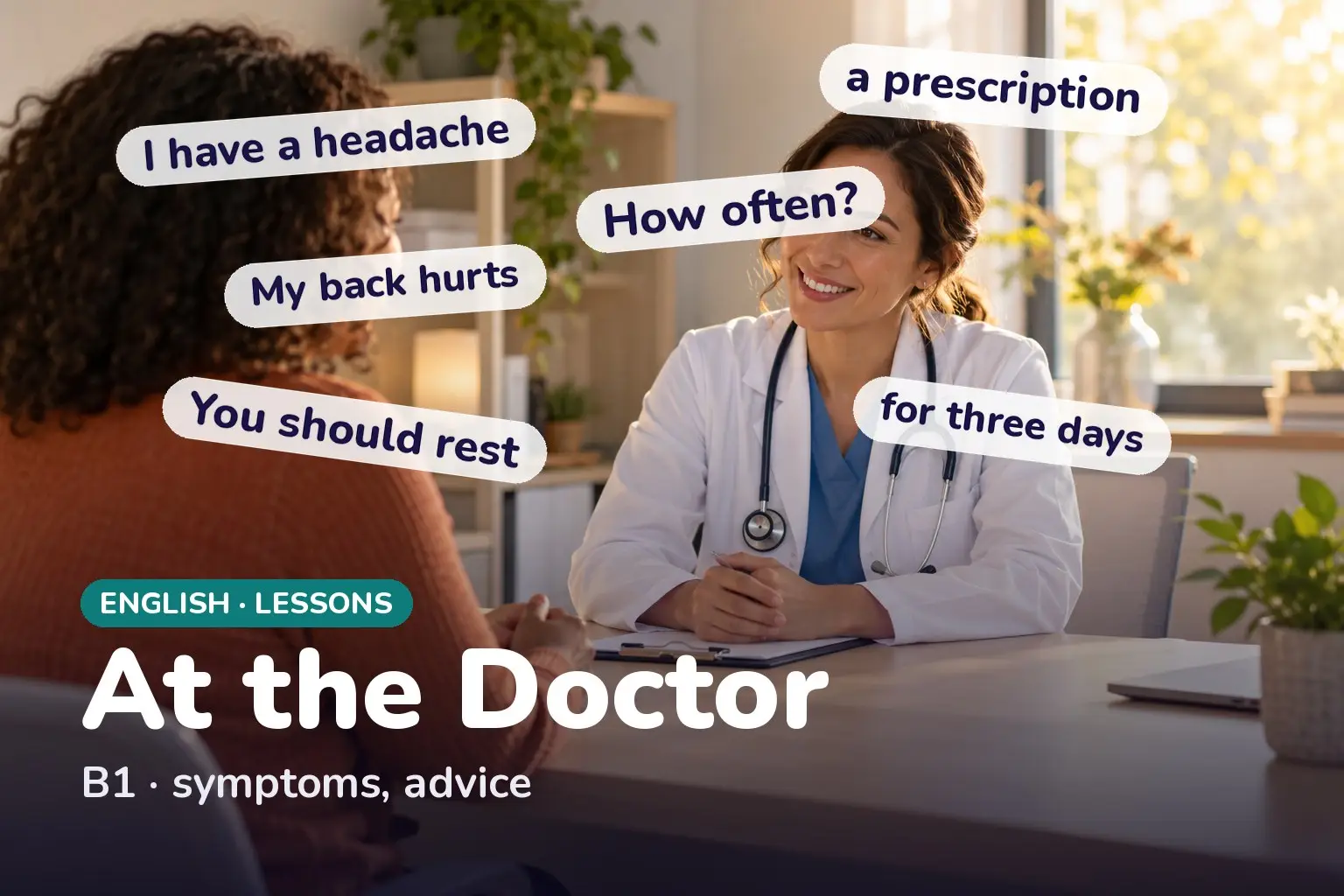
At the doctor, say what is wrong with 'I have a …' or 'My … hurts', and how long with 'for' or 'since'. The doctor examines you, gives advice, and may write a prescription. Learn these phrases and you can handle the visit.
Level: B1. A visit to the doctor follows the same shape in English everywhere: you say what is wrong, the doctor asks questions and examines you, then gives you advice and maybe some medicine. This lesson gives you the symptom words and the fixed phrases so you can explain a problem clearly and understand what you are told.
By the end of this page you can…
…describe common symptoms, say how long you have had them, understand simple advice, and follow a short conversation with a doctor or nurse.
Saying what is wrong
There are two main patterns, and strong learners use both. For a named condition, use I have a …: I have a headache, I have a cold, I have a sore throat. For a body part that hurts, use My … hurts or My … aches: My back hurts, my knee aches.
A third pattern describes how you feel in general with I feel …: I feel sick, I feel dizzy, I feel weak. Note that in British English feel sick means you want to vomit; I feel ill or I feel unwell is the general word for not healthy.
- I have a bad cough.
- My stomach hurts.
- I feel dizzy when I stand up.
Common symptoms
Here are the symptom words you will use most. Learn them as whole phrases.
| English | What it means |
|---|---|
| a headache | pain in your head |
| a sore throat | pain when you swallow |
| a temperature / a fever | your body is too hot |
| a cough | you cough again and again |
| a runny nose | liquid comes from your nose |
| to feel sick | you want to vomit (BrE) |
| to be dizzy | the room seems to spin |
| a rash | red, itchy spots on the skin |
Saying how long: for and since
The doctor will ask How long have you had this? You answer with the present perfect and one of two small words. Use for with a length of time and since with a starting point.
- I have had a cough for three days. (a length)
- I have had a cough since Monday. (a start point)
Understanding advice
After examining you, the doctor gives a diagnosis (what is wrong) and advice. Advice usually comes in three shapes:
- You should … — the main advice verb: You should rest and drink plenty of water.
- You need to … — stronger, closer to a must: You need to take this twice a day.
- Take / Avoid … — direct instructions: Take one tablet after meals. Avoid cold drinks.
If you need medicine, the doctor writes a prescription, which you take to a pharmacy (or chemist’s in British English). If you need time off, ask for a sick note (a doctor’s note).
Where to go
Match the problem to the place. For everyday illness you see a GP (general practitioner) at a clinic or surgery — book an appointment first. For a serious, sudden problem you go to A&E (accident and emergency, British) or the emergency room / ER (American), or call the local emergency number.
A short conversation
Doctor: Good morning. What seems to be the problem? Patient: I have a bad sore throat and a temperature. Doctor: I see. How long have you had this? Patient: For about three days. I also feel very tired. Doctor: Let me have a look. … It’s a throat infection. You should rest and drink plenty of fluids. I’ll write you a prescription for antibiotics. Patient: Thank you. Should I take time off work? Doctor: Yes, a few days. I’ll give you a sick note.
Example sentences
Play each line and say it aloud. These are the exact phrases you will use at a doctor’s visit.
- I'd like to make an appointment, please.Booking a visit at the clinic.
- I have a bad headache.Describing a named condition with 'I have a'.
- My back really hurts.Describing a body part with 'hurts'.
- My knee aches when I walk.Aches is a dull, ongoing pain.
- I have a sore throat and a cough.Two common symptoms together.
- I think I have a temperature.A temperature means a fever.
- I feel sick and dizzy.Feel sick (BrE) means you want to vomit.
- I feel weak and very tired.General 'I feel' for how your body feels.
- I've had this for three days.For + a length of time.
- I've had a cough since Monday.Since + the point it started.
- It hurts here, on the left side.Pointing to where the pain is.
- I'm allergic to penicillin.Telling the doctor about an allergy.
- Could you say that again, please?Asking the doctor to repeat.
- How often should I take this?Checking the instructions for medicine.
- Take one tablet twice a day after meals.A typical instruction you will hear.
- You should rest and drink plenty of water.Advice with 'you should'.
- You need to finish all the antibiotics.Stronger advice with 'you need to'.
- Avoid cold drinks for a few days.A direct instruction with 'avoid'.
- Where is the nearest pharmacy?Finding where to collect medicine.
- Could I have a sick note for work?Asking for the paper you give your employer.
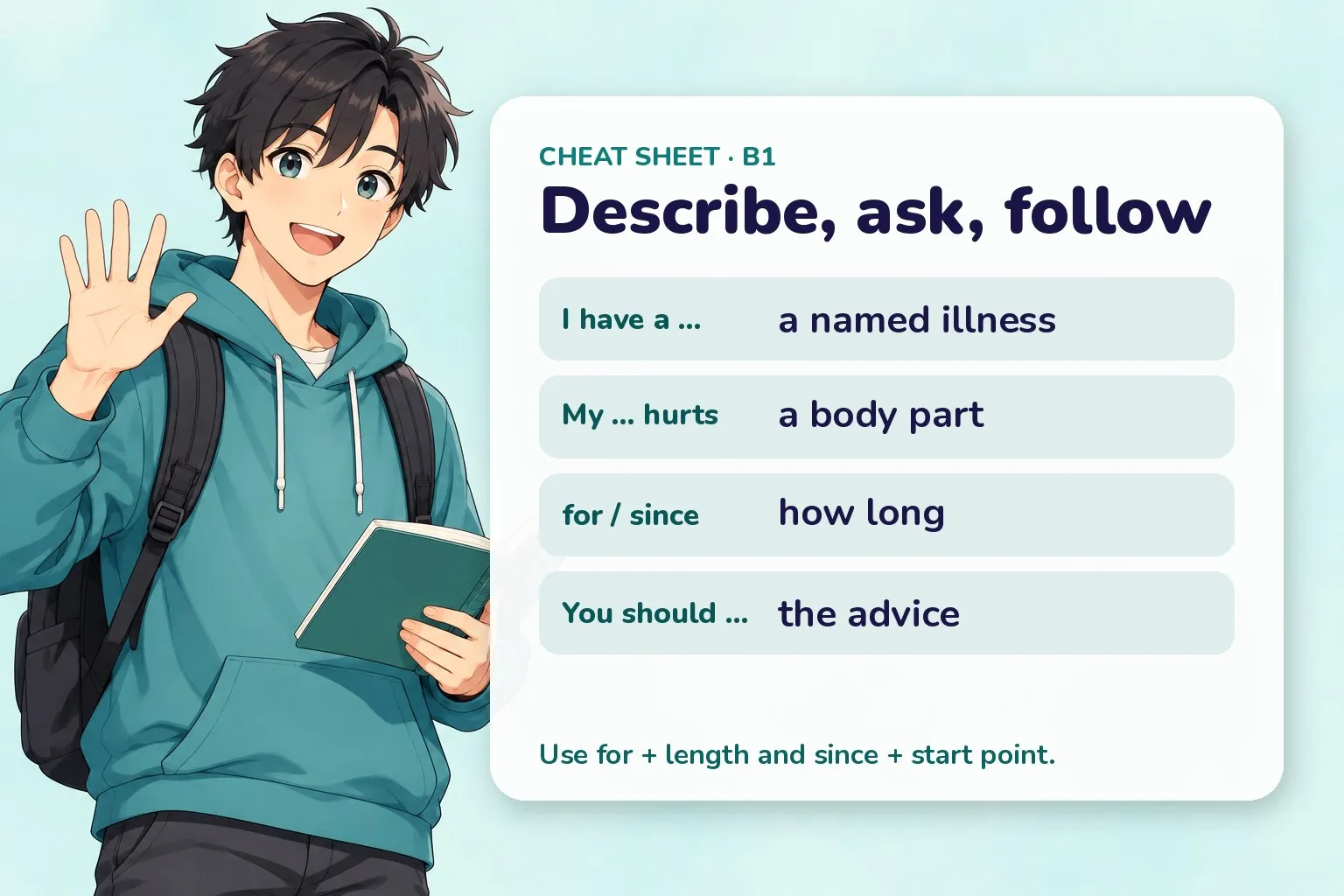
Quick recap before you practise.
Usage notes
- hurt vs ache vs pain: hurt is the everyday verb (my arm hurts); ache is a dull, lasting pain (my muscles ache); pain is the noun (I have a pain in my chest).
- medicine vs medication: both are fine; medicine is the everyday word, medication is a little more formal.
- chemist’s / pharmacy / drugstore: British chemist’s, international pharmacy, American drugstore — all the same place.
- sick: BrE vs AmE: in British English I feel sick usually means nausea; in American English sick just means ill. If in doubt, say I feel unwell or I feel nauseous to be clear.
Practice
At the doctor practice
Try each one, then press Check. No sign-up, nothing is sent anywhere — it all runs in your browser.
Hint: used with a length of time
Show answer
for — Use 'for' with a length of time: for three days.
Hint: used with a starting point
Show answer
since — Use 'since' with the point it started: since Monday.
5 Put the words in order to describe a symptom.
Show answer
I have a sore throat — The pattern is 'I have a' plus the condition: I have a sore throat.
6 Match each word to its meaning.
- prescription
- sick note
- GP
- pharmacy
Show answer
- prescription → paper for medicine
- sick note → paper for work
- GP → everyday doctor
- pharmacy → where you get medicine
These are the core words for a doctor's visit.
How to say it
A few health words trip up English learners — copy the audio, not the spelling.
- ache sounds like “ayk” — the ch is a hard k, never “atch”.
- cough sounds like “kof” — the gh is an f sound here.
- sore rhymes with “more”: “sor”, one syllable.
- nauseous is tricky; many say “NAW-shus” or “NAW-zee-us” — both are accepted.
Quiz
At the doctor quiz
10 questions · pick an answer and you'll see straight away if it's right.
-
Show answer
I have a cold. — Use 'I have a …' for an illness: I have a cold. ('I am cold' means the temperature.)
-
Show answer
hurts — Third-person singular adds -s: my knee hurts.
-
Show answer
for — Use 'for' with a length of time: for two weeks.
-
Show answer
since — Use 'since' with the point it started: since yesterday.
-
Show answer
prescription — A prescription is the paper you take to the pharmacy for medicine.
-
Show answer
You should rest. — 'Should' is followed by the base verb with no 'to': You should rest.
-
Show answer
sick note — A sick note (doctor's note) is the paper you give your employer.
-
Show answer
I want to vomit — In BrE 'feel sick' means nausea; 'feel ill/unwell' is the general word.
-
Show answer
A&E / the emergency room — Serious, sudden problems are emergencies — go to A&E or call for help.
-
Show answer
How often should I take this? — 'How often should I take this?' asks for the dose and timing.
Recap cheat-sheet
| Idea | Pattern | Example |
|---|---|---|
| Named condition | I have a + illness | I have a headache. |
| Body part hurts | My + part + hurts/aches | My back hurts. |
| How long (length) | for + length | for three days |
| How long (start) | since + point | since Monday |
| Advice | You should / need to + verb | You should rest. |
| Medicine paper | prescription → pharmacy | Take this to the pharmacy. |
Next
- Previous lesson: English: Household Chores
- Next lesson: English: Parts of the Body
- New here? Start with Start Learning English Here
All English lessons topics
Vocabulary, pronunciation, phrases, practice and exam help, ordered by level. Pick a topic and go straight to it. New lessons go live every day, so topics marked Coming soon fill in over the next weeks.
Lessons
A1 9 topics · 9 ready
A2 14 topics · 14 ready
- 10 English: Describing People
- 11 English: Ordering at a Cafe
- 12 English: Shopping & Prices
- 13 English: Clothing & Sizes
- 14 English: Asking for Directions
- 15 English: Using Public Transport
- 16 English: At the Hotel
- 17 English: Weather & Seasons
- 18 English: Hobbies & Free Time
- 19 English: Daily Routine
- 20 English: Housing & Rooms
- 21 English: Parts of the Body
- 22 English: Emotions & Feelings
- 23 English: Supermarket & Groceries
B1 19 topics · 19 ready
- 24 English: Household Chores
- 25 English: At the Doctor You are here
- 26 English: Making Appointments
- 27 English: Making Plans & Invitations
- 28 English: Phone & Messaging
- 29 English: Expressing Opinions
- 30 English: Talking About Past Experiences
- 31 English: Future Plans & Goals
- 32 English: School & Education
- 33 English: Jobs & Professions
- 34 English: Money & Banking
- 35 English: Restaurant & Dining Out
- 36 English: Travel & the Airport
- 37 English: Sightseeing & Tourism
- 38 English: Emergencies & Safety
- 39 English: Technology & the Internet
- 40 English: Complaints & Solving Problems
- 41 English: Small Talk & Networking
- 42 English Small-Talk & Politeness Culture
B2 11 topics · 11 ready
- 43 English: At the Office
- 44 English: The Job Interview
- 45 English: Formal Writing & Emails
- 46 English: News & Current Affairs
- 47 English: Environment & Nature
- 48 English: Health & Lifestyle
- 49 English: Culture & Traditions
- 50 English: Describing Trends & Data
- 51 English: Storytelling & Narration
- 52 English: Giving a Short Presentation
- 53 Writing Business Emails in English