English: Health & Lifestyle
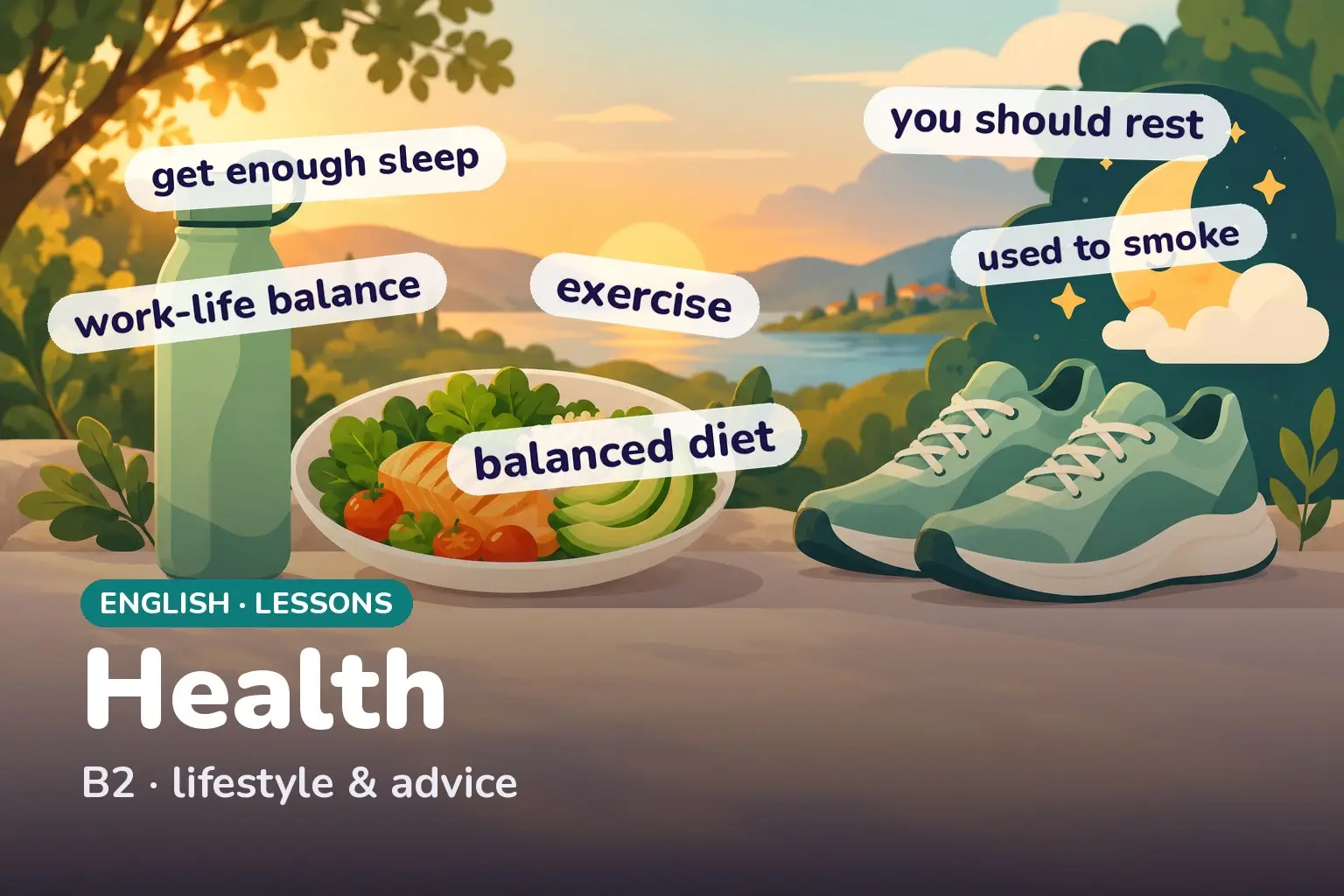
To talk about health and lifestyle in English, learn the wellbeing vocabulary (diet, exercise, stress, sleep, balance) and the advice modals: 'should', 'ought to', 'had better', 'you could'. Habits use the present simple with frequency ('I usually…') and 'used to' for the past.
Level: B2. Health and lifestyle is a topic you will use in conversation, writing, and exams. It brings together wellbeing vocabulary and two grammar areas you need to control: giving advice with modals, and talking about habits with the present simple and used to. This lesson puts them together.
By the end of this page you can…
…use health and lifestyle vocabulary accurately, give advice at the right strength with modals, and describe your habits now and in the past.
Vocabulary — wellbeing and lifestyle
Group these by area and they stick:
| Area | English words |
|---|---|
| Fitness | exercise, work out, keep fit, go for a run, gym |
| Diet | balanced diet, cut down on, healthy, junk food, portion |
| Mind | stress, relax, wellbeing, mindfulness, burnout |
| Sleep & rest | get enough sleep, insomnia, nap, routine |
| Balance | work-life balance, lifestyle, habit, cut out |
To work out is to exercise, usually at a gym; to keep fit is to stay in good physical condition. A balanced diet has the right mix of foods; to cut down on something is to have less of it (cut down on sugar), while to cut out something is to stop it completely (cut out smoking). Wellbeing is your general state of being healthy and happy.
Giving advice — the modal ladder
The main grammar of this topic is advice, and English grades it by strength. Learn it as a ladder from soft to strong, and link out to should and have to / must for the full forms:
- You could try yoga. — softest, just a suggestion.
- You should / ought to get more sleep. — normal advice.
- Why don’t you go for a walk? — friendly suggestion as a question.
- You had better see a doctor. — strong; hints at a bad result if you don’t.
- If I were you, I’d cut down on coffee. — advice from your own point of view.
Talking about habits — now and in the past
Habits are routines, so they use the present simple with frequency adverbs, not the continuous:
- I usually cook at home. / I rarely eat late. / I never skip breakfast.
For the past, use used to + base verb for a habit that has stopped, and contrast it with be used to + -ing for something now familiar — see used to and would and be used to:
- I used to smoke, but I quit two years ago. (past habit, now stopped)
- I’m used to getting up early. (it feels normal to me now)
A short conversation
A: I’ve been so tired lately. I can’t concentrate at work. B: You should get more sleep. How late do you stay up? A: Too late, honestly. And I drink a lot of coffee. B: If I were you, I’d cut down on the coffee and set a bedtime. A: You’re right. I used to have a routine, but I lost it.
Usage notes
- fit vs healthy: fit is about physical condition from exercise; healthy is the broader state (good diet, no illness). You can be fit but not perfectly healthy.
- diet (two meanings): a healthy diet = what you normally eat; go on a diet = eat less to lose weight. Context decides.
- advice (noun) vs advise (verb): give advice (noun, uncountable); advise someone to do (verb). Note the spelling and the s/c change.
- exercise: uncountable when it means physical activity (do exercise); countable only as a task (a grammar exercise).
Example sentences
Press play and say each line out loud — these are everyday health and advice phrases.
- You should get more sleep.Should = normal advice.
- You could try going for a walk.Could = a soft suggestion.
- If I were you, I'd cut down on sugar.Advice from your own view.
- You'd better see a doctor about that.Had better = strong, warns of a result.
- Why don't you join a gym?A friendly suggestion as a question.
- I usually work out twice a week.Present simple + frequency for a habit.
- She rarely eats junk food.Rarely = almost never.
- I used to smoke, but I quit.Used to + base verb: a past habit.
- I'm used to getting up early now.Be used to + -ing: now familiar.
- He wants to keep fit and stay healthy.Keep fit = stay in good shape.
- Try to eat a balanced diet.Balanced diet = the right mix of foods.
- You need to get enough sleep.Sleep is uncountable: enough sleep.
- Can I give you some advice?Advice is uncountable: some advice.
- I'm trying to cut out fast food.Cut out = stop completely.
- Stress can affect your health.Stress and health are both uncountable.
- A short nap helps me relax.Relax = rest and calm down.
- You ought to drink more water.Ought to = should.
- I never skip breakfast.Never + present simple for a habit.
- Working long hours can lead to burnout.Burnout = exhaustion from overwork.
- A good work-life balance keeps you well.Work-life balance is a key lifestyle idea.
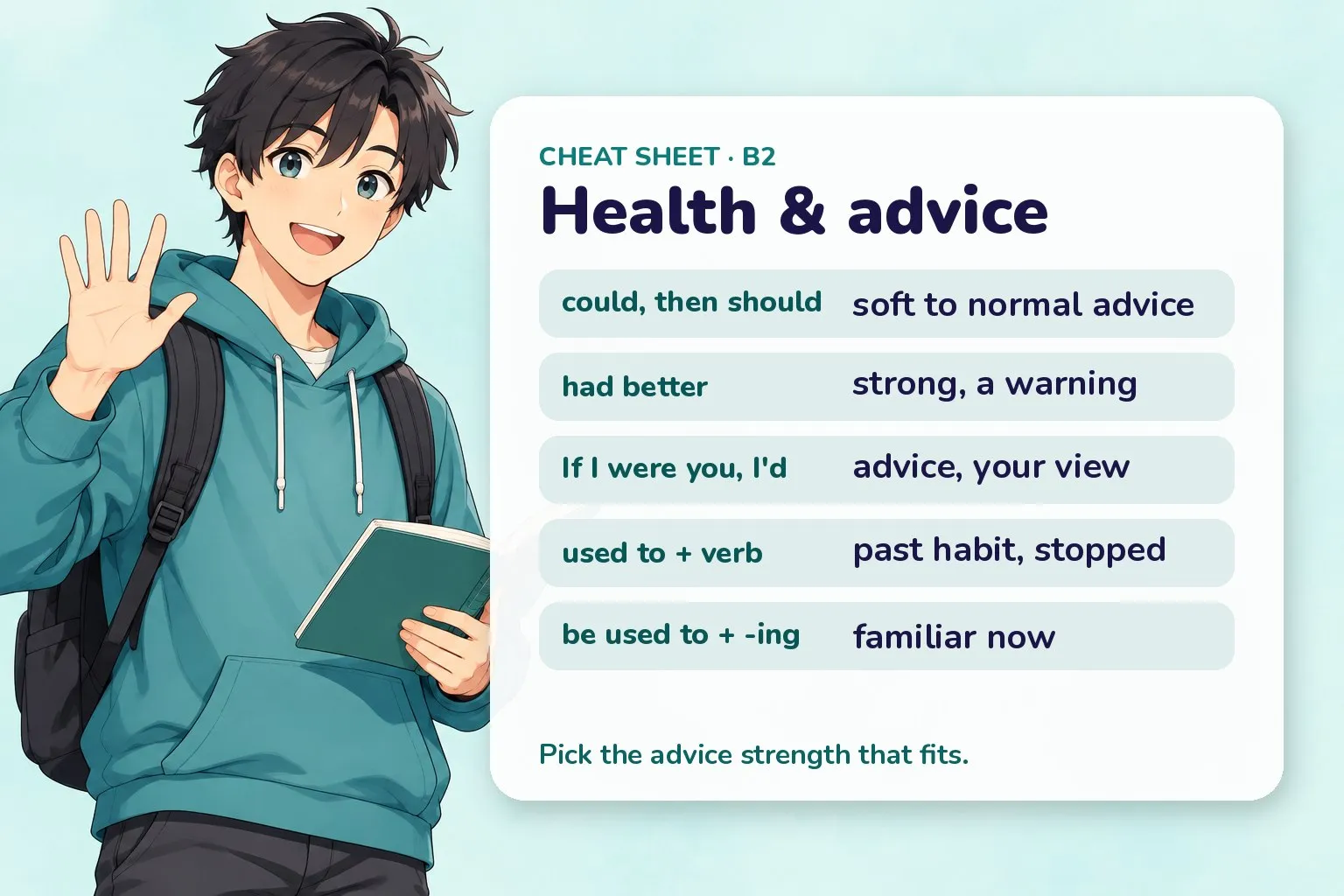
Quick recap before you practise.
Practice
Health and lifestyle practice
Try each one, then press Check. No sign-up, nothing is sent anywhere — it all runs in your browser.
Hint: used ___ + base verb
Show answer
used — 'Used to + base verb' describes a past habit that has now stopped.
Hint: advice is uncountable
Show answer
some — Advice is uncountable, so 'some advice', never 'an advice'.
5 Put the words in order to give advice from your own point of view.
Show answer
If I were you, I'd cut down on coffee — 'If I were you, I'd…' gives advice from your own perspective.
6 Match each phrase to its meaning.
- cut down on
- cut out
- keep fit
- burnout
Show answer
- cut down on → have less of
- cut out → stop completely
- keep fit → stay in good shape
- burnout → exhaustion from overwork
These high-frequency lifestyle phrases come up constantly at B2.
Quiz
Health and lifestyle quiz
11 questions · pick an answer and you'll see straight away if it's right.
-
Show answer
strong advice that warns of a result — 'Had better' is strong advice that hints at a bad consequence.
-
Show answer
I used to get up early. — 'Used to + base verb' = a past habit: I used to get up early.
-
Show answer
the noise is familiar to me now — 'Be used to + noun/-ing' = it feels normal now.
-
Show answer
Can I give you some advice? — Advice is uncountable: 'some advice' or 'a piece of advice'.
-
Show answer
stop sugar completely — Cut out = stop completely; cut down on = have less of.
-
Show answer
the present simple + frequency adverbs — Routines use the present simple: I usually cook at home.
-
Show answer
stress — Stress is uncountable: 'a lot of stress', not 'a stress'.
-
Show answer
You could… — 'You could…' is the softest; 'must/have to' is obligation, not advice.
-
Show answer
stay in good physical condition — Keep fit = stay in good physical shape, usually through exercise.
-
Show answer
advised — Advise is the verb (advise someone to do); advice is the noun.
-
Show answer
should — 'Ought to' means the same as 'should' — normal advice.
Recap cheat-sheet
| Idea | Pattern | Example |
|---|---|---|
| Advice ladder | could → should/ought to → had better | You should get more sleep. |
| Own view | If I were you, I’d… | If I were you, I’d rest. |
| Habit now | present simple + frequency | I usually cook at home. |
| Past habit | used to + base verb | I used to smoke. |
| Now familiar | be used to + -ing | I’m used to early starts. |
| Uncountable | some advice, enough sleep | Can I give you some advice? |
Next
- Previous lesson: English: Environment & Nature
- Next: more topics on the English lessons hub
- New here? Start with Start Learning English Here
All English lessons topics
Vocabulary, pronunciation, phrases, practice and exam help, ordered by level. Pick a topic and go straight to it. New lessons go live every day, so topics marked Coming soon fill in over the next weeks.
Lessons
A1 9 topics · 9 ready
A2 14 topics · 14 ready
- 10 English: Describing People
- 11 English: Ordering at a Cafe
- 12 English: Shopping & Prices
- 13 English: Clothing & Sizes
- 14 English: Asking for Directions
- 15 English: Using Public Transport
- 16 English: At the Hotel
- 17 English: Weather & Seasons
- 18 English: Hobbies & Free Time
- 19 English: Daily Routine
- 20 English: Housing & Rooms
- 21 English: Parts of the Body
- 22 English: Emotions & Feelings
- 23 English: Supermarket & Groceries
B1 19 topics · 19 ready
- 24 English: Household Chores
- 25 English: At the Doctor
- 26 English: Making Appointments
- 27 English: Making Plans & Invitations
- 28 English: Phone & Messaging
- 29 English: Expressing Opinions
- 30 English: Talking About Past Experiences
- 31 English: Future Plans & Goals
- 32 English: School & Education
- 33 English: Jobs & Professions
- 34 English: Money & Banking
- 35 English: Restaurant & Dining Out
- 36 English: Travel & the Airport
- 37 English: Sightseeing & Tourism
- 38 English: Emergencies & Safety
- 39 English: Technology & the Internet
- 40 English: Complaints & Solving Problems
- 41 English: Small Talk & Networking
- 42 English Small-Talk & Politeness Culture
B2 11 topics · 11 ready
- 43 English: At the Office
- 44 English: The Job Interview
- 45 English: Formal Writing & Emails
- 46 English: News & Current Affairs
- 47 English: Environment & Nature
- 48 English: Health & Lifestyle You are here
- 49 English: Culture & Traditions
- 50 English: Describing Trends & Data
- 51 English: Storytelling & Narration
- 52 English: Giving a Short Presentation
- 53 Writing Business Emails in English