English: Phone & Messaging
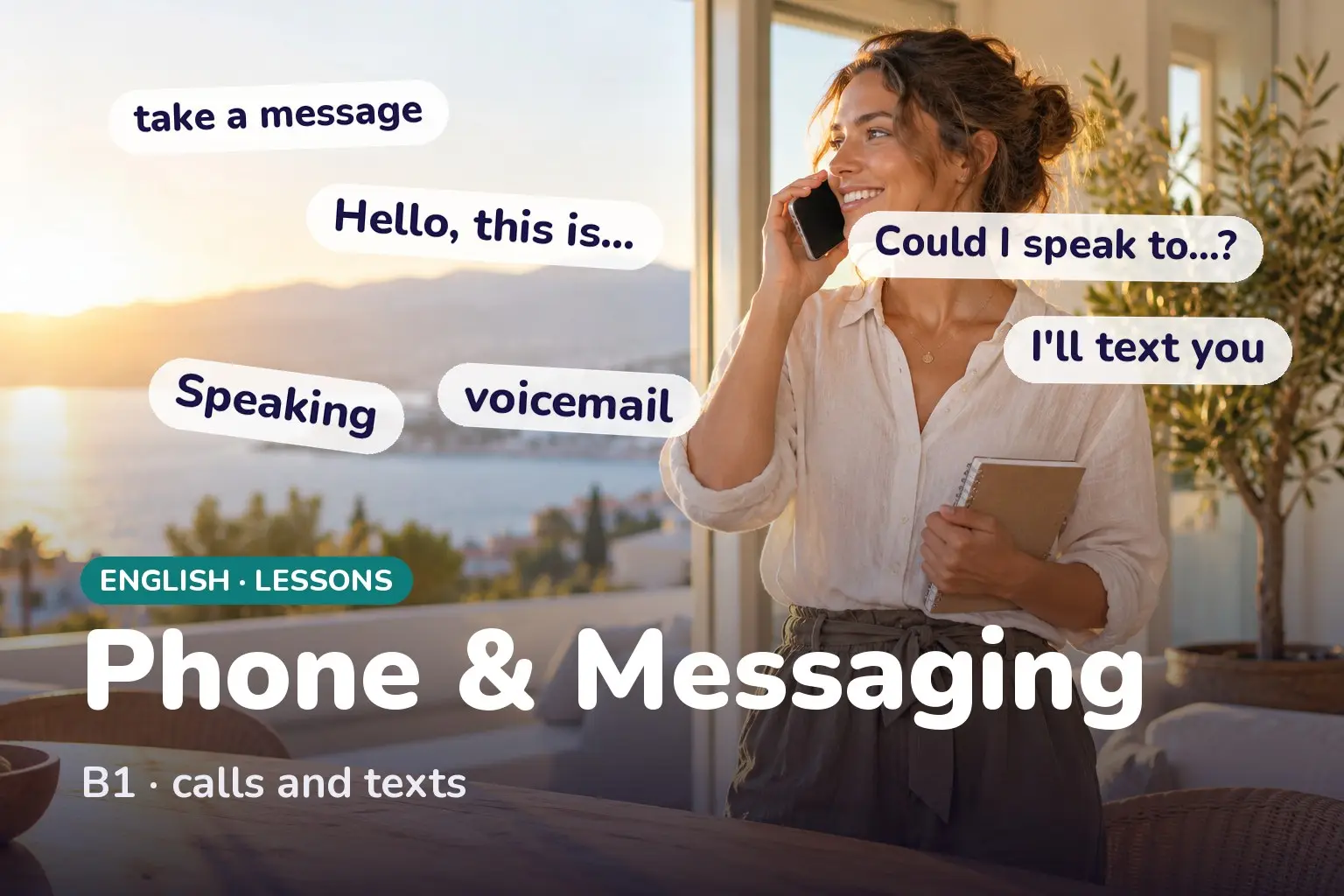
On the phone, open with 'Hello, this is …' and ask with 'Could I speak to …, please?'. If the person is out, leave a short voicemail or take a message. Texting is more relaxed, with short forms, but keep it clear.
Level: B1. Phone English has its own fixed phrases — the ones you say to open a call, ask for a person, take a message or leave a voicemail. Texting has its own relaxed style too. This lesson gives you both, and shows when to be polite and full, and when short is fine.
By the end of this page you can…
…open and answer a phone call, ask for the person you want, take and leave a message, understand a voicemail, and text in the right register for the reader.
Opening and answering a call
Phone English uses a few set phrases that are different from face-to-face English. The most important: say This is … to give your name, not I am ….
- Answering: Hello? · Hello, Bright Office, how can I help?
- Giving your name: Hello, this is Sam. (not I am Sam)
- Asking for someone: Could I speak to Maria, please? · Is Maria there?
- Saying it’s you: Speaking. (= you are already talking to the person asked for)
- Checking who it is: Who’s calling, please? · May I ask who’s calling?
Connecting, holding and messages
| Phrase | What it means |
|---|---|
| Hold on / Hang on a moment | Wait a short time |
| I’ll put you through | I’ll connect you to the person |
| The line’s busy / engaged | The person is on another call |
| Can I take a message? | Shall I write down a message for them? |
| Can I leave a message? | The caller wants to pass on a message |
| Could you call me back? | Please return my call |
| I’ll call back later | I will try again later |
Engaged is British English for a busy line; busy is American. Both are understood everywhere.
Leaving a voicemail
If no one answers, you reach voicemail (a recorded message). A clear voicemail has four parts, in order:
- Who you are: Hi, this is Dana Reyes.
- Why you called: I’m calling about tomorrow’s meeting.
- Your number: You can reach me on 555 0192.
- What you want: Could you call me back before five? Thanks.
Texting: a more relaxed register
Texting and messaging apps are informal. Short forms and dropped words are normal between friends:
- u (you), r (are), ur (your / you’re), thx / ty (thanks), pls (please), cu (see you), brb (be right back), btw (by the way), lol (laughing).
- Emoji, lower case and no full stops are all fine in friendly texts.
But register depends on the reader. A text to a friend can be cu @ 6 😄; a message to a boss or a company should stay in full, clear English: Hi, I’ll be about ten minutes late — sorry, see you soon.
A short conversation
Receptionist: Hello, Bright Office. How can I help? Caller: Hello, this is Dana Reyes. Could I speak to Mr Patel, please? Receptionist: I’m afraid he’s on another call. Can I take a message? Caller: Yes, please. Could you ask him to call me back on 555 0192? Receptionist: Of course — I’ll pass that on. Caller: Thank you. Goodbye.
Usage notes
- this is / speaking: This is Sam introduces you; Speaking confirms you are the person asked for. Neither is used face to face.
- call vs phone vs ring: call, phone and ring (British) all mean to telephone someone: I’ll call you, Phone me later, Give me a ring.
- call back vs ring back: both mean to return a call; call back is neutral and understood everywhere.
- text as a verb: Text me and I’ll text you are standard; the past is texted.
- hang up / pick up: hang up = end the call; pick up = answer the call.
- Full stops in texts: in very casual texts a full stop can read as cold or annoyed to some readers; that is a style choice, not a grammar rule.
Example sentences
Play each line and say it along with the audio — these are the exact phrases you will use on calls and in messages.
- Hello, this is Sam.Giving your name on the phone.
- Could I speak to Maria, please?Politely asking for the person you want.
- Speaking.You are already the person asked for.
- Who's calling, please?Politely asking who is on the line.
- Hold on a moment, please.Asking the caller to wait.
- I'll put you through.Connecting the caller to someone.
- I'm afraid the line's busy.The person is on another call.
- Can I take a message?Offering to write down a message.
- Can I leave a message?The caller wants to pass on a message.
- Could you ask her to call me back?Requesting a return call.
- I'll call back later.Saying you will try again.
- You've reached Dana. Please leave a message.A typical voicemail greeting.
- Hi, this is Dana. I'm calling about the meeting.Starting a voicemail: who and why.
- You can reach me on 555 0192.Giving your number in a voicemail.
- Could you call me back before five?Saying what you want them to do.
- Sorry, I think we got cut off.The call dropped and you called again.
- Can you hear me OK?Checking a bad connection.
- I'll text you the address.Text as a verb for messaging.
- On my way, see you at six.A short, clear informal text.
- I'll be about ten minutes late — sorry.A polite message that works for work too.
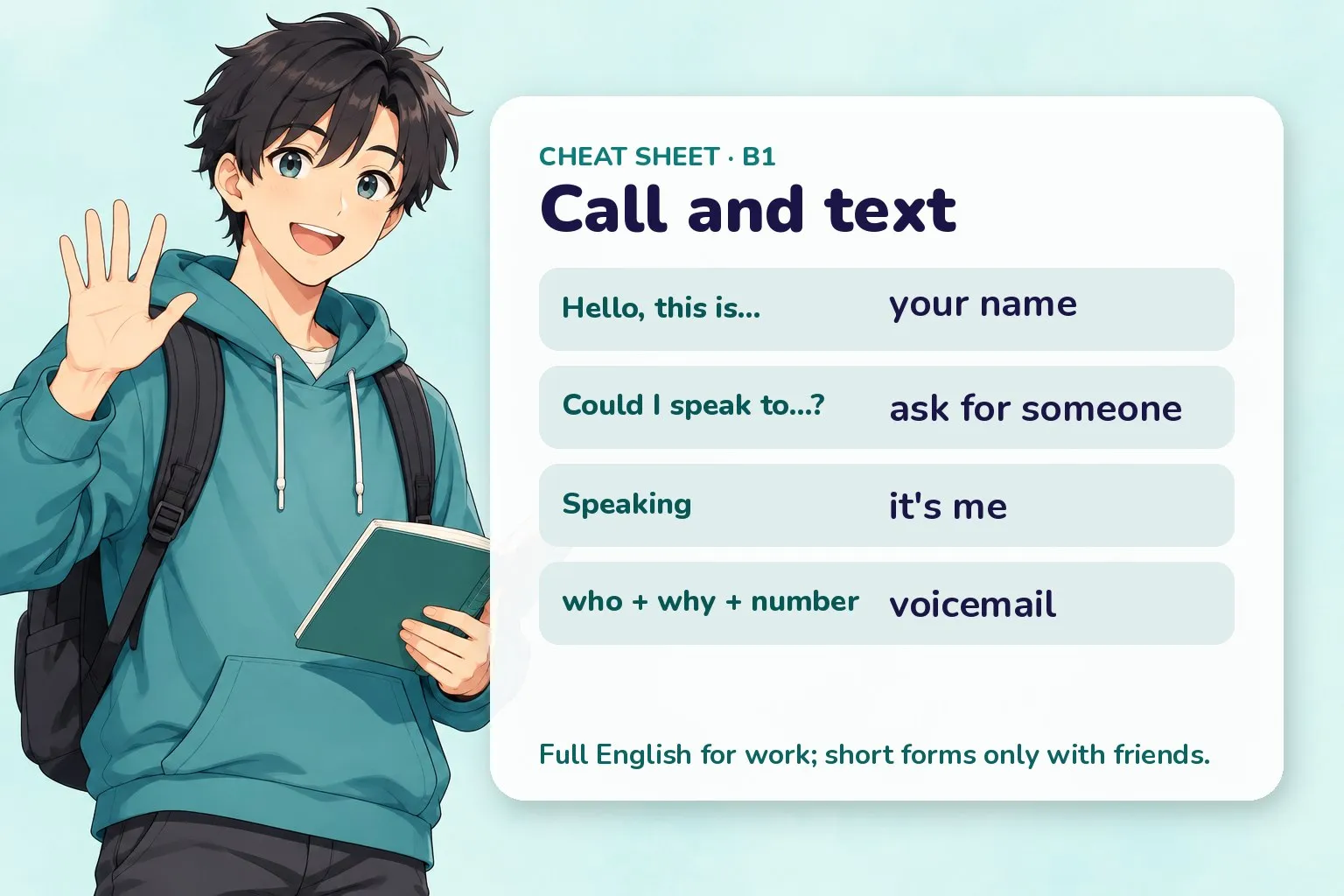
Quick recap before you practise.
Practice
Phone and messaging practice
Try each one, then press Check. No sign-up, nothing is sent anywhere — it all runs in your browser.
Hint: it means you are the person wanted
Show answer
Speaking — 'Speaking' confirms you are already the person asked for.
Hint: a verb for talking on the phone
Show answer
speak — 'Could I speak to …, please?' is the polite way to ask for someone.
4 Put the words in order to offer to write down a message.
Show answer
Can I take a message ? — 'Can I take a message?' offers to write a message for someone who is out.
5 Match each phone phrase to its meaning.
- I'll put you through
- the line's busy
- hang up
- call back
Show answer
- I'll put you through → connect you
- the line's busy → on another call
- hang up → end the call
- call back → return a call
These are the core phone phrases you will hear and use.
How to say it
A few of these words trip up English learners — copy the audio, not the spelling.
- message stresses the first part and has a soft g: MESS-ij.
- voicemail is one word, stress on the first part: VOICE-mail.
- busy is said BIZ-ee, not BYOO-zee.
- Could I links smoothly in speech: kud-eye, with could unstressed.
Quiz
Phone and messaging quiz
8 questions · pick an answer and you'll see straight away if it's right.
-
Show answer
This is Sam. — Use 'This is …' to give your name on a call.
-
Show answer
Speaking. — 'Speaking' means you are already the person asked for.
-
Show answer
I'll connect you to the person. — 'Put through' means connect the caller to someone else.
-
Show answer
A long story about your day — A voicemail should be short: who, why, your number, and what you want.
-
Show answer
the line's busy — 'Engaged' (British) and 'busy' (American) both mean the person is on another call.
-
Show answer
see you at six — 'cu' is a casual short form of 'see you'.
-
Show answer
full, clear sentences — Match the reader: with people you don't know, write full, clear English.
-
Show answer
return your call — 'Call me back' asks the person to return your call.
Recap cheat-sheet
| Function | Phrase |
|---|---|
| Give your name | Hello, this is Sam. |
| Ask for someone | Could I speak to …, please? |
| Confirm it’s you | Speaking. |
| Take / leave a message | Can I take / leave a message? |
| Voicemail | who + why + number + what you want |
| Texting | short forms with friends; full English for work |
Next
- Previous lesson: English: Making Plans & Invitations
- Next lesson: English: Expressing Opinions
- New here? Start with Start Learning English Here
All English lessons topics
Vocabulary, pronunciation, phrases, practice and exam help, ordered by level. Pick a topic and go straight to it. New lessons go live every day, so topics marked Coming soon fill in over the next weeks.
Lessons
A1 9 topics · 9 ready
A2 14 topics · 14 ready
- 10 English: Describing People
- 11 English: Ordering at a Cafe
- 12 English: Shopping & Prices
- 13 English: Clothing & Sizes
- 14 English: Asking for Directions
- 15 English: Using Public Transport
- 16 English: At the Hotel
- 17 English: Weather & Seasons
- 18 English: Hobbies & Free Time
- 19 English: Daily Routine
- 20 English: Housing & Rooms
- 21 English: Parts of the Body
- 22 English: Emotions & Feelings
- 23 English: Supermarket & Groceries
B1 19 topics · 19 ready
- 24 English: Household Chores
- 25 English: At the Doctor
- 26 English: Making Appointments
- 27 English: Making Plans & Invitations
- 28 English: Phone & Messaging You are here
- 29 English: Expressing Opinions
- 30 English: Talking About Past Experiences
- 31 English: Future Plans & Goals
- 32 English: School & Education
- 33 English: Jobs & Professions
- 34 English: Money & Banking
- 35 English: Restaurant & Dining Out
- 36 English: Travel & the Airport
- 37 English: Sightseeing & Tourism
- 38 English: Emergencies & Safety
- 39 English: Technology & the Internet
- 40 English: Complaints & Solving Problems
- 41 English: Small Talk & Networking
- 42 English Small-Talk & Politeness Culture
B2 11 topics · 11 ready
- 43 English: At the Office
- 44 English: The Job Interview
- 45 English: Formal Writing & Emails
- 46 English: News & Current Affairs
- 47 English: Environment & Nature
- 48 English: Health & Lifestyle
- 49 English: Culture & Traditions
- 50 English: Describing Trends & Data
- 51 English: Storytelling & Narration
- 52 English: Giving a Short Presentation
- 53 Writing Business Emails in English