English: Debating & Argumentation
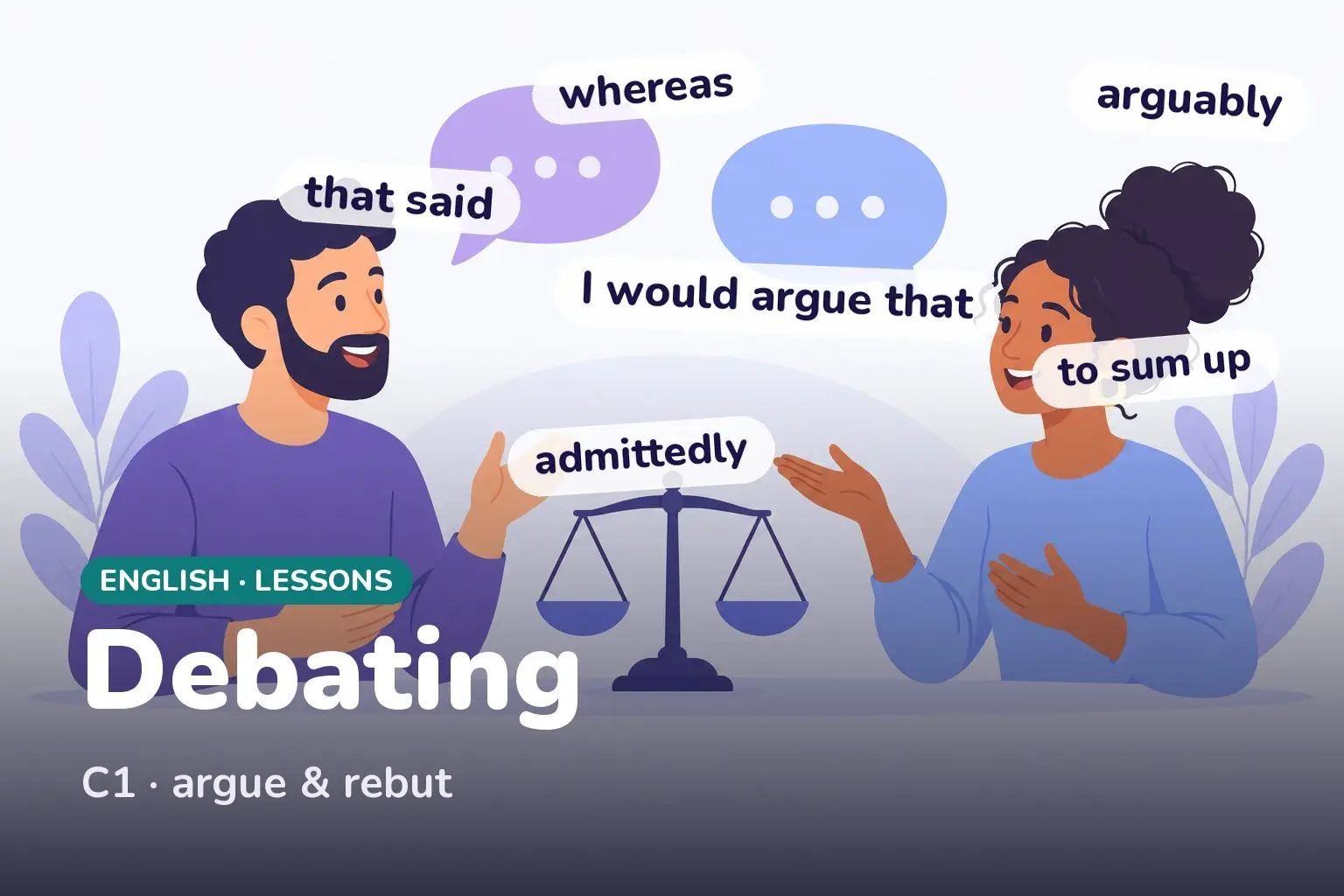
To argue well in English, build each point in three moves: state a claim ('I would argue that…'), support it ('This is borne out by…'), and handle the other side with a concession plus a rebuttal ('Admittedly…, but…'). Hedging keeps a C1 argument measured.
On this page15 sections · tap to jump
- 01By the end of this page you can…
- 02The shape of an argument
- 03Stating a position
- 04Supporting a claim
- 05Conceding, then rebutting — the strongest pattern
- 06Teaching point 1 — contrast connectors
- 07Teaching point 2 — advanced concession
- 08Teaching point 3 — hedging to sound credible
- 09A short conversation
- 10Usage notes
- 11Example sentences
- 12Practice
- 13How to say it
- 14Quiz
- 15Recap cheat-sheet
Level: C1. A good argument in English is not louder — it is better organised. Each point moves from a claim to the evidence for it to a short conclusion, and it deals with the other side fairly before knocking it down. This lesson gives you the language for every move: stating, supporting, conceding, rebutting, and hedging so you sound measured rather than dogmatic.
By the end of this page you can…
…state a position clearly, support it with evidence, concede a fair point and then rebut it, and hedge your claims so your argument sounds credible at C1.
The shape of an argument
Learn the parts so you can name what you are doing:
| Term | What it is |
|---|---|
| claim / thesis | the point you are trying to prove |
| premise | a statement your argument rests on |
| evidence | facts, examples or data that support the claim |
| reasoning | how the evidence leads to the claim |
| counterargument | the opposing view |
| concession | admitting part of the other side is right |
| rebuttal | showing why the other side still fails |
| conclusion | the point restated, now supported |
A single strong point runs: claim → evidence → reasoning → mini-conclusion. A full debate turn adds counterargument → concession → rebuttal before the conclusion.
Stating a position
Open with a frame that shows this is your reasoned view, not just an opinion:
- I would argue that remote work raises productivity.
- It seems to me that the evidence points the other way.
- My central claim is that the policy does more harm than good.
- There are strong grounds for believing that …
Supporting a claim
A claim with no support is just an assertion. Signpost your evidence:
- This is borne out by the latest figures.
- A case in point is the 2020 reform.
- Research consistently suggests that …
- The clearest evidence for this is …
Conceding, then rebutting — the strongest pattern
Flat disagreement sounds weak. The persuasive move is to concede a fair point and then rebut it:
- Admittedly, the cost is high, but the long-term savings outweigh it.
- Granted, there are exceptions; however, they are rare.
- It is true that critics have a point here. That said, they overlook the wider benefit.
- While it may be the case that X, this fails to account for Y.
Teaching point 1 — contrast connectors
Debate leans on precise contrast. Whereas and while join two contrasting clauses (Supporters stress freedom, whereas critics stress safety); however and nevertheless pivot between sentences; despite and in spite of take a noun or -ing (Despite the cost, …). Review connectors of cause and contrast.
Teaching point 2 — advanced concession
Concession has its own grammar. Although / even though open a clause (Even though the data is limited, …); much as fronts a verb (Much as I respect that view, …); admittedly and granted stand alone as discourse markers. Review advanced concession.
Teaching point 3 — hedging to sound credible
C1 arguments are measured. Hedging softens a claim so it is defensible: arguably, to some extent, it could be argued that, there is a tendency for, this may suggest. Over-strong claims (this proves, everyone knows) are easy to attack. Review cautious language and hedging, and link related points with advanced discourse markers.
A short conversation
Speaker A: I would argue that stricter rules are the only solution. Speaker B: Admittedly, the current system has gaps. That said, stricter rules may simply push the problem elsewhere. Speaker A: That’s a fair point, but it overlooks the deterrent effect. Speaker B: Perhaps — though the evidence for deterrence is, at best, mixed. Speaker A: Granted. Let me put it differently: even a partial reduction would justify the cost.
Usage notes
- argue that vs argue with vs argue about: you argue that something is true (make a case), argue with a person (dispute), and argue about a topic (quarrel). For debate, you want argue that.
- refute vs reject vs deny: refute means prove false with evidence (strong); reject means refuse to accept; deny means say something is not true. Don’t say refute when you only mean deny.
- convince vs persuade: convince someone of a fact or that something is true; persuade someone to do something. A good argument convinces; a call to action persuades.
- logical fallacy: a flaw in reasoning — a straw man (attacking a weaker version of the view), begging the question (assuming what you must prove), or an ad hominem (attacking the person, not the argument).
Example sentences
Press play and deliver each line as if you were in a debate.
- I would argue that the benefits clearly outweigh the risks.Stating a reasoned position.
- It seems to me that the opposite is true.A measured way to disagree.
- This is borne out by the most recent studies.borne out by = supported by.
- A case in point is last year's reform.introducing a supporting example.
- Admittedly, the policy is expensive.a concession before a rebuttal.
- Granted, there are exceptions, but they are rare.concede, then limit the concession.
- It is true that critics raise a valid concern. That said, they overlook the wider benefit.concession + pivot with 'that said'.
- That argument fails to account for the long-term costs.a rebuttal naming the gap.
- Much as I respect that view, the evidence is thin.'much as' for concession.
- Supporters stress freedom, whereas critics stress safety.whereas for balanced contrast.
- Despite the limited data, the pattern is striking.despite + noun for concession.
- It could be argued that the effect is overstated.hedged claim, hard to attack.
- To some extent, both sides are right.hedging to sound balanced.
- This may suggest a deeper problem.may suggest = cautious inference.
- The clearest evidence for this is the drop after 2019.pointing to the strongest proof.
- In response, I would make two points.signposting a rebuttal.
- That's a straw man — no one is actually claiming that.naming a logical fallacy.
- To sum up, the case for reform is stronger.signalling the conclusion.
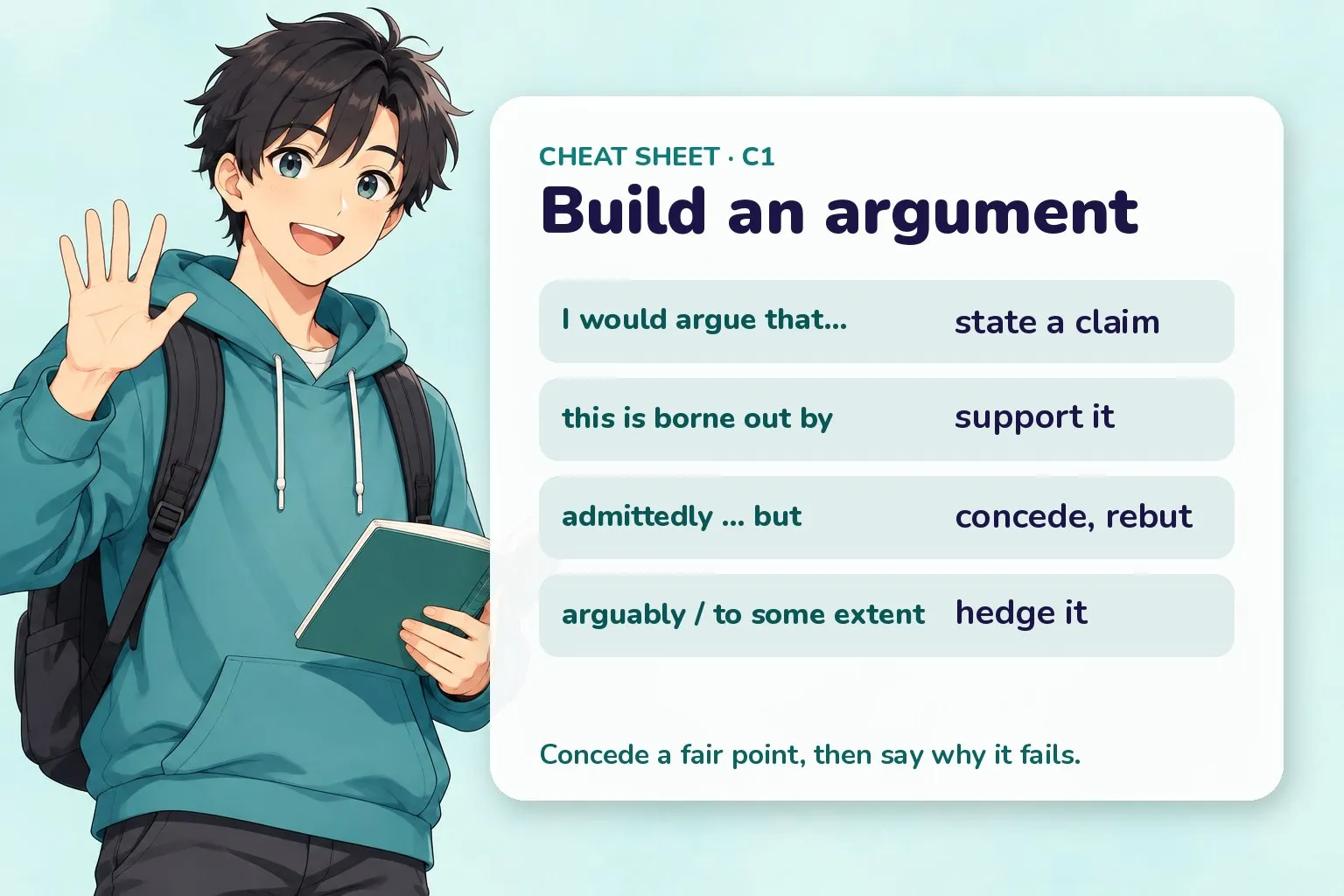
Quick recap before you practise.
Practice
Debating and argumentation practice
Try each one, then press Check. No sign-up, nothing is sent anywhere — it all runs in your browser.
Hint: a one-word concession marker
Show answer
Admittedly — Admittedly or Granted concedes a point before the 'but'.
Hint: balanced contrast within one sentence
Show answer
whereas — Whereas (or while) joins two contrasting clauses.
4 Put the words in order to state a hedged claim.
Show answer
It could be argued that the effect is overstated — It could be argued that… is a cautious, defensible way to make a point.
5 Match each term to its meaning.
- concession
- rebuttal
- premise
- straw man
Show answer
- concession → admitting part of the other side is right
- rebuttal → showing why the other side fails
- premise → a statement an argument rests on
- straw man → attacking a weaker version of a view
These are the core argument terms for this lesson.
How to say it
A few debate words are often mispronounced — copy the sounds.
- argument has three beats, AR-gyoo-ment; note there is no e after the u (not arguement).
- evidence is EV-i-dence, stress on the first syllable, a soft dence at the end.
- rebuttal stresses the middle: ri-BUT-ul, with a clear double-t sound.
- fallacy is FAL-uh-see, stress on the first syllable, ending in see.
Quiz
Debating and argumentation quiz
11 questions · pick an answer and you'll see straight away if it's right.
-
Show answer
admit part of the opposing view is right — A concession admits a fair point before you rebut it.
-
Show answer
That said, it overlooks… — 'That said' pivots from a concession to the point against it.
-
Show answer
That argument fails to account for the long-term costs. — A rebuttal says why the view fails — here, it ignores long-term costs.
-
Show answer
Supporters value freedom, whereas critics value safety. — Whereas joins two contrasting clauses; however pivots between sentences.
-
Show answer
It could be argued that the policy works. — 'It could be argued that' hedges the claim, making it defensible.
-
Show answer
prove a view false with evidence — Refute = prove false with evidence; deny merely says it isn't true.
-
Show answer
convince someone of a fact — Convince someone of a fact / that…; persuade someone to do something.
-
Show answer
attack a weaker version of the opposing view — A straw man misrepresents the opposing view as weaker, then attacks that.
-
Show answer
I would argue that… — 'I would argue that…' signals a reasoned position without overclaiming.
-
Show answer
concede before disagreeing — 'Much as' concedes respect for the view before the rebuttal.
-
Show answer
To sum up, — 'To sum up' signposts the conclusion; the others support or concede.
Recap cheat-sheet
| Move | Phrase | Example |
|---|---|---|
| State | I would argue that… | I would argue that it works. |
| Support | This is borne out by… | …borne out by the figures. |
| Concede | Admittedly / Granted… | Admittedly, it’s costly. |
| Rebut | That said / fails to account for | That said, it overlooks X. |
| Contrast | whereas, while, however | Supporters value A, whereas… |
| Hedge | arguably, to some extent | It could be argued that… |
Next
- Previous lesson: English: Describing Trends & Data
- New here? Start with Start Learning English Here
All English lessons topics
Vocabulary, pronunciation, phrases, practice and exam help, ordered by level. Pick a topic and go straight to it. New lessons go live every day, so topics marked Coming soon fill in over the next weeks.
Lessons
A1 9 topics · 9 ready
A2 14 topics · 14 ready
- 10 English: Describing People
- 11 English: Ordering at a Cafe
- 12 English: Shopping & Prices
- 13 English: Clothing & Sizes
- 14 English: Asking for Directions
- 15 English: Using Public Transport
- 16 English: At the Hotel
- 17 English: Weather & Seasons
- 18 English: Hobbies & Free Time
- 19 English: Daily Routine
- 20 English: Housing & Rooms
- 21 English: Parts of the Body
- 22 English: Emotions & Feelings
- 23 English: Supermarket & Groceries
B1 19 topics · 19 ready
- 24 English: Household Chores
- 25 English: At the Doctor
- 26 English: Making Appointments
- 27 English: Making Plans & Invitations
- 28 English: Phone & Messaging
- 29 English: Expressing Opinions
- 30 English: Talking About Past Experiences
- 31 English: Future Plans & Goals
- 32 English: School & Education
- 33 English: Jobs & Professions
- 34 English: Money & Banking
- 35 English: Restaurant & Dining Out
- 36 English: Travel & the Airport
- 37 English: Sightseeing & Tourism
- 38 English: Emergencies & Safety
- 39 English: Technology & the Internet
- 40 English: Complaints & Solving Problems
- 41 English: Small Talk & Networking
- 42 English Small-Talk & Politeness Culture
B2 11 topics · 11 ready
- 43 English: At the Office
- 44 English: The Job Interview
- 45 English: Formal Writing & Emails
- 46 English: News & Current Affairs
- 47 English: Environment & Nature
- 48 English: Health & Lifestyle
- 49 English: Culture & Traditions
- 50 English: Describing Trends & Data
- 51 English: Storytelling & Narration
- 52 English: Giving a Short Presentation
- 53 Writing Business Emails in English
C1 3 topics · 3 ready
- 54 English: Debating & Argumentation You are here
- 55 English: Idioms & Colloquialisms
- 56 English: Formal vs Informal Register