English: Hobbies & Free Time
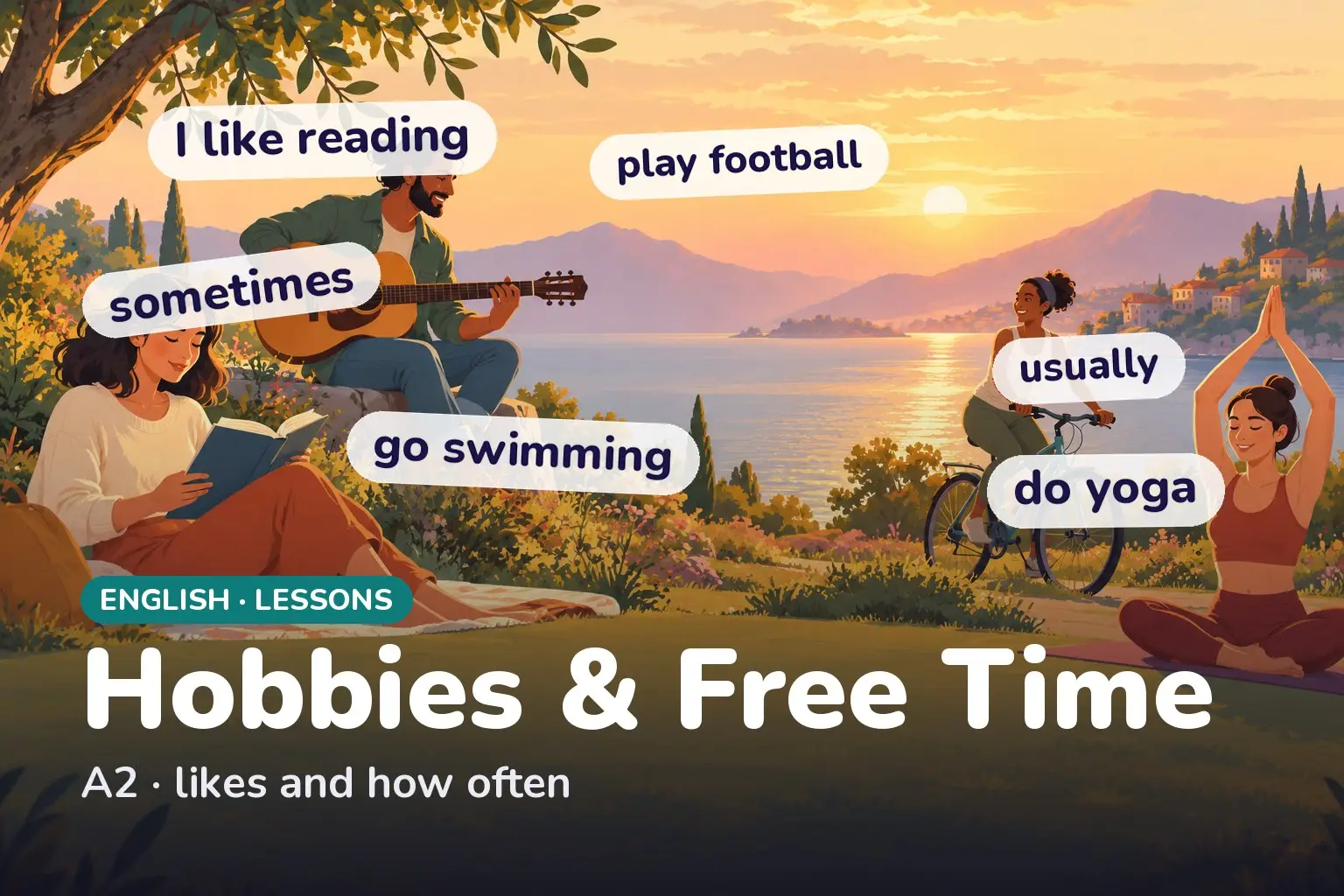
To talk about hobbies, use 'I like' or 'I enjoy' plus the -ing form: 'I like reading', 'I enjoy playing football'. Add how often with frequency words like 'usually' and 'sometimes'. Ask others 'What do you do in your free time?' or 'What are your hobbies?'
Level: A2. Talking about your free time is one of the first real conversations you will have in English. It rests on a simple pattern — a verb of liking plus the -ing form — plus the right verb for each activity and a few words to say how often. Learn those and you can describe your whole week.
By the end of this page you can…
…say what you like and don’t like doing, choose ‘play’, ‘go’ or ‘do’ for an activity, say how often you do it, and ask other people about their hobbies.
Saying what you like doing
The core pattern is a verb of feeling — like, love, enjoy, don’t like, hate — followed by the -ing form of the next verb:
- I like reading.
- I love playing the guitar.
- I enjoy cooking.
- I don’t like running.
This -ing form is called the gerund — a verb used as a noun. After these feeling verbs, English nearly always uses it.
Play, go or do?
Different activities take different verbs. Choosing the wrong one is the most common A2 mistake with hobbies.
| Verb | Use it for | Examples |
|---|---|---|
| play | sports with a ball and games | play football, play tennis, play chess |
| go | activities ending in -ing | go swimming, go shopping, go cycling |
| do | many other activities | do yoga, do karate, do a puzzle |
So you play basketball, you go running, and you do exercise. With musical instruments, use play the: play the piano, play the guitar.
Saying how often: frequency words
To say how often, use a frequency adverb: always, usually, often, sometimes, rarely, never. The important rule is where they go:
- Before the main verb: I often read at night. / She never watches TV.
- But after the verb ‘to be’: I am usually busy on Mondays.
You can also add a phrase at the end: once a week, twice a month, every day, at the weekend.
- I usually go to the gym twice a week.
- We sometimes play cards on Friday evenings.
Asking about hobbies
To ask someone about their free time, the natural questions are:
- What do you do in your free time?
- What are your hobbies?
- Do you play any sports?
- How often do you …?
A short conversation
Maya: What do you do in your free time? Tom: I love playing the guitar, and I go cycling most weekends. How about you? Maya: I usually read, and I sometimes do yoga in the morning. Tom: Nice! Do you play any sports? Maya: Not really — I prefer quiet hobbies. But I go swimming once a week.
Example sentences
Press play and repeat. These show the main patterns for talking about free time.
- What do you do in your free time?The natural way to ask about hobbies.Add 'in your free time' — without it, it asks about your job.
- What are your hobbies?Another friendly question about free time.
- I like reading.Feeling verb + -ing form.
- I love playing the guitar.Use 'play the' with instruments.
- I enjoy cooking at the weekend.'Enjoy' is also followed by -ing.
- I don't like running.A negative with 'don't like' + -ing.
- I play football every Saturday.'Play' for a sport with a ball.
- I go swimming once a week.'Go' for activities ending in -ing.
- I do yoga in the morning.'Do' when 'play' and 'go' don't fit.
- She plays the piano beautifully.Third person adds -s: plays.
- I usually go to the gym after work.'Usually' before the main verb.
- I am usually busy on Mondays.After 'to be', the adverb comes after: am usually.
- We sometimes play cards on Fridays.'Sometimes' with a time phrase.
- I never watch sport on TV.'Never' before the main verb.
- How often do you exercise?Asking about frequency.
- Twice a week, usually.A short answer about how often.
- Do you play any sports?A yes/no question about sport.
- My hobby is photography.Naming a hobby with 'is'.
- I'm learning to paint.Talking about a new hobby.
- I prefer quiet hobbies to loud ones.Saying what you like more.
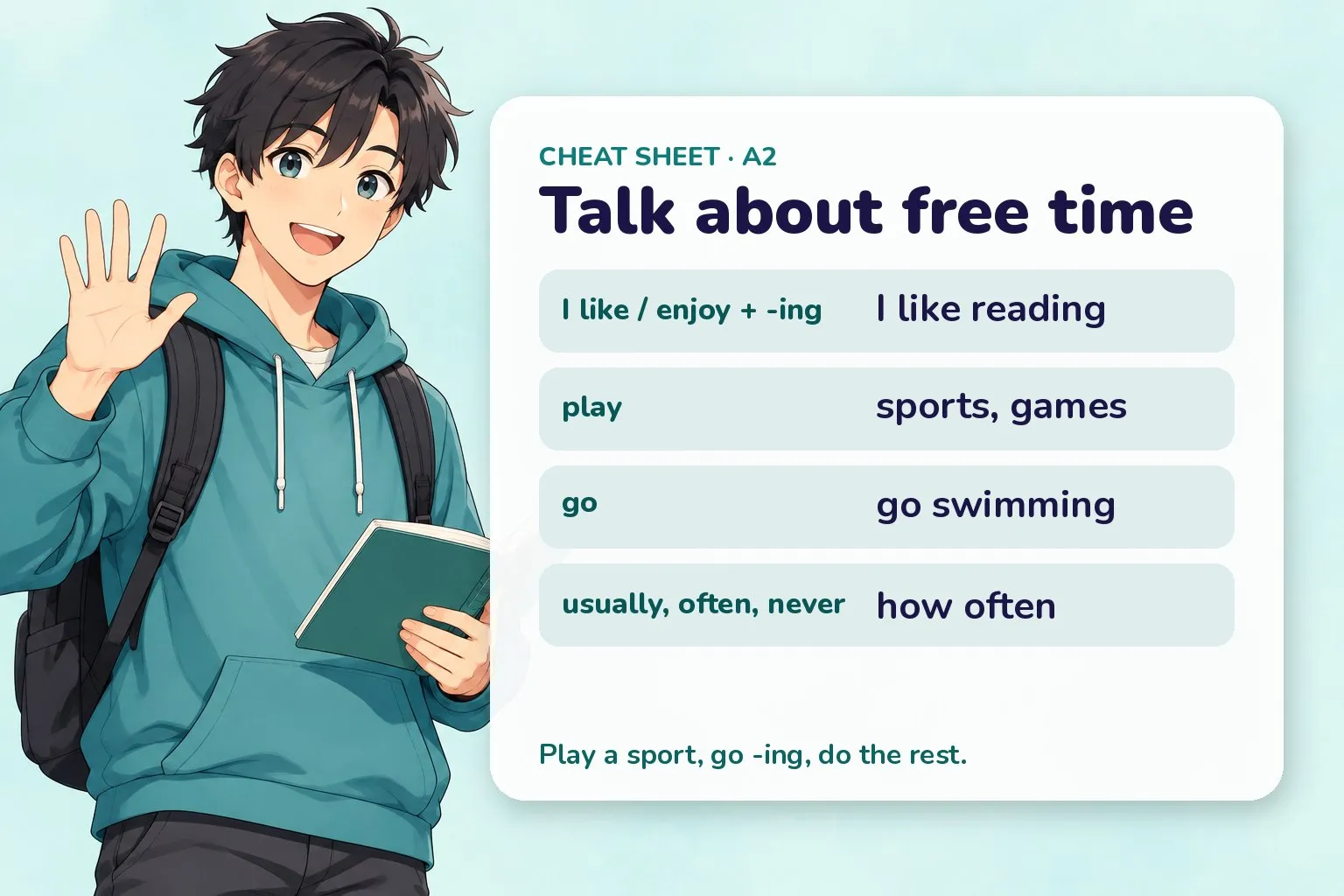
Quick recap before you practise.
Practice
Hobbies and free time practice
Try each one, then press Check. No sign-up, nothing is sent anywhere — it all runs in your browser.
Hint: after 'enjoy', use -ing
Show answer
cooking — Feeling verbs like 'enjoy' are followed by the -ing form: enjoy cooking.
Hint: it goes before the main verb 'go'
Show answer
usually — Frequency adverbs go before the main verb: I usually go.
5 Put the words in order to make a sentence.
Show answer
I love playing the guitar — Feeling verb + -ing form: I love playing the guitar.
6 Match each activity to the right verb.
- football
- swimming
- yoga
- the piano
Show answer
- football → play
- swimming → go
- yoga → do
- the piano → play the
Play for sports and instruments, go for -ing activities, do for the rest.
How to say it
A few of these everyday words catch English learners out — copy the audio.
- hobbies has a short o and a clear b: HOB-eez, not hoe-bees.
- enjoy stresses the second part: in-JOY.
- usually is often squeezed to three beats: YOO-zhoo-lee.
- cycling starts with a soft s sound: SY-kling, not ky-cling.
Quiz
Hobbies and free time quiz
8 questions · pick an answer and you'll see straight away if it's right.
-
Show answer
I like reading. — After 'like', use the -ing form: I like reading.
-
Show answer
play — Use 'play' for sports with a ball: play tennis.
-
Show answer
I go swimming. — Activities ending in -ing take 'go': go swimming.
-
Show answer
before 'read' — Frequency adverbs go before the main verb: I often read.
-
Show answer
usually — With 'to be', the adverb comes after the verb: I am usually tired.
-
Show answer
What do you do in your free time? — 'What do you do?' alone asks about a job; add 'in your free time' for hobbies.
-
Show answer
do yoga — When 'play' and 'go' don't fit, use 'do': do yoga.
-
Show answer
the — With instruments, use 'play the': play the guitar.
Next
- Next lesson: English: Daily Routine
- Previous lesson: English: Weather & Seasons
- New here? Start with Start Learning English Here
All English lessons topics
Vocabulary, pronunciation, phrases, practice and exam help, ordered by level. Pick a topic and go straight to it. New lessons go live every day, so topics marked Coming soon fill in over the next weeks.
Lessons
A1 9 topics · 9 ready
A2 14 topics · 14 ready
- 10 English: Describing People
- 11 English: Ordering at a Cafe
- 12 English: Shopping & Prices
- 13 English: Clothing & Sizes
- 14 English: Asking for Directions
- 15 English: Using Public Transport
- 16 English: At the Hotel
- 17 English: Weather & Seasons
- 18 English: Hobbies & Free Time You are here
- 19 English: Daily Routine
- 20 English: Housing & Rooms
- 21 English: Parts of the Body
- 22 English: Emotions & Feelings
- 23 English: Supermarket & Groceries
B1 19 topics · 19 ready
- 24 English: Household Chores
- 25 English: At the Doctor
- 26 English: Making Appointments
- 27 English: Making Plans & Invitations
- 28 English: Phone & Messaging
- 29 English: Expressing Opinions
- 30 English: Talking About Past Experiences
- 31 English: Future Plans & Goals
- 32 English: School & Education
- 33 English: Jobs & Professions
- 34 English: Money & Banking
- 35 English: Restaurant & Dining Out
- 36 English: Travel & the Airport
- 37 English: Sightseeing & Tourism
- 38 English: Emergencies & Safety
- 39 English: Technology & the Internet
- 40 English: Complaints & Solving Problems
- 41 English: Small Talk & Networking
- 42 English Small-Talk & Politeness Culture
B2 11 topics · 11 ready
- 43 English: At the Office
- 44 English: The Job Interview
- 45 English: Formal Writing & Emails
- 46 English: News & Current Affairs
- 47 English: Environment & Nature
- 48 English: Health & Lifestyle
- 49 English: Culture & Traditions
- 50 English: Describing Trends & Data
- 51 English: Storytelling & Narration
- 52 English: Giving a Short Presentation
- 53 Writing Business Emails in English