English: Numbers 0 to 100
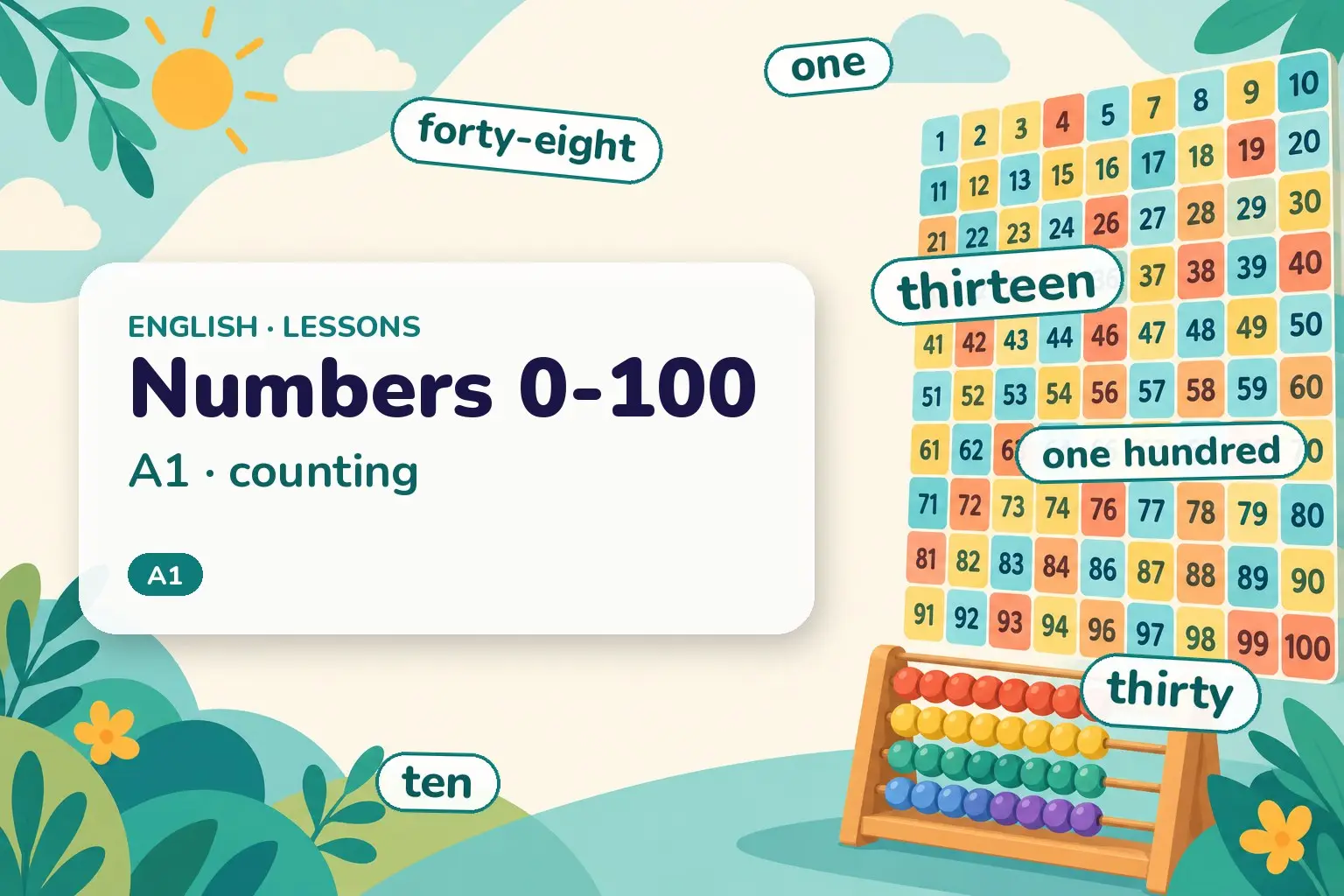
English counts 0–12 with unique words, then 13–19 end in '-teen' and 20–90 end in '-ty'. Two-digit numbers join a ten and a unit with a hyphen: 21 is 'twenty-one', 48 is 'forty-eight'. 100 is 'a hundred' or 'one hundred'.
Level: A1. Numbers come up every day — prices, times, ages, phone numbers and dates. English numbers follow clear patterns once you learn the first twenty words and the names of the tens.
By the end of this page you can…
…count from 0 to 100, read any two-digit number aloud, tell the teens from the tens by their stress, and avoid the common spelling traps.
The building blocks: 0 to 12
The first thirteen numbers each have their own word and simply must be learned:
| Number | Word | Number | Word |
|---|---|---|---|
| 0 | zero | 7 | seven |
| 1 | one | 8 | eight |
| 2 | two | 9 | nine |
| 3 | three | 10 | ten |
| 4 | four | 11 | eleven |
| 5 | five | 12 | twelve |
| 6 | six |
Zero has several spoken forms: zero (neutral), oh (for phone numbers and years: room two-oh-five), nil (football scores), and nought (British, for the digit itself).
The teens: 13 to 19
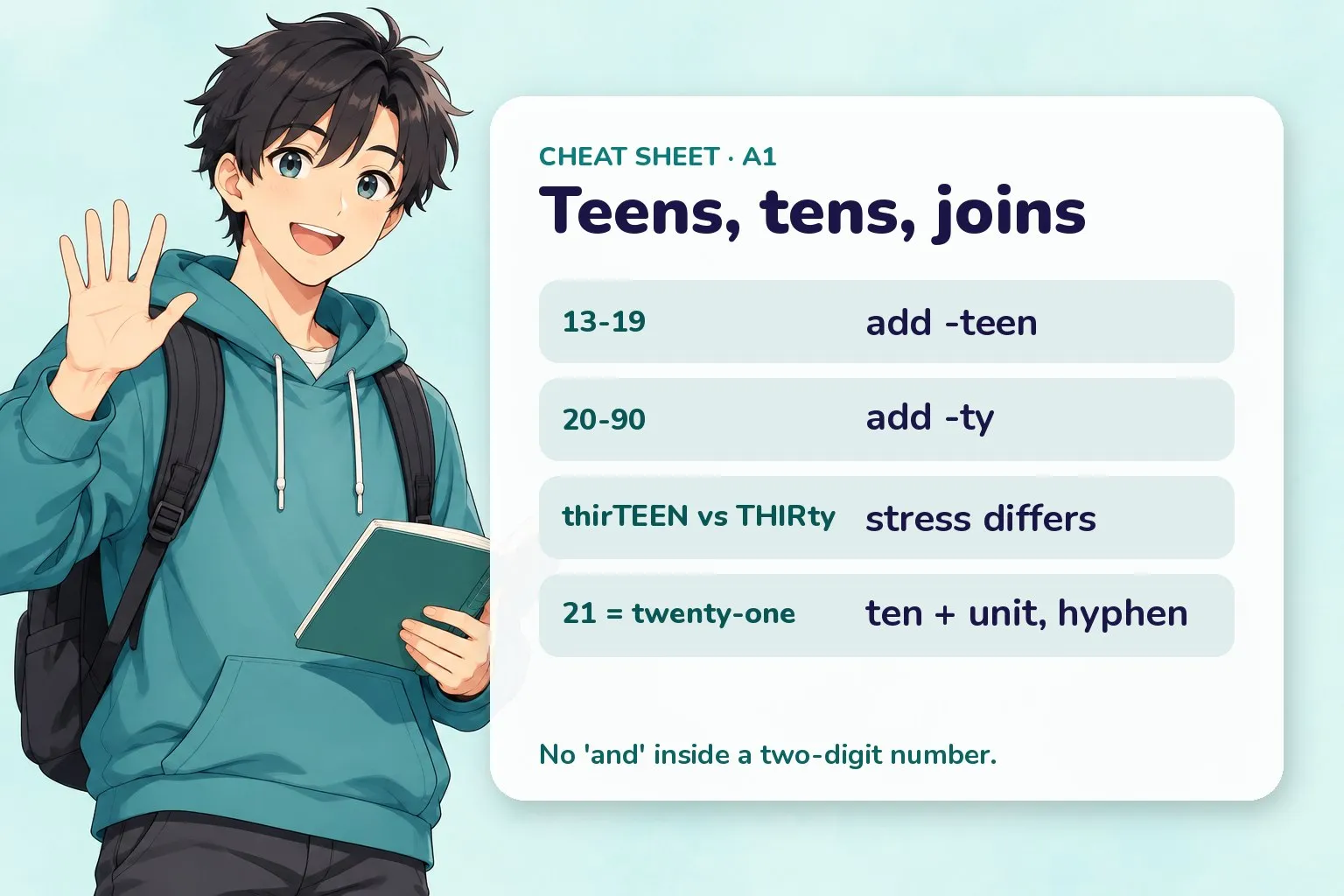
From 13 to 19, you add -teen to the single digit. Three of them change spelling slightly:
- 13 thirteen (not threeteen), 15 fifteen (not fiveteen), 18 eighteen (one t).
- The rest are regular: 14 fourteen, 16 sixteen, 17 seventeen, 19 nineteen.
The tens: 20 to 90
The tens end in -ty. Watch the three irregular spellings:
| Ten | Word | Ten | Word |
|---|---|---|---|
| 20 | twenty | 60 | sixty |
| 30 | thirty | 70 | seventy |
| 40 | forty | 80 | eighty |
| 50 | fifty | 90 | ninety |
Note forty has no u (unlike four), fifty matches fifteen, and eighty keeps a single t.
Joining tens and units: 21 to 99
For any two-digit number, say the ten first, then the unit, joined by a hyphen in writing:
- 21 = twenty-one, 35 = thirty-five, 48 = forty-eight, 99 = ninety-nine.
There is no little word between them. English does not say forty and five; that is a common mistake from other languages.
Reaching 100
100 is a hundred or one hundred. Use a hundred in everyday speech (it costs a hundred dollars) and one hundred when you are counting or being precise.
Example sentences
Play each line and say the number aloud. Notice the stress on the teens and tens.
- I have two brothers and one sister.Small numbers for counting people.
- There are seven days in a week.A common everyday fact.
- My phone number ends in oh-five.'Oh' is used for the digit 0 in phone numbers.
- She is thirteen years old.A teen number: stress the end, thir-TEEN.
- The bus leaves at thirty past the hour.A ten: stress the front, THIR-ty.
- Fourteen plus four is eighteen.Teens in a simple sum.
- The ticket costs fifteen dollars.A price with a teen number.
- My grandfather is fifty years old today.A round ten.
- Forty people came to the party.Note the spelling: forty, no u.
- The book has twenty-one chapters.A two-digit number with a hyphen.
- I counted thirty-five cars in the car park.Ten plus unit: thirty-five.
- He scored forty-eight points in the game.Another joined number.
- The train has ninety-nine seats.The highest two-digit number.
- That is one hundred per cent correct.'One hundred' for precise counting.
- It cost about a hundred euros.'A hundred' in relaxed speech.
- My address is number sixty-two.A house number read as a whole.
- There are sixty seconds in a minute.A useful round number.
- Please turn to page seventy-three.Reading a page number aloud.
- The speed limit here is eighty.A ten used alone.
- We invited twenty-six guests.A two-digit number for a count.
Quick recap before you practise.
Practice
Numbers 0 to 100 practice
Try each one, then press Check. No sign-up, nothing is sent anywhere — it all runs in your browser.
Hint: ten first, then the unit
Show answer
thirty-five — Say the ten then the unit, joined: thirty-five.
4 Put the tens in counting order from 20.
Show answer
twenty thirty forty — Counting up: twenty, thirty, forty.
5 Match each number to its word.
- 15
- 50
- 40
- 90
Show answer
- 15 → fifteen
- 50 → fifty
- 40 → forty
- 90 → ninety
Watch the spellings: fifteen/fifty, forty (no u), ninety.
How to say it
A few number words trip up English learners — focus on these.
- Teens vs tens. Thirteen = thir-TEEN (stress the end); thirty = THIR-ty (stress the front). This stress is the only clue in fast speech.
- -th endings. Three and thirty start with a soft th (tongue between the teeth), not a t or s sound.
- Forty rhymes with sporty; there is no u sound, unlike four.
- Hundred is said “hun-dred”, with the stress on the first part; don’t drop the d.
Quiz
Numbers 0 to 100 quiz
8 questions · pick an answer and you'll see straight away if it's right.
-
Show answer
forty — 40 is 'forty' — it drops the u of 'four'.
-
Show answer
twenty-one — Say the ten then the unit, joined with a hyphen: twenty-one.
-
Show answer
-teen — 13–19 add '-teen' to the digit: thirteen, fourteen, and so on.
-
Show answer
fifteen — 15 is 'fifteen' — the spelling changes from 'five'.
-
Show answer
where the stress falls — THIR-ty stresses the front; thir-TEEN stresses the end.
-
Show answer
After 'hundred', as in 'one hundred and one' — No 'and' inside a two-digit number; it only follows 'hundred'.
-
Show answer
oh — In phone numbers the digit 0 is said as 'oh'.
-
Show answer
a hundred — Everyday speech uses 'a hundred'; 'one hundred' is for precise counting.
Next
- Previous lesson: English: Greetings & Introductions
- Next lesson: English: Introducing Yourself
- New here? Start with Start Learning English Here
All English lessons topics
Vocabulary, pronunciation, phrases, practice and exam help, ordered by level. Pick a topic and go straight to it. New lessons go live every day, so topics marked Coming soon fill in over the next weeks.
Lessons
A1 9 topics · 9 ready
- 01 English: Greetings & Introductions
- 02 English: Numbers 0 to 100 You are here
- 03 English: Introducing Yourself
- 04 English: Days, Months & Dates
- 05 English: Telling the Time
- 06 English: Giving Personal Information
- 07 English: Family Members
- 08 English: Colours & Shapes
- 09 English: Food & Drink Basics
A2 14 topics · 14 ready
- 10 English: Describing People
- 11 English: Ordering at a Cafe
- 12 English: Shopping & Prices
- 13 English: Clothing & Sizes
- 14 English: Asking for Directions
- 15 English: Using Public Transport
- 16 English: At the Hotel
- 17 English: Weather & Seasons
- 18 English: Hobbies & Free Time
- 19 English: Daily Routine
- 20 English: Housing & Rooms
- 21 English: Parts of the Body
- 22 English: Emotions & Feelings
- 23 English: Supermarket & Groceries
B1 19 topics · 19 ready
- 24 English: Household Chores
- 25 English: At the Doctor
- 26 English: Making Appointments
- 27 English: Making Plans & Invitations
- 28 English: Phone & Messaging
- 29 English: Expressing Opinions
- 30 English: Talking About Past Experiences
- 31 English: Future Plans & Goals
- 32 English: School & Education
- 33 English: Jobs & Professions
- 34 English: Money & Banking
- 35 English: Restaurant & Dining Out
- 36 English: Travel & the Airport
- 37 English: Sightseeing & Tourism
- 38 English: Emergencies & Safety
- 39 English: Technology & the Internet
- 40 English: Complaints & Solving Problems
- 41 English: Small Talk & Networking
- 42 English Small-Talk & Politeness Culture
B2 11 topics · 11 ready
- 43 English: At the Office
- 44 English: The Job Interview
- 45 English: Formal Writing & Emails
- 46 English: News & Current Affairs
- 47 English: Environment & Nature
- 48 English: Health & Lifestyle
- 49 English: Culture & Traditions
- 50 English: Describing Trends & Data
- 51 English: Storytelling & Narration
- 52 English: Giving a Short Presentation
- 53 Writing Business Emails in English