English: The Job Interview
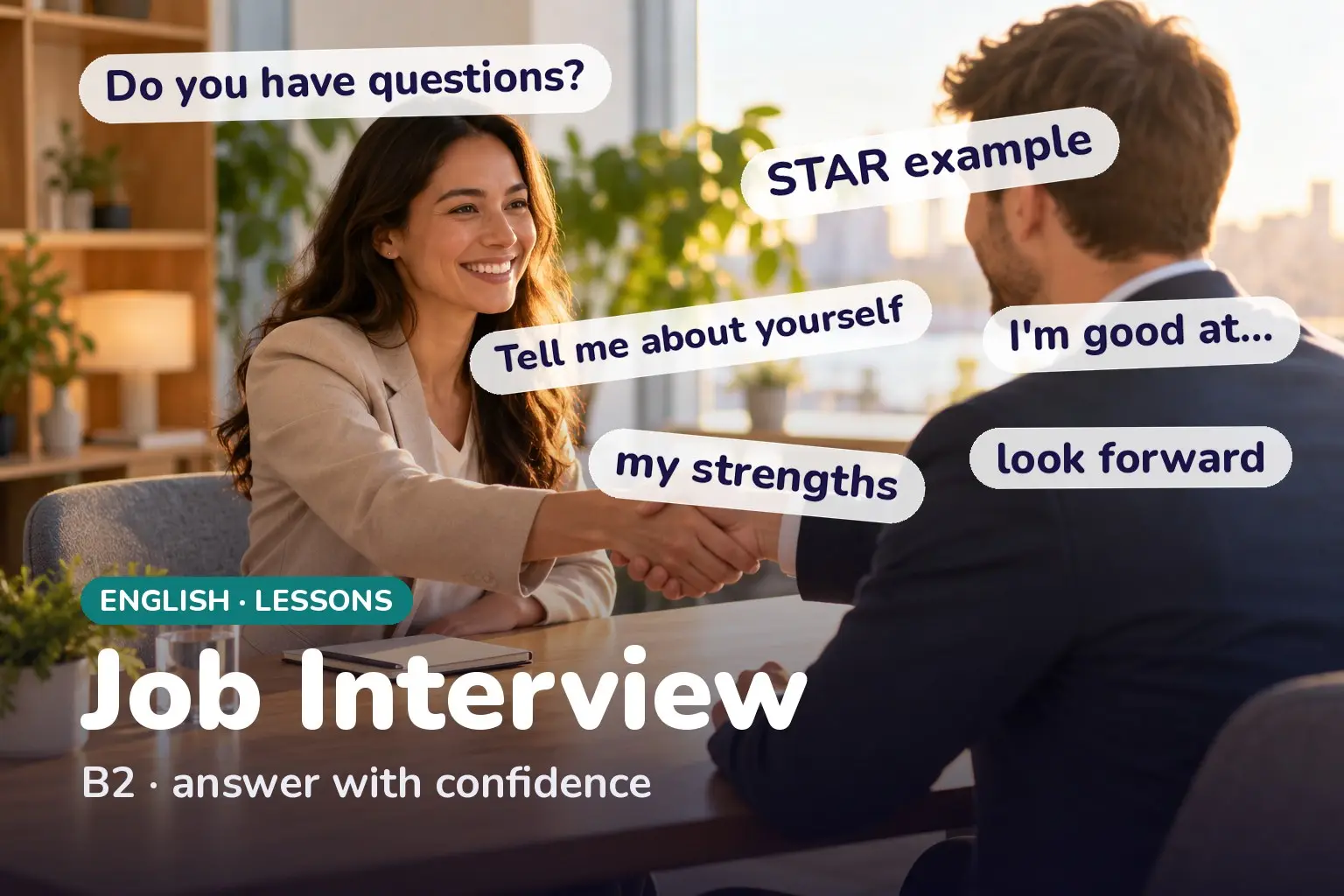
In an English interview, answer with a short claim plus one concrete example: 'I'm organised — in my last job I managed three projects at once.' Prepare a one-minute 'Tell me about yourself', and frame a weakness as something you are actively improving.
On this page13 sections · tap to jump
Level: B2. A job interview in English is not a grammar test — it is a chance to tell a few short, clear stories about your work. This lesson gives you the fixed phrases for the opening, the question types you can expect, and a simple structure that stops you from rambling.
By the end of this page you can…
…open an interview confidently, answer the most common questions with a concrete example, describe a weakness without sounding negative, and ask a good question at the end.
The shape of an interview
Most interviews follow the same path. The interviewer greets you, asks you to introduce yourself, then moves through your experience, your strengths and weaknesses, and your reasons for applying. At the end, they invite your questions.
You do not need long, perfect sentences. You need short answers backed by one real example. A claim with no example sounds empty; an example with no claim is hard to follow. Say both.
Tell me about yourself
This is almost always the first question, and it is not an invitation to tell your life story. Give a 60-second summary in three parts: what you do now, one key strength, and why you want this job.
- Right now I work as a …, where I … . (present role)
- I’m particularly good at … . (one strength)
- I’m applying for this role because … . (your reason)
Describing strengths with examples
To talk about strengths, pair an adjective with proof. A useful structure for the proof is STAR: the Situation, the Task, the Action you took, and the Result.
| Part | Question it answers | Example |
|---|---|---|
| Situation | What was the context? | Last year our team was short-staffed. |
| Task | What had to be done? | We still had to deliver on time. |
| Action | What did you do? | I reorganised the schedule and trained two new people. |
| Result | What happened? | We met the deadline with no overtime. |
Notice the tenses: the story is in the past simple (was, delivered, reorganised, trained, met), because it already happened. Your general skills stay in the present simple (I work well under pressure).
Talking about weaknesses
Every interviewer asks about a weakness, and the worst answers are the fake ones (I’m a perfectionist). Name a real but minor weakness, then say what you are doing about it. The pattern is: weakness + action you are taking.
- I used to struggle with public speaking, so I joined a group to practise, and it’s getting easier.
- I can focus too much on detail, so now I set myself time limits for each task.
Asking your own questions
When the interviewer says Do you have any questions?, say yes. Having none can look like a lack of interest. Keep them about the role or the team, not only pay and holidays.
- What does a typical week look like in this role?
- How is success measured in the first few months?
- What are the main challenges the team is facing right now?
A short conversation
Interviewer: So, tell me a little about yourself. Candidate: Of course. Right now I work as a customer support lead, where I manage a team of five. I’m particularly good at turning complaints into solutions, and I’m applying here because I want to move into training. Interviewer: Can you give me an example of handling pressure? Candidate: Sure. Last winter we had a system outage during our busiest week. I kept the team calm, split the queue by priority, and we cleared the backlog in two days with no lost customers. Interviewer: Great. Do you have any questions for us? Candidate: Yes — how is success measured in the first few months?
Example sentences
Press play and copy the rhythm. Say each line out loud until it feels natural.
- Thanks for having me.A warm, natural opener when you arrive.
- Right now I work as a project coordinator.Present simple for your current role.
- I'm particularly good at solving problems quickly.A strength, stated as a claim.
- I'm applying for this role because I want to grow.Your reason for the job.
- In my last job, I managed a team of six.Past simple for a previous role.
- Let me give you an example.The phrase that introduces your STAR story.
- The situation was that we were behind schedule.The S of STAR: the context.
- My task was to get the project back on track.The T of STAR: what had to be done.
- So I reorganised the plan and set clear deadlines.The A of STAR: the action you took.
- As a result, we delivered a week early.The R of STAR: the outcome.
- I work well under pressure.A general skill, in the present simple.
- I used to struggle with delegating, but I'm better at it now.A real weakness plus improvement.
- I'm the kind of person who likes to plan ahead.Describing your working style.
- That's a good question — let me think for a second.Buying a moment politely.
- Could you tell me more about the team?A thoughtful question to ask back.
- What does a typical week look like?Asking about the day-to-day role.
- How is success measured in this role?Showing you think about results.
- I'm available to start from the first of the month.Talking about your start date.
- Thank you for your time today.A polite way to close the interview.
- I look forward to hearing from you.A confident final line.
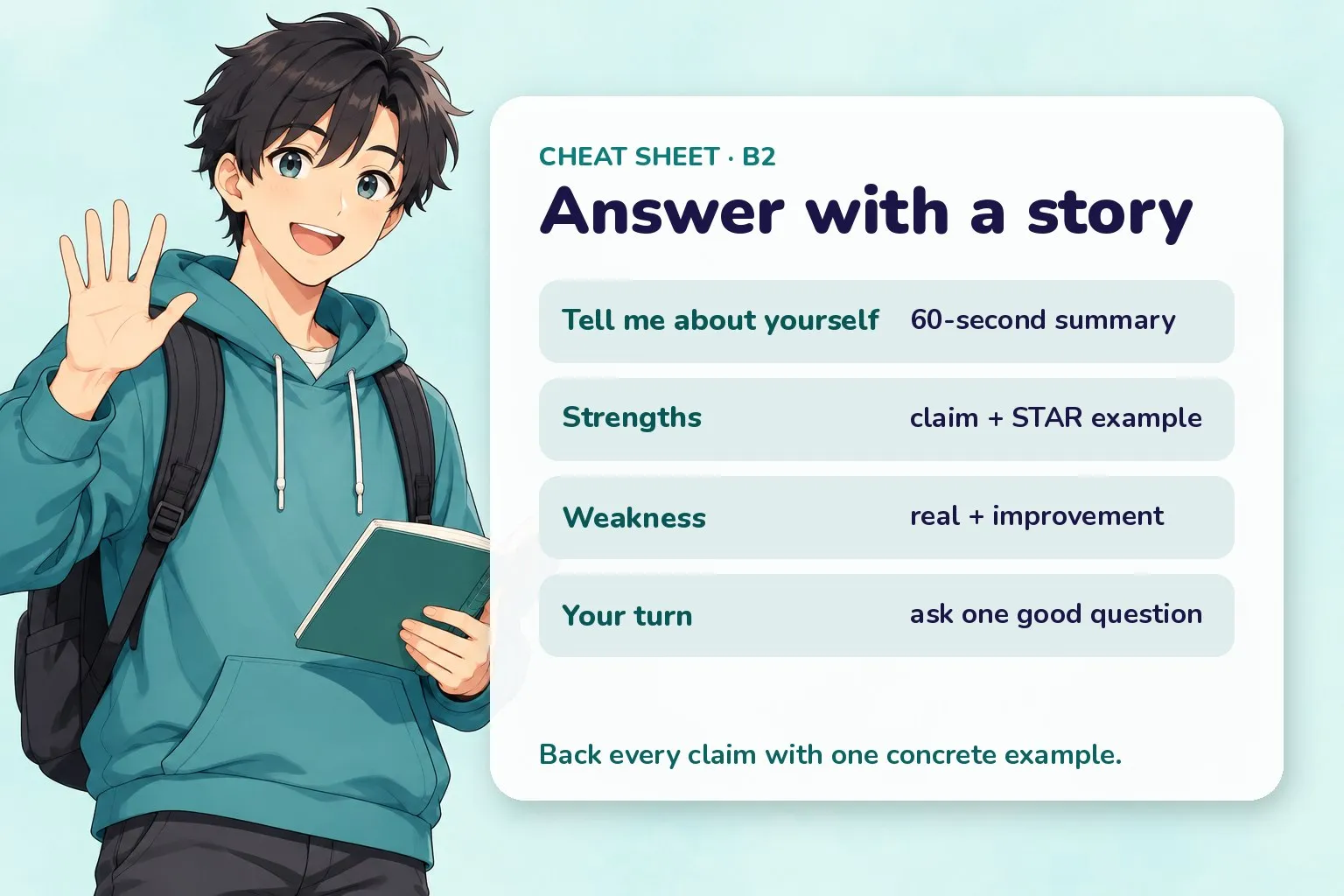
Quick recap before you practise.
Usage notes
- I’d rather than I would: contractions (I’m, I’ve, I’d) sound natural and confident in speech; full forms can sound stiff. Use them.
- used to vs now: I used to struggle with X means it was true in the past; adding but now I… shows growth. This contrast is exactly what interviewers listen for.
- soften, don’t boast: particularly good at, fairly confident with and I’d say I’m strong at all sound more credible than I’m the best at.
- keep stories to about 60 seconds: if an answer runs long, stop at the result. You can always say I can go into more detail if that’s useful.
Practice
Job interview practice
Try each one, then press Check. No sign-up, nothing is sent anywhere — it all runs in your browser.
Hint: the R in STAR
Show answer
result — 'As a result' introduces the outcome of your story.
4 Put the words in order to make a natural strength answer.
Show answer
I'm good at solving problems — The pattern is: I'm good at + activity.
5 Match each STAR part to what it answers.
- Situation
- Task
- Action
- Result
Show answer
- Situation → the context
- Task → what had to be done
- Action → what you did
- Result → what happened
STAR keeps an example answer short and in order.
Hint: it is finished, so past simple
Show answer
managed — Use the past simple for a previous role: I managed a team of six.
How to say it
A few interview words trip up English learners — copy the sounds, not the spelling.
- interview stresses the first part: IN-ter-view, three beats.
- experience has four beats with the stress in the middle: ik-SPEER-ee-uhns.
- colleague is two beats, stress first: KOL-eeg — the final -gue is just a hard g.
- strengths is one syllable; let the -ths run together rather than adding a vowel.
Quiz
Job interview quiz
8 questions · pick an answer and you'll see straight away if it's right.
-
Show answer
past simple — A completed action in a previous role takes the past simple: I managed, I led, I delivered.
-
Show answer
Action — STAR is Situation, Task, Action, Result.
-
Show answer
Yes — how is success measured in this role? — Having a thoughtful question shows genuine interest in the role.
-
Show answer
I'm applying for this role because I want to grow. — Use a contraction and the present simple: I'm applying… because I want to grow.
-
Show answer
I'm organised — in my last job I ran three projects at once. — Pair the claim with one concrete example.
-
Show answer
Name a real, minor one and the step you are taking. — A genuine weakness plus an improvement step shows self-awareness.
-
Show answer
That's a good question — let me think for a second. — A short, polite pause sounds far better than filler sounds.
-
Show answer
I look forward to hearing from you. — 'I look forward to hearing from you' is a standard, confident close.
Recap cheat-sheet
| Moment | What to do | Example |
|---|---|---|
| Opening | 60-second summary | Right now I work as…; I’m good at…; I’m applying because… |
| Strengths | claim + STAR example | I’m organised — last year I… and as a result… |
| Tenses | past for old jobs, present for skills | I managed a team; I work well under pressure. |
| Weakness | real + improvement step | I used to struggle with X, so now I… |
| Your turn | ask one good question | How is success measured in this role? |
| Close | thank + look forward | Thank you for your time; I look forward to hearing from you. |
Next
- Previous lesson: English: At the Office
- Next lesson: English: Formal Writing & Emails
- New here? Start with Start Learning English Here
All English lessons topics
Vocabulary, pronunciation, phrases, practice and exam help, ordered by level. Pick a topic and go straight to it. New lessons go live every day, so topics marked Coming soon fill in over the next weeks.
Lessons
A1 9 topics · 9 ready
A2 14 topics · 14 ready
- 10 English: Describing People
- 11 English: Ordering at a Cafe
- 12 English: Shopping & Prices
- 13 English: Clothing & Sizes
- 14 English: Asking for Directions
- 15 English: Using Public Transport
- 16 English: At the Hotel
- 17 English: Weather & Seasons
- 18 English: Hobbies & Free Time
- 19 English: Daily Routine
- 20 English: Housing & Rooms
- 21 English: Parts of the Body
- 22 English: Emotions & Feelings
- 23 English: Supermarket & Groceries
B1 19 topics · 19 ready
- 24 English: Household Chores
- 25 English: At the Doctor
- 26 English: Making Appointments
- 27 English: Making Plans & Invitations
- 28 English: Phone & Messaging
- 29 English: Expressing Opinions
- 30 English: Talking About Past Experiences
- 31 English: Future Plans & Goals
- 32 English: School & Education
- 33 English: Jobs & Professions
- 34 English: Money & Banking
- 35 English: Restaurant & Dining Out
- 36 English: Travel & the Airport
- 37 English: Sightseeing & Tourism
- 38 English: Emergencies & Safety
- 39 English: Technology & the Internet
- 40 English: Complaints & Solving Problems
- 41 English: Small Talk & Networking
- 42 English Small-Talk & Politeness Culture
B2 11 topics · 11 ready
- 43 English: At the Office
- 44 English: The Job Interview You are here
- 45 English: Formal Writing & Emails
- 46 English: News & Current Affairs
- 47 English: Environment & Nature
- 48 English: Health & Lifestyle
- 49 English: Culture & Traditions
- 50 English: Describing Trends & Data
- 51 English: Storytelling & Narration
- 52 English: Giving a Short Presentation
- 53 Writing Business Emails in English