English: Daily Routine
To describe a daily routine, use the present simple with routine verbs (wake up, get up, have breakfast, go to work). Put frequency adverbs like usually and always before the main verb, and order your day with first, then and finally.
On this page13 sections · tap to jump
Level: A2. Your daily routine is one of the first real things you can talk about in English. You already know the verb be and the present simple; this lesson gives you the everyday verbs — wake up, have breakfast, go to work — and shows how to join them into a natural description of your day.
By the end of this page you can…
…describe your morning, afternoon and evening in English, say how often you do things, and give the times — so you can answer the common question ‘What do you do every day?’
The routine verbs you need
Most of a daily routine is built from a small set of verbs. Many of them are two-word verbs (verb + small word): wake up, get up, get dressed. Learn each as a whole chunk.
- Morning: wake up, get up, have a shower, get dressed, have breakfast, brush my teeth, leave home, go to work.
- Daytime: start work, have lunch, finish work, come home.
- Evening: make dinner, have dinner, watch TV, do my homework, go to bed, fall asleep.
Notice the fixed pairs: you have breakfast, lunch and dinner (not eat breakfast — though that is also possible, have is the natural choice), you brush your teeth, and you get dressed.
Present simple — the tense for habits
A routine is something you do again and again, so English uses the present simple. For I, you, we and they, use the plain verb. For he, she and it, add -s.
| Subject | Verb | Example |
|---|---|---|
| I / you / we / they | get up | I get up at seven. |
| he / she / it | gets up | She gets up at seven. |
| I / you / we / they | have | We have dinner at eight. |
| he / she / it | has | He has dinner at eight. |
| negative | do/does not | He does not get up early. |
| question | do/does | What time do you get up? |
The -s drops again in questions and negatives, because does already carries it: Does she get up early? — She does not get up early.
Saying how often: frequency adverbs
To say how often, use a frequency adverb. From most to least: always, usually, often, sometimes, rarely, never.
The rule for position is simple and worth memorising: the adverb goes before the main verb, but after the verb be.
- I usually get up at seven. (before the main verb get)
- I am usually tired in the morning. (after the verb am)
Ordering your day
To make a routine flow, link the steps with sequence words: first, then, next, after that, and finally for the last step.
- First, I have a shower. Then I get dressed. After that, I have breakfast. Finally, I leave for work.
Telling the time in a routine
Three small prepositions carry most time phrases:
- at + a clock time or a fixed point: at 7 o’clock, at noon, at night, at the weekend.
- in + a part of the day: in the morning, in the afternoon, in the evening.
- on + a day: on Monday, on weekdays, on my day off.
Example sentences
Press play and copy the rhythm. Say each line out loud as part of your own day.
- I wake up at six thirty.The first step of the morning, with a clock time.
- I usually get up straight away.A frequency adverb before the main verb.
- First, I have a shower.First marks the opening step.
- Then I get dressed.Get dressed is a fixed two-word phrase.
- I have breakfast at seven.You have breakfast, lunch and dinner.
- I always brush my teeth after breakfast.Brush your teeth, never make your teeth.
- I leave home at half past seven.Leaving the house to start the day.
- She goes to work by bus.Third-person -s: she goes, not she go.
- He starts work at nine.Third-person -s on starts.
- We have lunch at one o'clock.A midday routine with a time.
- I often finish work late.Often before the main verb finish.
- After that, I come home.After that links the next step.
- My father makes dinner in the evening.In + part of the day.
- We have dinner together at eight.A shared evening routine.
- I sometimes watch TV after dinner.Sometimes before the main verb.
- The children do their homework before bed.Do your homework is a fixed pair.
- I am usually tired by ten.Usually after the verb be.
- I go to bed at about eleven.About softens an exact time.
- I rarely fall asleep quickly.Rarely means almost never.
- On Sundays, I never set an alarm.On + day, never before the main verb.
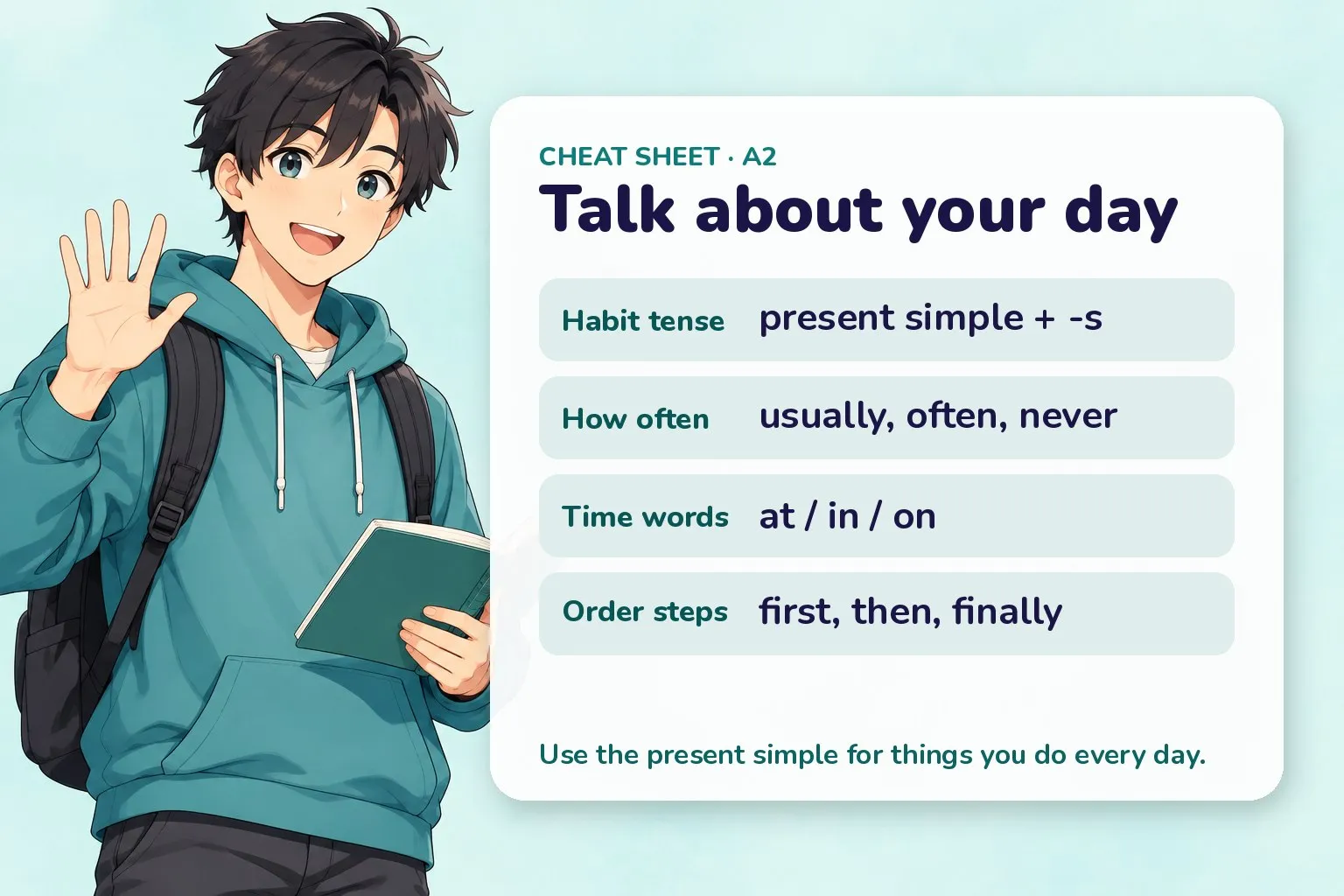
Quick recap before you practise.
A short conversation
Ben: What time do you get up during the week? Mia: I usually get up at six thirty. First I have a shower, then I make coffee. Ben: Do you have breakfast at home? Mia: Not always. On busy days I just grab something and leave. And you? Ben: I never miss breakfast — I can’t start the day without it!
Usage notes
- have vs eat: both are correct for meals, but have breakfast/lunch/dinner is the more natural everyday choice.
- at the weekend (BrE) / on the weekend (AmE): both are standard; pick one and stay consistent. This site uses a neutral style, so either is fine.
- get is everywhere in routines: get up, get dressed, get ready, get home. Treat each as one unit rather than translating get word for word.
- No -ing for habits: a routine uses the present simple (I get up at seven), not the present continuous (I am getting up would mean right now).
Practice
Daily routine practice
Try each one, then press Check. No sign-up, nothing is sent anywhere — it all runs in your browser.
Hint: used with clock times
Show answer
at — Use at with clock times: at 9 o'clock.
Hint: it goes before the main verb
Show answer
never — Frequency adverbs go before the main verb: I never get up early.
4 Put the words in order to make the first step of a routine.
Show answer
First, I have a shower — First marks the opening step: First, I have a shower.
5 Match each time word to what follows it.
- at
- in
- on
- after that
Show answer
- at → 7 o'clock
- in → the morning
- on → Monday
- after that → the next step
at + clock time, in + part of the day, on + day; after that links steps.
How to say it
A few routine words trip up English learners. Copy the audio, don’t spell them out letter by letter.
- breakfast has the stress on the first syllable and a short vowel: “BREK-fuhst”, not “break-fast”.
- usually squeezes to three beats in speech, roughly “YOO-zhoo-lee” or even “YOOZH-lee”.
- clothes is one syllable — “klohz” — with the final sound like a z; don’t add an extra -iz syllable.
- o’clock links the two parts smoothly: “uh-KLOK”, with the stress on clock.
Quiz
Daily routine quiz
8 questions · pick an answer and you'll see straight away if it's right.
-
Show answer
He has breakfast at seven. — The he/she/it form of have is has.
-
Show answer
at — It is a fixed phrase: at night, never in the night.
-
Show answer
always walks — The adverb goes before the main verb: she always walks.
-
Show answer
on Monday — Use on with days of the week: on Monday.
-
Show answer
Finally — Finally introduces the final step.
-
Show answer
What time do you get up? — Present simple questions with you use do: What time do you get up?
-
Show answer
I brush my teeth. — The fixed pair is brush your teeth.
-
Show answer
have — You have dinner; the natural everyday verb for meals is have.
Recap cheat-sheet
| Idea | Pattern | Example |
|---|---|---|
| Habit tense | present simple (+ -s for he/she/it) | She gets up at seven. |
| How often | adverb before main verb, after be | I usually walk; I am usually late. |
| Clock time | at | at 7 o’clock, at night |
| Part of day | in | in the morning |
| Day | on | on Monday |
| Order steps | first, then, after that, finally | First I shower, then I eat. |
Next
- Previous lesson: English: Hobbies & Free Time
- Next lesson: English: Housing & Rooms
- New here? Start with Start Learning English Here
- Build the sounds: English Pronunciation Overview
All English lessons topics
Vocabulary, pronunciation, phrases, practice and exam help, ordered by level. Pick a topic and go straight to it. New lessons go live every day, so topics marked Coming soon fill in over the next weeks.
Lessons
A1 9 topics · 9 ready
A2 14 topics · 14 ready
- 10 English: Describing People
- 11 English: Ordering at a Cafe
- 12 English: Shopping & Prices
- 13 English: Clothing & Sizes
- 14 English: Asking for Directions
- 15 English: Using Public Transport
- 16 English: At the Hotel
- 17 English: Weather & Seasons
- 18 English: Hobbies & Free Time
- 19 English: Daily Routine You are here
- 20 English: Housing & Rooms
- 21 English: Parts of the Body
- 22 English: Emotions & Feelings
- 23 English: Supermarket & Groceries
B1 19 topics · 19 ready
- 24 English: Household Chores
- 25 English: At the Doctor
- 26 English: Making Appointments
- 27 English: Making Plans & Invitations
- 28 English: Phone & Messaging
- 29 English: Expressing Opinions
- 30 English: Talking About Past Experiences
- 31 English: Future Plans & Goals
- 32 English: School & Education
- 33 English: Jobs & Professions
- 34 English: Money & Banking
- 35 English: Restaurant & Dining Out
- 36 English: Travel & the Airport
- 37 English: Sightseeing & Tourism
- 38 English: Emergencies & Safety
- 39 English: Technology & the Internet
- 40 English: Complaints & Solving Problems
- 41 English: Small Talk & Networking
- 42 English Small-Talk & Politeness Culture
B2 11 topics · 11 ready
- 43 English: At the Office
- 44 English: The Job Interview
- 45 English: Formal Writing & Emails
- 46 English: News & Current Affairs
- 47 English: Environment & Nature
- 48 English: Health & Lifestyle
- 49 English: Culture & Traditions
- 50 English: Describing Trends & Data
- 51 English: Storytelling & Narration
- 52 English: Giving a Short Presentation
- 53 Writing Business Emails in English